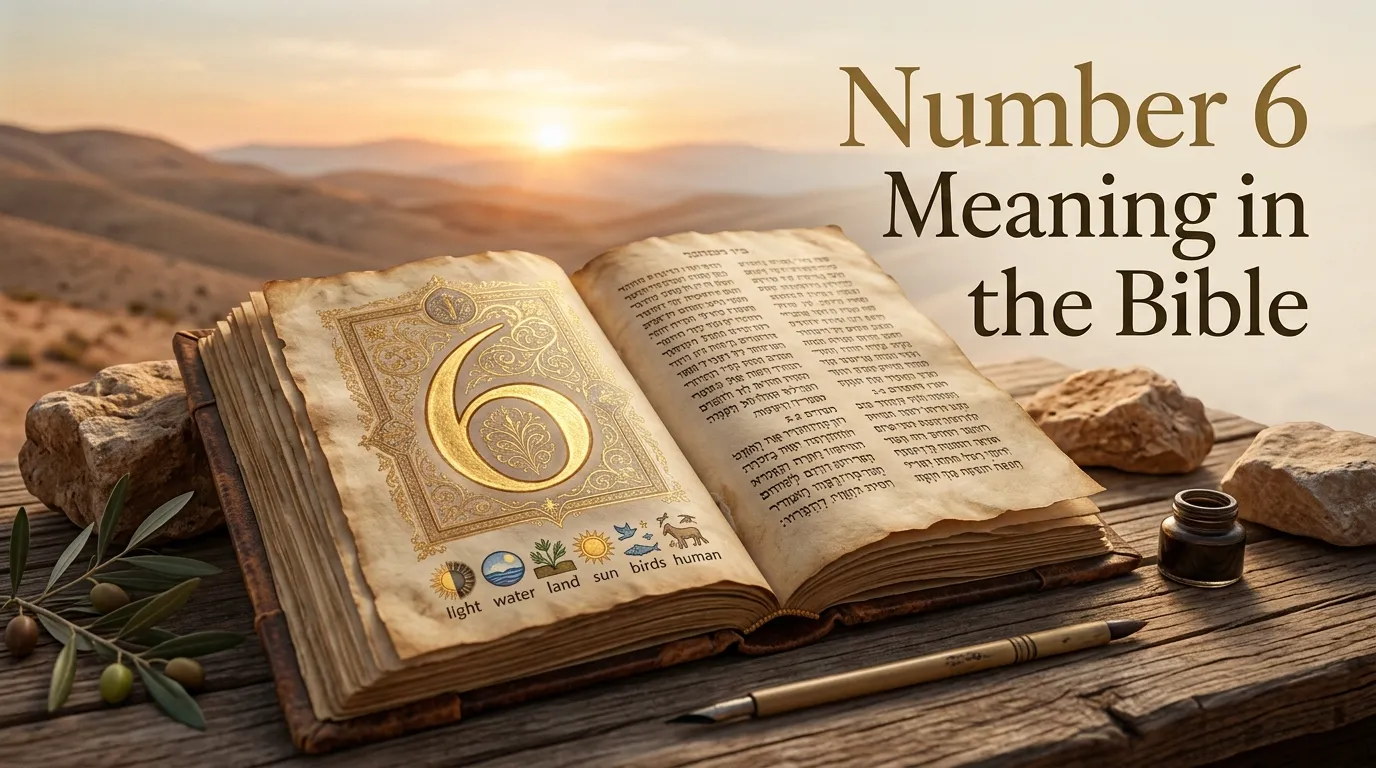
The number 6 meaning in the Bible centers on humanity, human labor, and incompleteness when measured against God’s perfect order.
Scripture presents six as the number tied to humanity creation and daily work, yet always falling short of the completeness found in seven.
Bible book creators, Christian authors, publishers, and ministry leaders often seek this understanding to handle numerical symbolism with accuracy and pastoral care in study materials, devotionals, and commentaries.
In the pages that follow you will find the clear biblical foundation for the number six, its Hebrew background, key passages explained in context, its symbolic weight, common pitfalls to avoid, and practical guidance for those who write and publish faith-based content for American readers.
Quick Reference Table
| Aspect | Biblical Insight | Primary Reference |
| Creation | God finished the work of creation in six days | Genesis 1:31; 2:1-2 |
| Humanity | Man created on the sixth day | Genesis 1:26-31 |
| Human Labor | Six days of work, rest on the seventh | Exodus 20:9-11 |
| Incompleteness | Six falls short of seven (divine completeness) | Pattern throughout Scripture |
| Mark of the Beast | 666 identified as the number of a man | Revelation 13:18 |
| Other Notable Uses | Goliath’s height (six cubits); Nebuchadnezzar’s image | 1 Samuel 17:4; Daniel 3 |
Biblical Meaning of the Number 6
Scripture never offers a single dictionary-style definition of the number six. Instead, the consistent pattern across the Old and New Testaments reveals its association with the human realm. God created the heavens and the earth in six days and rested on the seventh (Genesis 1–2). On the sixth day He formed man in His own image and declared everything “very good” (Genesis 1:31). From that point forward, six becomes linked to human activity, responsibility, and limitation.
The Ten Commandments reinforce the pattern: “Six days you shall labor and do all your work, but the seventh day is a Sabbath to the Lord your God” (Exodus 20:9-10). Six days belong to human effort; the seventh belongs to divine rest and completion. This rhythm appears again in the agricultural laws of the sabbatical year and in the six years of service for a Hebrew servant followed by release in the seventh (Exodus 21:2). The number six therefore carries the sense of what is human, finite, and still awaiting the fullness that only God supplies.
Hebrew Background
In the Hebrew Scriptures the cardinal number six is shesh. The word itself does not carry mystical weight apart from its repeated contextual use. Scholars note that shesh simply counts the days of creation and the ordinary cycle of human work. No ancient Hebrew text treats six as inherently evil or demonic. That association arises later, primarily from the triple six of Revelation 13:18. Careful Bible teachers distinguish the ordinary use of six from the specific symbolic loading given to 666 in the apocalyptic vision.
Key Bible Verses with Full Explanation
Genesis 1:26-31
On the sixth day God said, “Let us make man in our image, after our likeness.” He created male and female, blessed them, and gave them dominion. Then God saw everything He had made, and “behold, it was very good.” The sixth day marks the climax of the creation week for humanity. Man is the crowning work of the six days, yet the narrative immediately moves to the seventh-day rest. Humanity is complete in itself only when it rests in the finished work of God.
Exodus 20:8-11
The Sabbath command roots the six-day work week in the creation pattern itself. Six days are for labor; the seventh is holy. This structure protects human dignity by limiting work and pointing every week toward dependence on the Lord. For authors writing on vocation or rest, this passage supplies a solid biblical foundation: six days of faithful effort find their proper meaning only in relation to the seventh.
1 Samuel 17:4
Goliath of Gath stood “six cubits and a span.” The detail is historical, not allegorical, yet it fits the larger biblical pattern in which human strength, even when impressive, remains incomplete before the living God. David’s victory underscores that the battle belongs to the Lord, not to human stature measured in sixes.
Daniel 3:1
Nebuchadnezzar set up an image of gold sixty cubits high and six cubits wide. Again the numbers describe a real object, yet the scene of forced worship highlights human pride reaching for divine statusand failing. The three Hebrew men refuse to bow, demonstrating that six, however grand, cannot replace the living God.
Revelation 13:18
“This calls for wisdom: let the one who has understanding calculate the number of the beast, for it is the number of a man, and his number is 666.” The text itself identifies 666 as “the number of a man.” Early Christian writers and modern evangelical scholars generally understand this as a symbol of humanity in its ultimate rebellion against Godcomplete in its incompleteness, triple six falling short of the perfect seven. The verse does not assign occult power to the single digit six; it focuses on the specific triple form connected with the beast.
Spiritual Meaning and Application
The spiritual significance of six flows naturally from these texts. Six reminds believers that human effort, intelligence, and achievement, however necessary, remain unfinished without the rest and completion God alone provides. In pastoral terms, six can encourage humility: our best work still needs the seventh-day grace of Christ. At the same time, six affirms the dignity of ordinary labor. God Himself worked six days. Faithful service in the home, workplace, and church is not second-class; it is the proper human response to the Creator.
For mature believers, the number also guards against both despair and pride. Despair says human work is worthless; pride says human work is sufficient. Scripture places six between those extremesvaluable, yet incomplete apart from God.
Symbolism of the Number 6 in Scripture
Biblical symbolism of six is restrained and contextual rather than magical. It symbolizes:
- Humanity and the human sphere
- The ordinary cycle of work
- That which is good yet still short of divine perfection
- In the special case of 666, humanity organized in opposition to God
Unlike the number seven, which repeatedly signals completeness and covenant fulfillment, six never stands alone as a mark of divine approval. It always looks toward something more. This restrained symbolism protects teachers and writers from speculative excess while still allowing the number to carry meaningful weight in careful exposition.
Practical Application for Bible Book Creators and Authors
When preparing study guides, devotionals, or commentaries for American Christian readers, treat the number six with the same care you would any other biblical detail. First, stay close to the text. Cite the creation account, the Sabbath command, and Revelation 13:18 accurately and in full context. Second, avoid importing extra-biblical numerology. American audiences are already exposed to popular teachings that turn every six into a sign of the beast or a curse. Clear, Scripture-anchored explanation serves readers better than sensational claims.
Third, use the number to point people toward Christ. Six days of labor find their rest in the finished work of the cross and the open tomb. Six can become a quiet reminder that human striving is real and valuable, yet salvation and ultimate completion rest in the One who declared “It is finished.” Fourth, when writing for ministry leaders or small-group curricula, include the historical and literary context so pastors can teach with confidence. A short sidebar on the difference between ordinary six and the triple six of Revelation often prevents confusion.
Finally, model intellectual honesty. Where the Bible is silent, say so. Where scholars differ on the precise identity behind 666, acknowledge the range of responsible views without sensationalism. American Christian publishers value content that builds trust rather than inflames curiosity for its own sake.
Common Misunderstandings
One frequent misunderstanding treats every occurrence of six as inherently evil. Scripture does not support this. The sixth day of creation was “very good.” Six days of work are commanded and blessed. Another misunderstanding reads modern occult or gematria systems back into the biblical text. The Bible’s own use of numbers is far more restrained. A third error equates the single digit six with the mark of the beast. Revelation 13 speaks specifically of 666 as the number of a man; it does not condemn the ordinary number six. Careful writers help readers avoid these pitfalls by staying close to the actual passages.
FAQs
What does the number 6 symbolize spiritually?
Spiritually, the number 6 symbolizes humanity, work, responsibility, and the need to depend on God.
Is 6 a bad number in the Bible?
No, the number 6 is not inherently bad, but it often represents human imperfection and incompleteness apart from God.
What is the Hebrew meaning of the number 6?
In Hebrew, the number 6 is associated with humanity, creation, labor, and earthly responsibility.
What is the meaning of the number 6 in love?
The number 6 in love represents care, faithfulness, compassion, commitment, and nurturing relationships.
What is the meaning of Numbers chapter 6 in the Bible?
Numbers chapter 6 explains the Nazirite vow and concludes with God’s blessing over His people.
What is the spiritual meaning of the number 6 in a dream?
The spiritual meaning of the number 6 in a dream may point to responsibility, balance, relationships, or the need to refocus on God.
What is the biblical meaning of the number 6 in dreams?
Biblically, the number 6 in dreams can symbolize human weakness, hard work, or a reminder to trust God’s guidance.
What is Numbers chapter 6 in the Bible about?
Numbers chapter 6 is about the Nazirite vow and includes the well-known priestly blessing given to Israel.
Conclusion
The number 6 meaning in the Bible ultimately directs attention away from human sufficiency and toward the God who both works and rests. Six days of creation display His power; the seventh day displays His completeness.
Six days of labor invite us into meaningful work; the Sabbath rest invites us into grace. For every Bible book creator, author, editor, and ministry leader, this pattern offers a steady foundation for teaching.
Present the number six as Scripture presents ittied to humanity, limited yet purposeful, and always pointing beyond itself to the One who makes all things complete in Christ. May your writing serve the church with the same clarity and faithfulness that the Word itself provides.
Discover More Post
- Worship Meaning in the Bible: A Simple Biblical Guide
- Covenant Meaning in the Bible: Biblical Guide
- Exalt Meaning in the Bible Explained Simply
- Passover Meaning in the Bible: God’s Powerful Message

I’m Nicholas Sparks, and storytelling has always been my passion. Through TheBiblimeaning, I share insights about my books, unforgettable characters, romance, emotions, and the deeper meanings behind my stories. This platform brings readers closer to my writing journey, latest releases, and the inspiration that shapes every novel I create.