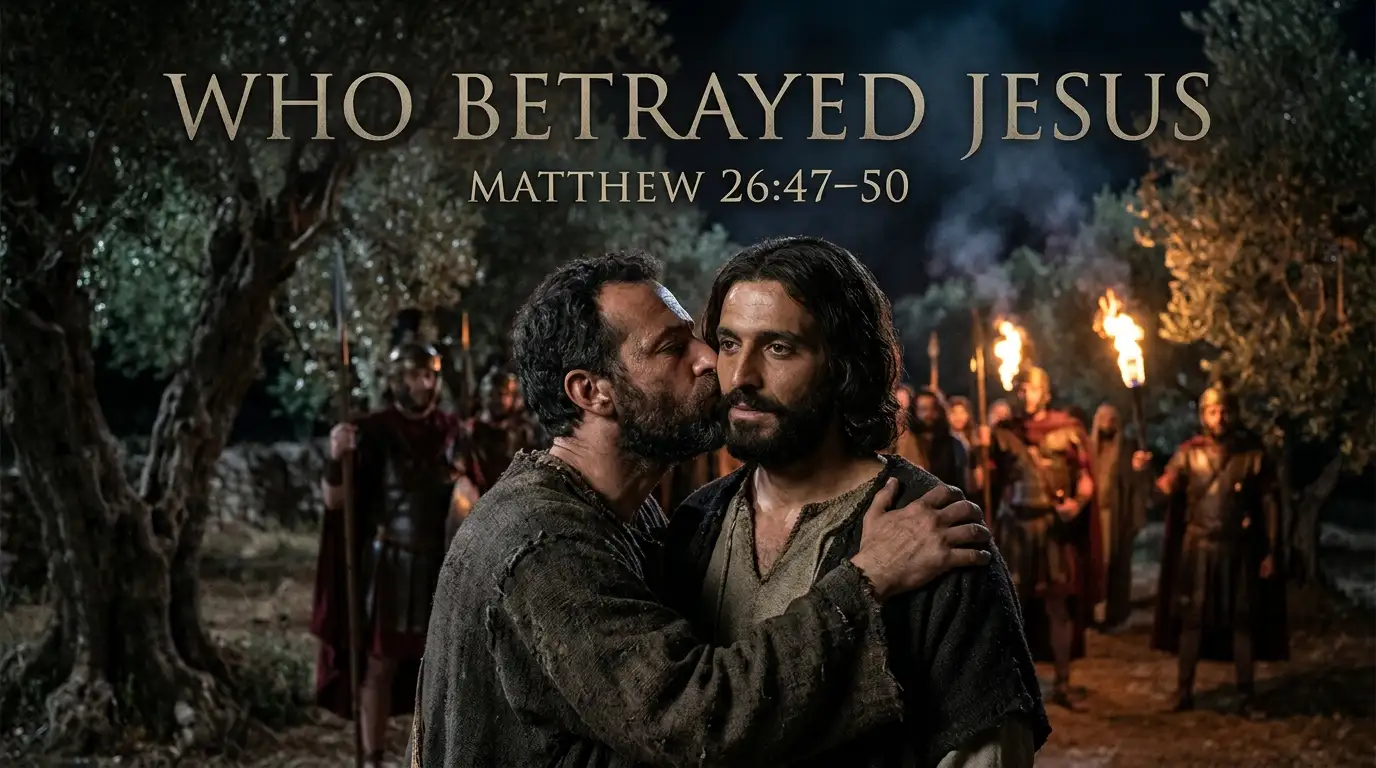
Judas Iscariot betrayed Jesus. He was one of the twelve apostles (Matthew 10:2-4; Mark 3:19; Luke 6:16).
He agreed to hand Jesus over to the chief priests for thirty pieces of silver (Matthew 26:14-16).
He then led an armed crowd to Gethsemane and identified Jesus with a kiss (Matthew 26:47-50).
Others failed Jesus that night. Peter denied him three times (Matthew 26:69-75), and the rest of the disciples ran away (Matthew 26:56).
But only Judas is named as the one who handed Jesus over to his enemies, and Mark 3:19 and John 6:71 mark him with that deed from the moment they list him among the Twelve.
Who Was Judas Iscariot?
Jesus chose Judas after a night of prayer (Luke 6:12-16). Like the others, Judas received authority to heal and to drive out demons (Matthew 10:1-4). The group trusted him with the money bag (John 12:6; 13:29).
The name “Iscariot” is not explained in Scripture. Many scholars think it means “man of Kerioth,” a town in Judea. That would make him the only non-Galilean among the Twelve. Others link it to the Latin sicarius (“dagger-man”), but the Gospels never say Judas belonged to any violent group. Because the Bible does not settle this, it is best to treat every meaning as a guess.
The Bible does say plainly that Judas stole from the common fund (John 12:6). It also says Jesus knew from the start who would betray him (John 6:64, 70-71). Even so, Jesus kept him close and never treated him as an outcast.
Timeline: How the Betrayal Unfolded
- The deal. Two days before Passover (Matthew 26:2), Judas went to the chief priests and asked what they would pay him (Matthew 26:14-16). Mark says they were glad and promised money (Mark 14:10-11). Luke says Satan entered Judas first (Luke 22:3-6), and that he looked for a moment away from the crowds (Luke 22:6).
- The Last Supper. Jesus said one of the Twelve would betray him (Matthew 26:21; John 13:21). Each disciple asked, “Is it I, Lord?” (Matthew 26:22). Judas asked, “Is it I, Rabbi?” and Jesus answered, “You have said so” (Matthew 26:25). Jesus gave Judas the dipped bread, and Satan entered him again (John 13:26-27). Judas went out, and John adds, “And it was night” (John 13:30).
- Gethsemane. Judas knew the place, because Jesus often met his disciples there (John 18:2). He arrived with a crowd carrying swords and clubs (Matthew 26:47). The agreed signal was a kiss (Matthew 26:48). Judas said, “Greetings, Rabbi!” and kissed him (Matthew 26:49).
- Jesus’ reply. In Matthew, Jesus says, “Friend, do what you came for” (Matthew 26:50). In Luke, he asks, “Judas, are you betraying the Son of Man with a kiss?” (Luke 22:48).
What Does “Betray” Really Mean?
The Greek word behind “betray” is paradidomi, which means “to hand over.” The same word describes the Father giving up his Son for us (Romans 8:32), and Jesus giving himself (Galatians 2:20). Paul uses it of “the night he was betrayed” (1 Corinthians 11:23).
This shows two things at once. Judas truly did a wicked act (Matthew 26:24). Yet God’s plan of salvation was moving through that same handing over (Acts 2:23).
Who betrayed Jesus at the Last Supper
Judas Iscariot betrayed Jesus during the events surrounding the Last Supper. He was one of the twelve disciples who had followed Jesus and witnessed His teachings and miracles. During the meal, Jesus revealed that one of His disciples would betray Him. Judas had already agreed with the religious leaders to hand Jesus over for thirty pieces of silver. Later, he identified Jesus to the authorities in the Garden of Gethsemane, leading to His arrest (Matthew 26:14–25).
Who betrayed Jesus in The Chosen
In the television series The Chosen, Judas Iscariot is portrayed as the disciple who betrays Jesus. The series explores his personal struggles, financial concerns, and growing disappointment as he follows Jesus. His decisions gradually lead him toward the religious authorities who want Jesus arrested. Although the show adds fictional conversations and dramatic details to develop his character, the central event follows the biblical account. Judas ultimately betrays Jesus, setting the stage for His arrest and crucifixion.
Who betrayed Jesus in Islam
In Islam, the Quran does not identify Judas Iscariot or another specific person as the one who betrayed Jesus. Surah An-Nisa (4:157–158) teaches that Jesus was neither killed nor crucified and that Allah raised him to Himself. Some traditional Islamic interpretations suggest that another person was made to resemble Jesus and was crucified instead. However, Muslim scholars have held different views about this event, and the Quran itself does not name the person involved.
Why did Judas betray Jesus
Judas Iscariot betrayed Jesus for thirty pieces of silver, but his reasons may have involved more than money. In the Gospel of Matthew 26:14–16, Judas approached the chief priests and agreed to hand Jesus over for payment. John 12:4–6 also describes Judas as dishonest and concerned about money. Luke 22:3–6 mentions Satan’s influence in his decision. Although the Bible describes these details, it does not provide a complete explanation of Judas’s personal thoughts or intentions.
Who betrayed Jesus Peter
Peter did not betray Jesus in the same way Judas Iscariot did. Instead, Peter denied knowing Jesus three times after His arrest, just as Jesus had predicted. According to Matthew 26:69–75, Peter became afraid when people recognized him as one of Jesus’ followers. He denied the connection before a rooster crowed. Later, Peter deeply regretted his actions and was restored by Jesus. His story teaches an important lesson about forgiveness, repentance, and renewed faith.
Who betrayed Jesus for 30 pieces of silver
Judas Iscariot was the disciple who betrayed Jesus for thirty pieces of silver. According to Matthew 26:14–16, Judas approached the chief priests and asked what they would pay him to hand Jesus over. They agreed to give him thirty pieces of silver. Judas then searched for an opportunity to identify Jesus without causing a disturbance. This payment became one of the most recognized details of the betrayal in the biblical account.
Who betrayed Jesus first
Judas Iscariot was the first disciple to arrange Jesus’ betrayal. Before the Last Supper, Judas had already approached the chief priests and agreed to hand Jesus over for thirty pieces of silver. Peter’s denial happened later, after Jesus was arrested. Although both disciples failed Jesus during His final hours, their actions were different. Judas deliberately helped the authorities find Jesus, while Peter denied knowing Him out of fear (Matthew 26:14–16, 69–75).
Who betrayed Jesus with a kiss
Judas Iscariot betrayed Jesus with a kiss in the Garden of Gethsemane. He used this familiar greeting as a sign to help the religious authorities identify Jesus among His followers. According to Matthew 26:47–50, Judas approached Jesus and kissed Him, allowing the soldiers to recognize whom they needed to arrest. This moment became a powerful symbol of deception because Judas used an expression of friendship and affection to carry out his betrayal.
Why Did Judas Betray Jesus?
The Bible never gives one complete explanation. Four main views are common among readers.
1. Greed. Judas asked, “What will you give me?” (Matthew 26:15). John says he was a thief who stole from the bag (John 12:6). He also objected to the costly perfume poured on Jesus, an amount worth about a year’s wages (John 12:3-5; Mark 14:3-5).
2. Satan’s influence. Luke 22:3 and John 13:27 say Satan entered Judas. This explains the force behind the act but does not erase Judas’ own choice. He went to the chief priests himself (Luke 22:4).
3. Disappointment. Some suggest Judas expected a political king and grew frustrated when Jesus spoke of suffering (Matthew 16:21-22; John 6:15, 66). The Gospels do not state this motive, so it stays a theory.
4. Unbelief. Compare how the others spoke. At the Supper, Judas calls Jesus “Rabbi,” while the others say “Lord” (Matthew 26:22, 25, 49). John says some followers never believed, and Jesus knew who would betray him (John 6:64). Jesus also said one of the Twelve was “a devil” (John 6:70-71).
The wisest reading holds all four lightly. Scripture clearly names greed, Satan, and unbelief, and it leaves the rest unsaid.
Thirty Pieces of Silver: What Did It Mean?
Thirty shekels was the compensation owed when an ox killed a slave (Exodus 21:32). In Zechariah 11:12-13, the shepherd is paid thirty pieces of silver and throws them to the potter in the house of the Lord. Matthew connects this to Judas’ payment (Matthew 27:9-10).
The price was an insult. The chief priests valued Jesus at the price of a slave. By common estimates it was roughly four months of a laborer’s wages, far less than the perfume Mary poured out (John 12:3-5).
What Happened to Judas After the Betrayal?
Matthew 27:3-10 says Judas saw Jesus condemned and “changed his mind.” He brought the silver back and said, “I have sinned by betraying innocent blood.” The priests answered, “What is that to us? See to it yourself.” Judas threw the money into the temple and went and hanged himself. The priests used the silver to buy the potter’s field, a burial place for strangers.
Acts 1:18-19 adds that the field was called Akeldama, the “Field of Blood,” and that Judas fell headlong in it and his body burst open. The two accounts are usually read as two sides of one event. Matthew tells how the money was spent, and Acts describes how the death ended.
His place among the Twelve was filled by Matthias (Acts 1:21-26). Peter said this also fulfilled Psalm 109:8 (Acts 1:20).
Regret Is Not the Same as Repentance
Judas felt deep guilt, but guilt alone does not bring a person back to God. Paul separates “godly sorrow,” which leads to repentance and life, from “worldly sorrow,” which leads to death (2 Corinthians 7:10).
Compare Peter. He also failed badly. He denied Jesus three times, and the Lord looked at him (Luke 22:61-62). Peter wept, and after the resurrection Jesus restored him with three questions about love (John 21:15-19). Judas took his guilt to the priests and then to his own death. Peter took his failure back to Jesus.
Did Peter Betray Jesus Too?
Peter denied Jesus, but he did not hand him over. Peter’s fall was fear in the courtyard (Matthew 26:69-75). Judas’ act was planned, paid for, and carried out (Matthew 26:14-16, 47-49). That is why the Gospels keep the word “betrayer” for Judas alone (Luke 6:16).
Was Judas Forced by Prophecy?
Scripture foretold the betrayal. Psalm 41:9 speaks of a close friend who ate bread and “lifted his heel” against the righteous one, and Jesus applied it to Judas (John 13:18). Zechariah 11:12-13 describes the thirty pieces (Matthew 27:9-10).
Yet Judas was never a puppet. Jesus says, “The Son of Man will go just as it is written about him, but woe to that man who betrays the Son of Man!” (Matthew 26:24; Luke 22:22). Judas is held responsible. Acts 1:25 says he “turned aside to go to his own place.”
God’s plan and human choice sit together in Scripture. Joseph’s brothers meant evil, and God meant good (Genesis 50:20). At the cross, Jesus was handed over by God’s plan, yet wicked men carried it out (Acts 2:23).
Why Is Judas Called “the Son of Perdition”?
In his prayer, Jesus says he lost none of those given to him “except the son of perdition, that Scripture might be fulfilled” (John 17:12). The phrase points to a man headed for ruin, and it shows that Judas’ fall did not catch Jesus by surprise.
This is a serious verse, and Christians should not speak lightly about anyone’s final destiny. Scripture also reminds us that God’s mercy is open to everyone who turns to him (Romans 10:13; 1 John 1:9).
Lessons From the Story of Judas
- Being close to Jesus is not the same as being loyal to him. Judas shared the meals and the ministry, yet his heart drifted (John 6:70-71; 1 John 2:19).
- Small sins grow. Stealing from the bag came before betraying the Lord (John 12:6). Deal with hidden sins early (Proverbs 28:13).
- Stay watchful. “Let anyone who thinks he is standing take heed lest he fall” (1 Corinthians 10:12).
- Return to Jesus when you fail. Peter shows the way (John 21:15-19). If you carry guilt, take it to Christ (1 John 1:9).
- God can use evil for good. He did so at the cross (Acts 2:23; Genesis 50:20), though that never excuses the evil.
People Around Jesus That Night
| Person or group | What they did | Reference |
|---|---|---|
| Judas Iscariot | Betrayed Jesus with a kiss for silver | Matthew 26:14-16, 47-50 |
| Peter | Denied Jesus three times, then wept | Matthew 26:69-75; Luke 22:61-62 |
| The other disciples | Fled when Jesus was arrested | Matthew 26:56 |
| Chief priests and elders | Plotted the arrest and handed Jesus to Pilate | Matthew 26:3-4; 27:1-2 |
| Pilate | Found no guilt, yet handed Jesus over | Luke 23:13-25 |
FAQs
Who betrayed Jesus? Judas Iscariot, one of the twelve apostles, betrayed him to the chief priests for thirty pieces of silver (Matthew 26:14-16; Mark 3:19).
Why did Judas betray Jesus? The Gospels point to greed (John 12:6; Matthew 26:15), Satan’s influence (Luke 22:3; John 13:27), and unbelief (John 6:64). Other motives are theories, not Scripture.
What was the kiss of Judas? A prearranged sign for the crowd (Matthew 26:48). In that culture a kiss greeted a respected teacher, which made the betrayal even sharper (Luke 22:48).
How much was thirty pieces of silver? It was the price of a slave under the law (Exodus 21:32), and Matthew ties it to Zechariah 11:12-13 (Matthew 27:9-10).
What happened to Judas? He returned the silver, said “I have sinned,” and hanged himself (Matthew 27:3-5). Acts 1:18-19 describes the field and his death there.
Did Judas repent? Matthew 27:3 describes regret, not a turning back to God. Paul’s distinction between godly and worldly sorrow explains the difference (2 Corinthians 7:10).
Did Peter betray Jesus too? Peter denied Jesus (Matthew 26:69-75) but was restored (John 21:15-19). Only Judas handed him over (Luke 6:16).
Was Judas forced to do it? No. Prophecy foretold it (Psalm 41:9; Zechariah 11:12-13), yet Judas chose freely and Jesus held him responsible (Matthew 26:24; Acts 1:25).
Conclusion
Judas Iscariot betrayed Jesus, a trusted apostle who sold his Lord for thirty pieces of silver and identified him with a kiss (Matthew 26:14-16, 47-50). The Bible names greed, Satan’s influence, and unbelief, and it holds God’s plan and Judas’ choice together (Matthew 26:24; Acts 2:23).
The warning is for us. Guard your heart from small sins, stay close to faithful believers, and when you fall, run to Jesus the way Peter did (1 Corinthians 10:12; John 21:15-19).
Discover More Post
- Trust in God: What the Bible Says, Why It Is Hard and How to Grow It
- Nicodemus in the Bible: Who He Was and What His Story Teaches
- How Old Was Mary When She Had Jesus? The Biblical Answer
- What Does God Really Look Like? Bible Explained