Nicodemus was a Pharisee and a member of the Jewish ruling council who appears only in the Gospel of John.
He comes to Jesus by night and hears that he must be “born again” (John 3:1-21), he speaks up for fair treatment of Jesus before the council (John 7:50-52), and after the crucifixion he brings a huge amount of burial spices for Jesus’ body (John 19:38-42).
Taken together, these three scenes show a man whose faith moves from private curiosity to public, costly honor.
This guide goes through each scene, explains what “born again” meant, looks at the question of whether Nicodemus truly believed, and shows what his story means for readers today.
Where Nicodemus Appears in the Bible
- John 3:1-21: He visits Jesus at night and hears about being born again.
- John 7:45-52: He asks the other Pharisees whether the law lets them judge a man without a hearing.
- John 19:38-42: He helps Joseph of Arimathea bury Jesus and brings about a hundred pounds of myrrh and aloes.
He is not named in Matthew, Mark or Luke. Everything the Bible tells us about him is found in these three scenes in John.
How did Nicodemus in the Bible die
The Bible does not tell us how Nicodemus died or what happened during his final years. His last appearance is in John 19:39–40, where he brings myrrh and aloes to help Joseph of Arimathea prepare Jesus’ body for burial. This act shows his growing courage and respect for Jesus. Some later Christian traditions describe his death and persecution, but Scripture does not confirm these accounts.
Story of Nicodemus in the Bible KJV
The story of Nicodemus in the Bible KJV appears in the Gospel of John. He was a Pharisee and a respected Jewish leader who visited Jesus at night to learn about His teachings (John 3:1–21). Jesus explained that people must be born again to enter God’s kingdom. Later, Nicodemus defended Jesus before the Jewish council (John 7:50–52). After the crucifixion, he helped prepare Jesus’ body for burial, showing a growing willingness to stand with Him.
Is Nicodemus in the Bible good or bad
Nicodemus is generally presented as a sincere man who wanted to understand God’s truth. Although he was a Pharisee and a member of the Jewish ruling council, he showed respect for Jesus and recognized that His miracles came from God. He also defended Jesus when other religious leaders questioned Him (John 7:50–52). His final appearance shows him helping prepare Jesus’ body for burial. His actions suggest growing faith rather than hostility toward Christ.
Nicodemus in the Bible The Chosen
In The Chosen, Nicodemus is portrayed as a respected Pharisee who becomes deeply interested in Jesus and His teachings. The series uses creative storytelling to explore his questions, fears, family life, and spiritual struggles. His nighttime meeting with Jesus reflects the biblical account in John 3. However, some personal conversations and dramatic events shown in the series are fictional additions. The Bible itself provides only a few details about Nicodemus, leaving much of his personal life unknown.
Nicodemus in the Bible born again
Nicodemus learned about being born again during his nighttime conversation with Jesus in John 3:1–21. At first, he misunderstood Jesus’ words and wondered how an adult could be born a second time. Jesus explained that spiritual rebirth comes through the Holy Spirit, not physical birth. This conversation teaches that entering God’s kingdom requires a transformed heart and a new spiritual life. It also introduces the powerful message of God’s love in John 3:16.
Nicodemus in the Bible John 3
John 3 tells the story of Nicodemus, a Pharisee and Jewish leader who secretly visited Jesus at night. During their conversation, Jesus taught him about spiritual rebirth and explained why people must be born again to enter God’s kingdom. Nicodemus struggled to understand this teaching, so Jesus used simple examples to explain the work of the Holy Spirit. Their discussion also includes John 3:16, which reveals God’s love and His promise of eternal life through Jesus Christ.
Nicodemus in the Bible meaning
The name Nicodemus comes from the ancient Greek name Nikodemos, commonly understood to mean victory of the people. It combines Greek elements associated with victory and people. In the Bible, Nicodemus was a Pharisee, a Jewish religious leader, and a member of the Sanhedrin. His story appears in the Gospel of John, where he moves from a private conversation with Jesus to defending Him and helping with His burial. His story highlights curiosity, courage, and growing faith. Behind the Name+2
Nicodemus in the Bible was he saved
The Bible does not directly state whether Nicodemus received salvation, but his actions provide meaningful clues about his faith. He first visited Jesus privately, later defended Him before the Jewish council, and eventually helped prepare His body for burial (John 3:1–21; 7:50–52; 19:39–40). These actions suggest that his understanding and commitment may have grown over time. Many Christians view him as a believer, although his final spiritual condition is not explicitly confirmed in Scripture
Who Was Nicodemus?
John introduces him in one verse: “There was a man of the Pharisees, named Nicodemus, a ruler of the Jews.” (John 3:1)
A Pharisee
The Pharisees were known for careful obedience to the law of Moses and its traditions (Matthew 23:2-3; Philippians 3:5). Not all Pharisees opposed Jesus. Some invited Him to dinner (Luke 7:36), and one of the most respected Pharisees, Gamaliel, later defended the apostles before the council (Acts 5:34-39).
A Member of the Council
Calling him “a ruler of the Jews” means he sat on the ruling council, the Sanhedrin. This was the same body of chief priests and Pharisees that met to plan against Jesus (John 11:47-53). Nicodemus was therefore taking a real risk every time he showed interest in Jesus.
“The Teacher of Israel”
Jesus calls him “a master of Israel” (John 3:10, KJV; many modern translations say “Israel’s teacher”). The title shows that Nicodemus was a respected teacher of the law, and it explains why Jesus’ question, “knowest not these things?”, was so pointed.
A Wealthy Man
The very large amount of spices he later brings (John 19:39) suggests he had considerable means. His name is Greek and is usually understood to mean “victor of the people”, though the Bible itself does not explain it.
The Night Visit: John 3:1-21
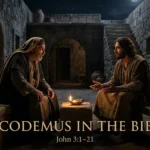
Why Did Nicodemus Come at Night?
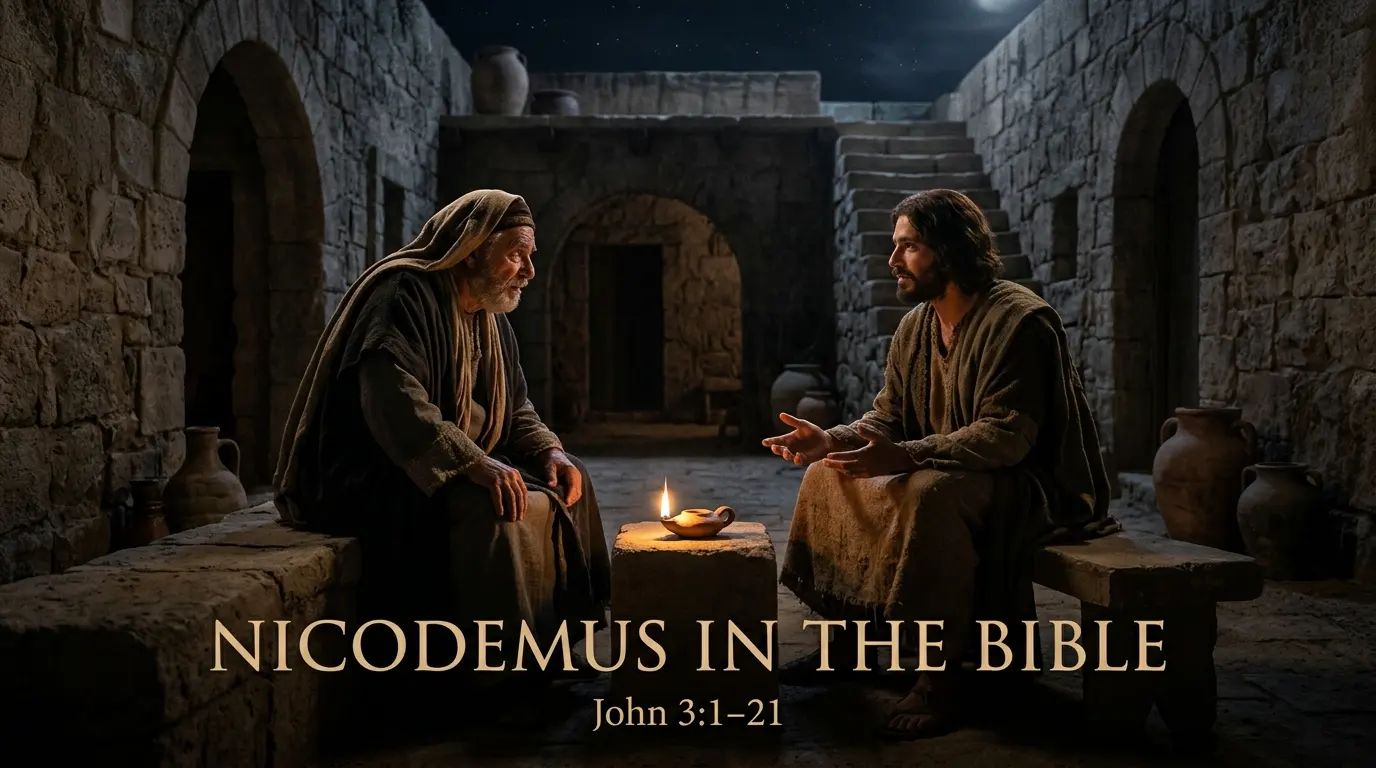
John says only that he “came to Jesus by night” (John 3:2). He does not give a reason, so the Bible leaves several possibilities open. Nicodemus may have wanted a long, quiet conversation away from the crowds. He may have been afraid of what his fellow rulers would say, since fear of the Pharisees kept many leaders silent (John 12:42; compare John 9:22). John also often uses light and darkness as symbols (John 1:5; John 3:19-21), so the night setting may carry a meaning beyond the clock.
The important fact is that he came. He did not criticize Jesus from a distance. He began with respect: “Rabbi, we know that thou art a teacher come from God: for no man can do these miracles that thou doest, except God be with him.” (John 3:2)
Jesus’ Surprising Answer
Jesus did not return the compliment or discuss the miracles. He went straight to the heart of the matter: “Verily, verily, I say unto thee, Except a man be born again, he cannot see the kingdom of God.” (John 3:3)
Nicodemus took the words literally: “How can a man be born when he is old? can he enter the second time into his mother’s womb, and be born?” (John 3:4) Jesus explained that He meant a birth “of water and of the Spirit” (John 3:5), because “that which is born of the flesh is flesh; and that which is born of the Spirit is spirit” (John 3:6).
Born Again or Born from Above?
The Greek word John uses in John 3:3 can mean “again” or “from above”, and John likely intends both. A new birth is a fresh start, and it also comes from God, not from human effort.
Jesus compares the Spirit to the wind: “The wind bloweth where it listeth, and thou hearest the sound thereof, but canst not tell whence it cometh, and whither it goeth: so is every one that is born of the Spirit.” (John 3:8) In both Hebrew and Greek, the same word can mean wind, breath or spirit (compare Ezekiel 37:9-10). Jesus’ point is that the new birth is God’s work. It cannot be seen at its source, but it can be seen in its results.
Why Jesus Said Nicodemus Should Have Known
When Nicodemus asks, “How can these things be?” (John 3:9), Jesus answers, “Art thou a master of Israel, and knowest not these things?” (John 3:10). This is not meant as an insult. The Old Testament had already promised a new heart and a new spirit for God’s people: “Then will I sprinkle clean water upon you, and ye shall be clean… A new heart also will I give you, and a new spirit will I put within you… And I will put my spirit within you.” (Ezekiel 36:25-27) The words “water” and “Spirit” in John 3:5 echo that promise. Jesus was telling the teacher that the promise he studied was now being fulfilled.
The Bronze Serpent and John 3:16
Jesus then points back to another Old Testament story: “And as Moses lifted up the serpent in the wilderness, even so must the Son of man be lifted up: That whosoever believeth in him should not perish, but have eternal life.” (John 3:14-15) In Numbers 21:8-9, Israelites who were bitten by snakes looked at a bronze serpent on a pole and lived. In the same way, Jesus said, those who look to Him in faith will receive life.
This leads to the best-known verse in the Bible: “For God so loved the world, that he gave his only begotten Son, that whosoever believeth in him should not perish, but have everlasting life.” (John 3:16) The next verse adds that God did not send His Son “to condemn the world; but that the world through him might be saved” (John 3:17).
Light and Darkness
The conversation closes with a warning and an invitation: “men loved darkness rather than light, because their deeds were evil” (John 3:19), “But he that doeth truth cometh to the light, that his deeds may be made manifest, that they are wrought in God” (John 3:21). The man who came at night is being invited into the light.
What Does Born Again Mean?
People sometimes use “born again” to describe a strong feeling or a decision. In John 3, it is far deeper. It means God gives new spiritual life to someone who trusts in Jesus (John 3:15-16). Other New Testament writers describe the same change as “the washing of regeneration, and renewing of the Holy Ghost” (Titus 3:5), as being “born again, not of corruptible seed, but of incorruptible, by the word of God” (1 Peter 1:23), and as becoming “a new creature” (2 Corinthians 5:17).
This means that new birth is not earned by learning more, by keeping more rules or by religious rank. Nicodemus had all three, and Jesus still told him he needed new birth.
Defending Jesus: John 7:45-52
The second scene takes place in Jerusalem during the Feast of Tabernacles (John 7:2, 7:37). The chief priests and Pharisees had sent officers to arrest Jesus, but the officers returned empty-handed and said, “Never man spake like this man.” (John 7:46) The Pharisees answered with contempt: “Have any of the rulers or of the Pharisees believed on him? But this people who knoweth not the law are cursed.” (John 7:48-49)
Nicodemus, “he that came to Jesus by night, being one of them” (John 7:50), then speaks: “Doth our law judge any man, before it hear him, and know what he doeth?” (John 7:51) His argument comes from the law itself, which told judges to “hear the causes between your brethren, and judge righteously” (Deuteronomy 1:16-17).
His colleagues turned on him at once: “Art thou also of Galilee? Search, and look: for out of Galilee ariseth no prophet.” (John 7:52) The taunt shows how costly even a mild defense was in that room.
Nicodemus did not claim Jesus was the Messiah here. He only asked for a fair hearing. But compared with the night visit, this was a step forward, since he now spoke in front of his peers. Faith in John’s Gospel often grows in steps like this, not in a single leap.
Burying Jesus: John 19:38-42
The final scene comes after the crucifixion, when the disciples had scattered. Joseph of Arimathea, “being a disciple of Jesus, but secretly for fear of the Jews” (John 19:38), asked Pilate for the body. Matthew 27:57 calls Joseph a rich man, Mark 15:43 calls him “an honourable counsellor, which also waited for the kingdom of God”, and Luke 23:50 calls him “a good man, and a just”.
John then adds: “And there came also Nicodemus, which at the first came to Jesus by night, and brought a mixture of myrrh and aloes, about an hundred pound weight.” (John 19:39) The two men “wound it in linen clothes with the spices, as the manner of the Jews is to bury” (John 19:40) and placed the body in a new tomb in a garden “wherein was never man yet laid” (John 19:41).
A Royal Burial
The amount of spices was extraordinary. The Bible describes a similar burial for King Asa, whose body was laid “in the bed which was filled with sweet odours and divers kinds of spices” (2 Chronicles 16:14). Nicodemus and Joseph gave Jesus the honors of a king at a time when He had been publicly shamed as a criminal. Isaiah had said His grave would be “with the rich in his death” (Isaiah 53:9), and the tomb of a rich man is where Jesus was laid (Matthew 27:57-60).
A Costly Risk
This act was not private. Touching a dead body made a person ritually unclean for seven days (Numbers 19:11), and the next day was the Passover season (John 19:42; compare John 18:28, where the leaders avoided defilement). Taking the body down also meant publicly siding with an executed man. Nicodemus, who had once come in the dark, now acted in broad daylight.
Did Nicodemus Believe in Jesus?
John never records a statement of faith from Nicodemus, so we should be careful not to say more than the text does. Here is what the Gospel shows:
- He called Jesus a teacher from God (John 3:2).
- He was given the gospel invitation of John 3:16-21, but John does not record his reply.
- He argued for Jesus to receive a fair hearing (John 7:51).
- He publicly honored Jesus’ body at great cost (John 19:39).
John also tells us that “among the chief rulers also many believed on him; but because of the Pharisees they did not confess him, lest they should be put out of the synagogue: For they loved the praise of men more than the praise of God.” (John 12:42-43) Nicodemus may have been one of these leaders at first. If so, John 19 shows a man who moved beyond that fear. Many readers conclude that Nicodemus became a follower of Jesus, and his actions certainly point that way, but the Bible does not describe his conversion directly.
From Night to Day
John’s use of the word “night” gives Nicodemus’ story another layer. When Judas left the upper room to betray Jesus, John writes, “he went immediately out: and it was night” (John 13:30). Judas walks out into the darkness. Nicodemus, who came from the darkness, is later described as the man “which at the first came to Jesus by night” (John 19:39), and the word “first” reminds the reader how far he has traveled. John says Jesus is the light that “shineth in darkness” (John 1:5), and Nicodemus’ story shows that light slowly reaching one man.
Nicodemus, Joseph, Gamaliel and Peter
Comparing Nicodemus with other New Testament figures helps us avoid simple labels.
- Joseph of Arimathea was also a member of the council and a secret disciple who acted openly at the burial (John 19:38; Mark 15:43).
- Gamaliel was a Pharisee in the council who urged caution about punishing the apostles (Acts 5:34-39).
- Peter confessed Jesus boldly (Matthew 16:16), denied Him three times (Matthew 26:69-75), and was restored by Jesus after the resurrection (John 21:15-17).
- Judas betrayed Jesus and ended in despair (Matthew 27:3-5).
Nicodemus sits between these paths. He is not a dramatic confessor like Peter, but a seeker whose faith grows quietly and then shows itself in a costly deed.
What Nicodemus Teaches Us Today
Honest Questions Are Welcome
Jesus did not turn Nicodemus away for coming with questions (John 3:4, 3:9). Seeking is the first step, and Jesus promised, “seek, and ye shall find” (Matthew 7:7).
Knowledge and Position Are Not Enough
A respected teacher of Israel still needed the new birth (John 3:3, 3:10). Religious knowledge, a title or a good reputation cannot replace trust in Jesus.
Faith Often Grows in Steps
The sequence of John 3, John 7 and John 19 shows a believer who becomes braver over time. This should encourage anyone whose faith feels slow or timid. Jesus does not despise “the day of small things” (Zechariah 4:10), and He said a mustard seed of faith can grow into a large plant (Matthew 13:31-32).
Courage Can Look Ordinary
Nicodemus did not make a great speech. He asked a question about fairness and later brought spices. Standing for justice (Deuteronomy 1:16-17) and giving generously (John 19:39; compare John 12:3) are ordinary acts that still require courage when they cost something.
Do Not Judge a Person by One Scene
If we read only John 3, we might call Nicodemus timid. If we read only John 19, we might call him bold. John gives us all three scenes so we can see a whole journey, and we should be equally patient with others in their growth (Romans 14:1; Galatians 6:1).
How to Apply Nicodemus’ Story
- If you are seeking: Read John 3 slowly and write down your questions. Talk with a trusted Christian friend or pastor (Proverbs 27:17), and ask for the faith to take the next step (Mark 9:24).
- If you are a believer: Speak up for fairness when someone is judged without being heard (Proverbs 31:8-9), and honor Jesus openly even when it costs you something (Matthew 10:32).
- If you lead others: Be patient with people who are growing slowly. Listen before answering (James 1:19), and let trust develop without pressure.
Frequently Asked Questions About Nicodemus
Who was Nicodemus in the Bible?
Nicodemus was a Pharisee, a ruler of the Jews and a teacher of Israel who appears only in John 3, John 7 and John 19. He came to Jesus at night, defended Him before the council, and helped bury Him after the crucifixion.
Why did Nicodemus come to Jesus at night?
John does not say (John 3:2). He may have wanted privacy, feared criticism from other rulers (John 12:42), or wanted a long talk. John also uses night and light as symbols (John 3:19-21), so the setting may carry a spiritual meaning as well.
What did Jesus tell Nicodemus?
Jesus told him that no one can see the kingdom of God unless he is born again (John 3:3), that this means being born of water and the Spirit (John 3:5), and that God so loved the world that He gave His Son so that everyone who believes may have eternal life (John 3:16).
What does born again mean in John 3?
It means receiving new life from God through the Holy Spirit, by trusting in Jesus (John 3:5-8, 3:15-16). The Greek phrase can also mean “born from above”, which stresses that it is God’s work and not a human achievement.
Did Nicodemus become a follower of Jesus?
The Bible does not record a confession. His defense of Jesus (John 7:51) and his costly gift at the burial (John 19:39) lead many readers to see him as a follower, but John never states this outright.
How many times is Nicodemus mentioned in the Bible?
Three scenes in one Gospel: John 3:1-21, John 7:45-52 (he speaks in verses 50-51), and John 19:38-42. He is also referred to in John 7:50 and John 19:39 as the man who first came to Jesus by night.
What happened to Nicodemus after Jesus’ resurrection?
The Bible does not say. John 19 is the last mention of him. Later writings, including a work called the Gospel of Nicodemus, are not part of Scripture, so the safest approach is to rely on what John tells us.
What is the difference between Nicodemus and Joseph of Arimathea?
Both were members of the council and both honored Jesus at His burial (John 19:38-39). Joseph is described as a rich disciple who had been secret “for fear of the Jews” (John 19:38), and he asked Pilate for the body (Mark 15:43). Nicodemus is the one who brought the spices (John 19:39).
Conclusion
Nicodemus appears in only three scenes, but they tell a complete story of a person drawn toward Jesus. In John 3 he comes at night with honest questions and learns that new birth comes from God, not from rank or learning. In John 7 he asks for a fair hearing for Jesus in front of hostile colleagues. In John 19 he brings a royal amount of spices and, together with Joseph, buries Jesus in the open.
His story offers hope to anyone whose faith feels cautious or unfinished. Jesus welcomes seekers (John 6:37), gives new birth by the Spirit (John 3:5-8), and is patient with those who grow slowly toward the light (John 3:21).
Discover More Post
- How Old Was Mary When She Had Jesus? The Biblical Answer
- What Does God Really Look Like? Bible Explained
- Difference Between Catholic And Christian: Key Facts to Understand
- 12 Disciples Of Jesus: Names, Facts, and Their Roles

I’m Nicholas Sparks, and storytelling has always been my passion. Through TheBiblimeaning, I share insights about my books, unforgettable characters, romance, emotions, and the deeper meanings behind my stories. This platform brings readers closer to my writing journey, latest releases, and the inspiration that shapes every novel I create.