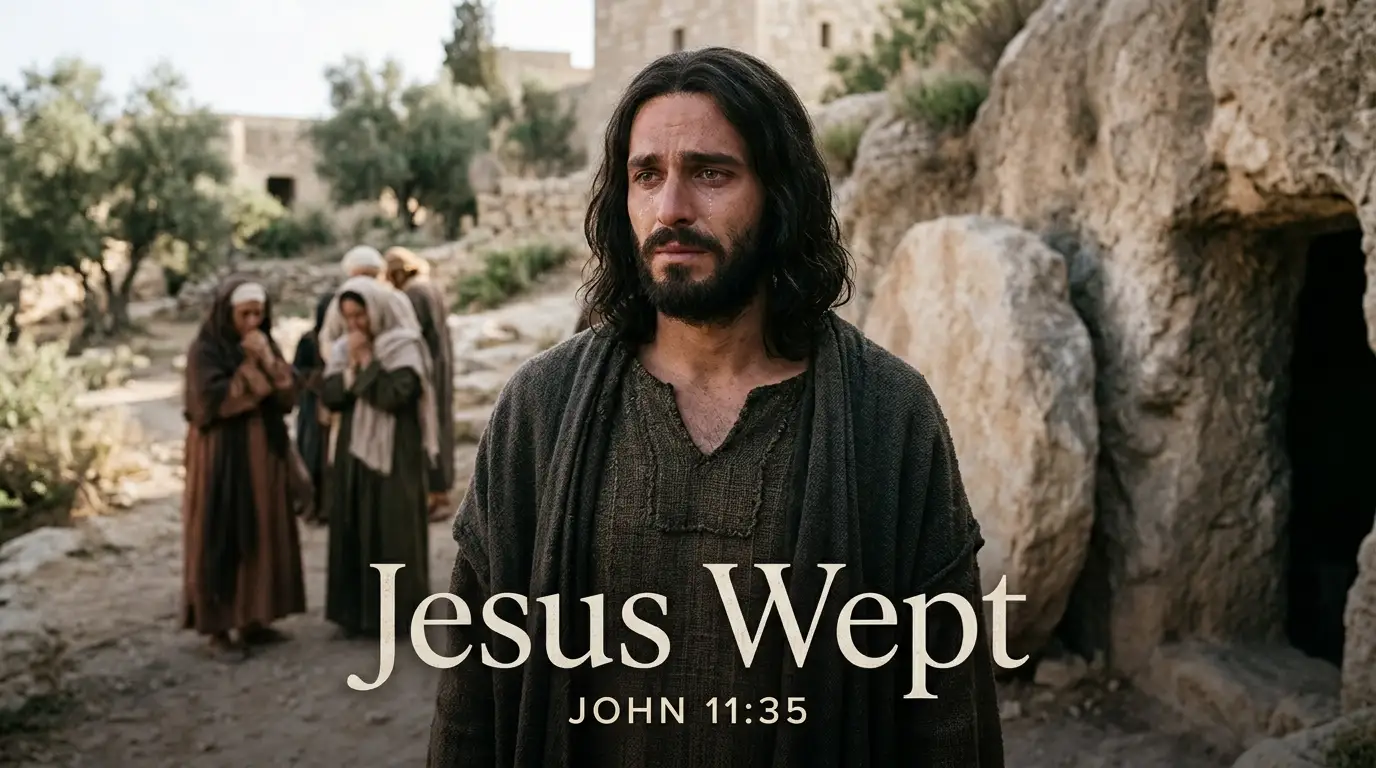
“Jesus wept” is the shortest verse in the English Bible, found in John 11:35. It has only two words, yet it shows Jesus standing at the tomb of his friend Lazarus in Bethany, crying beside people who were grieving.
This guide walks through the story verse by verse, explains the Greek word behind “wept”, answers why Jesus cried even though he knew he would raise Lazarus, and shows what this verse offers to anyone who is grieving today.
Quick answer: Jesus wept because he loved Lazarus (John 11:5, 11:36), shared the sorrow of Mary and Martha (John 11:33), and faced the pain that death brings into the world (1 Corinthians 15:26).
He knew Lazarus would live again (John 11:11, 11:23), and he wept anyway. Tears and hope can stand together.
Where Is “Jesus Wept” in the Bible?
Jesus wept is found in the Gospel of John, chapter 11, verse 35. The King James Version reads simply, “Jesus wept.” The verse sits inside the longer story of the death and raising of Lazarus, which runs from John 11:1 to 11:44. Read alone, the verse is moving. Read inside the full chapter, it becomes one of the clearest pictures of Jesus’ love in the whole Bible.
The Story Behind John 11:35
The story takes place in Bethany, a village about two miles from Jerusalem (John 11:18). Lazarus lived there with his sisters, Mary and Martha. John tells us plainly that Jesus loved all three (John 11:5). Here is the story step by step.
| Passage | What happens |
|---|---|
| John 11:1-3 | Lazarus falls ill. His sisters send word to Jesus that the one he loves is sick. |
| John 11:4-6 | Jesus says the illness will end in God’s glory, then stays where he is for two more days. |
| John 11:11-15 | Jesus tells his disciples Lazarus has “fallen asleep”, then says plainly that Lazarus is dead. |
| John 11:17-19 | Jesus arrives. Lazarus has already been in the tomb four days, and many mourners have come to comfort the sisters. |
| John 11:20-27 | Martha meets Jesus first. Jesus tells her, “I am the resurrection, and the life” (John 11:25). |
| John 11:28-32 | Mary comes, falls at his feet, and says the same words Martha said: if you had been here, my brother would not have died. |
| John 11:33-35 | Jesus sees Mary and the mourners weeping, is deeply moved, asks where Lazarus is laid, and weeps. |
| John 11:36-37 | Some say, “Behold how he loved him!” Others ask why he did not stop Lazarus from dying. |
| John 11:38-44 | Jesus goes to the tomb, prays, and calls, “Lazarus, come forth.” Lazarus walks out alive. |
Notice the order. Jesus does not hurry past the sorrow to get to the miracle. He listens to Martha (John 11:21-27), meets Mary in her grief (John 11:32-33), and weeps (John 11:35). Only then does he go to the tomb. The miracle does not cancel the tears. It sits beside them.
Why Did Jesus Wait Two Days?
Mary and Martha sent for Jesus because they trusted him to help (John 11:3). Yet John 11:6 says that even though Jesus loved them, he stayed two more days. This delay is what both sisters later felt so deeply: “Lord, if thou hadst been here, my brother had not died” (John 11:21, 11:32).
Jesus gave the reason in advance. The illness was “for the glory of God” (John 11:4), and the delay would lead his disciples to believe (John 11:15). The delay was not a lack of love. It set the stage for a greater work, even though it caused real pain along the way.
What Does “Wept” Mean in the Greek?
The Greek word in John 11:35 is edakrysen, from dakryo. It means to shed tears. Quiet, personal tears are in view here.
This is different from the word John uses for Mary and the mourners in John 11:33. There the word is klaio, which describes weeping aloud, wailing. Jesus does not simply join the loud mourning of the crowd. His tears are quiet and deeply personal.
John 11:33 also says Jesus was “deeply moved in his spirit and greatly troubled” (ESV). The Greek word translated “deeply moved” (embrimaomai) can carry a sense of strong, even indignant, emotion. The same idea returns in John 11:38, where Jesus is again “groaning in himself” as he comes to the tomb. John wants us to see that Jesus’ tears were not mild politeness. They came from deep within.
Why Did Jesus Weep If He Knew Lazarus Would Rise?
This is the question most readers ask. Jesus had told his disciples he was going to wake Lazarus (John 11:11) and had told Martha that her brother would rise again (John 11:23). So why cry? The text points to several connected reasons.
1. He loved Lazarus and the sisters
The crowd saw the answer right away: “Behold how he loved him!” (John 11:36). His tears were the visible side of a real friendship (John 11:5). Love does not stand at a distance and explain grief away. It steps in and shares the pain.
2. Death is a real enemy
Even though Lazarus would be raised that day, death had still done its damage: separation, mourning, and fear. Paul later calls death “the last enemy that shall be destroyed” (1 Corinthians 15:26). Jesus did not treat death as a small thing. He grieved over what it does to people God made.
3. He is truly human
The Gospel of John opens by saying the Word “was made flesh” (John 1:14). Hebrews 4:15 says Jesus is a high priest who can be “touched with the feeling of our infirmities.” Tears at a tomb show that his humanity was real. He did not pretend or hide his feelings to look strong.
4. He was moved against what death does
John 11:33 and 11:38 use language of strong feeling. Many Bible teachers read part of this as righteous anger at death and at the heartbreak it causes. Sorrow and anger at wrong can live in the same scene. Both belong to love.
Why the Four Days Mattered
John is careful to say Lazarus had been in the tomb four days (John 11:17). When Jesus asks for the stone to be removed, Martha objects that by now there will be a smell, “for he hath been dead four days” (John 11:39). Some Jewish tradition of that era held that hope of revival faded after about three days, so the detail tells us this was no case of a man who had merely fainted. By every human measure, the situation was final.
That makes both the tears and the raising stronger. The tears show love in a situation that looked hopeless. The raising shows power over death in the same situation (John 11:43-44). Together they are the heart of John 11.
Other Times Jesus Wept
John 11:35 is not the only place the Bible shows Jesus in tears.
| Moment | Where it is found | What it shows |
|---|---|---|
| At the tomb of Lazarus | John 11:35 | Personal compassion for grieving friends |
| Over Jerusalem | Luke 19:41-44 | Sorrow for a city that missed the way of peace |
| In prayer in his days on earth | Hebrews 5:7 | Honest anguish brought to God, often linked with Gethsemane (Matthew 26:38) |
Here the Greek word is klaio (loud weeping) in Luke 19:41, while John 11:35 uses the quieter dakryo. Isaiah described the coming Servant as “a man of sorrows, and acquainted with grief” (Isaiah 53:3). The tears of Jesus fit that picture.
What “Jesus Wept” Teaches About God
God is not distant from pain. Many people picture God as calm and untouched by suffering. John 11:35 corrects that picture. In Christ, God steps into the scene of grief and weeps with the grieving.
God notices tears. The psalmist prays, “put thou my tears into thy bottle” (Psalm 56:8), and Psalm 34:18 says the Lord is “nigh unto them that are of a broken heart.” Jesus’ tears at the tomb show that nearness in action.
Faith and grief can live together. Jesus knew resurrection was coming, and he still wept. Strong faith does not mean never crying. Ecclesiastes 3:4 reminds us there is “a time to weep, and a time to laugh.”
Comfort begins with presence. Paul tells believers to “weep with them that weep” (Romans 12:15). Jesus models this before it is commanded. He sits in the sorrow first and does not lecture the mourners.
Jesus Wept and Grief Today
If you are facing loss now, this verse gives permission and hope together.
- Name the loss honestly. Jesus did not act as if Lazarus was only sleeping once the facts were clear (John 11:14). You do not need to hide your pain.
- Let others come close. Mary and Martha had friends around them (John 11:19). Comfort often arrives through presence, not speeches.
- Hold hope gently. Paul says believers grieve, but “not as others which have no hope” (1 Thessalonians 4:13). Hope in resurrection does not ask you to stop missing the one you loved.
- Bring your pain to God. Even when words run out, tears can be a prayer (Psalm 56:8).
- Remember the promise. Jesus said, “I am the resurrection, and the life” (John 11:25), and Revelation 21:4 promises that God “shall wipe away all tears.” Matthew 5:4 adds, “Blessed are they that mourn: for they shall be comforted.”
If you want to help someone who is grieving, follow the pattern of John 11. Show up, listen, and avoid rushing to fix things. Keep coming back after the funeral, when most people have moved on. Paul describes God as the “God of all comfort,” who comforts us so that we can comfort others (2 Corinthians 1:3-4).
What This Verse Does Not Mean
It does not mean Jesus lost hope or doubted his power. The very next scenes show him praying with confidence and calling Lazarus out (John 11:41-44). Sorrow and trust can exist together.
It does not teach that God sends death as a punishment for grieving people. The Bible treats death as an enemy that Christ will defeat (1 Corinthians 15:26, 15:54-55). Jesus wept because death is painful and wrong, even while he held power over it.
It does not say that crying is a lack of faith. Other faithful people in Scripture also wept: Abraham for Sarah (Genesis 23:2), Joseph over his father (Genesis 50:1), David over Absalom (2 Samuel 18:33), and Nehemiah over Jerusalem (Nehemiah 1:4).
How to Study John 11 for Yourself
Read the whole chapter slowly, in three parts:
- John 11:1-16: friendship, illness, and delay.
- John 11:17-37: the meetings with Martha and Mary, and the tears at the tomb.
- John 11:38-44: the raising of Lazarus.
Then read John 11:45-53 and John 12:9-11 to see how this miracle led some to believe and pushed others to plot against Jesus, and even against Lazarus. The raising of Lazarus points ahead to Jesus’ own death and resurrection.
A simple method works well. Read once for the story, again for what it shows about Jesus, and a third time for one honest response in your own life. Write down one question you still have, one comfort you found, and one person you could comfort this week.
FAQs
What is the shortest verse in the Bible?
In most English Bibles, John 11:35 (“Jesus wept”) is the shortest verse. In the original languages, other verses are often noted as shorter, such as 1 Thessalonians 5:16 in Greek and Job 3:2 in Hebrew. The English two-word verse stands out because it pauses a dramatic miracle story for one deeply human moment.
Where is “Jesus wept” found in the Bible?
It is in John 11:35. The full story of the death and raising of Lazarus is in John 11:1-44.
Why did Jesus weep at the tomb of Lazarus?
Jesus wept out of love for Lazarus, Mary, and Martha (John 11:5, 11:33, 11:36), out of grief over what death does to people (1 Corinthians 15:26), and as a truly human Saviour who shares our sorrow (Hebrews 4:15).
Did Jesus weep because he doubted?
No. He had already told Martha that her brother would rise (John 11:23) and prayed with confidence before calling Lazarus out (John 11:41-43). His tears show love, not doubt.
How many times did Jesus weep in the Bible?
The Gospels and Hebrews point to at least three occasions: at the tomb of Lazarus (John 11:35), over Jerusalem (Luke 19:41), and in anguished prayer (Hebrews 5:7).
What does “Jesus wept” mean for someone grieving today?
It means you are not alone in your grief. Jesus knows sorrow from the inside (Isaiah 53:3, Hebrews 4:15), he is near to the brokenhearted (Psalm 34:18), and he promises a day when God will wipe away every tear (Revelation 21:4).
A Final Word of Comfort
Two words, “Jesus wept”, change how we see God, grief, and hope. They tell us that love moves toward pain, that tears are not shameful, and that hope in the resurrection does not require us to pretend loss does not hurt.
If you are grieving, you are not grieving next to a distant God. You are grieving next to a Saviour who wept at a tomb himself and who still calls the weary and the broken to come to him (Matthew 11:28).
Conclusion
John 11:35 shows a Saviour who does not stand far from sorrow. At the tomb of Lazarus, Jesus wept with Mary and Martha even though the miracle was moments away (John 11:33-44). Tears and hope belong together. When you grieve, name the loss in prayer, let trusted people stay close, and let hope grow slowly. When someone near you grieves, offer presence before advice and keep showing up long after the funeral. That quiet, steady presence mirrors the Jesus who wept, and who still brings life and comfort to all who come to him.
Discover More Post
- Trust in God: What the Bible Says, Why It Is Hard and How to Grow It
- Nicodemus in the Bible: Who He Was and What His Story Teaches
- How Old Was Mary When She Had Jesus? The Biblical Answer
- What Does God Really Look Like? Bible Explained