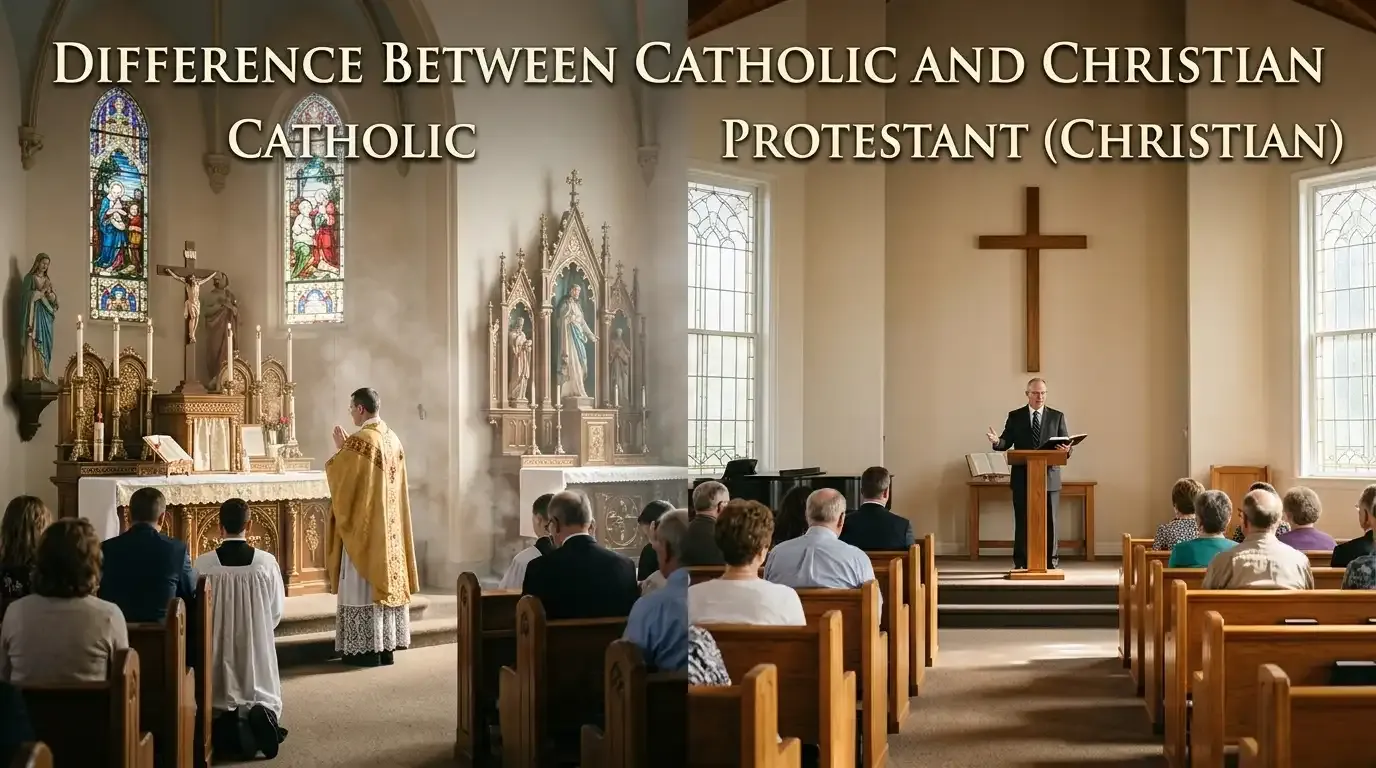
Catholics are Christians, but not all Christians are Catholic. Catholic is one branch of the large Christian faith, side by side with Orthodox and Protestant branches.
When most people ask this question, they mean the gap between Catholic and Protestant. In day to day talk, some use the word Christian to mean Protestant, and that loose use breeds mix ups.
To clear the mix up, start with the family picture. All Catholics are Christians, just as all squares are shapes with four sides.
Not all Christians are Catholic, just as not all such shapes are squares. A Catholic can rightly say that he or she is Christian, and a Protestant can say the same.
The Simple Family Picture
Christian faith is the broad family of people who follow Jesus Christ. They trust that he is the Son of God, that he died for sins, and that he rose again. Inside this family sit large branches with their own ways of church life. The Catholic Church is the largest single branch, with over one billion members round the world.
The Orthodox churches form one more old branch, strong in East Europe and the Middle East. Protestant churches form many branches that grew from the Reformation in the 1500s. Each branch keeps the core faith in Jesus. Each one reads some points of faith and church life in its own way.
What Catholics And Other Christians Share
First, note the large shared ground before the gaps. Catholics and Protestants both trust in one God, known as Father, Son, and Holy Spirit. Both trust that Jesus is fully God and fully man, born of Mary, put to death on a cross, buried, and raised to life. Both trust that new life comes through Jesus Christ, not through human worth alone.
Authority: Bible, Tradition, And The Pope
The largest gap is about who has the last word. Catholics trust that God speaks through the Bible, through church tradition, and through the teaching voice of the Church. That teaching voice is led by the Pope and the bishops. Bible and tradition are seen as streams from one source, with the Church as their guard.
Most Protestants hold to Scripture alone as the last word for faith and life. They prize church tradition, church councils, and wise leaders, but these do not rank with the Bible. If a church custom seems to clash with the Bible, the Bible wins. Protestant churches are led in local or national ways, with no single world Pope at the top.
Salvation, Faith, And Works
Both Catholics and Protestants say new life comes by grace through Jesus Christ. They part ways on how faith, works, and grace fit with each other. Most Protestants stress faith alone, which means a person is made right with God by trust in Christ. Good works then flow from true faith, as fruit from a sound tree, not as the price paid for new life.
Sacraments And Worship
Catholics count seven sacraments, which are Baptism, Confirmation, Eucharist, Penance, Anointing of the Sick, Holy Orders, and Marriage. These are seen as signs that give grace, not as bare signs. The Eucharist, shared at Mass, stands at the heart of church life. Catholics trust that in Mass, bread and wine turn into the true Body and Blood of Christ, a teaching called transubstantiation.
Ephesians 2:8 – For it is by grace you have been saved, through faith, and this is not from yourselves, it is the gift of God.
John 3:16 – For God so loved the world that he gave his one and only Son, that whoever believes in him shall not perish but have eternal life.
Mary, Saints, And Purgatory
Mary, the mother of Jesus, is prized in both churches, but Catholics prize her most. Catholic teaching calls Mary the Mother of God. It teaches that she was kept free from sin at her start, in the teaching called the Immaculate Conception, stayed a virgin, and was taken to heaven at her death. Catholics ask Mary and saints to pray for them, as one might ask a friend to pray.
Catholic teaching is firm that worship goes to God alone. Praise given to Mary and saints is of a distinct kind, not worship due to God. Most Protestants prize Mary as a true servant of God and the mother of Jesus, yet they do not pray to her or to saints. They pray straight to God through Christ, the one mediator for all.
Purgatory marks one more clear gap between the sides. Catholics trust that purgatory is a state of cleansing after death for those who die in grace but still need to be made pure. Protestants tend to turn this view down, and they trust that through faith in Christ, believers pass straight to heaven. This gap links with views on prayer for the dead and on how final cleansing works.
Biggest difference between Catholic and Christian
The biggest difference between Catholicism and other Christian denominations is not belief in Jesus, but how religious authority and certain teachings are understood. Catholics are Christians who follow the teachings and traditions of the Catholic Church, including the authority of the Pope. Other Christian groups, particularly Protestants, generally do not recognize papal authority. They may also differ in their understanding of salvation, sacraments, and church traditions. Both Catholics and other Christians share faith in Jesus Christ and his resurrection. Catholic Answers Tract+2
Difference between Catholic and Protestant
Catholics and Protestants are two major groups within Christianity, and they share belief in Jesus Christ, the Bible, and the importance of faith. However, they differ in several religious teachings and practices. Catholics recognize the authority of the Pope and follow both Scripture and Sacred Tradition. Most Protestants emphasize the Bible as their highest authority and do not accept papal leadership. They also have different views about sacraments, communion, Mary, saints, and how salvation is understood. Catholic Treasury+2
Difference between Catholic and Christian Bible
The main difference between Catholic and many Protestant Christian Bibles is the number of books they contain. A Catholic Bible has 73 books, including seven Old Testament books known as the Deuterocanonical books. Most Protestant Bibles contain 66 books, with 39 in the Old Testament and 27 in the New Testament. Both traditions include the same 27 New Testament books. These differences come from different understandings of which ancient Jewish writings belong in the biblical canon. USCCB+2
Difference between Catholic and Orthodox
Catholic and Orthodox Christians share many ancient Christian beliefs, including the Trinity, the divinity of Jesus, and the importance of sacraments. However, their churches differ in leadership and certain theological teachings. Catholics recognize the Pope as having universal authority over the Church, while Eastern Orthodox churches are governed through bishops and councils without accepting papal supremacy. Other differences include the wording of the Nicene Creed, views about purgatory, and some practices surrounding worship. Both traditions have rich histories and liturgical customs. Catholic Treasury+1
Christian vs Catholic vs Protestant
Christianity is the religion centered on the life, teachings, death, and resurrection of Jesus Christ. Catholicism and Protestantism are two major branches of Christianity. Catholics follow the teachings of the Catholic Church, recognize the Pope, and observe seven sacraments. Protestants include many denominations that generally emphasize biblical authority and recognize fewer sacraments. Both groups believe in Jesus as the Son of God and share important Christian teachings. Their differences mainly involve church authority, traditions, worship, and theology. Catholic Answers Tract+2
Difference between Catholic and Baptist
Catholics and Baptists are Christian groups with shared beliefs in Jesus Christ, the Bible, and salvation. However, their religious practices and teachings differ in important ways. The Catholic Church recognizes seven sacraments, while Baptist churches generally recognize two ordinances: baptism and the Lord’s Supper. Catholics baptize infants, whereas Baptists typically practice believer’s baptism through immersion. Catholics also recognize the Pope’s authority and Sacred Tradition, while Baptists generally emphasize the Bible as their final authority for faith and practice. New Advent+2
Is Christian and Catholic can be together
Yes, Christians and Catholics can build friendships, relationships, and marriages because Catholics are also Christians. Both groups share faith in Jesus Christ, although they may follow different church traditions and religious practices. In a relationship, understanding each other’s beliefs, respecting religious differences, and communicating openly can help create a strong connection. Couples may also discuss important matters such as church attendance, marriage ceremonies, baptism, and raising children. Mutual respect and shared values can help people from both traditions live together peacefully.
Difference between Catholic and Christian school
A Catholic school is a type of Christian educational institution that combines regular academic learning with Catholic religious teachings. Christian schools may follow different Protestant or non-Catholic traditions, depending on their beliefs and educational approach. Catholic schools generally include Catholic prayers, religious education, church traditions, and teachings about the sacraments. Other Christian schools may focus on Bible study, prayer, and their particular denomination’s beliefs. Both types aim to support students’ academic development while encouraging moral values, spiritual growth, and respect for others.
The Bible: 73 Books Or 66 Books
Catholic Bibles hold 73 books, with 46 in the Old Testament and 27 in the New Testament. Protestant Bibles hold 66 books, with 39 in the Old Testament and 27 in the New Testament. The gap lies in seven Old Testament books, plus bits added to Esther and Daniel. Catholics call these books deuterocanonical, while Protestants tend to call them Apocrypha.
These books are Tobit, Judith, Wisdom, Sirach, Baruch, and 1 and 2 Maccabees. They were part of the Greek Old Testament used by many early Christians. At the Reformation, Protestant leaders set them aside from the canon, since they were not in the Hebrew Bible. Catholics kept them, and the Council of Trent backed the 73 book canon.
| Topic | Catholic View | Protestant Views |
| Authority | Bible, tradition, and church teaching | Bible alone as last word |
| Leadership | Pope and bishops | Local leaders, no pope |
| Bible books | 73 books, with 7 added books | 66 books |
| Sacraments | Seven sacraments | Generally two: Baptism and Lord’s Supper |
| Eucharist | Real presence through transubstantiation | Memorial meal, or spirit presence, varies by church |
| Salvation | Grace through faith, lived in love | Grace through faith alone, works as fruit |
| Mary and saints | Honoured, asked to pray | Honoured, not prayed to |
| Confession | To a priest in confession | Directly to God in prayer |
| Purgatory | Cleansing before heaven | Not held |
| Clergy | Priests, bishops, deacons | Pastors and elders, may marry |
History In Brief
Christian faith began with Jesus and his apostles in the first century. For many centuries, there was one broad church, though tongue, culture, and thought varied from East to West. In 1054, the Great Schism split East Orthodox and West Catholic churches, mainly over the Pope, points of faith, and tongue. Both sides claimed a true link with the early church.
In the 1500s, the Protestant Reformation, led by men such as Martin Luther and John Calvin, took issue with Catholic ways and teachings. The chief points were indulgences, church rule, and how a person is made right with God. The split in the West has lasted since that time. Protestant faith has grown into Lutheran, Reformed, Anglican, Baptist, Methodist, Pentecostal, and many more families.
In our day, talks go on between Catholic and Protestant leaders. They have made joint claims on faith and new life, and local churches work side by side in prayer and care for the people with low-income. Gaps still stand, but the tone is far kinder than in past days, when strife at times turned to war. Past roots help us see why the gaps run deep.
How To Talk About This Respectfully
When you talk of these gaps, paint each side as it paints itself. Catholics do not worship Mary or saints in Catholic teaching, since they prize them and ask for prayer. Protestants do not turn down good works, since they insist works flow from faith and do not buy new life. To dodge such false pictures makes talk fair and far more helpful for all.
It also helps to ask what a person trusts, not to guess from a label. Not all Protestant churches are the same, and not all Catholics live faith in the same way. A Baptist, a Lutheran, an Anglican, and a Pentecostal may part ways on baptism, church rule, and song. Yet they share a Protestant name, and Catholic ways also vary by land and culture in clear ways.
For one who seeks a church, the hands on questions tend to count most. What does this church teach on Jesus, the Bible, and new life? How does it meet for worship, and how does it care for its members? A visit, a read of its faith claim, and a chat with its leaders can give far more light than a label alone.
| Question To Ask | Catholic Answer In Brief | Protestant Answer In Brief |
| Are Catholics Christian | Yes, one branch of Christian faith | Yes, and Protestants are too |
| Who leads the church | Pope and bishops | Pastors and elders |
| How many sacraments | Seven | Usually two |
| How is forgiveness received | Through faith, repentance, and sacraments | Through faith and repentance, to God |
| What happens after death | Heaven, hell, or purgatory | Heaven or hell, no purgatory |
FAQs
Are Catholics Christians
Yes, Catholics are Christians, since they trust in Jesus Christ as Lord and Saviour. They trust in the Trinity, and they trust that new life comes through Christ alone. Catholic faith is one branch of the Christian faith, not a distinct faith on its own. That is why the short answer to this often asked question is yes.
What is the main difference between Catholic and Protestant
The main gaps are church rule, sacraments, and some points of faith. Catholics trust Bible, tradition, and the teaching voice of the Church, and they count seven sacraments. They hold their own teachings on Mary, saints, and purgatory that most Protestants do not share. Most Protestants hold Scripture alone as the last word, and they tend to count two sacraments.
Do Catholics and Protestants read the same Bible
Mostly yes, since the New Testament is the same in both churches. Catholic Old Testaments add seven books that Protestant Old Testaments do not count as canon. That is why Catholic Bibles hold 73 books while Protestant Bibles hold 66 books. For most day to day reading, the shared ground is far larger than the gap.
Can a Catholic attend a Protestant service, or vice versa
In many places, guests are gladly welcomed to join in worship. Rules on sharing communion do vary, so a guest should take care on that point. Catholics are normally asked to keep the Sunday Mass duty at Mass itself. The kind move is to check with the local church first.
Which branch is right
That choice turns on deep trust about church rule, Scripture, old ways, and church past. This article paints each side in fair terms, but it does not settle that debate for you. Readers are urged to study Scripture and church past, and to weigh the teachings of each tradition. A chat with trusted leaders can help you weigh hard points with care and prayer.
Conclusion
The plain answer is that Catholics are Christians, but not all Christians are Catholic. Catholic is one branch of the large Christian faith, side by side with Orthodox and Protestant branches. Most questions on this topic mean the gap between Catholic and Protestant in fact. Both sides trust in Jesus as Lord and Saviour, in the Trinity, and in new life through Christ.
Discover More Post
- Is Jesus God? Understand What the Bible Says
- What Language Did Jesus Speak? Aramaic, Hebrew, Greek, and Latin Explained
- How Old Is God? Understanding God’s Eternal Existence
- What Language Did Jesus Speak? Aramaic, Hebrew, Greek, and Latin Explained
I’m Nicholas Sparks, and storytelling has always been my passion. Through TheBiblimeaning, I share insights about my books, unforgettable characters, romance, emotions, and the deeper meanings behind my stories. This platform brings readers closer to my writing journey, latest releases, and the inspiration that shapes every novel I create.