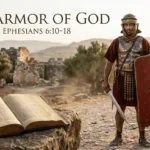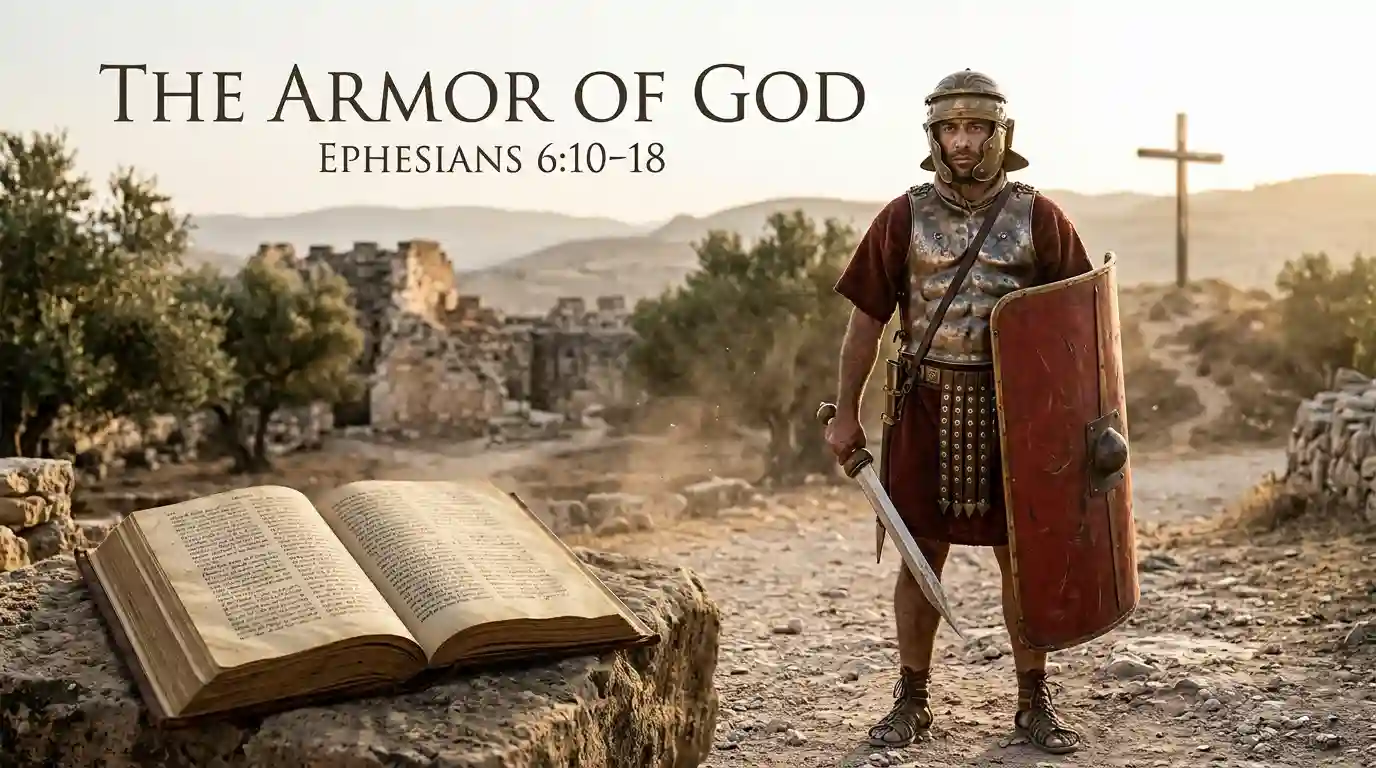
The armor of God is a picture from Ephesians 6:10-18 in which the apostle Paul describes the believer as a soldier who stands firm against spiritual evil.
The six pieces are the belt of truth, the breastplate of righteousness, the shoes of the gospel of peace, the shield of faith, the helmet of salvation and the sword of the Spirit, which is the word of God. Paul then adds prayer (Ephesians 6:18).
The armor is not a magic charm and it is not for fighting people: “we wrestle not against flesh and blood” (Ephesians 6:12).
This guide explains each piece with its Bible references, shows how to “put on” the armor each day, and clears up common misunderstandings. Verses are quoted from the King James Version unless noted.
Ephesians 6:10-18: The Full Passage
“Finally, my brethren, be strong in the Lord, and in the power of his might. Put on the whole armour of God, that ye may be able to stand against the wiles of the devil. For we wrestle not against flesh and blood, but against principalities, against powers, against the rulers of the darkness of this world, against spiritual wickedness in high places. Wherefore take unto you the whole armour of God, that ye may be able to withstand in the evil day, and having done all, to stand. Stand therefore, having your loins girt about with truth, and having on the breastplate of righteousness; and your feet shod with the preparation of the gospel of peace; above all, taking the shield of faith, wherewith ye shall be able to quench all the fiery darts of the wicked. And take the helmet of salvation, and the sword of the Spirit, which is the word of God: praying always with all prayer and supplication in the Spirit, and watching thereunto with all perseverance and supplication for all saints.” (Ephesians 6:10-18)
The Six Pieces of the Armor of God at a Glance
- Belt of truth (Ephesians 6:14): honesty and God’s truth that hold everything together.
- Breastplate of righteousness (Ephesians 6:14): right standing with God and a life lived rightly, guarding the heart.
- Shoes of the gospel of peace (Ephesians 6:15): firm footing and readiness to share the good news.
- Shield of faith (Ephesians 6:16): trust in God that stops “fiery darts” of doubt, fear and temptation.
- Helmet of salvation (Ephesians 6:17): the assurance of salvation that protects the mind.
- Sword of the Spirit (Ephesians 6:17): the word of God, used to answer lies and temptation.
- Prayer (Ephesians 6:18): the constant communication with God that goes with every piece.
Who Wrote Ephesians 6 and Why Soldiers?
The letter begins, “Paul, an apostle of Jesus Christ by the will of God, to the saints which are at Ephesus” (Ephesians 1:1). Paul wrote it as “the prisoner of Jesus Christ” (Ephesians 3:1), and he calls himself “an ambassador in bonds” (Ephesians 6:20). Acts 28:16 says that in Rome he lived under guard with a soldier, so the Roman soldier’s equipment was in front of him as he wrote.
The Ephesians also lived in a city where spiritual powers were taken seriously. The city worshipped the goddess Diana (Acts 19:27-28), and many who became believers burned their books of magic (Acts 19:19). Paul reminds them that Christ is far above every power (Ephesians 1:20-21), and that they are to stand in His strength, not their own: “be strong in the Lord, and in the power of his might” (Ephesians 6:10).
What Is the Enemy in Ephesians 6?
Paul is clear about who the enemy is not: “we wrestle not against flesh and blood” (Ephesians 6:12). The struggle is against “the wiles of the devil” (Ephesians 6:11) and spiritual forces of evil. Other passages describe how the enemy works:
- He is “a liar, and the father of it” (John 8:44).
- He can be “transformed into an angel of light” (2 Corinthians 11:14).
- He is “the accuser of our brethren” (Revelation 12:10).
- He “as a roaring lion, walketh about, seeking whom he may devour” (1 Peter 5:8).
The weapons of this fight are not physical: “the weapons of our warfare are not carnal, but mighty through God to the pulling down of strong holds; casting down imaginations, and every high thing that exalteth itself against the knowledge of God, and bringing into captivity every thought to the obedience of Christ” (2 Corinthians 10:4-5). That is why the armor is truth, righteousness, peace, faith, salvation, the word and prayer.
Where the Armor of God Comes From in the Old Testament
Paul’s picture has roots in Isaiah. In Isaiah 59:16-17, God Himself acts as a warrior when no one else will: “his arm brought salvation unto him… For he put on righteousness as a breastplate, and an helmet of salvation upon his head.” Isaiah 11:5 says of the coming ruler, “righteousness shall be the girdle of his loins, and faithfulness the girdle of his reins”. Isaiah 52:7 speaks of “the feet of him that bringeth good tidings, that publisheth peace”.
This means the armor is first God’s own. Believers are not building their own defense. They are being clothed with what God provides, and Christ is the true warrior. Paul uses similar pictures elsewhere: “the breastplate of faith and love; and for an helmet, the hope of salvation” (1 Thessalonians 5:8), “the armour of righteousness on the right hand and on the left” (2 Corinthians 6:7), and “the armour of light” (Romans 13:12).
The Belt of Truth (Ephesians 6:14)
“Stand therefore, having your loins girt about with truth.” A soldier’s belt held his tunic and gear in place so he could move freely. Truth does the same for the believer.
What it means:
- God’s truth. Jesus said, “Sanctify them through thy truth: thy word is truth” (John 17:17), and, “I am the way, the truth, and the life” (John 14:6).
- Truthful living. “Putting away lying, speak every man truth with his neighbour” (Ephesians 4:25). God desires “truth in the inward parts” (Psalm 51:6).
- Freedom. “Ye shall know the truth, and the truth shall make you free” (John 8:32).
How to wear it: When a thought or temptation arises, ask what is true, according to God’s word. Tell the truth, even when a small lie would be easier (Proverbs 12:22).
The Breastplate of Righteousness (Ephesians 6:14)
The breastplate protected the chest, where the heart sits. Righteousness protects the heart in two ways.
- Given righteousness. God gives a right standing to those who trust Christ: “He hath made him to be sin for us, who knew no sin; that we might be made the righteousness of God in him” (2 Corinthians 5:21). “There is therefore now no condemnation to them which are in Christ Jesus” (Romans 8:1). This answers the enemy’s accusations (Revelation 12:10).
- Lived righteousness. Believers are also called to “follow after righteousness, godliness, faith, love, patience, meekness” (1 Timothy 6:11).
How to wear it: “Keep thy heart with all diligence; for out of it are the issues of life” (Proverbs 4:23). When you fail, confess, because “he is faithful and just to forgive us our sins” (1 John 1:9), and then keep walking.
The Shoes of the Gospel of Peace (Ephesians 6:15)
“And your feet shod with the preparation of the gospel of peace.” Roman soldiers wore sturdy sandals for traction on rough ground. This piece gives two things: stability and readiness.
- Stability. “Being justified by faith, we have peace with God through our Lord Jesus Christ” (Romans 5:1). “The peace of God, which passeth all understanding, shall keep your hearts and minds through Christ Jesus” (Philippians 4:7).
- Readiness to share. “How beautiful are the feet of them that preach the gospel of peace” (Romans 10:15). Peter adds, “be ready always to give an answer to every man that asketh you a reason of the hope that is in you with meekness and fear” (1 Peter 3:15).
- Peacemaking. “If it be possible, as much as lieth in you, live peaceably with all men” (Romans 12:18). “Blessed are the peacemakers” (Matthew 5:9).
Peace may seem an odd part of a battle picture, but a soldier who loses his footing cannot stand. Standing is the point: Paul uses “stand” repeatedly (Ephesians 6:11, 13, 14).
How to wear it: Before reacting in anger or panic, pause and remember you already have peace with God. Then speak gently (Proverbs 15:1).
The Shield of Faith (Ephesians 6:16)
“Above all, taking the shield of faith, wherewith ye shall be able to quench all the fiery darts of the wicked.” The Roman shield was large and could be soaked in water to put out flaming arrows. Faith does the same to the “fiery darts” of doubt, fear, shame and temptation.
- What faith is. “Faith is the substance of things hoped for, the evidence of things not seen” (Hebrews 11:1).
- Where faith comes from. “Faith cometh by hearing, and hearing by the word of God” (Romans 10:17).
- What faith does. “This is the victory that overcometh the world, even our faith” (1 John 5:4).
- Faith can be weak and still real. “Lord, I believe; help thou mine unbelief” (Mark 9:24). Jesus prayed for Peter, “that thy faith fail not” (Luke 22:32).
How to wear it: When a fiery dart hits, answer with a promise of God, such as “Casting all your care upon him; for he careth for you” (1 Peter 5:7). Pray it aloud and share the struggle with other believers (Galatians 6:2).
The Helmet of Salvation (Ephesians 6:17)
The helmet protected the head. Salvation guards the mind with the assurance that we belong to God.
- Security. “Neither death, nor life… shall be able to separate us from the love of God, which is in Christ Jesus our Lord” (Romans 8:38-39).
- Hope. Paul calls it “for an helmet, the hope of salvation” (1 Thessalonians 5:8).
- A renewed mind. “Be not conformed to this world: but be ye transformed by the renewing of your mind” (Romans 12:2). “Set your affection on things above” (Colossians 3:2).
- Guarded thoughts. “Whatsoever things are true… honest… just… pure… lovely… of good report… think on these things” (Philippians 4:8).
How to wear it: Each morning, remind yourself who you are in Christ: saved by grace (Ephesians 2:8-9). When a thought says you are worthless or alone, test it against what God says (2 Corinthians 10:5).
The Sword of the Spirit (Ephesians 6:17)
The sword is “the word of God”, the only piece Paul names that is used to attack, though in practice it is also how we answer lies. “The word of God is quick, and powerful, and sharper than any twoedged sword” (Hebrews 4:12).
Jesus Used the Sword
When the devil tempted Jesus in the wilderness, Jesus answered each time with Scripture: “It is written, Man shall not live by bread alone” (Matthew 4:4), “It is written again, Thou shalt not tempt the Lord thy God” (Matthew 4:7), and “Get thee hence, Satan: for it is written, Thou shalt worship the Lord thy God, and him only shalt thou serve” (Matthew 4:10).
Context Matters
In that same account the devil also quoted Scripture (Matthew 4:6, quoting Psalm 91:11-12), but he used it wrongly. This is why Paul tells Timothy to be “rightly dividing the word of truth” (2 Timothy 2:15). Learn the word in context, so that you can use it correctly.
How to wear it: Read the Bible regularly (2 Timothy 3:16-17) and memorize key verses: “Thy word have I hid in mine heart, that I might not sin against thee” (Psalm 119:11). Use Scripture to answer lies and to comfort, never to shame others (Colossians 3:16).
Prayer: The Seventh Piece
Paul does not end with the sword. He adds, “Praying always with all prayer and supplication in the Spirit, and watching thereunto with all perseverance and supplication for all saints” (Ephesians 6:18). Prayer is how the whole armor is put on and kept on.
- Continual: “Pray without ceasing” (1 Thessalonians 5:17). “Men ought always to pray, and not to faint” (Luke 18:1).
- Specific: “In every thing by prayer and supplication with thanksgiving let your requests be made known unto God” (Philippians 4:6).
- For others: Paul asks for prayer for himself: “that utterance may be given unto me, that I may open my mouth boldly” (Ephesians 6:19-20).
- Dependent on God: Jesus taught us to pray, “deliver us from evil” (Matthew 6:13).
How to Put On the Armor of God Every Day
The command is to “put on” the armor (Ephesians 6:11). Paul uses the same words elsewhere: “put ye on the Lord Jesus Christ” (Romans 13:14) and “Put on therefore, as the elect of God, holy and beloved, bowels of mercies, kindness” (Colossians 3:12). It is a daily act of trust, done through prayer.
- Morning: Pray through each piece. Ask God for truth in your speech, a clean conscience, peace in conflict, faith in doubt, a secure mind and a clear grasp of His word (Psalm 5:3).
- During the day: When you are tested, recall the piece that fits the moment and act on it.
- Evening: Review the day, thank God for where you stood firm, and confess where you did not (1 John 1:9).
A Short Morning Prayer
Lord, I am strong only in You and in the power of Your might (Ephesians 6:10). Today I put on Your truth, Your righteousness in Christ, Your peace, and faith that trusts You. I take the assurance of my salvation and Your word as my sword. Help me to stand, and having done all, to stand (Ephesians 6:13). Keep me praying always (Ephesians 6:18). In Jesus’ name, amen.
The Armor of God for Children and Families
Ephesians 6 begins with instructions to children and parents (Ephesians 6:1-4), and Paul’s letter was read in whole households. Moses told parents, “thou shalt teach them diligently unto thy children, and shalt talk of them when thou sittest in thine house” (Deuteronomy 6:6-7). Jesus welcomed children: “Suffer little children to come unto me” (Matthew 19:14).
- Make it simple. One piece a day, with one verse (belt: John 17:17; shield: Hebrews 11:1; sword: Psalm 119:11).
- Make it active. Act out each piece and link it to an everyday situation, such as telling the truth or being kind to a sibling.
- Keep it gentle. Focus on God’s care and strength (Psalm 56:3), rather than fear of the enemy.
- Pray as a family, with each person taking a piece and naming a situation for the week.
Common Misunderstandings About the Armor of God
1. It Is Not a Magic Charm
In Ephesus, some men tried to use the name of Jesus as a formula over a person with an evil spirit, and it went badly for them. The spirit answered, “Jesus I know, and Paul I know; but who are ye?” (Acts 19:13-16). The armor is not a set of words to recite. It is a life of trusting Christ.
2. It Does Not Promise a Trouble-Free Life
Paul wrote Ephesians in chains (Ephesians 6:20) and faced beatings, shipwreck and hunger (2 Corinthians 11:23-27). The armor helps us “to stand” (Ephesians 6:13), not to avoid every hardship. Jesus said, “In the world ye shall have tribulation: but be of good cheer; I have overcome the world” (John 16:33).
3. It Is Not for Fighting People
“We wrestle not against flesh and blood” (Ephesians 6:12). “The servant of the Lord must not strive; but be gentle unto all men, apt to teach, patient, in meekness instructing those that oppose themselves” (2 Timothy 2:24-25). “Be not overcome of evil, but overcome evil with good” (Romans 12:21).
4. It Does Not Blame the Devil for Everything
Believers also face temptations that come from within: “every man is tempted, when he is drawn away of his own lust, and enticed” (James 1:14). The right response combines humility and resistance: “Submit yourselves therefore to God. Resist the devil, and he will flee from you” (James 4:7).
5. It Is Not Self-Made
Paul says “be strong in the Lord” (Ephesians 6:10), not in yourself. The armor is God’s gift, and it is meant to be worn “whole” (Ephesians 6:11, 13), not one piece at a time.
A Note on Thoughts and Mental Health
The helmet and the shield are about thoughts, but persistent anxiety, depression or intrusive thoughts are not always spiritual attacks, and they are not a sign of weak faith. If they are severe or last a long time, talk to a doctor or counselor as well as to someone you trust in your church (Proverbs 11:14; Galatians 6:2).
Is Victory Already Won?
Believers do not fight for victory. They stand in one that Christ has already won. “Having spoiled principalities and powers, he made a shew of them openly, triumphing over them in it” (Colossians 2:15). “Greater is he that is in you, than he that is in the world” (1 John 4:4). “In all these things we are more than conquerors through him that loved us” (Romans 8:37). This is why Paul can say that, “having done all, to stand” (Ephesians 6:13).
A 7-Day Plan to Practice the Armor
- Day 1, Belt of truth (Ephesians 6:14): Read John 17:17 and tell the truth in every conversation today.
- Day 2, Breastplate of righteousness: Read Romans 8:1 and 2 Corinthians 5:21, and thank God for your right standing in Christ.
- Day 3, Shoes of peace (Ephesians 6:15): Read Romans 12:18 and make one step toward peace with someone.
- Day 4, Shield of faith (Ephesians 6:16): Read Hebrews 11:1 and 1 Peter 5:7, and hand one worry to God.
- Day 5, Helmet of salvation (Ephesians 6:17): Read Romans 8:38-39 and Philippians 4:8, and replace one negative thought with a true one.
- Day 6, Sword of the Spirit: Memorize Psalm 119:11 or Matthew 4:4.
- Day 7, Prayer (Ephesians 6:18): Pray through the whole armor and for others (Ephesians 6:19-20).
FAQs
What are the six pieces of the armor of God?
The belt of truth, the breastplate of righteousness, the shoes of the gospel of peace, the shield of faith, the helmet of salvation and the sword of the Spirit (Ephesians 6:14-17). Paul then adds prayer (Ephesians 6:18).
Where is the armor of God in the Bible?
It is in Ephesians 6:10-18. Related images appear in Isaiah 59:17, Isaiah 11:5 and Isaiah 52:7, and in 1 Thessalonians 5:8, 2 Corinthians 6:7 and Romans 13:12.
How do you put on the armor of God every day?
Pray through each piece in the morning, recall the right piece when you are tested, and review the day in the evening. The command is to “put on” the whole armor (Ephesians 6:11) and to pray always (Ephesians 6:18).
What does the armor of God protect against?
It protects against “the wiles of the devil” (Ephesians 6:11), including lies, accusation, fear, temptation and discouragement. It does not remove hardship, but it helps believers to “stand” (Ephesians 6:13).
Is the sword of the Spirit the only weapon?
It is the only piece Paul describes as an attacking weapon, and he says it is “the word of God” (Ephesians 6:17). Prayer works alongside it (Ephesians 6:18), and Jesus used Scripture against temptation (Matthew 4:4-10).
What does “stand” mean in Ephesians 6?
It means to hold your ground and not give way to evil. Paul repeats the word in Ephesians 6:11, 13 and 14, ending with “having done all, to stand” (Ephesians 6:13). Standing is trusting in Christ’s victory (Colossians 2:15).
Is the armor of God only for pastors or also for everyone?
It is for all believers. Paul wrote to “the saints which are at Ephesus” (Ephesians 1:1), and he tells all of them to “take unto you the whole armour of God” (Ephesians 6:13).
Can children learn about the armor of God?
Yes, with simple words, examples and prayer. Parents are told to teach God’s word diligently to their children (Deuteronomy 6:6-7). Keep it gentle and focus on God’s care.
Conclusion
The armor of God is a picture of the life God gives: truth, righteousness in Christ, peace, faith, salvation, the word of God and prayer (Ephesians 6:14-18). Believers do not put it on to fight people (Ephesians 6:12), or to earn safety, but to stand in the strength of the Lord (Ephesians 6:10) and in the victory Christ has already won (Colossians 2:15).
Put it on each day in prayer, use the piece that fits the moment, and review the day with thanks. As Paul says, take “the whole armour of God, that ye may be able to withstand in the evil day, and having done all, to stand” (Ephesians 6:13).
Discover More Post
- Jesus Wept (John 11:35): Meaning, Story, and Hope for Grief
- Who Betrayed Jesus? Judas Iscariot, the Kiss, and What the Bible Says
- God Is Love: What 1 John 4 Means and How to Live It
- Trust in God: What the Bible Says, Why It Is Hard and How to Grow It

Hi, I’m James Patterson, a storyteller who loves creating thrilling mysteries, unforgettable characters, and page-turning adventures. Through TheBiblimeaning, I share insights about authors, books, literary meanings, biographies, and the stories behind famous writers. My goal is to help readers discover the deeper world of literature while enjoying engaging and informative content.