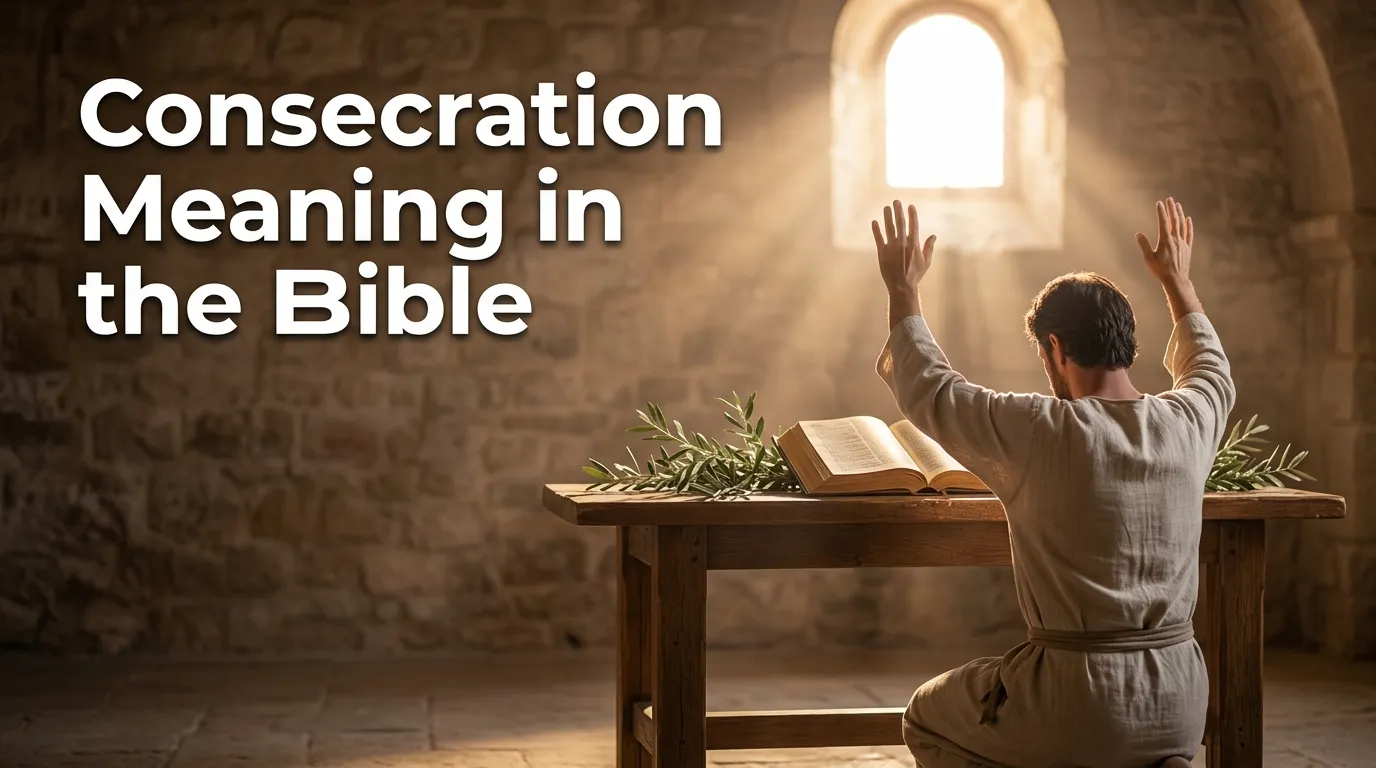
Consecration means to set something or someone apart for God’s exclusive use and purpose.
In the Bible, consecration describes the process of dedicating people, objects, and places to holy service making them different from ordinary, everyday things.
This word appears throughout Scripture, from the anointing of priests in Exodus to Paul’s call for believers to present their bodies as living sacrifices in Romans.
If you’re writing a Bible study, devotional, or commentary on this topic, you need more than a dictionary definition.
You need the full biblical picture: the Hebrew and Greek roots, the key passages, the theological weight, and practical ways to help your readers apply this truth today.
That’s exactly what this guide provides.
Quick Reference Table
| Aspect | Summary |
| Focus Keyword | Consecration meaning in the Bible |
| Core Definition | Setting apart persons, places, or objects for God’s exclusive use |
| Hebrew Term | Qadash (קָדַשׁ) to be holy, set apart, sanctify |
| Greek Term | Hagiazo (ἁγιάζω) to make holy, sanctify, dedicate |
| Key Old Testament Passage | Exodus 29:1–9 (consecration of priests) |
| Key New Testament Passage | Romans 12:1 (living sacrifice) |
| Related Concepts | Sanctification, holiness, dedication, purification |
| Who Gets Consecrated | Priests, Levites, firstborn, altars, the tabernacle, believers |
Biblical Meaning
At its core, consecration means separation unto God. It’s not primarily about being extra spiritual or achieving moral perfection. It’s about belonging. Something consecrated no longer belongs to common, everyday use. It belongs to the Lord.
Think of it this way: a wedding ring isn’t just a piece of jewelry. Once given in marriage, it carries meaning and purpose beyond its material value. Consecration works similarly, but on a far greater scale. In the Old Testament, God consecrated priests, altars, the tabernacle, and even the firstborn of Israel. In the New Testament, this idea deepens. Believers themselves become consecratedset apart for God’s purposes through Christ.
This is why the topic matters so much for Bible book creators. Consecration touches nearly every major theme in Scripture: worship, holiness, priesthood, covenant, and Christian living. A well-researched study on this word gives readers a doorway into understanding how God relates to His people across both Testaments.
Hebrew and Greek Meaning
Understanding the original languages gives your writing depth and credibilitysomething Bible study readers and reviewers notice immediately.
Hebrew: Qadash (קָדַשׁ)
The primary Hebrew word behind consecrate is qadash, which means to be set apart, to be holy, or to sanctify. It shares the same root as qadosh (holy) and qodesh (holiness). The word appears over 170 times in the Old Testament in various forms. When Exodus 29 describes the consecration of Aaron and his sons, the Hebrew phrase literally means to fill the handa picture of being equipped and entrusted with priestly service.
Greek: Hagiazo (ἁγιάζω)
In the New Testament, the Greek word hagiazo is translated sanctify or consecrate. It comes from the same root as hagios (holy) and hagiasmos (sanctification). Jesus uses this word in John 17:19 when He says, For their sakes I consecrate myself, that they also may be sanctified in truth (ESV). This connects Old Testament consecration directly to the person and work of Christ.
Both words carry the same essential idea across languages: separation from common use, dedication to sacred purpose.
Biblical Context
Consecration first appears prominently in the establishment of Israel’s priesthood. In Exodus 28–29, God gives Moses detailed instructions for setting apart Aaron and his sons as priests. This wasn’t a casual appointment. It involved washing, special garments, anointing oil, and blood sacrificesa seven-day ceremony marking a complete transfer from ordinary life to sacred service (Exodus 29:35–37).
The concept extends beyond people. Leviticus 8 describes the consecration of the altar itself. Numbers 3 describes the consecration of the Levites as a instead set apart for tabernacle service, replacing the firstborn of Israel who were originally claimed by God (Numbers 3:12–13).
By the time we reach the New Testament, consecration takes on a more personal, individual dimension. Instead of a priestly class alone being set apart, all believers are called a royal priesthood, a holy nation (1 Peter 2:9). This shift is significant for any Bible study exploring the continuity between Old and New Testament worship.
Key Bible Verses with Full Explanation
Exodus 29:9 (ESV) And you shall gird Aaron and his sons with sashes and bind caps on them. And the priesthood shall be theirs by a statute forever. Thus you shall ordain Aaron and his sons.
Leviticus 8:10–12 (ESV) Moses anoints the tabernacle and its furnishings, then anoints Aaron to consecrate him.
This passage extends consecration beyond people to physical objects and spaces. The anointing oil, poured out generously, marked everything it touched as belonging to God. This teaches an important principle: consecration isn’t limited to individuals. Places and things dedicated to God’s service carry their own kind of sacred distinction.
Joshua 3:5 (ESV) Then Joshua said to the people, ‘Consecrate yourselves, for tomorrow the LORD will do wonders among you.’
Before crossing the Jordan River into the Promised Land, Joshua calls the people to consecrate themselves. This shows consecration wasn’t reserved only for priests. Ordinary Israelites were called to prepare themselves spiritually before witnessing God’s power.
John 17:19 (ESV) And for their sake I consecrate myself, that they also may be sanctified in truth.
Here, Jesus applies the language of consecration to Himself, just before His crucifixion. He sets Himself apart completely for the purpose of the Father’s will, so that His followers might likewise be set apart.
Romans 12:1 (ESV) I appeal to you therefore, brothers, by the mercies of God, to present your bodies as a living sacrifice, holy and acceptable to God, which is your spiritual worship.
Paul doesn’t use the word consecrate directly here, but the concept is unmistakable. Believers are called to offer themselves not an animal sacrifice, but their whole livesas something holy and dedicated to God.
Spiritual Meaning and Application
For modern believers, consecration means intentionally setting your life apart for God’s purposes. It’s not about earning holiness through effort. Scripture is clear that holiness ultimately comes through Christ (1 Corinthians 1:30). But consecration is our responsea deliberate choice to live differently because we belong to Him.
This might look like setting aside time for prayer and Scripture, being intentional about what you allow into your mind and heart, or dedicating your work, family, and finances to God’s glory. Consecration isn’t a single event for most Christians. It’s a daily posture, echoed in Romans 12:1’s call to present ourselves continually.
Symbolism
Throughout Scripture, consecration is often symbolized through specific physical actions: washing (purification), anointing with oil (the Holy Spirit’s presence and empowerment), and blood (atonement and covenant). Each symbol reinforces the same truthconsecration involves both cleansing from what is common and empowering for what is sacred. Bible teachers can use these symbols to help readers visualize an otherwise abstract theological concept.
Practical Application for Bible Book Creators and Authors
If you’re writing a devotional, Bible study, or commentary on consecration, consider these approaches:
- Pair Old and New Testament passages. Readers benefit from seeing how priestly consecration in Exodus connects to Romans 12’s call for believers today.
- Use the Hebrew and Greek terms sparingly but accurately. A little language study builds trust without overwhelming casual readers.
- Include reflection questions. Since consecration is personal and ongoing, prompts like What areas of your life need to be set apart for God? deepen engagement.
- Avoid conflating consecration with sinless perfection. This is a common misunderstanding worth addressing directly in your material (see below).
- Consider a study format that moves from definition, to biblical examples, to personal applicationthis structure serves both new believers and seasoned pastors using your material for sermon prep.
Common Misunderstandings
Some readers assume consecration means achieving moral perfection or earning God’s favor through works. Scripture doesn’t teach this. Consecration is about position and purposebeing set apartnot about flawless behavior. Another common mix-up is confusing consecration with sanctification. They’re closely related but not identical: consecration is the act of setting apart, while sanctification describes the ongoing process of becoming holy in practice. Clarifying this distinction in your writing will serve careful readers and theology students well.
FAQs
What are the 5 benefits of consecration?
Consecration strengthens your relationship with God, increases spiritual growth, and prepares you for His purpose.
What are the Scriptures on consecration and sanctification?
The Bible teaches consecration and sanctification through verses that emphasize holiness, obedience, and being set apart for God.
Why is consecration important in the Bible?
Consecration is important because it reflects devotion to God and a commitment to living a holy life.
What are the types of consecration in the Bible?
The Bible describes personal, priestly, and communal consecration for God’s service and glory.
What is the spiritual meaning of consecration?
The spiritual meaning of consecration is being set apart for God with wholehearted dedication and obedience.
How do you consecrate yourself to God?
You consecrate yourself to God through prayer, repentance, obedience, worship, and surrender to His will.
What does consecration mean?
Consecration means being set apart and dedicated to God for His holy purposes.
What are the Scriptures on consecration to God?
Many Bible verses encourage consecration to God by calling believers to holiness, faithfulness, and complete devotion.
Conclusion
Consecration is one of Scripture’s most powerful pictures of belonging to God. From the anointed priests of Exodus to Paul’s call for living sacrifices, the Bible consistently teaches that God’s people are set apartnot to be distant or exclusive, but to be useful, purposeful, and devoted to Him.
As you write about this topic, remember that consecration isn’t a burden to carry alone. It’s an invitation, made possible through Christ, to live a life fully given to the One who set us apart in the first place. For you were bought with a price. So glorify God in your body (1 Corinthians 6:20, ESV).
Discover More Post
- Number 6 Meaning in the Bible: Biblical Symbolism Explained
- Biblical Origin of the Name Israel: A Complete Bible Guide
- Biblical Meaning of Covenant: What It Really Means
- Biblical Meaning of Covetousness: A Complete Bible Guide