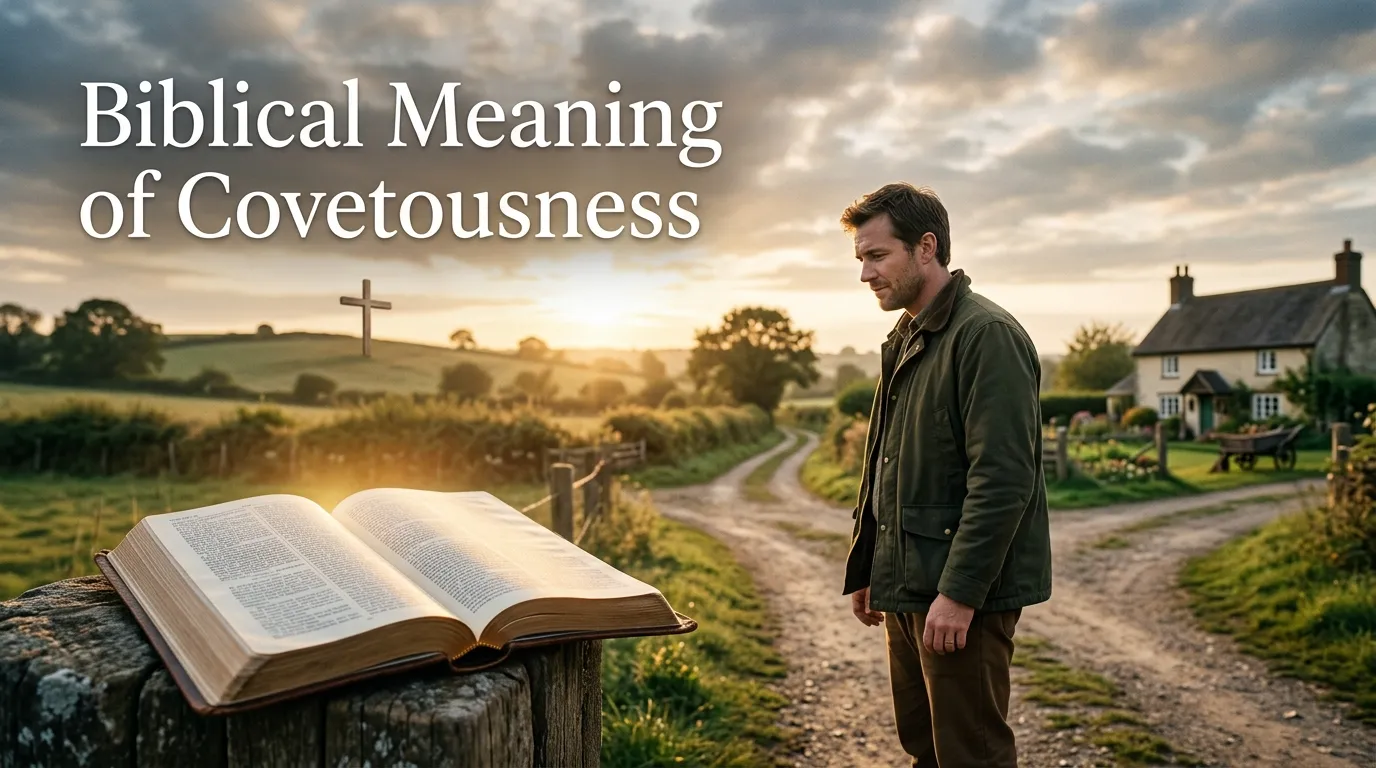
In Scripture, covetousness is the sinful longing for another person’s possessions, position, spouse, or status. God treats it as a heart-level violation of His law.
The tenth commandment states it clearly: “You shall not covet your neighbor’s house. You shall not covet your neighbor’s wife, or his male or female servant, his ox or donkey, or anything that belongs to your neighbor” (Exodus 20:17).
Covetousness is more than envy. Envy resents what another has. Covetousness actively wants to take it or at least possess something like it.
The New Testament links it to idolatry because the heart has made the desired object its functional god (Colossians 3:5; Ephesians 5:5).
Hebrew and Greek Meaning
In the Old Testament the primary Hebrew verb is חָמַד (chamad). It means “to desire, take pleasure in, or covet.” The word itself can be neutral, but the context of the commandment makes the desire sinful when it targets what belongs to another. A related noun, בֶּצַע (betsa), often carries the sense of unjust gain or greedy profit.
In the New Testament the key Greek word is πλεονεξία (pleonexia). It combines “more” (pleon) and “to have” (echo). It describes an aggressive craving for moremore money, more power, more recognitionregardless of the cost to others. Another related term is ἐπιθυμία (epithymia), which means strong desire or lust. When the New Testament pairs these words with possessions or status, the desire is condemned.
Key Bible Verses Explained
Exodus 20:17 / Deuteronomy 5:21
God lists specific objectshouse, wife, servants, livestockand then adds the broad phrase “or anything that belongs to your neighbor.” The command reaches the hidden motives of the heart, not only outward actions.
Luke 12:15
Jesus said, “Watch out! Be on your guard against all kinds of greed; life does not consist in an abundance of possessions.” He spoke these words after a man asked Him to settle an inheritance dispute. Jesus refused to act as a civil judge and instead exposed the deeper issue: the man’s heart was fixed on getting more rather than on being rich toward God.
Colossians 3:5
“Put to death, therefore, whatever belongs to your earthly nature: sexual immorality, impurity, lust, evil desires and greed, which is idolatry.” Paul places covetousness (greed) in the same list as sexual sin and calls it idolatry. The heart that clings to wealth or status is treating created things as ultimate.
1 Timothy 6:6–10
“Godliness with contentment is great gain… For the love of money is a root of all kinds of evil.” Paul does not say money itself is evil. He warns that craving more money opens the door to many other sins and can cause people to wander from the faith.
Hebrews 13:5
“Keep your lives free from the love of money and be content with what you have, because God has said, ‘Never will I leave you; never will I forsake you.’” Contentment is rooted in God’s presence, not in the size of one’s bank account.
Spiritual Meaning and Heart Issues
Covetousness reveals a failure of trust. It says, in effect, “God has not given me enough.” It also reveals a failure of love. When I covet my neighbor’s good, I stop rejoicing with those who rejoice and begin calculating how to gain at their expense.
Scripture consistently ties the cure to contentment and generosity. Contentment is not passive resignation. It is active trust that God is enough. Generosity breaks the grip of greed by training the hands to open rather than to grasp.
Practical Application
- Examine your desires. Ask: “Would I still want this if no one else had it?” Honest answers often expose covetousness.
- Practice gratitude daily. Thank God specifically for what He has already given. Gratitude starves greed.
- Give regularly and proportionately. Generous giving is a practical way to declare that money is a tool, not a master.
- Limit comparison. Social media and advertising fuel covetousness by constantly showing what others have. Setting boundaries protects the heart.
- Replace the craving with worship. When the desire for more rises, turn immediately to Scripture and prayer that celebrate God’s sufficiency.
Common Misunderstandings
Some people think covetousness only applies to extreme greed or illegal schemes. Scripture applies it to ordinary heart attitudes toward ordinary possessions. Others assume ambition itself is sinful. Scripture distinguishes healthy ambition (desiring to use gifts for God’s glory and the good of others) from covetous ambition (desiring gain at the expense of others or in place of God). Ambition becomes covetous when it is driven by comparison and discontent rather than by stewardship and love.
FAQs
How do you pronounce covetousness?
Covetousness is pronounced KUHV-i-tus-nis.
What are examples of covetousness in the Bible?
Examples include Achan, Judas Iscariot, and Gehazi, who desired what did not belong to them.
What is the definition of covetousness?
Covetousness is an intense and sinful desire to possess something that belongs to someone else.
What are the consequences of covetousness in the Bible?
The Bible teaches that covetousness leads to sin, spiritual downfall, broken relationships, and God’s judgment.
What is the meaning of covetousness and what are some examples?
Covetousness means greed for another person’s possessions, as seen in biblical figures like Achan and Judas.
What is the meaning of covetousness in Hebrew?
In Hebrew, covetousness is commonly linked to the word chamad, meaning “to desire” or “to long for.”
What is the meaning of covetousness in the Bible (KJV)?
In the KJV, covetousness refers to greedy desire for what belongs to others and is condemned as sin.
What is the Greek meaning of covetousness?
The Greek word for covetousness is pleonexia, meaning greed, excessive desire, or the craving for more than one needs.
Humanize 186 words
Conclusion
Covetousness is a heart sin that God takes seriously because it dethrones Him and damages relationships.
The good news is that the gospel offers both forgiveness and power for change. Jesus, who had every right to claim the glory of heaven, chose the path of self-giving love. Those who belong to Him are called to the same freedom: freedom from the endless craving for more and freedom to rest in the God who never withholds what is truly good.
“Godliness with contentment is great gain.” That is the better way Scripture holds out to every believer.
Discover More Post
- Worship Meaning in the Bible: A Simple Biblical Guide
- Covenant Meaning in the Bible: Biblical Guide
- Exalt Meaning in the Bible Explained Simply
- Passover Meaning in the Bible: God’s Powerful Message

I’m Nicholas Sparks, and storytelling has always been my passion. Through TheBiblimeaning, I share insights about my books, unforgettable characters, romance, emotions, and the deeper meanings behind my stories. This platform brings readers closer to my writing journey, latest releases, and the inspiration that shapes every novel I create.