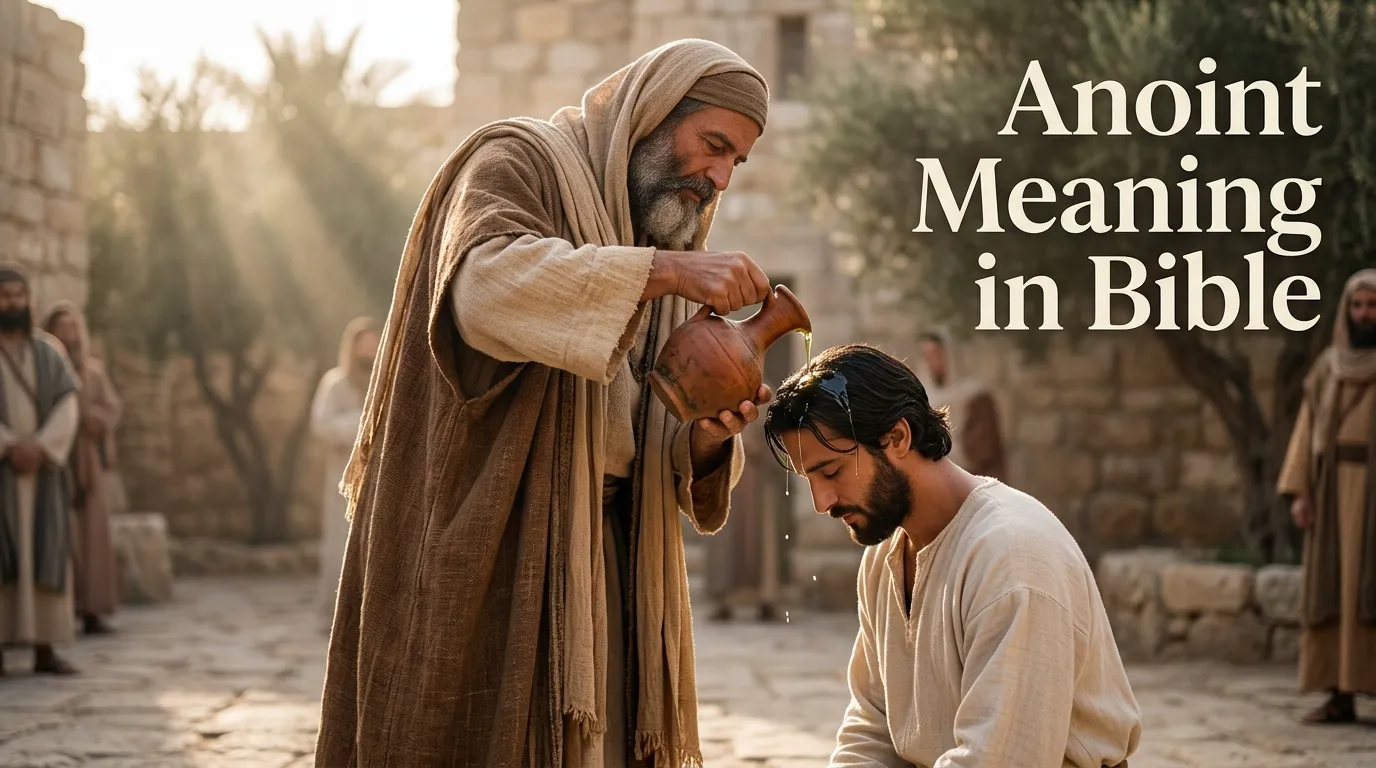
If you’ve ever wondered what anoint means in the Bible, here’s the short answer: to anoint means to pour or rub oil on a person or object as a sign of setting them apart for God’s purpose.
It’s a physical act with deep spiritual weight. In Scripture, anointing marked kings, priests, prophets, and even everyday objects used in worship.
This article walks through the full biblical meaning of anointing the Hebrew and Greek roots, the key passages, the spiritual significance, and how it applies to modern faith.
If you create Bible study materials, devotionals, or commentaries, you’ll also find practical guidance for explaining this concept accurately and clearly to your readers.
Quick Reference Table
| Aspect | Summary |
| Hebrew word | mashach (מָשַׁח) to smear or to rub with oil |
| Greek word | chrio (χρίω) to anoint or to consecrate |
| Related term | Messiah (Hebrew) and Christ (Greek) both mean Anointed One |
| Who was anointed | Kings, priests, prophets, sacred objects, and believers (spiritually) |
| Common oil used | Olive oil, sometimes mixed with spices |
| Main purpose | Setting apart for God’s service, marking divine calling |
| Key Old Testament example | David anointed king by Samuel (1 Samuel 16:13) |
| Key New Testament example | Jesus called the Christ the Anointed One |
Biblical Meaning
Anointing in the Bible is an act of consecration. When someone or something was anointed, it was set apart from ordinary use and dedicated to God’s purposes. This wasn’t a symbolic gesture without substance. In the ancient Near East, oil was valuable. Pouring it out signified honor, blessing, and a serious transfer of purpose.
Three main groups were anointed in the Old Testament: kings, priests, and prophets. Each anointing marked a person as chosen by God for a specific role. Objects were anointed too the tabernacle, the altar, and its furnishings were all consecrated with holy oil (Exodus 30:26-29).
By the time you reach the New Testament, the concept deepens. Jesus is called the Christ, which is simply the Greek translation of the Hebrew Messiah both mean Anointed One. Jesus fulfills and completes the Old Testament pattern of anointed kings, priests, and prophets in a single person.
Hebrew / Greek Meaning
The Hebrew word behind anoint is mashach (מָשַׁח), pronounced maw-SHAKH. It literally means to smear or rub with oil. From this root comes mashiach, meaning anointed one the word that becomes Messiah in English.
In the Greek New Testament, the word is chrio (χρίω), which carries the same idea of anointing or consecrating for a divine purpose. From chrio we get Christos, translated Christ. This is why Jesus Christ essentially means Jesus the Anointed One it’s not a last name, but a title declaring His role as Messiah.
There’s a second Greek word worth knowing: chrisma (χρίσμα), used in 1 John 2:20 and 2:27, referring to the anointing believers receive from the Holy Spirit. This word gives us the English term chrism, still used in some liturgical traditions today.
Biblical Context
Anointing appears throughout the Old and New Testaments, but its role shifts depending on the era.
In the time of the patriarchs, anointing was rare and personal. Jacob anointed a stone pillar at Bethel after his dream of the ladder to heaven (Genesis 28:18). This wasn’t about ordaining a leader it was marking a place as holy because God had met him there.
Once Israel became a nation with priests, kings, and a tabernacle, anointing became formal and ceremonial. God gave Moses a specific recipe for holy anointing oil (Exodus 30:22-25) and commanded that this oil never be duplicated for ordinary use (Exodus 30:32-33). This shows how seriously God treated the symbolism anointing wasn’t something to imitate casually.
Kingship anointing became especially significant starting with Saul, then David, then the ongoing line of Judah’s kings. Prophets like Samuel performed these anointings, showing that even kings answered to God’s authority as expressed through His prophets.
By the New Testament, formal ritual anointing of kings and priests fades from the narrative. Instead, the focus shifts to Jesus as the ultimate Anointed One, and later, to the Holy Spirit’s anointing of believers.
Key Bible Verses with Full Explanation
1 Samuel 16:13
Then Samuel took the horn of oil and anointed him in the midst of his brothers. And the Spirit of the Lord rushed upon David from that day forward.
Exodus 30:30
You shall anoint Aaron and his sons and consecrate them, that they may serve me as priests.
This verse establishes the priesthood’s anointing. Aaron and his sons were set apart for temple service, distinct from all other Israelites. The anointing here formalized their role as mediators between God and the people, a role that later finds its fulfillment in Christ as our great High Priest (Hebrews 4:14).
Luke 4:18
The Spirit of the Lord is upon me, because he has anointed me to proclaim good news to the people with low-income .
Jesus reads this from Isaiah 61 in the synagogue at Nazareth, then declares that this Scripture is fulfilled in Himself. He identifies His own ministry as an anointed one sent, empowered, and commissioned by God’s Spirit to preach, heal, and free the oppressed.
1 John 2:27
But the anointing that you received from him abides in you, and you have no need that anyone should teach you.
Here the language shifts from physical oil to spiritual reality. John tells believers they have an anointing from God understood as the indwelling Holy Spirit that teaches and guides them.
James 5:14
Is anyone among you sick? Let him call for the elders of the church, and let them pray over him, anointing him with oil in the name of the Lord.
Spiritual Meaning & Application
Beyond the historical ritual, anointing carries a spiritual principle still relevant today: God sets people apart and empowers them for His purposes. This doesn’t require literal oil. For most Christians, anointing today refers to the Holy Spirit’s presence and gifting in a believer’s life.
When someone says a preacher’s message was anointed, they usually mean it carried unusual spiritual power or clarity evidence that the Holy Spirit was at work, not just human skill. This popular usage traces directly back to the biblical pattern of anointing marking God’s empowering presence.
It’s worth being careful here. Scripture never promises that every believer will feel a dramatic sense of anointing at all times. The anointing John describes in 1 John 2:27 is the ongoing presence of the Holy Spirit in every true believer, not a special feeling reserved for a few.
Symbolism
Oil in the Bible consistently symbolizes several things: the Holy Spirit, joy, healing, and consecration. Anointing oil brings these ideas together into one physical act.
- Setting apart anointing marked a clear before-and-after moment of dedication to God
- Empowering presence anointing often accompanied the coming of God’s Spirit, as seen with David and with Jesus
- Healing and care oil had practical medicinal uses in the ancient world, adding a layer of compassion to anointing for the sick
- Joy and blessing Psalm 45:7 and Psalm 23:5 both connect anointing oil with gladness and abundance
Practical Application for Bible Book Creators & Authors
If you’re writing devotionals, Bible studies, or commentary material on this topic, a few things will strengthen your content’s accuracy and trustworthiness:
Distinguish literal from figurative anointing. Many readers confuse the Old Testament ritual with the New Testament spiritual reality. Clearly separate anointing with literal oil (kings, priests, the sick) from anointing by the Holy Spirit (believers today). This single clarification prevents a lot of theological confusion.
Avoid overstating anointing as a feeling. It’s tempting in devotional writing to describe anointing purely as an emotional or charismatic experience. Stay grounded in what Scripture actually says: anointing is about God’s Spirit and God’s calling, not primarily about goosebumps or excitement.
Use Messiah and Christ to reinforce meaning. Readers often don’t realize these titles literally mean Anointed One. Explaining this connection helps readers understand Jesus’s identity more deeply and adds real teaching value to your material.
Cite primary texts, not secondary claims. When discussing anointing oil recipes or ritual details, stick to Exodus 30 rather than repeating traditions not found in Scripture. This keeps your work trustworthy for careful readers, pastors, and reviewers.
Consider a sidebar or callout box in your book explaining the Hebrew word mashach and its connection to Messiah. Readers appreciate these language insights, and they add credibility to your work.
FAQs
What is the meaning of anointing?
Anointing is God’s divine blessing and empowerment for a specific purpose or calling.
What are the signs of an anointed person?
An anointed person often displays spiritual wisdom, godly character, faith, and a heart for serving God.
What is the spiritual meaning of anointing?
The spiritual meaning of anointing is God’s presence, favor, and power working through a believer.
What are the 7 manifestations of the anointing?
The anointing is commonly seen through wisdom, power, healing, boldness, guidance, peace, and spiritual growth.
What is the meaning of anointing in Hebrew?
In Hebrew, anointing comes from the word mashach, meaning “to smear or consecrate with oil.”
What are some examples of anointing in the Bible?
The Bible records the anointing of David, Saul, Aaron, Elisha, and Jesus for God’s purposes.
What is the power of anointing in the Bible?
The power of anointing equips believers to fulfill God’s will through His strength and guidance.
What is the purpose of anointing in the Bible?
The purpose of anointing is to set people apart for God’s service and empower them to accomplish His work.
Conclusion
Anointing in the Bible tells a bigger story than a single ritual. It moves from oil poured on kings and priests, to prophets calling out God’s chosen leaders, to Jesus Himself the Messiah, the Christ, the ultimate Anointed One and finally to every believer who carries the Holy Spirit within.
As Psalm 23:5 puts it, You anoint my head with oil; my cup overflows. That’s the heart of anointing: God’s generous, purposeful blessing poured out on His people.
For those of you writing and teaching on this topic, may your work reflect both the historical accuracy and the spiritual depth of this beautiful biblical theme giving your readers a clearer picture of how God has always set His people apart for His good purposes.
Discover More Post
- Number 6 Meaning in the Bible: Biblical Symbolism Explained
- Biblical Origin of the Name Israel: A Complete Bible Guide
- Biblical Meaning of Covenant: What It Really Means
- Biblical Meaning of Covetousness: A Complete Bible Guide