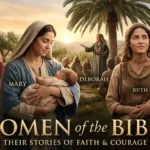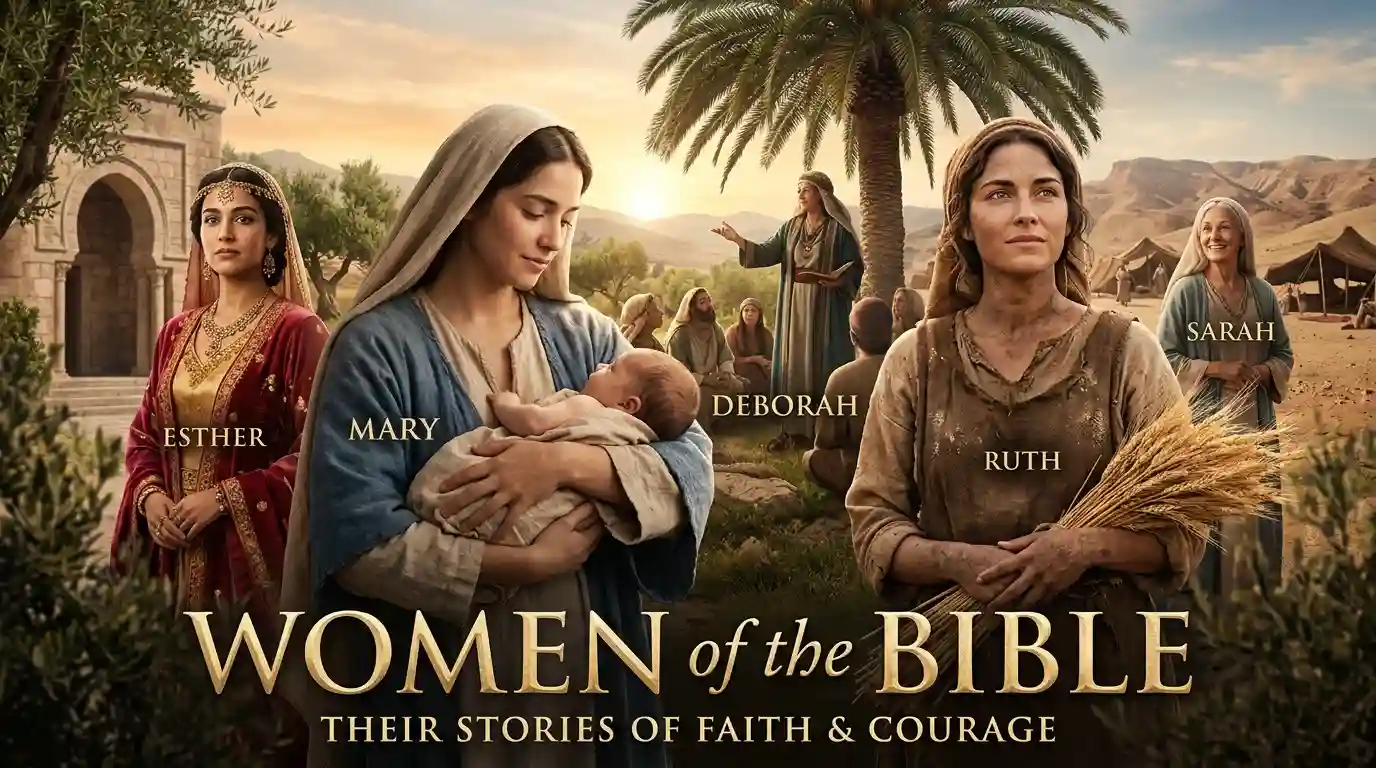
The women of the Bible were mothers, judges, prophets, queens, hosts, teachers, and the first witnesses of the risen Jesus.
Their stories are not side notes to a story about men. They are part of the main story of how God works in the world.
This guide lists the key women in order, shows where to read about each one, and draws out what they teach us. All quotes are from the King James Version.
Key Takeaways
- Made in God’s image: Men and women are both made in God’s image (Genesis 1:27).
- Leaders and prophets: Women such as Miriam, Deborah, and Huldah spoke and led for God (Exodus 15:20; Judges 4:4; 2 Kings 22:14).
- In the family line of Jesus: Tamar, Rahab, Ruth, and Bathsheba are named in his genealogy (Matthew 1:3-6).
- First witnesses: Women were the first to see the empty tomb and the risen Lord (John 20:11-18).
- Early church: Women hosted churches, taught, and served (Acts 16:14-15; Acts 18:26; Romans 16:1-2).
Quick List of Women in the Bible
| Name | Where to read | Known for |
|---|---|---|
| Eve | Genesis 2-4 | The first woman, called the mother of all living |
| Sarah | Genesis 11-23 | Waited for the son God promised her |
| Hagar | Genesis 16; 21 | Met God in the wilderness |
| Rebekah, Rachel, Leah | Genesis 24-35 | Mothers of the family God chose |
| Shiphrah and Puah | Exodus 1 | Midwives who refused Pharaoh’s order |
| Jochebed | Exodus 2 | Mother of Moses |
| Miriam | Exodus 15; Numbers 12 | Prophet and worship leader |
| Rahab | Joshua 2; 6 | Hid the spies and is named in Jesus’ family line |
| Deborah | Judges 4-5 | Judge and prophet who led Israel |
| Jael | Judges 4-5 | Defeated the enemy commander Sisera |
| Ruth and Naomi | Ruth 1-4 | Loyalty and redemption |
| Hannah | 1 Samuel 1-2 | Prayed for a son and gave him to God |
| Abigail | 1 Samuel 25 | Peacemaker who prevented bloodshed |
| Huldah | 2 Kings 22 | Prophet who confirmed the book of the law |
| Esther | Esther 1-10 | Queen who saved her people |
| Mary | Luke 1-2; John 19 | Mother of Jesus |
| Elizabeth | Luke 1 | Mother of John the Baptist |
| Anna | Luke 2 | Prophet who recognized the infant Jesus |
| Mary Magdalene | Luke 8; John 20 | First to see the risen Jesus |
| Martha and Mary of Bethany | Luke 10; John 11-12 | Friends and hosts of Jesus |
| The Samaritan woman | John 4 | Told her town about Jesus |
| Dorcas (Tabitha) | Acts 9 | Disciple known for good works |
| Lydia | Acts 16 | Early convert at Philippi who hosted the church |
| Priscilla | Acts 18; Romans 16 | Teacher and church host |
| Phoebe | Romans 16 | Servant (deacon) of the church in Cenchreae |
Why the Stories of Biblical Women Matter
The Bible opens with a statement about both sexes: “So God created man in his own image, in the image of God created he him; male and female created he them” (Genesis 1:27). The New Testament carries the same idea forward: “There is neither Jew nor Greek, there is neither bond nor free, there is neither male nor female: for ye are all one in Christ Jesus” (Galatians 3:28). Joel 2:28, quoted in Acts 2:17-18, promises that “your sons and your daughters shall prophesy.”
These stories also show faith as it really is. Sarah laughed and then trusted (Genesis 18:12-15; 21:1-7). Hannah wept and then sang (1 Samuel 1:10; 2:1). Ruth grieved and then stayed loyal (Ruth 1:16). Mary was troubled and then said yes (Luke 1:29, 1:38). They were real people who grew in trust, not flawless saints.
When is Jesus’ birthday month and day
Jesus’ exact birthday, including the month and day, is not mentioned in the Bible. Most Christians celebrate His birth on December 25, while some Eastern Christian communities celebrate Christmas on January 7. However, these dates represent traditional religious celebrations rather than confirmed historical birth dates. The Gospels describe Jesus’ birth in Bethlehem but do not provide a specific calendar date. Therefore, December 25 is the traditional celebration date, not a proven date of Jesus’ actual birth.
When is Jesus’ real birthday month
The real birth month of Jesus remains unknown because the Bible does not provide an exact date or month. December is widely recognized because Christians celebrate Christmas on December 25. However, some historical theories suggest that Jesus may have been born during spring or autumn. These suggestions are based on interpretations of biblical events and historical timelines, not confirmed records. Although different months have been proposed, there is no reliable evidence establishing one as His actual birth month.
When was Jesus born and died
Jesus was probably born between 6 and 4 BC, although historians cannot confirm His exact birth year. The Gospel accounts place His birth in Bethlehem during the reign of King Herod the Great. Jesus was later crucified in Jerusalem under the Roman governor Pontius Pilate, most likely around AD 30 or 33. Christians believe He rose from the dead three days after His crucifixion. His birth, death, and resurrection are central events of the Christian faith.
Jesus’ birth date September 11
September 11 is sometimes mentioned in discussions about the possible birth date of Jesus, but no reliable historical record confirms this date. The Bible describes His birth in Bethlehem without identifying a specific day or month. Different researchers have suggested alternative dates by examining biblical timelines, ancient calendars, and historical events. However, these calculations remain theories rather than established facts. December 25 is the traditional Christmas celebration date, while Jesus’ actual birthday remains unknown.
Jesus birthday April 17
April 17 is not a confirmed historical date for Jesus’ birth, although some alternative theories place His birth during the spring season. Early Christian writers discussed several possible dates, including dates in March, April, and May. These suggestions came from religious calculations and interpretations rather than direct historical records. The Bible does not identify Jesus’ exact birthday, so April 17 should not be presented as a proven date. Christians traditionally celebrate His birth on December 25.
Is Christmas Jesus’ birthday
Christmas is the traditional Christian celebration of Jesus Christ’s birth, observed by most Christians on December 25. However, this does not mean historians have confirmed that Jesus was born on that exact day. The Bible tells the story of His birth in Bethlehem but does not mention a specific date. Christians celebrate Christmas to remember God’s gift of Jesus, His love for humanity, and the hope of salvation. It is a celebration of His birth rather than a confirmed birthday anniversary.
Is Easter Jesus birthday
No, Easter is not Jesus’ birthday. It is the Christian celebration of His resurrection after His crucifixion and death. According to the New Testament, Jesus was buried and rose from the dead on the third day. Easter is one of the most important celebrations in Christianity because it represents victory over death, forgiveness, and everlasting hope. Christmas celebrates the birth of Jesus, while Easter remembers His resurrection. Both holidays have different meanings but are essential to Christian faith.
How many years ago was Jesus born
Jesus was likely born around 6 to 4 BC, meaning His birth happened approximately 2,029 to 2,031 years ago as of 2026. Historians estimate this period by examining ancient historical records and the account of King Herod in the Gospel of Matthew. Interestingly, the traditional calendar does not include a year zero, which affects calculations between BC and AD. Although the exact year remains uncertain, Jesus’ birth is generally placed more than two thousand years ago.
Women of the Bible book
Women of the Bible TV series
Women of the Bible PDF
Women of the Bible and their stories
Women of the Bible names
Women of the Bible on Fox
Women of the Bible movie
Women of the Bible Where to watch
Women of the Bible book
A Women of the Bible book explores the lives, faith, struggles, and experiences of women mentioned in Scripture. It often features inspiring stories of well-known figures such as Esther, Ruth, Mary, Deborah, Sarah, and Hannah. These books help readers understand how women played important roles in biblical history and God’s plans. Many editions include Bible verses, historical background, reflection questions, and practical lessons that encourage readers to strengthen their faith and apply biblical wisdom to everyday life.
Women of the Bible TV series
The Faithful: Women of the Bible is a 2026 biblical drama series that brings several important Old Testament women’s stories to television. It focuses on Sarah, Hagar, Rebekah, Leah, and Rachel, exploring their relationships, family struggles, difficult choices, and faith. The series presents familiar biblical events through the experiences of these women. Its dramatic storytelling helps viewers connect with their personal journeys while exploring the historical and spiritual themes found in Genesis.
Women of the Bible PDF
A Women of the Bible PDF can provide a convenient way to read biblical stories, study important female figures, and explore their spiritual lessons. Depending on the edition, readers may find character summaries, Scripture references, discussion questions, and devotional activities. Some resources are designed for individual Bible study, while others support church groups and classroom discussions. When choosing a PDF, look for a trustworthy edition that includes accurate biblical references and clear explanations rather than unsupported interpretations.
Women of the Bible and their stories
The Bible shares the stories of many women whose lives demonstrate courage, faith, wisdom, patience, and perseverance. Eve is remembered as the first woman, Sarah experienced God’s promise of motherhood, Ruth showed loyalty, and Esther demonstrated remarkable courage. Deborah served as a leader and judge, while Mary became the mother of Jesus. Their experiences include both victories and difficult moments. Together, these stories reveal how women contributed to biblical history and offer meaningful lessons about trusting God.
Women of the Bible names
Some well-known women of the Bible include Eve, Sarah, Hagar, Rebekah, Rachel, Leah, Miriam, Deborah, Ruth, Naomi, Hannah, Esther, Abigail, Mary, and Martha. Each woman has a different story and a unique place in Scripture. Some are remembered for their leadership, others for their faith, family relationships, or acts of courage. Exploring their names alongside their biblical stories can help readers understand their roles and discover meaningful lessons about faith, character, and God’s purpose.
Women of the Bible on Fox
The Faithful: Women of the Bible is a biblical drama series that premiered on FOX in March 2026. It follows five women from Genesis: Sarah, Hagar, Rebekah, Leah, and Rachel. The series features Minnie Driver as Sarah, Natacha Karam as Hagar, and Alexa Davalos as Rebekah. Through family relationships, motherhood, love, rivalry, and faith, the show explores the personal experiences behind these biblical figures. Its six episodes present their stories through dramatic television storytelling.
Women of the Bible movie
The Women of the Bible theme has inspired several television productions and biblical films that explore the lives of important female figures in Scripture. These productions often focus on characters such as Esther, Ruth, Mary, and Sarah, bringing their experiences to life through historical settings and dramatic storytelling. One notable 2026 production is The Faithful: Women of the Bible, which is a limited television series rather than a single movie. It explores five women’s stories from Genesis.
Women of the Bible Where to watch
Viewers interested in watching The Faithful: Women of the Bible can look for its episodes through available television and streaming services. The series originally premiered on FOX in March 2026, with episodes released across three weeks. It is also listed on Disney+ in supported regions. Availability may vary depending on your country, subscription, and local streaming rights. Checking the current catalog in your region is the best way to find out whether the complete series is available to watch.
Women in Genesis
Eve. Genesis 3:20 says, “And Adam called his wife’s name Eve; because she was the mother of all living.” Her story holds both failure and hope. She and Adam disobeyed God in Eden (Genesis 3:6), yet God promised that the offspring of the woman would defeat the serpent (Genesis 3:15). Christians see that promise fulfilled in Christ (Galatians 4:4).
Sarah. Sarah waited for years for the son God promised (Genesis 17:15-16). She laughed when she heard it (Genesis 18:12), and still Isaac was born when God said (Genesis 21:1-3). Hebrews 11:11 says she “judged him faithful who had promised.”
Hagar. Hagar, Sarah’s servant, fled into the wilderness, where God found her. She said, “Thou God seest me” (Genesis 16:13). Her story shows that God sees people others cast aside (Genesis 21:17-19).
Rebekah, Rachel, and Leah. These women appear in the family story that leads to Israel (Genesis 24; 29-35). Their lives include love, rivalry, grief, and hope, and the Bible does not hide any of it. God kept his promise through very human families.
Women in Exodus and the Conquest
Shiphrah and Puah. These Hebrew midwives disobeyed Pharaoh’s order to kill baby boys. Exodus 1:17 says, “But the midwives feared God, and did not as the king of Egypt commanded them, but saved the men children alive.”
Jochebed and Miriam. Jochebed hid her baby Moses and placed him in the river, and Miriam watched over him (Exodus 2:1-10). Hebrews 11:23 credits the faith of Moses’ parents. Years later, Exodus 15:20 says, “And Miriam the prophetess, the sister of Aaron, took a timbrel in her hand; and all the women went out after her with timbrels and with dances.” Miriam was not perfect, as Numbers 12:1-2 shows, but Micah 6:4 still lists her beside Moses and Aaron as a leader God sent.
Rahab. Rahab hid Israel’s spies in Jericho and asked for mercy for her family (Joshua 2:1-21; 6:25). She is honored in Hebrews 11:31 and James 2:25, and she appears in the family line of Jesus (Matthew 1:5).
The daughters of Zelophehad. These five sisters asked for their father’s inheritance, and God told Moses that they were right (Numbers 27:1-7). Their case shaped Israel’s law on inheritance.
Judges, Prophets, and Leaders
Judges 4:4 says, “And Deborah, a prophetess, the wife of Lappidoth, she judged Israel at that time.” Deborah settled disputes under a palm tree, called Barak to battle, and went with him (Judges 4:4-9). In her song she says she “arose a mother in Israel” (Judges 5:7). Jael ended the battle by defeating the commander Sisera (Judges 4:17-22), and Judges 5:24 blesses her.
Huldah was consulted when the book of the law was found in the temple. Her message led to King Josiah’s reform (2 Kings 22:14-20; 2 Chronicles 34:22-28).
Women prophets in the Bible
| Prophet | Where | What she did |
|---|---|---|
| Miriam | Exodus 15:20 | Led worship after the Red Sea |
| Deborah | Judges 4:4 | Judged Israel and gave God’s word |
| Huldah | 2 Kings 22:14 | Confirmed the book of the law for Josiah |
| Isaiah’s wife | Isaiah 8:3 | Called “the prophetess” |
| Anna | Luke 2:36-38 | Recognized the infant Jesus in the temple |
| Philip’s four daughters | Acts 21:9 | Prophesied in Caesarea |
Women of Faith in the Time of the Kings
Ruth and Naomi. Naomi lost her husband and sons and returned to Bethlehem in grief, saying, “Call me Mara” (Ruth 1:20). Ruth, a Moabite widow, would not leave her: “Intreat me not to leave thee… for whither thou goest, I will go; and where thou lodgest, I will lodge: thy people shall be my people, and thy God my God” (Ruth 1:16). Ruth married Boaz and became the great-grandmother of King David (Ruth 4:13-17).
Hannah. Hannah prayed for a son for years, and Eli first thought she was drunk (1 Samuel 1:10-16). When Samuel was born she kept her vow (1 Samuel 1:27-28) and sang a song of praise (1 Samuel 2:1-10). Mary’s song in Luke 1:46-55 echoes it.
Abigail. Abigail acted quickly with food and wise words to stop David from taking revenge on her husband’s household (1 Samuel 25:18-35).
The widow of Zarephath and the woman of Shunem. The widow shared her last food with Elijah and saw God provide (1 Kings 17:8-16). The Shunammite woman made a room for Elisha and later saw her son raised (2 Kings 4:8-37). Hebrews 11:35 refers to this when it says, “Women received their dead raised to life again.”
Esther. Esther, also called Hadassah, became queen of Persia (Esther 2:7, 2:17). When Haman plotted to destroy the Jews, her cousin Mordecai asked, “who knoweth whether thou art come to the kingdom for such a time as this?” (Esther 4:14). She asked the people to fast and said, “if I perish, I perish” (Esther 4:16). Her plea saved her people (Esther 7-9).
Women in the Family Line of Jesus
Matthew’s genealogy does something unusual by naming five women. Tamar (Matthew 1:3; Genesis 38), Rahab (Matthew 1:5), Ruth (Matthew 1:5), and Bathsheba, described as “her that had been the wife of Urias” (Matthew 1:6; 2 Samuel 11-12), appear before Mary (Matthew 1:16). Several of them were foreigners or had stories marked by hardship. Matthew’s list shows that God’s plan reached through people the world might have overlooked.
Women Around Jesus
Mary, the mother of Jesus. Mary answered the angel with, “Behold the handmaid of the Lord; be it unto me according to thy word” (Luke 1:38). She raised Jesus, stood near the cross (John 19:25), and was with the believers in prayer after his ascension (Acts 1:14).
Elizabeth and Anna. Elizabeth welcomed Mary with joy and blessing (Luke 1:41-45). Anna, a prophet who served in the temple, spoke about the child to everyone looking for redemption (Luke 2:36-38).
Mary Magdalene. Luke 8:2 says she was one “out of whom went seven devils.” Luke 8:1-3 also names Joanna, Susanna, and “many others, which ministered unto him of their substance,” so women helped fund his ministry.
Was Mary Magdalene a prostitute?
No Bible passage says so. The idea grew later when she was blended with the unnamed sinful woman of Luke 7:37-50 and with Mary of Bethany, and a sermon by Pope Gregory I in AD 591 helped spread it. Most scholars today, including Catholic scholars, reject that identification.
Others who met Jesus.
- Martha and Mary of Bethany hosted him, and Mary sat to learn from him (Luke 10:38-42). Martha spoke of her faith before Lazarus was raised (John 11:20-27).
- The Samaritan woman talked with Jesus at the well and then told her town (John 4:7-30, 4:39).
- The woman with the issue of blood touched his cloak, and he said, “Daughter, thy faith hath made thee whole; go in peace” (Mark 5:25-34).
- The Syrophoenician woman pleaded for her daughter, and Jesus said, “O woman, great is thy faith: be it unto thee even as thou wilt” (Matthew 15:21-28).
- The poor widow gave two small coins, and Jesus said she gave more than all the others (Mark 12:41-44).
The Women at the Cross and the Empty Tomb
Women stayed near the cross when most of the disciples had fled (Mark 15:40-41; John 19:25). They went to the tomb on the first day of the week (Matthew 28:1-10; Luke 24:1-10). John 20:16 tells the moment Mary Magdalene recognized Jesus when he said her name, and John 20:18 says she “came and told the disciples that she had seen the Lord.”
Luke 24:11 adds an honest detail: the apostles did not believe them at first, because “their words seemed to them as idle tales.” The Gospels record the women as the first witnesses even though that was unlikely to impress readers at the time.
Women in the Early Church
| Woman | Where | Role |
|---|---|---|
| Dorcas (Tabitha) | Acts 9:36-42 | A disciple “full of good works,” raised by Peter |
| Mary, mother of John Mark | Acts 12:12 | Opened her home for prayer |
| Lydia | Acts 16:14-15 | Her heart “the Lord opened”; hosted Paul’s team |
| Priscilla | Acts 18:26; Romans 16:3-4 | Taught Apollos with Aquila and hosted a church |
| Philip’s daughters | Acts 21:9 | Prophesied |
| Phoebe | Romans 16:1-2 | Servant of the church in Cenchreae and helper of many |
| Junia | Romans 16:7 | Greeted by Paul with Andronicus as “of note among the apostles” |
| Tryphena and Tryphosa | Romans 16:12 | Praised for working hard in the Lord |
| Euodia and Syntyche | Philippians 4:2-3 | Co-workers with Paul in the gospel |
| Lois and Eunice | 2 Timothy 1:5 | Passed faith to Timothy |
Romans 16:1 calls Phoebe “a servant of the church which is at Cenchrea.” The Greek word is diakonos, which some translations render as “deacon.” Scholars also debate whether Romans 16:7 means that Andronicus and Junia were apostles or that the apostles held them in high regard.
Did Women Lead in the Early Church?
The New Testament shows women prophesying (Acts 21:9; 1 Corinthians 11:5), teaching (Acts 18:26), hosting churches (Colossians 4:15), and serving (Romans 16:1-2). Christians still differ on what this means for church leadership today.
Some churches point to passages like 1 Timothy 2:12 and 1 Corinthians 14:34-35 and teach that certain teaching or leadership roles are reserved for men. Others point to Galatians 3:28 and to women like Deborah, Priscilla, and Phoebe and teach that women may serve in all roles. Both groups agree that the Bible records women playing real and valued roles in the story of redemption.
Not Every Woman in the Bible Is a Model
The Bible records bad examples too. Jezebel promoted idol worship and the murder of Naboth (1 Kings 16:31-33; 21:1-25), and Athaliah seized the throne by killing her own descendants (2 Kings 11:1-3). Delilah betrayed Samson (Judges 16). Even the faithful women had flaws, as Sarah’s laughter (Genesis 18:12) and Miriam’s complaint (Numbers 12:1-2) show. Scripture is honest about people, which is part of why it can be trusted.
What About the Proverbs 31 Woman?
Proverbs 31:10-31 is a poem describing wisdom and strength in action. It begins, “Who can find a virtuous woman? for her price is far above rubies” (Proverbs 31:10), and it ends, “Favour is deceitful, and beauty is vain: but a woman that feareth the LORD, she shall be praised” (Proverbs 31:30). The Hebrew word for “virtuous” here, chayil, means strength or valor. Boaz uses it of Ruth in Ruth 3:11. The poem is best read as a portrait of wise, courageous character, not a checklist.
Lessons the Women of the Bible Teach Today
| Lesson | Examples | Scripture |
|---|---|---|
| Courage | Esther, Deborah, Shiphrah and Puah | Esther 4:14-16; Judges 4:4-9; Exodus 1:17 |
| Prayer | Hannah, Mary, Anna | 1 Samuel 1:10; Luke 1:46-55; Luke 2:37 |
| Loyalty | Ruth, Naomi | Ruth 1:16 |
| Wisdom | Abigail, Huldah | 1 Samuel 25:32-33; 2 Kings 22:14-20 |
| Witness | Mary Magdalene, the Samaritan woman | John 20:18; John 4:39 |
| Hospitality | Lydia, Martha, Priscilla | Acts 16:15; Luke 10:38; Acts 18:26 |
| Welcome for outsiders | Rahab, Ruth, Hagar | Joshua 6:25; Ruth 4:13; Genesis 16:13 |
Bible Verses About Women
| Verse | What it says |
|---|---|
| Genesis 1:27 | “male and female created he them” |
| Judges 5:7 | “until that I Deborah arose, that I arose a mother in Israel” |
| Ruth 1:16 | “thy people shall be my people, and thy God my God” |
| Proverbs 31:30 | “a woman that feareth the LORD, she shall be praised” |
| Esther 4:14 | “for such a time as this” |
| Luke 1:38 | “Behold the handmaid of the Lord; be it unto me according to thy word” |
| John 20:18 | “Mary Magdalene came and told the disciples that she had seen the Lord” |
| Romans 16:1 | “I commend unto you Phebe our sister, which is a servant of the church” |
| Galatians 3:28 | “there is neither male nor female: for ye are all one in Christ Jesus” |
Frequently Asked Questions
Who are the most important women in the Bible?
Common answers include Eve, Sarah, Miriam, Deborah, Ruth, Hannah, Esther, Mary the mother of Jesus, and Mary Magdalene. The Bible names many more, and each one adds something to the story.
Which books of the Bible are named after women?
Ruth and Esther. Catholic and Orthodox Bibles also include Judith. No New Testament book is named after a woman, although women appear throughout it.
Who was the first woman in the Bible?
Eve (Genesis 2:21-22; 3:20).
Who was the first person to see Jesus after the resurrection?
John 20:11-18 says it was Mary Magdalene. Matthew 28:9 also records Jesus meeting the women on their way from the tomb.
Was Mary Magdalene a prostitute?
No. Luke 8:2 says seven demons had gone out of her, and no Bible text calls her a prostitute. That idea came from later tradition.
Who were the female prophets in the Bible?
Miriam (Exodus 15:20), Deborah (Judges 4:4), Huldah (2 Kings 22:14), Isaiah’s wife (Isaiah 8:3), Anna (Luke 2:36), and the four daughters of Philip (Acts 21:9).
Were there women disciples of Jesus?
Luke 8:1-3 names women who traveled with Jesus and supported his ministry, including Mary Magdalene, Joanna, and Susanna. Mary of Bethany sat “at Jesus’ feet” to learn (Luke 10:39), which was the place of a student.
Did women lead in the early church?
Women hosted churches, prophesied, taught, and served (Acts 16:14-15; Acts 18:26; Acts 21:9; Romans 16:1-2). Churches differ today on which leadership roles women may hold.
What can women today learn from women of the Bible?
Courage from Esther, prayer from Hannah, loyalty from Ruth, wisdom from Abigail, and bold witness from Mary Magdalene. The lessons apply to anyone, since these stories show how God works through ordinary people.
Conclusion
From Eve in Genesis to the hosts and teachers of the early church, women stand at the heart of the Bible story. They led as judges and prophets, saved a people as a queen, prayed through years of waiting, and were the first to carry the news of the resurrection (John 20:18). Their stories are honest about weakness and clear about God’s faithfulness.
Discover More Post
- The Armor of God: Meaning of Each Piece in Ephesians 6
- When Is Jesus’ Birthday? December 25, the Bible, and What History Shows
- Motivational Bible Verses: Scriptures for Strength, Courage and Hope
- Jesus Wept (John 11:35): Meaning, Story, and Hope for Grief