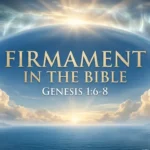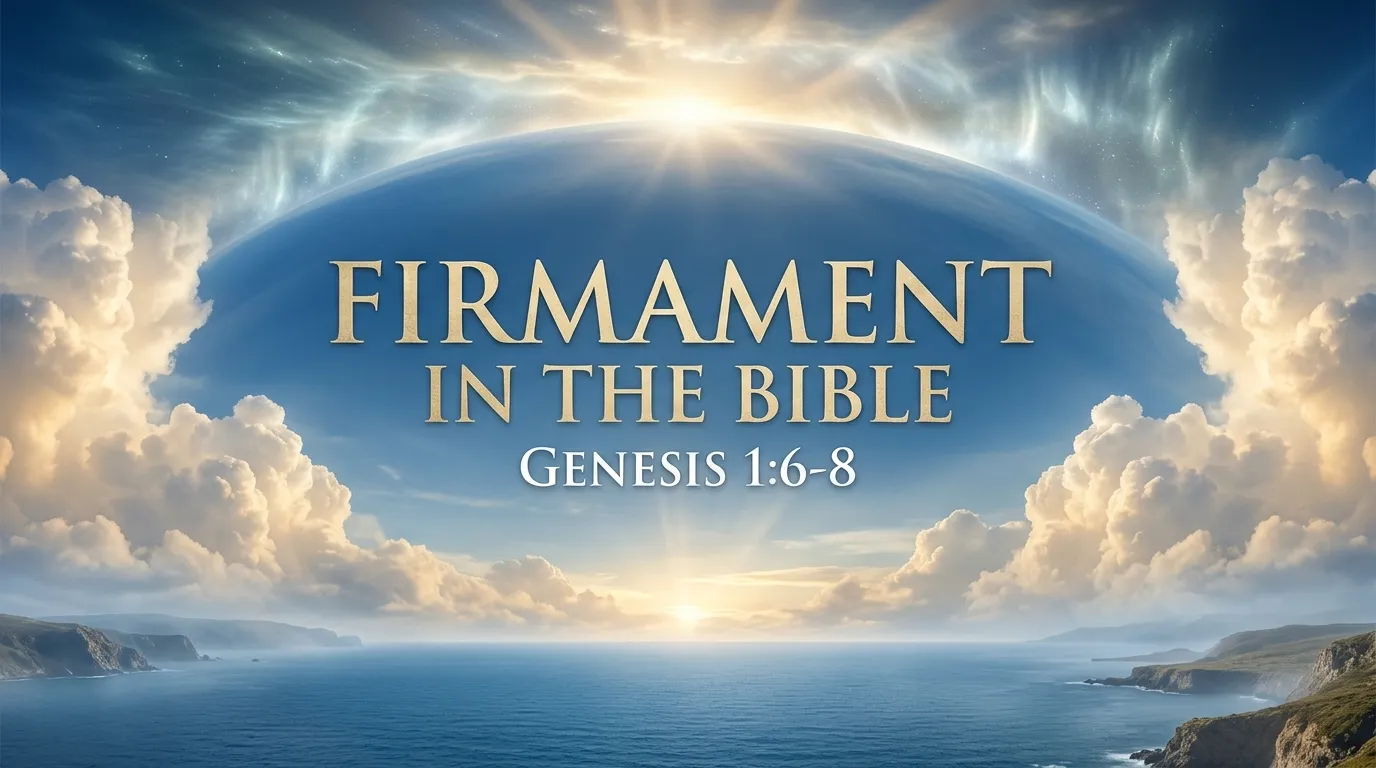
Firmament is an old Bible word for the sky God made on day two. It splits waters below from waters above, and God called that sky heaven.
The Hebrew word is raqia, which pictures a thing spread out wide. In new Bibles the same word is rendered as expanse, vault, or sky.
Many readers meet firmament first in Genesis 1, in the King James Version. Modern versions use expanse, since that word fits the Hebrew sense more plainly.
The shift in words can confuse readers, who ask if the meaning changed too. This guide traces the word, its uses, and its lessons, with fairness and care.
What Does Firmament Mean
Raqia comes from a Hebrew root that means to spread out, beat out, or stretch. It pictures a thin sheet spread wide, like metal hammered flat in old craft. In Genesis, God spreads the sky out, to divide waters and give order to chaos. The word thus holds both space and firmness, in one vivid picture of creation.
Greek translators rendered raqia as stereoma, a firm and solid thing in Greek terms. Latin translators used firmamentum, from which our English firmament comes in time. King James kept firmament, which gave the word a long life in English Bibles. Modern translators chose expanse, to stress open space, not a hard shell in sky.
The Firmament in Genesis 1
On day two, God said let there be a firmament, to divide waters from waters. God made the firmament, called it heaven, and evening and morning marked day two. That act brings order: waters below stay seas, while waters above stay aloft in sky. The sky thus becomes a roof, a space, and a home for life to come.
Genesis 1:6-8 – And God said, Let there be a firmament in the midst of the waters, and let it divide the waters from the waters. And God made the firmament, and divided the waters which were under the firmament from the waters which were above the firmament: and it was so. And God called the firmament Heaven. And the evening and the morning were the second day.
On day four, God set sun, moon, and stars in the firmament, for light and time. Lights mark days, seasons, and years, and they serve as signs, not gods to worship. On day five, birds fly in the open firmament, in the sky above the earth. Together, days two, four, and five show the sky as ordered space for life.
Waters Above the Firmament: What Did It Mean
Waters above the firmament puzzle readers, since the sky today holds rain, not a sea. Four views seek to explain the phrase, and none is proven as a sole fact. One view holds that waters above mean clouds, rain, and vapor in the sky. A second view holds that they mean a sea above, in an old world picture.
A third view holds that waters above are poetic, for God’s power over chaos and flood. A fourth view holds that they mean a past vapor canopy, now gone after the flood. Each view reads Genesis with care, yet each faces gaps in text and science alike. Wise readers hold the main lesson firm, while they weigh views with humility and grace.
The main lesson is order: God speaks, chaos yields, and life finds a safe place. Waters, in the Bible, often stand for chaos, danger, and death without form. God divides them, sets bounds, and makes room for land, light, and living things. That order, not a weather chart, is the heart of the Genesis account for faith.
Is the Firmament a Solid Dome
Some readers ask if the Bible teaches a solid dome over a flat earth in sky. The solid dome view reads raqia as a hard shell, like a bowl over the earth. Ancient peoples did picture the sky as a dome, with stars fixed in its arch. That picture may sit behind the words, yet the text does not teach earth shape as doctrine.
The expanse view reads raqia as open sky, spread out, not a hard shell at all. Birds fly in it, stars shine in it, and rain falls through it, as open space. The picture language view reads dome words as poetry, for God’s majesty and order. All three views agree on the core: God made the sky, ordered it, and rules it still.
Fair reading states each view, its best point, and its limit, without scorn or fear. A dome view must face birds and rain, which move through open sky with ease. An expanse view must face the firm root of raqia, which hints at solid form. A poetry view must face that Genesis also claims real acts of God in time.
The Firmament Elsewhere in the Bible
Psalms use firmament for worship, since the sky shows God’s glory without words. Psalm 19 says the heavens declare glory, and the firmament shows his handiwork plain. Psalm 150 calls us to praise God in the firmament of his power and might. Sky thus becomes a vast hall for praise, where all creation joins in song.
Ezekiel sees an expanse like crystal above living creatures, with a throne above it. That vision links sky, glory, and God’s rule, in a scene of awe and fear. Daniel says the wise shine like the brightness of the firmament, for all time. Faithful lives thus reflect God’s light, as stars shine in the night sky for all.
Firmament in the Bible Genesis Verse
The word firmament first appears in Genesis 1:6–8. In this passage, God commands a space to form between the waters and calls it Heaven. On the second day of creation, God separates the waters above from the waters below. This part of Genesis shows how God brings order to creation. The firmament is often understood as the sky or expanse above the earth. It helps readers understand the Bible’s account of creation.
What Is a Firmament
A firmament is the expanse that God made on the second day of creation, as described in Genesis 1. In simple words, it refers to the sky or the space above the earth. The King James Bible uses the word firmament, while many modern translations use expanse. In the Bible, it has a special role in the creation story. It shows God’s power and how He brought order to the world.
Firmament in the Bible KJV
In the King James Version (KJV), the word firmament appears in several passages, mainly in Genesis, Psalms, Ezekiel, and Daniel. Genesis 1:6 describes God’s command to create a firmament in the middle of the waters. Genesis 1:8 says God called the firmament Heaven. Other verses use it to show God’s glory and power. For example, Psalm 19:1 says the firmament shows His handiwork. These verses connect creation with praise for God.
What Happened to the Firmament in the Bible
The Bible does not say that the firmament disappeared or was destroyed. In Genesis, God creates it as part of the world and gives it a place in His design. Later passages still speak of the firmament when describing the heavens and God’s glory. Some readers understand it as the sky, while others study its meaning in the ancient view of the world. The main message remains that God created the heavens and everything within His design.
How Many Times Is Firmament Mentioned in the Bible
In the King James Version, the word firmament appears 17 times across the Old Testament. Most of these references are found in Genesis, Psalms, Ezekiel, and Daniel. The exact count can vary between Bible translations because some versions use words like expanse or sky instead. If you are studying this word, use one Bible translation for your search. This will help you find each mention and understand how the word is used in different passages.
Firmament in the Bible Pronounce
The word firmament is pronounced with four syllables, with the main stress on the first syllable. It sounds like a word that may be new to many modern readers, but its meaning is closely linked to the sky or heavens in the Bible. You may come across it while reading Genesis 1 or Psalm 19. Learning its pronunciation can make Bible reading easier and help you feel more confident when discussing Scripture with others.
Firmament in the Bible Catholic
In Catholic Bible teaching, the firmament is part of the creation story in Genesis 1:6–8. God creates an expanse to separate the waters, then calls it Heaven. Catholic readers may use translations that say sky or expanse instead of firmament. The passage teaches that the world is created by God and has order and purpose. It also invites readers to reflect on the beauty of creation and give thanks to its Creator.
Firmament in the Bible in Spanish
In Spanish Bibles, the word firmament is commonly translated as firmamento. In Genesis 1:6–8, this word describes the expanse God creates to separate the waters. Some Spanish translations may use wording that explains the sky or heavens more clearly. For example, the Reina-Valera Bible uses expansión in Genesis 1. Both terms help readers understand the creation story. The passage shows God’s power and the order He gives to the world.
How Modern Readers Should Read Firmament Passages
Read firmament passages first for their main claim: God made, ordered, and rules the sky. Ask what the passage meant first, in its old world, tongue, and genre of text. Ask what it means now, for worship, trust, and care for creation in our day. Do not force old sky words to answer new science questions they did not pose.
| Passage | What it says about the firmament | Main lesson for readers |
| Genesis 1:6-8 | God made an expanse to separate waters, and called it heaven | God brings order out of watery chaos by his word |
| Genesis 1:14-17 | Sun, moon, and stars are set in the expanse | Lights are created tools for time and light, not gods to worship |
| Genesis 1:20 | Birds fly in the open expanse of heaven | The expanse is open space for life, not only a barrier |
| Psalm 19:1 | The firmament shows God’s handiwork | Creation itself preaches God’s glory without words |
| Psalm 150:1 | Praise God in the firmament of his power | The sky is a vast sanctuary for worship |
| Ezekiel 1:22-26 | An expanse like crystal above living creatures, with a throne above | God’s majesty is above all creation, yet he speaks to his people |
| Daniel 12:3 | The wise shine like the brightness of the firmament | Faithful lives reflect God’s light forever |
Science and faith need not clash here, if each is kept in its own proper lane. Science maps how the sky works, with air, clouds, rain, and stars in space. Genesis tells who made the sky, why order matters, and how we should respond. Both can be true in their lanes, without one erasing the other in haste.
| Translation choice | How it renders raqia | What a reader should notice |
| King James Version | Firmament | Historic word, carries a sense of firmness from Latin |
| New King James Version | Firmament | Keeps the historic word with modern grammar |
| New International Version | Vault, expanse, or sky, depending on passage | Aims for natural modern English in each context |
| English Standard Version | Expanse | Keeps the idea of something spread out |
| New Living Translation | Space or sky | Very readable, stresses the open sky picture |
Translation choice matters, since firmament, vault, and expanse each stress a distinct shade. Firmament stresses firmness and old roots, with Latin and King James weight. Expanse stresses open space, with a modern and plain sense for readers today. Vault stresses an arch, with a dome hint, in some passages and versions alike.
FAQ
What is the firmament in the Bible in simple terms
Firmament means the sky God made on day two, to divide waters and give order. It is the open space above earth, where sun, moon, stars, and birds appear. Old versions call it firmament, while new versions call it expanse, vault, or sky. The core sense is ordered sky, made by God’s word, for life and light.
What is the Hebrew word for firmament
The Hebrew word is raqia, from a root that means to spread out or stretch. It pictures a sheet spread wide, like metal hammered flat in old craft. Greek used stereoma, Latin used firmamentum, and English kept firmament from Latin. Modern English uses expanse, to stress open space in the sky for life.
Is the firmament a solid dome over a flat earth
The Bible does not teach a solid dome or flat earth as a doctrine of faith. Some old pictures used dome words, yet Genesis claims God made and ordered sky. Birds, rain, and stars move in open space, which fits an expanse view well. Read dome words as old pictures or poetry, not as a science text on shape.
What are the waters above the firmament
Waters above may mean clouds and rain, a sea above, poetry for chaos, or a past canopy. No view is proven as a sole fact, and each faces gaps in text and science. The main point is order: God divides waters, sets bounds, and makes room for life. Hold that lesson firm, and weigh the four views with humility and care.
Where does the firmament appear in the Bible
Firmament appears first in Genesis 1, on days two, four, and five, for sky and lights. It appears in Psalms, for praise, and in Ezekiel, for glory above living creatures. It appears in Daniel, for wise lives that shine like stars in the sky. Each use links sky with God’s glory, order, and hope for his people.
Why do modern Bibles not use the word firmament as much
Modern Bibles use expanse, vault, or sky, since those words fit raqia more plainly. Firmament carries a Latin sense of firmness, which can hint at a hard shell. Expanse stresses open space, which fits birds, stars, and rain in the text. The meaning stays the same, while the word choice grows clearer for new readers.
Does believing in the firmament conflict with modern astronomy
Belief in the firmament need not clash with modern astronomy, if lanes are kept clear. Astronomy maps how sky works, with air, clouds, stars, and space in view. Genesis tells who made sky, why order matters, and how we should respond in faith. Both can stand, since one gives mechanism, and the other gives meaning and hope.
Conclusion
Firmament means the sky God spread out on day two, to divide waters and give order. Raqia moved through Greek, Latin, and King James, to expanse in modern Bibles today. Days two, four, and five show sky as space for lights, birds, and life in full. Psalms, Ezekiel, and Daniel use sky for praise, glory, and hope that shines bright.
Read these passages for God’s order, power, and care, not as a science chart alone. Weigh dome, expanse, and poetry views with fairness, humility, and grace in full. Let the sky preach glory each day, and let wise lives shine like stars at night. May the firmament remind you that God made, ordered, and rules all things well.
Discover More Post
- Seek First the Kingdom of God: Meaning, Context, and Daily Life
- With God All Things Are Possible: Meaning of Matthew 19:26
- How Many Books Are in the Bible? 66, 73, 81, and Why the Number Changes
- Ethiopian Bible in English: Books, History and How to Read It

Hi, I’m James Patterson, a storyteller who loves creating thrilling mysteries, unforgettable characters, and page-turning adventures. Through TheBiblimeaning, I share insights about authors, books, literary meanings, biographies, and the stories behind famous writers. My goal is to help readers discover the deeper world of literature while enjoying engaging and informative content.