The Ethiopian Bible is the Scripture of the Ethiopian Orthodox Tewahedo Church, which also shares its canon with the Eritrean Orthodox Tewahedo Church.
Its narrower canon has 81 books, and a broader list can reach about 88 or more, depending on how texts are counted.
For comparison, Protestant Bibles have 66 books and Catholic Bibles have 73.
The Ethiopian canon includes the whole Hebrew Old Testament and the 27 books of the New Testament, plus additional writings such as 1 Enoch, Jubilees and the books of Meqabyan.
Quick Facts About the Ethiopian Bible
- Church: Ethiopian Orthodox Tewahedo Church (and the Eritrean Orthodox Tewahedo Church).
- Main languages: Ge’ez (the ancient church language) and Amharic (the everyday language).
- Narrower canon: 81 books.
- Broader canon: up to about 88 books, depending on how church-order texts are counted.
- Books found in this canon but not in Protestant, Catholic or most Orthodox Bibles: 1 Enoch, Jubilees, the three books of Meqabyan, and 4 Baruch (the Paralipomena of Jeremiah).
- English edition: no single official complete edition, so check each one carefully.
Ethiopia in the Bible
Ethiopia (called Cush in Hebrew) appears often in Scripture. Psalm 68:31 says, “Princes shall come out of Egypt; Ethiopia shall soon stretch out her hands unto God.” Zephaniah 3:10 speaks of worshippers “from beyond the rivers of Ethiopia”. Jeremiah 38:7-13 tells how an Ethiopian official named Ebed-melech rescued the prophet Jeremiah.
The New Testament records an Ethiopian official who came to faith: “a man of Ethiopia, an eunuch of great authority under Candace queen of the Ethiopians, who had the charge of all her treasure, and had come to Jerusalem for to worship” (Acts 8:27). He was reading the prophet Isaiah, Philip explained the Scripture to him, and he was baptized (Acts 8:28-38). The Ethiopian church connects its own early story with this passage, and it also shows how long Ethiopia’s link with the Scriptures has been.
What Is the Ethiopian Bible?
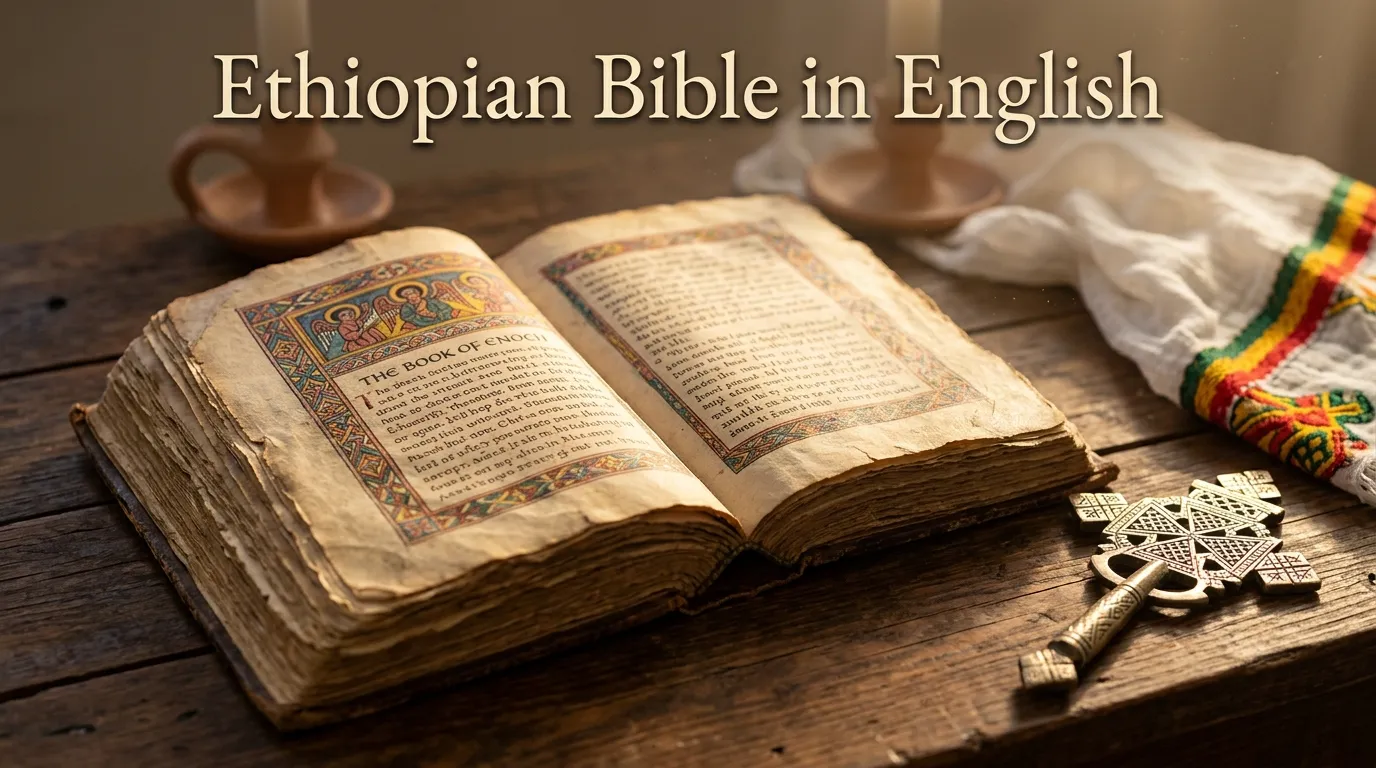
The Ethiopian Bible is not a different religion’s book. It is the Christian Bible as received, copied and used by one of the oldest Christian churches. The church belongs to the family of Oriental Orthodox churches, and its Scripture has been preserved mostly in Ge’ez, the church’s classical language, with Amharic used for preaching and daily life.
Many languages and nations are part of God’s plan for His word. On the day of Pentecost, people said, “we hear them speak in our tongues the wonderful works of God” (Acts 2:11), and John saw worshippers “of all nations, and kindreds, and people, and tongues” (Revelation 7:9). The Ethiopian Bible is one witness to this long history of Scripture in many tongues.
A Tradition of Careful Copying
For centuries, monks and scribes copied these books by hand, often in beautifully illustrated manuscripts. The Bible itself values careful copying of Scripture. Kings of Israel were told to keep a copy of the law and “read therein all the days of his life” (Deuteronomy 17:18-19), and Ezra “was a ready scribe in the law of Moses” (Ezra 7:6). Among the oldest surviving Ethiopian manuscripts are the Garima Gospels, illuminated Gospel books that scholars date to roughly the fifth to seventh centuries.
How Many Books Are in the Ethiopian Bible: 81 or 88?
This is the most searched question, and the short answer is that it depends on how books are counted.
- The narrower canon: 81 books. This is the figure most often given as the church’s standard list. Many lists divide it as 46 Old Testament and 35 New Testament books, where the New Testament total includes church-order texts alongside the 27 books known to all Christians. Other lists describe the same canon a little differently, so you may see different splits.
- The broader canon: about 88 books. This larger number comes from adding or separately counting further church-order and historical texts, such as the Sinodos, the Books of the Covenant, Ethiopic Clement, the Didascalia and Josippon. Sources do not all agree on the exact number or on which texts to count.
So “88 books” is not a separate Bible. It is a larger way of counting. Many printed “88-book” editions also use different lists, which is why it is important to read the contents page before buying.
Compared With Other Bibles
- Protestant Bible: 66 books (39 Old Testament, 27 New Testament).
- Catholic Bible: 73 books (46 Old Testament, 27 New Testament).
- Ethiopian Orthodox narrower canon: 81 books.
- Ethiopian Orthodox broader canon: up to about 88 books.
The Ethiopian Old Testament includes the entire Hebrew Old Testament, and most of the books that Catholic Bibles call deuterocanonical (such as Tobit, Judith, Wisdom, Sirach and Baruch), though it does not include 1 and 2 Maccabees as Catholic Bibles have them. It then adds its own additional books.
Why Does the Ethiopian Bible Have More Books?
The lists of the Bible differ between churches because the church recognized its Scriptures over time, in different places and languages. Jesus spoke of “the law of Moses, and in the prophets, and in the psalms” (Luke 24:44), and Paul said that “unto them were committed the oracles of God” (Romans 3:2). Paul also wrote that “All scripture is given by inspiration of God, and is profitable for doctrine, for reproof, for correction, for instruction in righteousness” (2 Timothy 3:16). But the New Testament does not give a full list of every book that belongs in the Bible, so churches formed their lists through use, teaching and councils over time.
The Ethiopian church received its Scriptures through Ge’ez translations and kept some books in use that other churches later set aside. It is more accurate to say that this church continued to read and preserve certain writings than that it added books to the Bible. Scholars still debate details such as when each book was translated and when the lists were fixed.
What About Deuteronomy 4:2 and Revelation 22:18-19?
Some readers cite “Ye shall not add unto the word which I command you” (Deuteronomy 4:2) and Revelation 22:18-19 against any extra books. These verses warn against changing the words of that particular message. They do not give a list of canon books, so the question of which books belong in the canon is decided on historical and church grounds. Christians disagree about it, and it is fair to say so.
The Unusual Books of the Ethiopian Canon
1 Enoch
Enoch is a man in Genesis who “walked with God: and he was not; for God took him” (Genesis 5:24; see also Hebrews 11:5). The book of 1 Enoch is a collection of visions of angels, judgment and the end of the world, which expands on the story in Genesis 6:1-4. It survives completely only in Ge’ez, which is why Ethiopian manuscripts are so important to scholars.
The New Testament refers to a prophecy of Enoch: “And Enoch also, the seventh from Adam, prophesied of these, saying, Behold, the Lord cometh with ten thousands of his saints, to execute judgment upon all” (Jude 14-15). This saying is found in 1 Enoch. Jude’s quote shows that early Christians knew the book, but it does not prove that the whole book is Scripture. Paul also quotes pagan poets (Acts 17:28; Titus 1:12) without calling their works Scripture.
Jubilees
Jubilees retells the story from Genesis to early Exodus, divided into periods of jubilees. The jubilee idea comes from the law: “thou shalt number seven sabbaths of years unto thee, seven times seven years” (Leviticus 25:8). In Jubilees, an angel gives Moses the history on the mountain (compare Exodus 24:12-18). It gives special attention to the Sabbath (Exodus 20:8-11), the covenant and the calendar.
The Books of Meqabyan
There are three Ethiopian books of Meqabyan. They are not the same as the books of Maccabees in Catholic and Orthodox Bibles. They tell of faithfulness and suffering for God, themes seen elsewhere in Scripture (Daniel 3:16-18; Hebrews 11:35-38).
4 Baruch (Paralipomena of Jeremiah)
This writing continues the story of Jeremiah’s secretary Baruch (compare Jeremiah 36) and the exile in Babylon.
Church-Order Texts
The broader canon includes writings on church life and order, such as the Sinodos, the Books of the Covenant, Ethiopic Clement and the Didascalia. Other churches do not count these as Scripture. In the Ethiopian church they teach about worship, the clergy and daily Christian life.
Is the Ethiopian Bible the Oldest or the Most Complete Bible?
Some sellers use phrases like “original uncut Bible” or “the only complete Bible”. These claims are misleading.
- It is not the “original” Bible. It is the canon of one ancient church. Other ancient churches (Coptic, Syriac, Armenian, Greek, Latin) also preserved old Bibles with their own lists.
- It is the largest traditional canon. That is a fair statement, but being larger does not by itself mean being more correct. Christians use different lists.
- Old manuscripts do not make a whole canon older. The Garima Gospels are very old, but that is a statement about those manuscripts, not about the age of every book in the canon.
The Bereans are praised because they “searched the scriptures daily, whether those things were so” (Acts 17:11), and Paul says, “Prove all things; hold fast that which is good” (1 Thessalonians 5:21). Checking claims is a good Christian habit.
Ge’ez, Amharic and English: How Translation Works
The Ethiopian Scriptures were translated into Ge’ez, probably from Greek (and in some cases other sources), and copied for centuries. Amharic Bibles were later produced for everyday reading. English translations must therefore deal with several layers: Ge’ez manuscripts, Greek and Hebrew sources, and differences between manuscripts.
Good translation involves explaining the text, as Ezra’s helpers did: “So they read in the book in the law of God distinctly, and gave the sense, and caused them to understand the reading” (Nehemiah 8:8). For difficult books such as Enoch and Jubilees, notes matter as much as the translation.
Where to Read the Ethiopian Bible in English
There are three main kinds of English resources.
1. Free Online Resources
Some online platforms present the Ethiopian Orthodox Bible with Ge’ez, Amharic and English text, and you can read the Ethiopian Orthodox Tewahedo Church’s list of books on them. Early twentieth-century English translations of 1 Enoch and Jubilees by R. H. Charles are in the public domain and widely available. They are old translations, so they may use older language and scholarship.
2. Scholarly Editions
University and academic publishers produce translations of 1 Enoch and Jubilees from Ge’ez, with long introductions and notes. These are best for study. Libraries often have them.
3. Commercial “Complete Ethiopian Bible” Editions
Many books and e-books advertise an “88-book Ethiopian Bible in English”. Some may be useful, but quality varies, and some marketing claims (for example “the only authentic translation”) cannot be checked. If you buy one, use the checklist below.
How to Choose a Good English Edition: A 6-Point Checklist
- Is the list of books shown? A good edition lists every book and says whether it follows the 81-book or broader list.
- Who translated it? Look for a named translator or team, and not only a publisher.
- What is the source? Does it say whether it was translated from Ge’ez, Greek, or an older English text?
- Are there notes? Introductions and footnotes help with hard books like Enoch and Jubilees.
- Does it avoid exaggerated claims? Be careful with “the only authentic Bible”, “secrets the churches hid” and similar promises. Scripture warns, “Beloved, believe not every spirit, but try the spirits” (1 John 4:1).
- Can you preview it? Read a sample page to check clarity, formatting and notes.
How to Read the Ethiopian Bible Well
- Start with the books you already know. “Thy word is a lamp unto my feet, and a light unto my path” (Psalm 119:105). Know the Gospels and Genesis before reading the unusual books.
- Read in context. Paul told Timothy to be “rightly dividing the word of truth” (2 Timothy 2:15). Read 1 Enoch alongside Genesis 5-6 and Jude, and Jubilees alongside Genesis and Exodus.
- Listen before judging. “He that answereth a matter before he heareth it, it is folly and shame unto him” (Proverbs 18:13). Ask what each book meant in its own time and how the church uses it today.
- Be respectful. These books are holy to Ethiopian Orthodox Christians. Paul asks us to receive others who differ, “but not to doubtful disputations” (Romans 14:1), and to be “speaking the truth in love” (Ephesians 4:15). Peter says to answer “with meekness and fear” (1 Peter 3:15).
- Keep your focus on Christ. Whatever list you use, Jesus said that the Scriptures bear witness to Him (Luke 24:44; John 5:39).
A 7-Day Starter Plan
- Day 1: Read Acts 8:26-40 (the Ethiopian official) and Psalm 68:31.
- Day 2: Read Genesis 5:21-24, Hebrews 11:5 and Jude 14-15.
- Day 3: Read an introduction to 1 Enoch, then its opening chapters.
- Day 4: Read Leviticus 25:1-12 to understand the jubilee idea.
- Day 5: Read an introduction to Jubilees and its first chapters, alongside Genesis 1.
- Day 6: Compare the 66, 73, 81 and 88 book lists, noting the differences.
- Day 7: Read Acts 17:11 and 1 Thessalonians 5:21, and write down how you will test what you read.
Frequently Asked Questions About the Ethiopian Bible in English
Is there an official Ethiopian Bible in English?
There is no single official English translation of the full canon. The Ethiopian Orthodox Tewahedo Church uses Ge’ez and Amharic texts. English readers use a mix of online editions, scholarly translations and printed books of different quality.
How many books are in the Ethiopian Bible?
The narrower canon has 81 books, and a broader list can reach about 88 when more church-order and historical texts are counted.
What books are in the Ethiopian Bible but not in the Protestant Bible?
The Ethiopian canon includes the deuterocanonical books (Tobit, Judith, Wisdom, Sirach, Baruch and others), 1 Enoch, Jubilees, the three books of Meqabyan, 4 Baruch, and church-order texts.
Is the Book of Enoch in the Bible?
It is part of the Ethiopian Orthodox canon. Most other churches do not count it as Scripture. Jude 14-15 refers to a prophecy of Enoch, but that alone does not decide whether the whole book is Scripture.
What language was the Ethiopian Bible written in?
The Ethiopian church’s Scriptures are in Ge’ez, an ancient language used in worship, and Amharic is used in daily life. The Bible was originally written in Hebrew, Aramaic and Greek.
Can I read the Ethiopian Bible in English for free?
You can read parts of it online for free, including public-domain translations of 1 Enoch and Jubilees and some online Ethiopian Orthodox Bible platforms. A complete, well-annotated English edition of the whole canon is usually a paid product, so check it carefully before buying.
Is the Ethiopian Bible the oldest Bible?
It is one of the oldest living Christian traditions, and its manuscripts such as the Garima Gospels are very old. But other churches also have very old Bibles, so it should not be called “the oldest Bible”.
Is the Ethiopian Bible the original Bible?
No. The books of the Bible were written in Hebrew, Aramaic and Greek, and different churches recognize slightly different lists. The Ethiopian Bible is the canon of one ancient church.
Conclusion
The Ethiopian Bible is the Scripture of an ancient African church. It contains 81 books in its narrower canon, with a broader list of about 88, and it keeps books such as 1 Enoch, Jubilees and Meqabyan that most other churches do not count as Scripture. There is no single official English edition, so check the book list, the translator, the source and the notes.
Read it with respect and with discernment: “Prove all things; hold fast that which is good” (1 Thessalonians 5:21). Begin with the Scriptures you know, test what you read (Acts 17:11), and let your reading lead you to Christ.
Discover More Post
- Women of the Bible: Their Stories, Roles, and Lessons From Genesis to the Early Church
- How Old Is God? What the Bible Says About God’s Eternity
- The Armor of God: Meaning of Each Piece in Ephesians 6
- Jesus Wept (John 11:35): Meaning, Story, and Hope for Grief

I’m Nicholas Sparks, and storytelling has always been my passion. Through TheBiblimeaning, I share insights about my books, unforgettable characters, romance, emotions, and the deeper meanings behind my stories. This platform brings readers closer to my writing journey, latest releases, and the inspiration that shapes every novel I create.