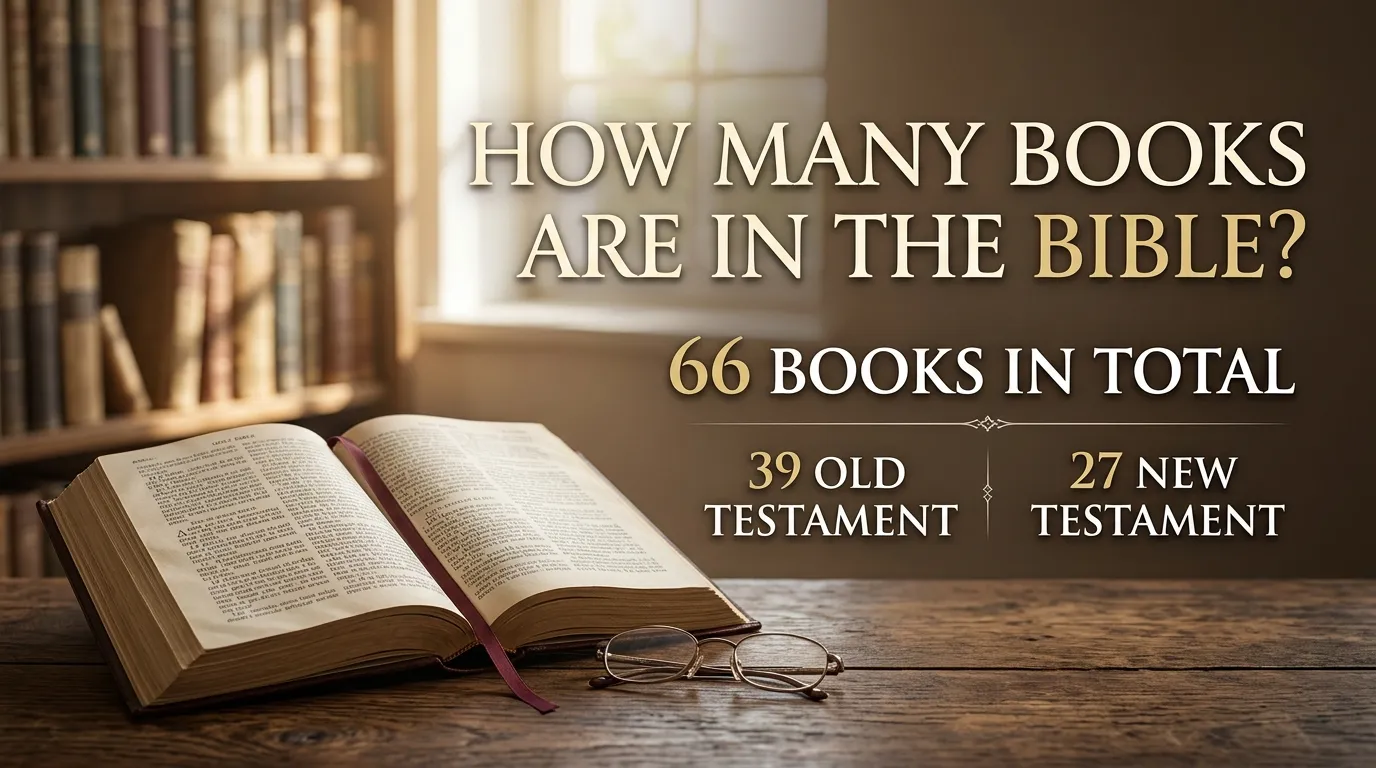
How many books are in the Bible? Most Protestant Bibles have 66 books (39 in the Old Testament and 27 in the New Testament).
Catholic Bibles have 73, Orthodox Bibles have about 76 or more, and the Ethiopian Orthodox Bible has 81 or more.
The New Testament has the same 27 books in almost every list, so the differences come from the Old Testament and from a few extra texts.
This guide gives the counts, lists every book, and explains why churches differ. All quotes are from the King James Version.
Key Takeaways
- Protestant Bible: 66 books, with 39 in the Old Testament and 27 in the New.
- Catholic Bible: 73 books, because it adds seven Old Testament books and some additions to Esther and Daniel.
- Orthodox and Ethiopian Bibles: Even more, depending on the list.
- Hebrew Bible: 24 books by Jewish counting, which hold the same material as the Protestant Old Testament.
- Why it differs: History, language, and each church’s rule for what counts as Scripture, not hidden books or fraud.
The Short Answer by Tradition
| Tradition | Old Testament | New Testament | Total |
|---|---|---|---|
| Hebrew Bible (Tanakh) | 24 books | Not included | 24 |
| Protestant | 39 | 27 | 66 |
| Catholic | 46 | 27 | 73 |
| Eastern Orthodox (Greek) | About 49 | 27 | About 76 (some lists give up to 81) |
| Ethiopian Orthodox (narrower canon) | 46 | 35 | 81 |
Orthodox and Ethiopian totals vary by source and by list, because some writings are counted as separate books in one list and as parts of another. Some Ethiopian lists give 88 with a broader canon.
The 66 Books of the Protestant Bible
2 Timothy 3:16 says, “All scripture is given by inspiration of God, and is profitable for doctrine, for reproof, for correction, for instruction in righteousness.” The 66 books fall into clear groups, which makes them easier to find and read.
The 39 books of the Old Testament
| Group | Books | Count |
|---|---|---|
| Law | Genesis, Exodus, Leviticus, Numbers, Deuteronomy | 5 |
| History | Joshua, Judges, Ruth, 1 Samuel, 2 Samuel, 1 Kings, 2 Kings, 1 Chronicles, 2 Chronicles, Ezra, Nehemiah, Esther | 12 |
| Poetry and Wisdom | Job, Psalms, Proverbs, Ecclesiastes, Song of Solomon | 5 |
| Major Prophets | Isaiah, Jeremiah, Lamentations, Ezekiel, Daniel | 5 |
| Minor Prophets | Hosea, Joel, Amos, Obadiah, Jonah, Micah, Nahum, Habakkuk, Zephaniah, Haggai, Zechariah, Malachi | 12 |
The 27 books of the New Testament
| Group | Books | Count |
|---|---|---|
| Gospels | Matthew, Mark, Luke, John | 4 |
| History | Acts | 1 |
| Paul’s letters | Romans, 1 Corinthians, 2 Corinthians, Galatians, Ephesians, Philippians, Colossians, 1 Thessalonians, 2 Thessalonians, 1 Timothy, 2 Timothy, Titus, Philemon | 13 |
| General letters | Hebrews, James, 1 Peter, 2 Peter, 1 John, 2 John, 3 John, Jude | 8 |
| Prophecy | Revelation | 1 |
How Many Books Are in the Old Testament?
The answer is 39 in Protestant Bibles and 46 in Catholic Bibles. The Hebrew Bible holds the same material as the Protestant Old Testament but counts it as 24 books, because several works are grouped together. In Luke 24:44, Jesus mentions the three parts of the Hebrew Scriptures: “the law of Moses, and in the prophets, and in the psalms.”
| Part of the Hebrew Bible | What it holds | Count |
|---|---|---|
| Law (Torah) | Genesis to Deuteronomy | 5 |
| Prophets | Joshua, Judges, Samuel, Kings, Isaiah, Jeremiah, Ezekiel, and the Twelve (Hosea to Malachi) | 8 |
| Writings | Psalms, Proverbs, Job, Song of Songs, Ruth, Lamentations, Ecclesiastes, Esther, Daniel, Ezra-Nehemiah, Chronicles | 11 |
Some older Jewish counts give 22 books by joining Ruth to Judges and Lamentations to Jeremiah. The material is the same, and only the grouping changes. Paul says the Jews were the people to whom “were committed the oracles of God” (Romans 3:2).
How Many Books Are in the New Testament?
The New Testament has 27 books in Protestant, Catholic, and Orthodox Bibles. A few traditions differ at the edges:
- The traditional Syriac Peshitta had 22 New Testament books and left out 2 Peter, 2 John, 3 John, Jude, and Revelation.
- The Ethiopian Orthodox Bible adds eight church-order texts to the 27, for 35 in its narrower canon.
The early church already treated the letters of Paul as Scripture. 2 Peter 3:15-16 speaks of “all his epistles” and compares the way some twist them to the way they twist “the other scriptures.”
Why Do Catholic Bibles Have 73 Books?
Catholic Bibles add these seven books to the Old Testament: Tobit, Judith, Wisdom, Sirach, Baruch, 1 Maccabees, and 2 Maccabees. They also include additional sections in Esther and Daniel (such as Susanna and Bel and the Dragon). Together with the 39 books Protestants count, that makes 46.
These writings came into the church through the Septuagint, the Greek translation of the Old Testament that many New Testament writers quoted. Jerome, who produced the Latin Vulgate around AD 400, noted that they were not in the Hebrew Bible but included them. The Council of Trent confirmed the Catholic list in 1546. Some Catholic readers see an echo of 2 Maccabees 7 in Hebrews 11:35, though scholars debate this.
Why Protestant Bibles have 66
During the Reformation, Protestant churches chose to follow the Hebrew canon for the Old Testament. They called the extra books “Apocrypha” and treated them as useful reading but not as Scripture for doctrine. The first King James Bible of 1611 still printed the Apocrypha in a separate section, and the Westminster Confession of 1647 later listed the 66 books by name. Catholics call the extra books deuterocanonical, which means “second canon.”
Why Do Orthodox and Ethiopian Bibles Have More?
Eastern Orthodox churches follow the Septuagint, so they include the Catholic additions plus a few more, such as 1 Esdras, 3 Maccabees, the Prayer of Manasseh, and Psalm 151. Their totals vary by church and by how the lists are counted.
The Ethiopian Orthodox Tewahedo Church has the longest canon. Its Old Testament includes Jubilees and 1 Enoch. Jude 14-15 quotes Enoch, which is one reason that book has been valued there. Quoting a writing does not by itself make it Scripture for every church, since Paul also quotes pagan poets in Acts 17:28. Other churches value 1 Enoch as an ancient text, but they do not include it in the canon.
Why the Count Can Be Confusing
Three things make the number change:
- Splitting and joining. Samuel, Kings, and Chronicles are each one book in the Hebrew Bible and two in Christian Bibles. Ezra-Nehemiah and the twelve minor prophets are also grouped in Jewish counting.
- Added books. Catholic and Orthodox churches count writings that Protestants do not.
- Different names. The same writings are called deuterocanonical in one tradition and Apocrypha in another.
How the Canon Was Formed
The list of books grew over centuries, and it was not decided in a single vote. Several steps stand out:
| Step | What happened |
|---|---|
| Before Jesus | Jewish communities treated the Law, the Prophets, and the Writings as Scripture (Luke 24:44). |
| First century | Christians read the Gospels and apostolic letters in worship and shared them between churches (Colossians 4:16; 2 Peter 3:15-16). |
| AD 367 | Athanasius of Alexandria listed the same 27 New Testament books we use today in his Easter letter. |
| AD 393 and 397 | Church councils at Hippo and Carthage affirmed the same New Testament list. |
| 1546 | The Council of Trent fixed the Catholic Old Testament list at 46 books. |
| 1647 | The Westminster Confession listed the 66 books for many Protestants. |
The early church looked at whether a book was linked to the apostles, whether it was widely used in churches, and whether it agreed with the faith handed down. Luke 1:1-4 shows that many accounts of Jesus were already circulating, and Luke wrote to give certainty about what had been “most surely believed.”
Books Mentioned in the Bible but Not Included
The Bible refers to some writings that are not in it. This does not mean books were removed. Biblical authors drew on other records, and many writings were never meant to be Scripture.
| Mentioned writing | Verse |
|---|---|
| The Book of the Wars of the LORD | Numbers 21:14 |
| The Book of Jasher | Joshua 10:13; 2 Samuel 1:18 |
| The Book of the Chronicles of the Kings of Israel | 1 Kings 14:19 |
| An earlier letter from Paul to Corinth | 1 Corinthians 5:9 |
| The letter from Laodicea | Colossians 4:16 |
John 21:25 also reminds us that Jesus did many more things than are recorded: “I suppose that even the world itself could not contain the books that should be written.” Later writings such as the Gospel of Thomas were not accepted, because churches did not trace them to the apostles or find them consistent with the faith they had received.
The Bible by the Numbers
| Fact | Number |
|---|---|
| Books (Protestant) | 66 |
| Chapters | 1,189 |
| Verses (KJV) | About 31,000 |
| Longest book by chapters | Psalms (150) |
| Longest chapter | Psalm 119 (176 verses) |
| Shortest chapter | Psalm 117 (2 verses) |
| Shortest verse in English | John 11:35, “Jesus wept.” |
| Longest verse in the KJV | Esther 8:9 |
| Shortest Old Testament book | Obadiah (21 verses) |
| Fewest verses in the New Testament | 2 John (13 verses); 3 John is the shortest by Greek word count |
| Writers and time span | About 40 writers over roughly 1,500 years |
How to Count the Books in Your Own Bible
- Open the table of contents and count the Old Testament titles, then the New Testament titles.
- Check whether your Bible has books after Malachi or before Matthew, such as Tobit, Wisdom, or the Maccabees.
- Look for words like “Apocrypha” or “Deuterocanonical” in the contents.
- If you see only the 39 and 27 listed above, you have the 66-book Bible. If you see more, you have a longer canon.
Which Bible Should You Choose?
Choose a translation you will actually read, in clear English. If you belong to a church, it makes sense to use the Bible your church uses in worship. Whichever list you choose, the core story from Genesis to Revelation is the same, and the New Testament is the same 27 books.
A Simple Reading Plan Through the Bible
| Step | Read | Why |
|---|---|---|
| 1 | John, Mark, and Acts | Meet Jesus and the early church first |
| 2 | Genesis, Exodus, and Psalms | See creation, rescue, and prayer |
| 3 | Romans and Proverbs | Learn core teaching and wisdom for daily life |
| 4 | The rest of the Gospels, then the history books | Build the full storyline |
| 5 | The prophets and the remaining letters | Finish with the larger picture |
Go slowly, and read a little each day. The Law and the prophets can feel dense at first, so a study guide or a friend to read with can help.
FAQs
How many books are in the Bible in total?
It depends on the tradition. Protestant Bibles have 66, Catholic Bibles have 73, Orthodox Bibles have about 76 or more, and Ethiopian Orthodox Bibles have 81 or more.
How many books are in the Old Testament?
39 in Protestant Bibles and 46 in Catholic Bibles. The Hebrew Bible has the same material as the Protestant list but counts it as 24 books.
How many books are in the New Testament?
27 in Protestant, Catholic, and Orthodox Bibles. The Ethiopian Orthodox Bible counts 35 in its narrower canon by adding church-order texts.
Why do some Bibles have more books than others?
Because churches follow different lists of Old Testament writings. Catholic and Orthodox churches follow the Greek Septuagint list, and Protestants follow the Hebrew list.
What are the deuterocanonical books?
The seven Old Testament books that Catholic Bibles add: Tobit, Judith, Wisdom, Sirach, Baruch, 1 Maccabees, and 2 Maccabees, plus additions to Esther and Daniel. Protestants usually call them the Apocrypha.
Did Protestants remove books from the Bible?
Protestant churches chose to follow the Hebrew canon, which had never included these writings. The 1611 King James Bible still printed them in a separate section.
Is the Ethiopian Bible really 81 books?
Yes, in its narrower canon (46 Old Testament and 35 New Testament). Some lists give 88 for a broader canon.
When was the Bible’s list of books settled?
The New Testament list of 27 appears in Athanasius’ letter of AD 367, and councils affirmed it in the late 300s. The Catholic Old Testament list was formally confirmed at the Council of Trent in 1546.
Conclusion
The answer to “how many books are in the Bible?” is 66 for Protestants, 73 for Catholics, and more for Orthodox and Ethiopian churches. The core stays the same everywhere: the Old Testament points forward, and the New Testament tells of Christ and the church.
Pick one Bible, count its books, and start reading. Begin with the Gospel of John, and let the whole story shape your faith over time.
Discover More Post
- Women of the Bible: Their Stories, Roles, and Lessons From Genesis to the Early Church
- How Old Is God? What the Bible Says About God’s Eternity
- The Armor of God: Meaning of Each Piece in Ephesians 6
- Jesus Wept (John 11:35): Meaning, Story, and Hope for Grief
I’m Nicholas Sparks, and storytelling has always been my passion. Through TheBiblimeaning, I share insights about my books, unforgettable characters, romance, emotions, and the deeper meanings behind my stories. This platform brings readers closer to my writing journey, latest releases, and the inspiration that shapes every novel I create.