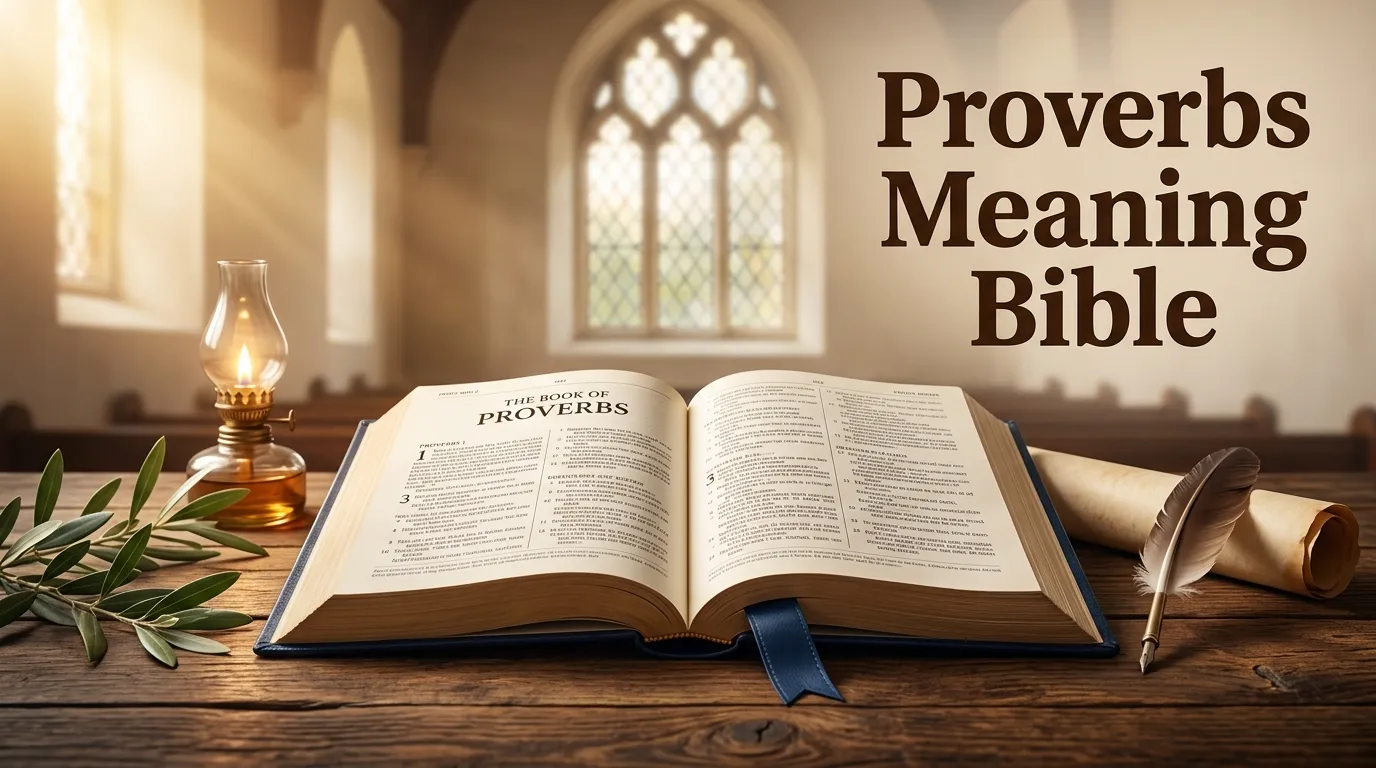
The Book of Proverbs in the Bible offers practical, God-centered wisdom for everyday life.
If you’re searching for the Proverbs meaning in the Bible, you’re looking for more than clever sayings you’re seeking timeless guidance on how to live skillfully under God’s direction.
This article explores the book’s purpose, key themes, and how its wisdom applies today, especially for those new to Scripture or growing in faith.
You’ll discover why Proverbs remains one of the most beloved and practical books in the Bible.
Quick Reference Table
| Aspect | Details |
| Hebrew Title | Mishlei (Book of Parables/Sayings) |
| Author | Primarily Solomon |
| Key Verse | Proverbs 1:7 |
| Main Theme | Wisdom for righteous living |
| Structure | Introductory poems, collections of sayings, and concluding acrostic |
Biblical Meaning
The Book of Proverbs is a collection of wise teachings, mostly from King Solomon, designed to impart skill in living. Unlike narrative books that tell stories, Proverbs delivers short, memorable statements on topics like work, relationships, speech, money, and character.
Its core message is that true wisdom begins with a right relationship with God. Life works best when we align our decisions with God’s design rather than our own limited understanding.
Hebrew Meaning
In Hebrew, the book is called Mishlei, from the word mashal. This term goes beyond our English idea of a proverb. It often means a parable, comparison, or extended metaphor meant to illustrate deeper truths about life.
Solomon uses these sayings like mirrors, helping readers see themselves and God’s ways more clearly. The goal isn’t just knowledge but skillful, moral living that honors the Lord.
Biblical Context
Proverbs belongs to the Wisdom Literature of the Old Testament, alongside Job and Ecclesiastes. Solomon, known for his God-given wisdom (1 Kings 3), compiled many of these proverbs, though others contributed as well, such as Agur and King Lemuel.
The book was written during Israel’s monarchy period, offering guidance for kings, leaders, families, and ordinary people. It contrasts two paths: the way of wisdom (righteousness, humility, diligence) and the way of folly (wickedness, pride, laziness).
Key Bible Verses with Explanations
Proverbs 1:7 The fear of the Lord is the beginning of knowledge; fools despise wisdom and instruction.
This verse serves as the motto for the entire book. Fear of the Lord means reverent awe and respect, not terror. It is the foundation for all true understanding. Without it, even smart people act foolishly. Fools reject correction because they trust their own way instead of God’s.
Proverbs 3:5-6 Trust in the Lord with all your heart and lean not on your own understanding; in all your ways submit to him, and he will make your paths straight.
In context, these verses encourage dependence on God rather than self-reliance. The surrounding chapter links this trust to honoring God with our resources and accepting His discipline, leading to a guided, blessed life.
Proverbs 31:30 Charm is deceptive, and beauty is fleeting; but a woman who fears the Lord is to be praised.
This concludes the book’s famous description of a virtuous woman. It emphasizes that character rooted in reverence for God outlasts external appearances.
Spiritual Meaning
Spiritually, Proverbs reveals God’s character as the source of all wisdom. It shows that wisdom is not merely intellectual but relational and moral. The personified Wisdom in chapters 1–9 calls out like a teacher or even foreshadows Christ, who is later called the wisdom of God in the New Testament (1 Corinthians 1:24).
The book points to the need for a transformed heart that values God’s instruction over worldly shortcuts.
Symbolism
- The Path: Frequently used to symbolize life’s direction either toward life and blessing or destruction.
- Lady Wisdom vs. Lady Folly: Two women represent choices we face daily. Wisdom leads to life; Folly leads to ruin.
- The Fear of the Lord: Symbolizes the starting point and ongoing attitude of a godly life.
Practical Application
For new believers or anyone seeking guidance, Proverbs invites daily reading and reflection. Ask yourself:
- How can I apply this proverb to my work, words, or relationships today?
- Where am I leaning on my own understanding instead of trusting God?
Mature Christians and pastors can use it for counseling, teaching, and personal growth. Youth and students benefit from its advice on friends, discipline, and future planning. Women find encouragement in the strength and dignity of Proverbs 31.
Start small: Memorize one proverb a week and pray for wisdom, as James 1:5 encourages.
Common Misunderstandings
Some treat Proverbs as ironclad promises rather than general principles. For example, Train up a child in the way he should go (Proverbs 22:6) offers wise direction, but it doesn’t guarantee every child will follow perfectly, as human free will and other factors play a role.
Others see it as secular self-help. In reality, every bit of advice flows from relationship with God.
More Searched Questions About Proverbs in the Bible
What does “proverb” mean in Hebrew, word by word?
Proverb in the Bible starts from the Hebrew word mashal (H4912), and the book itself takes its Hebrew title from it: Mishlei, the plural form, the book of meshalim. Mashal covers more than the English word “proverb” suggests: it means a proverb, a parable, a comparison, or a pointed saying that sets one thing beside another so the truth lands harder. Nathan’s story of the poor man’s lamb set beside David’s sin is a mashal; so is a one-line saying about a gentle answer. The body’s own Hebrew section gives the short form, that mashal “often means a parable, comparison, or extended metaphor”; the Strong’s number and the title form are what this answer adds.
One honest note belongs here, because the searches often ask for a single flat definition. There is none to give. “Proverb” in English covers several Hebrew forms at once: short sayings, longer poems, riddles, and comparisons, and the book of Proverbs holds all of them. The Greek title the body’s FAQ names, Paroimiai, means wise sayings, comparisons, or instructive maxims, which is the same range in Greek dress. A word written in Malayalam, Tagalog, Hindi, Tamil or Marathi script is the same Hebrew word carried through English, spelled in another alphabet, and its meaning stays where the Hebrew root puts it. There is no separate Malayalam meaning, Tagalog meaning, Hindi meaning, Tamil meaning or Marathi meaning to give, and the searches that ask for one are answered by that single fact.
What is the book of Proverbs about, in one summary?
Proverbs is about skill in living under God’s direction, and the book states its own purpose at the start: “To know wisdom and instruction; to perceive the words of understanding; To receive the instruction of wisdom, justice, and judgment, and equity; To give subtilty to the simple, to the young man knowledge and discretion” (Proverbs 1:2-4, in part). The book is thirty-one chapters of that instruction: opening poems about wisdom and folly, long collections of short sayings on work, speech, money, relationships and character, and a closing acrostic about the virtuous woman. It belongs to the Wisdom Literature of the Old Testament, beside Job and Ecclesiastes, but where Job wrestles with suffering and Ecclesiastes with meaning, Proverbs teaches the daily craft of choosing well.
The shape of the book matters for the searches that ask about particular chapters. Chapter 10 opens the first great collection of Solomon’s sayings: “The proverbs of Solomon. A wise son maketh a glad father: but a foolish son is the heaviness of his mother” (Proverbs 10:1). Everything from chapter 10 onward is largely short, two-line sayings, while chapters 1 to 9 are longer poems. The book’s message, in one line, is the body’s own FAQ line and it is accurate: fearing the LORD is the foundation of true wisdom and righteous living. The next questions take that message apart piece by piece, starting with who wrote it.
Who wrote Proverbs, and when was it gathered?
The book names its own authors, and they are more than one. It opens: “The proverbs of Solomon the son of David, king of Israel” (Proverbs 1:1). A second collection opens the same way: “The proverbs of Solomon” (Proverbs 10:1). A third collection names its copyists, not a new author: “These are also proverbs of Solomon, which the men of Hezekiah king of Judah copied out” (Proverbs 25:1). Then come two further names: “The words of Agur the son of Jakeh, even the prophecy” (Proverbs 30:1), and “The words of king Lemuel, the prophecy that his mother taught him” (Proverbs 31:1). Solomon is therefore the chief author, but not the only voice in the book.
The honest note is that the book is a collection gathered over time, not a single author’s diary written at one sitting. The Hezekiah note alone proves the gathering: men of a later king copied out Solomon’s sayings, which means the book took shape across generations, from Solomon’s monarchy through Hezekiah’s. The body’s own context section already says this in short form, that Solomon compiled many of the proverbs “though others contributed as well, such as Agur and King Lemuel”, and that the book was written during Israel’s monarchy period. No date more precise than that is fixed here, because the book itself gives none, and no later date is invented for any part of it.
What does “the fear of the LORD is the beginning of knowledge” mean?
The verse is the book’s motto, quoted here in full King James wording: “The fear of the LORD is the beginning of knowledge: but fools despise wisdom and instruction” (Proverbs 1:7). “Beginning” here means foundation and starting point, not merely the first lesson in a course: knowledge that starts anywhere else is built on sand, in the book’s own picture. And the second half defines the opposite: fools do not lack information, they despise wisdom and instruction, which is why the body’s own explanation is right that even smart people act foolishly without this foundation. The companion verse says the same thing about wisdom itself: “The fear of the LORD is the beginning of wisdom: and the knowledge of the holy is understanding” (Proverbs 9:10).
Fear here means reverent awe and obedience, not terror, and that reading comes from the texts’ own pairing, never from psychology. The fear of the LORD is paired with knowledge in 1:7 and with wisdom and understanding in 9:10, and throughout the book it walks with humility, obedience and turning from evil, not with cowering. A child who respects a father’s word enough to obey it is closer to the picture than a servant who flinches. The searches that ask “what does Proverbs say about fear” are answered by that pairing: fear of the LORD is the posture that makes all other learning possible, because it puts the learner in right relation to the God who gives wisdom.
What does Proverbs 3:5-6 mean, verse by verse?
The passage is quoted here in full King James wording, because the searches ask for the verses themselves: “Trust in the LORD with all thine heart; and lean not unto thine own understanding. In all thy ways acknowledge him, and he shall direct thy paths” (Proverbs 3:5-6). Verse by verse: trust with all the heart means wholehearted reliance, not partial trust kept in reserve. “Lean not unto thine own understanding” does not forbid thinking; it forbids propping oneself on one’s own limited view when God’s direction is available. “In all thy ways acknowledge him” means bringing every path, work, money, relationships, to God rather than only the religious ones. And “he shall direct thy paths” is the promise that follows: God straightens the way for the one who trusts and acknowledges Him.
Two honest notes belong with the promise. First, the chapter’s own context widens it: the surrounding verses link this trust to honouring God with substance (Proverbs 3:9-10, in part) and to accepting His discipline (Proverbs 3:11-12, in part), so the promise sits inside a life of honour and correction, not beside it. Second, the verse promises direction, not a specific outcome in every case: it says God will direct the paths, not that every path will end where the reader hopes, and it is never used here as a prosperity formula. The body’s own explanation already points this way, toward dependence on God rather than self-reliance leading to a guided, blessed life, and this answer keeps it there: direction is the promise, and the outcome stays in God’s hands.
Who is the Proverbs 31 woman, and is she a checklist?
She is the woman of the book’s closing poem, twenty-two verses, one for each letter of the Hebrew alphabet, an acrostic poem in Hebrew that runs from Proverbs 31:10 to 31:31. The poem opens with a question: “Who can find a virtuous woman? for her price is far above rubies” (Proverbs 31:10). “Virtuous woman” is the King James wording for ‘eshet chayil, a woman of strength and worth, and the poem then shows her at work: buying fields, planting vineyards, making garments, trading, caring for her household and for the poor, speaking with wisdom and kindness. The poem closes where the book began, with the fear of the LORD: “Favour is deceitful, and beauty is vain: but a woman that feareth the LORD, she shall be praised” (Proverbs 31:30).
The poem describes an ideal, not a checklist every reader must complete, and that distinction is labelled here as application, because the text itself gives no scoring system. No reader, wife or otherwise, is asked by the passage to match every verse at once; the poem gathers a lifetime of strength, skill and reverence into one portrait, so that readers can admire the whole and imitate part. The searches that ask for the “proverbs 31 wife” or “proverbs 31 girl” mean the same passage, and songs and lyrics about the passage are modern use, not text: they honour the poem, they do not extend it. The body’s own practical section already says women find encouragement in the strength and dignity of Proverbs 31, and this answer keeps it as encouragement, not as a test.
Who are Lady Wisdom and Lady Folly?
They are the book’s two personified voices, not two literal women, and they call out through the opening poems. Wisdom cries aloud: “Wisdom crieth without; she uttereth her voice in the streets” (Proverbs 1:20, in part). She builds a house and invites the simple to her feast: “Wisdom hath builded her house, she hath hewn out her seven pillars” (Proverbs 9:1). Folly mirrors her exactly and inverts her: she too sits at the door and calls to passers-by, but her feast ends in death (Proverbs 9:13-18, in part). The two women represent the two paths the body’s own context section names, the way of wisdom and the way of folly, and every choice in the book is a choice between their two invitations.
One fence belongs here, because the body’s own spiritual section says personified Wisdom “even foreshadows Christ, who is later called the wisdom of God in the New Testament (1 Corinthians 1:24)”. Christ is never named in Proverbs, so any Christ reading of Lady Wisdom is interpreters’ reading, stated as a reading here, never as a text fact. The New Testament does call Christ the wisdom of God, and many readers hear that behind Proverbs 8, but the book itself presents Wisdom as God’s own voice calling in the streets, not as a named person. The passage to hold onto is Wisdom’s own promise: “For whoso findeth me findeth life, and shall obtain favour of the LORD” (Proverbs 8:35).
Are Proverbs promises or principles?
They are principles, general wisdom sayings, not unconditional guarantees, and the verse the searches ask about proves the point. “Train up a child in the way he should go: and when he is old, he will not depart from it” (Proverbs 22:6). Read as an ironclad promise, the verse would guarantee every well-raised child stays on the path, which neither life nor the rest of Scripture shows. Read as a principle, it says the ordinary fruit of faithful training is a child who keeps the way, which is what wise parents aim at and pray for. The body’s own misunderstandings section already agrees: the verse “offers wise direction, but it doesn’t guarantee every child will follow perfectly, as human free will and other factors play a role”.
The same reading governs the whole book, and interpreters broadly agree on it, though the agreement is noted here carefully, never as settled doctrine. A proverb describes how life usually works under God’s ordering, not how it must work in every case: diligence usually leads to plenty, laziness usually to want, honest speech usually to trust, but exceptions stand all over Scripture, Job among them. That is why Proverbs is wisdom, not law and not prophecy: it trains judgment for the ordinary run of life, and it leaves the exceptions to God’s larger story. Readers who treat a proverb as a contract will be disappointed by life; readers who treat it as a principle will be guided by it.
What does Proverbs 8 say about wisdom, and what does it not say?
Proverbs 8 is Wisdom’s great speech, and it opens with a question: “Doth not wisdom cry? and understanding put forth her voice?” (Proverbs 8:1). Wisdom stands at the gates, at the entry of the city, at the coming in at the doors, calling to all who pass, and her call is public, not secret: anyone can hear it, which is why the chapter answers the searches about wisdom’s voice directly. The centre of the speech is Wisdom’s age: “The LORD possessed me in the beginning of his way, before his works of old” (Proverbs 8:22). Wisdom was with God before creation, delighting in His world and in the sons of men, and the chapter closes with the same promise as the whole book: finding Wisdom is finding life.
What the chapter does not say matters as much as what it says. It does not name Christ, and it does not settle any doctrine about Wisdom’s nature on its own: one verse, however weighty, is not asked here to carry a system, and no settled creation doctrine is built on Proverbs 8:22 alone. The verse numbered 8 in the chapter sits inside this same call, Wisdom speaking at the gates and rejoicing before God, not as a separate saying with its own meaning. The searches that ask “proverbs 8 meaning” are therefore answered by the chapter as a whole: Wisdom cries aloud, she was with God from the beginning, and whoever finds her finds life and favour from the LORD.
How can a reader use Proverbs day by day?
This answer is application, and it is labelled as application, because no verse gives a daily programme and none is invented here. What the texts and the body’s own practical section give together is a simple pattern. Read a little, daily: the book’s thirty-one chapters lend themselves to a chapter a day, but no verse commands that rhythm, so it is offered as a habit, not a rule. Start small, as the body already says: memorize one proverb a week and pray for wisdom, as James encourages: “If any of you lack wisdom, let him ask of God, that giveth to all men liberally, and upbraideth not; and it shall be given him” (James 1:5). Ask the book’s own questions through the day: where am I leaning on my own understanding instead of trusting God, and how can this proverb shape my work, my words, or my relationships today?
Two cautions close the section, both from the book’s own shape. First, do not read a single proverb as the whole counsel: a saying about diligence needs its neighbours about rest, and a saying about speech needs its neighbours about silence, which is why reading whole chapters beats collecting favourite lines. Second, do not measure the week by outcomes: the book promises direction, not a weekly result, and a heart increasingly aligned with God’s wisdom is the honest measure, not a flawless seven days. The body’s own conclusion already says it well: open its pages regularly, ask the Holy Spirit to teach you, and watch how God’s wisdom shapes your steps.
FAQs
What are 10 Proverbs in the Bible?
Ten well-known biblical proverbs include teachings about wisdom, honesty, humility, diligence, and trusting God.
How many Proverbs are in the Bible?
The Book of Proverbs contains 31 chapters with hundreds of wise sayings about godly living.
What is the main message of the Book of Proverbs?
The main message of Proverbs is that fearing the Lord is the foundation of true wisdom and righteous living.
What is the meaning of Proverbs in the Bible in Malayalam?
In Malayalam, Proverbs refers to wise sayings that teach practical life lessons based on God’s truth.
What is the Greek meaning of Proverbs?
The Greek title for Proverbs, Paroimiai, means wise sayings, comparisons, or instructive maxims.
What are some examples of proverbs?
Examples include “A gentle answer turns away wrath” and “Trust in the Lord with all your heart.”
Is there a Proverbs study guide PDF available?
Yes, many Christian ministries and Bible study websites offer free Proverbs study guide PDFs.
What is a proverb in literature?
In literature, a proverb is a short, memorable saying that expresses a general truth or practical wisdom.
Conclusion
The meaning of Proverbs in the Bible ultimately calls us to wisdom that leads to a flourishing life rooted in reverence for God. As Proverbs 9:10 reminds us, The fear of the Lord is the beginning of wisdom, and knowledge of the Holy One is understanding.
Whether you’re just starting your faith journey or have walked with Christ for years, Proverbs offers reliable guidance. Open its pages regularly, ask the Holy Spirit to teach you, and watch how God’s wisdom shapes your steps. May you grow in grace and truth as you apply these ancient words to your modern life.
Discover More post
- Lust Meaning in Bible: A Christian Guide
- Jubilee Meaning in Bible: God’s Year of Freedom
- Parable Meaning in the Bible: Full Guide