
The Jacob name meaning in the Bible carries two layers of truth, and both matter for anyone teaching or writing about him.
At birth, his name pointed to a physical detail and a spiritual pattern: heel-grabber or supplanter. Later in his life, God gave him a second name, Israel, meaning he strives with God.
Together, these two names tell the story of a man who moved from grasping for blessing through his own effort to receiving it through surrender to God.
In this article, you’ll learn the Hebrew roots behind Jacob’s name, the biblical context of his birth and his encounter with God, a full explanation of the key verses that define his identity, and practical ways to use this material accurately in Bible studies, devotionals, and commentary.
This guide is built for Bible book creators, pastors, and content teams who need theological accuracy alongside strong, readable prose.
Another Name for Jacob in the Bible Genesis 32:28
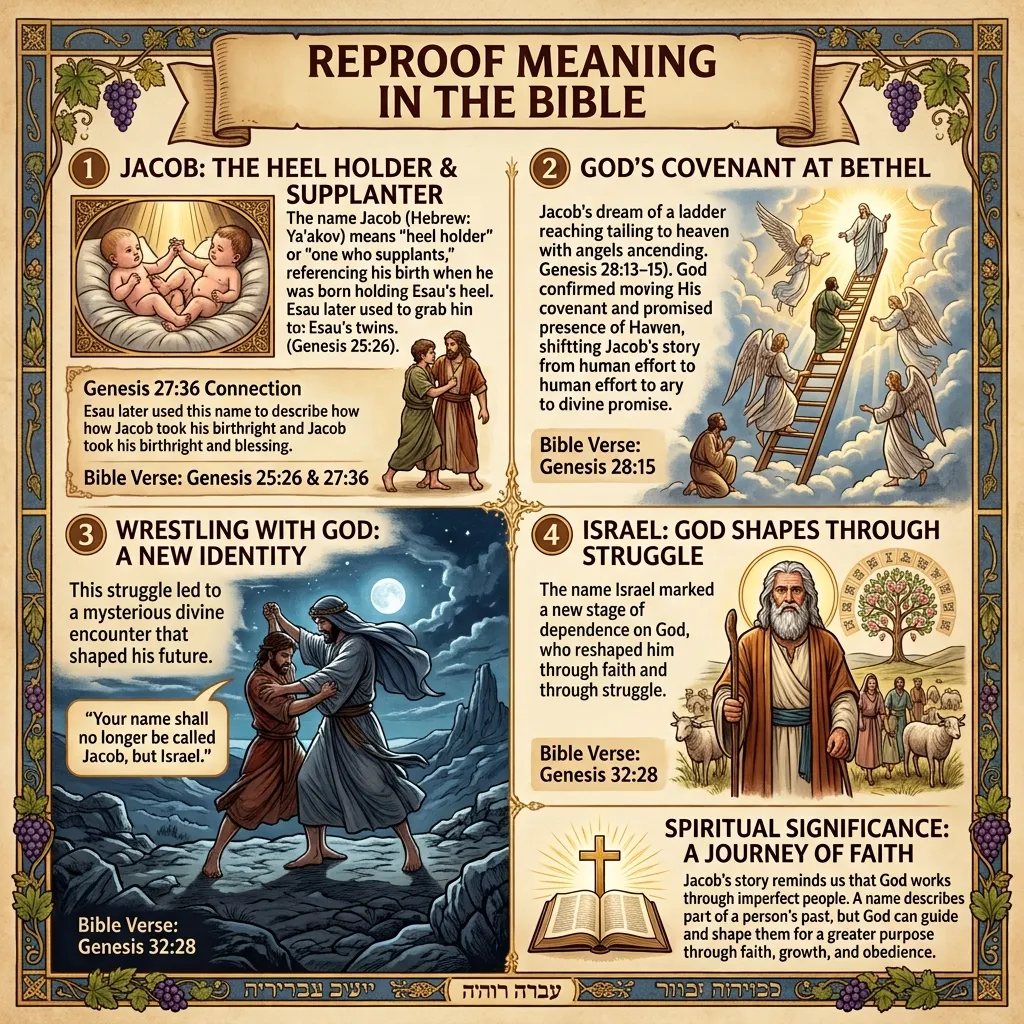
Another name for Jacob in the Bible is Israel. God gave Jacob this name after he wrestled through the night and sought His blessing. In Genesis 32:28, God said, “Your name shall no longer be called Jacob, but Israel.” The name Israel marked a new stage in Jacob’s life. He was still the same person, but God had shaped him through struggle and faith. Later, the Bible often calls his family the people of Israel. This name became central to the story of God’s covenant people. Jacob’s new name points to God’s power to change a person.
Bible Verse: Genesis 32:28
Jacob Name Meaning in Bible Genesis 25:26
The name Jacob is linked with the Hebrew name Ya’akov. Its meaning is often explained as “heel holder” or “one who supplants.” Jacob received this name because he was born holding Esau’s heel. Genesis 25:26 records this unusual birth. Later, Esau used Jacob’s name to describe how Jacob had taken his birthright and blessing. Yet Jacob’s story did not end with his early mistakes. God worked in his life and gave him the name Israel. His story shows that a name may describe part of a person’s story, but God can also shape that person for a greater purpose.
Bible Verse: Genesis 25:26
Jacob Meaning in Bible Genesis 27:36
The biblical meaning of Jacob is closely tied to the ideas of heel holder, supplanter, or one who takes the place of another. This meaning becomes clear in Jacob’s story with Esau. In Genesis 27:36, Esau connected Jacob’s name with his actions concerning the birthright and blessing. At first, Jacob’s story includes choices made through human effort and deception. Yet God did not abandon him. Through years of hardship, Jacob learned to depend more on God. His life gives an important lesson: God can work through imperfect people and lead them toward faith, growth, and obedience.
Bible Verse: Genesis 27:36
Jacob Name Meaning Bible Genesis 28:13–15
The name Jacob carries a strong biblical story behind it. Jacob was the son of Isaac and Rebekah and the grandson of Abraham. His name is tied to his birth, when he came out holding Esau’s heel (Genesis 25:26). But Jacob’s identity became much more than his name. At Bethel, God confirmed His covenant with him and promised to be with him. Genesis 28:13–15 shows that God’s plan for Jacob rested on divine promise, not human strength alone. Jacob’s story reminds readers that God can guide a person even through seasons of failure, fear, and change.
Bible Verse: Genesis 28:15
Meaning of Jacob in the Bible Genesis 32:27–28
The meaning of Jacob in the Bible is best understood through both his name and his life. His name is connected with the idea of a heel holder or supplanter. Yet God later changed his name to Israel. In Genesis 32:27–28, Jacob wrestled through the night and received a new name from God. This moment marked a major change in his story. Jacob had spent much of his life trying to gain what he wanted, but he came to a place of dependence on God. His journey shows that God can transform a person through struggle and faith.
Bible Verse: Genesis 32:28
Meaning of Jacob Genesis 25:26
The meaning of Jacob comes from the Hebrew name Ya’akov and is commonly connected with “heel holder” or “supplanter.” The first connection appears in Genesis 25:26, where Jacob was born holding his brother Esau’s heel. This detail explains the name given to him. His later actions also made the meaning important to his story. Jacob took Esau’s birthright and received Isaac’s blessing. Still, the Bible shows more than Jacob’s early failures. God remained faithful to him and later gave him the name Israel. His life shows how God can lead a flawed person toward lasting faith.
Bible Verse: Genesis 25:26
Jacob Biblical Meaning Genesis 32:28
The biblical meaning of Jacob includes the idea of a heel holder or supplanter, based on his birth and later actions. But the Bible gives Jacob’s name a deeper story through his relationship with God. After a night of struggle, God changed his name to Israel in Genesis 32:28. This change shows that Jacob’s life was not defined only by his past. God continued His covenant promise through him and his family. Jacob’s story teaches that God sees more than a person’s past mistakes. He can bring growth, purpose, and change through a long journey of faith.
Bible Verse: Genesis 32:28
Quick Reference Table
| Detail | Information |
| Hebrew Name | יַעֲקֹב (Ya’akov) |
| Common Meaning | Heel-grabber, supplanter, or he follows/deceives |
| Root Word | Akev (heel) and the verb aqab (to follow closely, to deceive) |
| Later Name | Israel he strives with God (Genesis 32:28) |
| Parents | Isaac and Rebekah |
| Twin Brother | Esau |
| Birth Account | Genesis 25:19–26 |
| Renaming Account | Genesis 32:22–30; Genesis 35:9–10 |
| Role in Scripture | Father of the twelve teams of Israel |
Biblical Meaning
Jacob’s name is one of the clearest examples in Scripture of a name that describes both a moment and a character trait. When Rebekah gave birth to twins, Esau came out first, and Jacob followed, his hand gripping his brother’s heel. Genesis 25:26 records this directly: Afterward his brother came out, with his hand gripping Esau’s heel, so he was named Jacob.
That single image, a hand on a heel, became the foundation for his name and, in many ways, for the first half of his life story. Jacob spent years grasping for what he wanted, sometimes through cleverness, sometimes through outright deception. His name became a kind of shorthand for his character before God transformed him.
Hebrew / Greek Meaning
The Hebrew name Ya’akov (יַעֲקֹב) comes from the root akev, meaning heel. From this noun, Hebrew also forms the verb aqab, which can mean to follow at the heel, to trip up, or to deceive. This is why English Bible translations often render Jacob’s name as heel-grabber or supplanter someone who takes the place of another by coming up from behind.
This wordplay is not just linguistic trivia. Scripture itself uses it as a moral commentary. In Genesis 27:36, after Jacob deceives their father Isaac to steal Esau’s blessing, Esau cries out, Is he not rightly named Jacob? For he has cheated me these two times. The Hebrew word translated cheated there is built on the same root as Jacob’s name. The text is making a deliberate connection between the name and the deed.
There is no New Testament Greek form of Jacob as a separate name to analyze in this context, since Jacob’s Hebrew name is transliterated into Greek in the New Testament (Iakob) when referring to the patriarch, and it later becomes the basis for the name James in English translation history. For clarity in Bible teaching materials, it’s best to keep the focus on the Hebrew roots, since that’s where the name’s meaning actually originates.
Biblical Context
Jacob was the younger of twin sons born to Isaac and Rebekah, grandson of Abraham. Genesis 25:23 records that before the twins were even born, God told Rebekah, Two nations are in your womb… the older shall serve the younger. This prophecy set up a lifelong tension between Jacob and his older twin, Esau.
As a young man, Jacob obtained Esau’s birthright through a bargain over a bowl of stew (Genesis 25:29–34), and later, with his mother’s help, deceived his blind father Isaac into giving him the blessing meant for the firstborn (Genesis 27:1–29). These events fit the supplanter meaning of his name perfectly. Jacob spent years relying on his own scheming, and it cost him. He had to flee his home to escape Esau’s anger, and he later found himself deceived in turn by his uncle Laban (Genesis 29:15–25).
The turning point in Jacob’s story comes many years later, as he prepares to return home and face Esau again. Genesis 32 describes a night when Jacob wrestled with a mysterious figure, identified in the text as a man, but later understood as an encounter with God Himself. It’s in this moment that Jacob receives a new name.
Key Bible Verses with Full Explanation
Genesis 25:26 Afterward his brother came out, with his hand gripping Esau’s heel, so he was named Jacob. This is the origin verse for Jacob’s name. It’s a straightforward historical detail, but Hebrew readers would have immediately understood the wordplay: a name rooted in heel foreshadowing a life of grasping and following closely on someone else’s advantage.
Genesis 27:36 Esau said, ‘Is he not rightly named Jacob? For he has cheated me these two times. He took away my birthright, and behold, now he has taken away my blessing.’ Here Scripture itself confirms the deeper meaning of Jacob’s name.
Genesis 32:24–28 Jacob wrestles all night with a man at the Jabbok River. When the man cannot overpower him, He touches Jacob’s hip and disables it, then says, Your name shall no longer be called Jacob, but Israel, for you have striven with God and with men, and have prevailed.
Genesis 35:9–10 God appears to Jacob again at Bethel and reaffirms his new name: Your name is Jacob; no longer shall your name be called Jacob, but Israel shall be your name. So he called his name Israel. This second naming confirms that the change at Peniel was not a one-time event but a permanent identity shift, sealed directly by God.
Hosea 12:3–4 The prophet Hosea later reflects on Jacob’s story: In the womb he took his brother by the heel, and in his manhood he strove with God. He strove with the angel and prevailed; he wept and sought his favor. Hosea uses Jacob’s history as a lesson for the nation of Israel, reminding readers that the same God who transformed Jacob is still calling His people to seek Him earnestly rather than rely on their own schemes.
Spiritual Meaning & Application
Jacob’s story offers a picture that many believers recognize in their own lives. There is a season of grasping trying to secure blessing, identity, or security through our own effort, sometimes through means we’re not proud of. And there is a season of wrestling where God meets us honestly, often in a place of weakness, and refuses to let us leave without transforming us.
The change from Jacob to Israel is not just a plot detail. It’s a theological statement about how God deals with flawed people. God did not wait for Jacob to become perfect before blessing him. He met Jacob in the middle of his mess, at a river crossing, alone and afraid, and gave him both a new name and a permanent limp a reminder that real transformation often leaves a mark.
For Bible teachers, this makes Jacob’s name meaning a rich entry point into discussions about identity in Christ, the difference between self-effort and grace, and how God can redeem even a compromised past.
Symbolism
Jacob’s two names symbolize two ways of relating to God and others. Jacob represents self-reliance, cunning, and grasping for control. Israel represents surrendered strength a person who wrestles honestly with God rather than manipulating circumstances.
Many Bible teachers use this contrast to illustrate the broader biblical theme of transformation, similar to Simon becoming Peter or Saul becoming Paul, though each of these name changes carries its own distinct context and should not be treated as identical patterns.
Practical Application for Bible Book Creators & Authors
When writing about Jacob’s name meaning, a few practices will strengthen both the theological accuracy and the reader trust of your material:
- Always distinguish between what the Hebrew text directly supports (the heel root and its wordplay) and later interpretive traditions. Stick close to Genesis 25:26 and 27:36 as your textual anchors.
- Present the name change to Israel as a defining arc, not a side note. Readers connect strongly with transformation stories, and Jacob’s is one of the clearest in the Old Testament.
- Avoid overstating the meaning of Israel beyond what Genesis 32:28 states. The text says Jacob striven with God and with men, and have prevailed keep your explanation grounded in that wording rather than adding speculative detail.
- Use Hosea 12:3–4 as a bridge verse if you want to show how later Scripture reflects on Jacob’s story, which is especially useful for devotionals connecting Old Testament narrative to prophetic reflection.
- When creating study questions or workbook content, consider inviting readers to reflect on their own Jacob seasons versus Israel seasons this is a natural, non-forced application many audiences respond to.
Common Misunderstandings
Some materials present Jacob as simply meaning deceiver, full stop. This oversimplifies the Hebrew. The root more precisely relates to heel and the action of following closely or supplanting; the deceiver connotation comes from how the word is used in context (Genesis 27:36), not from the word itself in isolation. It’s accurate to explain both the literal root and the moral overtone the text develops, but they should not be flattened into a single definition.
Another common error is treating the name change to Israel as erasing the name Jacob. Scripture continues to use both names for him afterward, sometimes even in the same passage. This isn’t a contradiction; it reflects how Hebrew narrative often keeps both an old and new identity in view.
FAQs
Q: What does the name Jacob mean spiritually?
A: Spiritually, Jacob represents God’s grace, transformation, perseverance, and the journey from struggle to a life of faith.
Q: What is the meaning of Jacob in Hebrew?
A: In Hebrew, Jacob (Ya’aqov) means “heel holder” or “supplanter,” referring to his birth holding his brother Esau’s heel.
Q: What is another name for Jacob in the Bible?
A: Another name for Jacob in the Bible is Israel, the name God gave him after blessing him following his struggle with the angel.
Q: What is the meaning of Jacob in Greek?
A: In Greek, Jacob is written as Iakōbos (Ἰάκωβος), a form that carries the same meaning and biblical identity as the Hebrew name.
Q: What is the connection between Jacob and Israel in the Bible?
A: Jacob became Israel after God renamed him, making him the father of the twelve teams of Israel.
Q: What does the name Jacob mean in English?
A: In English, Jacob is commonly understood to mean “supplanter” or “one who follows,” based on its Hebrew origin.
Q: What is the meaning and origin of the name Jacob?
A: Jacob is a Hebrew name meaning “heel holder” or “supplanter,” originating from the Old Testament patriarch Jacob.
Q: What is the meaning of Jacob in Arabic?
A: In Arabic, Jacob is Ya’qub (يعقوب), the name of a respected prophet in Islam and the Bible, derived from the same Hebrew origin.
Conclusion
Jacob’s name meaning in the Bible is more than a linguistic footnote. It’s a window into one of Scripture’s clearest transformation stories a man who spent years grasping for blessing on his own terms, until God met him at a river crossing and gave him a new name to match a new identity.
For Bible book creators and teachers, this dual-name story offers rich, textually grounded material for devotionals, studies, and commentary that point readers toward the same truth Jacob learned: God is willing to meet us in our weakest, most honest moments and lead us from striving to blessing. As Genesis 32:28 reminds us, this is a God who meets us by name and sometimes gives us a new one.
Discover More Post
- Envy Meaning in the Bible: Definition, Lessons & Warnings
- Circumcision Bible Meaning: Spiritual Meaning & Purpose
- Fortress Meaning in the Bible and Its Spiritual Significance
- Ezekiel Meaning in Bible: Full Bible Meaning

I’m Nicholas Sparks, and storytelling has always been my passion. Through TheBiblimeaning, I share insights about my books, unforgettable characters, romance, emotions, and the deeper meanings behind my stories. This platform brings readers closer to my writing journey, latest releases, and the inspiration that shapes every novel I create.