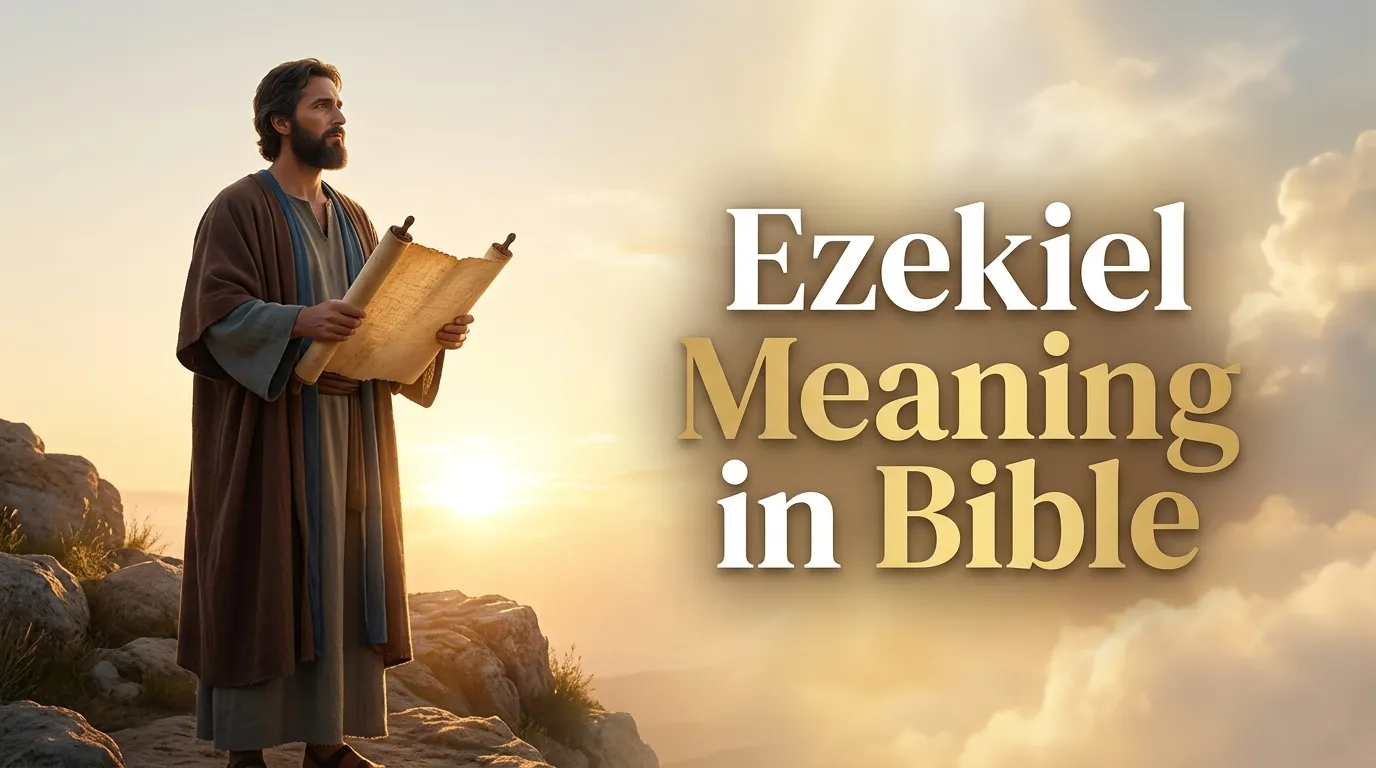
When American Bible readers, pastors, and content creators type “Ezekiel meaning in Bible,” they are looking for more than a dictionary definition.
They want the Hebrew roots of the name, the prophet’s story, the message of his book, and how that message still speaks to the church today.
The name Ezekiel means “God strengthens” or “God will strengthen.” That simple truth sits at the heart of one of the most vivid and hopeful books in the Old Testament.
In the pages ahead you will see the Hebrew background of the name, the historical setting of the prophet’s ministry, the major themes of the book that bears his name, key passages explained in context, and practical ways Bible study authors and ministry leaders can use Ezekiel’s message in the resources they create.
Quick Reference Table
| Aspect | Detail |
| Hebrew Name | יְחֶזְקֵאל (Yehezqel) |
| Meaning | “God strengthens” / “God will strengthen” |
| Root Words | ḥazaq (to strengthen) + El (God) |
| Historical Setting | Babylonian exile, 593–571 BC |
| Primary Audience | Jewish exiles in Babylon |
| Key Themes | God’s glory, judgment, restoration, new heart |
| Famous Visions | Chariot-throne, dry bones, new temple |
Hebrew Meaning of Ezekiel
The name Yehezqel combines two Hebrew elements. The verb ḥazaq means to be strong, to seize, to harden, or to strengthen. The second element is El, the common Old Testament word for God. Together they form the declaration “God strengthens” or “May God strengthen.”
This is not a private wish for the prophet alone. In the ancient Near Eastern world a name often announced a person’s calling or the character of the God who sent him. Every time someone spoke Ezekiel’s name, they were reminded that the Lord is the One who gives strength to the weak and upholds the failing.
Scripture never records Ezekiel explaining his own name, yet the theme of divine strength runs through his entire ministry. When the people felt abandoned in a foreign land, the prophet’s very identity pointed them back to the God who still had power to restore.
Biblical Context: Who Was Ezekiel and When Did He Serve?
Ezekiel was a priest from a Zadokite family (Ezekiel 1:3). In 597 BC the Babylonian king Nebuchadnezzar carried King Jehoiachin and many skilled Israelites into exile. Ezekiel was among them. Five years later, in the fifth year of Jehoiachin’s captivity (593 BC), the word of the Lord came to him by the Chebar canal in Babylon (Ezekiel 1:1–3).
His ministry lasted at least until 571 BC. During those years he received a series of dramatic visions and acted out strange symbolic messages. He lay on his side for hundreds of days, cooked food over dung, shaved his head, and refused to mourn openly when his wife died. Each action was a living sermon to a people who had lost their temple, their land, and, in many hearts, their hope.
The book of Ezekiel is carefully dated. Nearly every major section opens with a precise chronological marker. These dates allow us to place the prophet’s words against the historical backdrop of the final fall of Jerusalem in 586 BC and the long years of exile that followed. For Bible book creators this chronological clarity is a gift: the text itself invites careful historical teaching.
Key Bible Verses with Full Explanation
Ezekiel 1:28
“Like the appearance of the bow that is in the cloud on the day of rain, so was the appearance of the brightness all around. Such was the appearance of the likeness of the glory of the Lord. And when I saw it, I fell on my face, and I heard the voice of one speaking.”
This verse closes the opening vision of the chariot-throne. Ezekiel sees living creatures, wheels within wheels, and a sapphire-like expanse. Above it all is a human-like figure surrounded by radiance that looks like a rainbow. The prophet does not see God directly; he sees “the appearance of the likeness of the glory of the Lord.
Ezekiel 36:26–27
“And I will give you a new heart, and a new spirit I will put within you. And I will remove the heart of stone from your flesh and give you a heart of flesh.
Spoken to a people whose hearts had grown hard through idolatry and covenant breaking, these words announce a radical internal renewal. God Himself will replace the stone heart with a living one and place His Spirit inside His people so that obedience becomes possible.
Ezekiel 37:1–14 (the valley of dry bones)
The Spirit of the Lord sets Ezekiel down in a valley full of bones. They are very dry. The Lord asks, “Son of man, can these bones live?” Ezekiel answers, “O Lord God, you know.” Then he is commanded to prophesy. As he speaks, the bones come together, sinews and flesh appear, and finally breath enters them. The vision is explained: “These bones are the whole house of Israel.” God will open their graves, put His Spirit in them, and settle them in their own land.
Ezekiel 48:35
“And the name of the city from that time on shall be, The Lord Is There.”
The final verse of the book names the restored city Yahweh-Shammah. After chapters of temple measurements and land allotments, the closing word is relational presence. The God who left the temple in chapters 8–11 returns and stays. That is the ultimate strengthening.
Spiritual Meaning and Application
The name Ezekiel and the book that carries it announce that God’s strength is not limited by geography, political defeat, or the hardness of human hearts. He can strengthen a lone priest by a foreign canal. He can strengthen a nation that feels as lifeless as dry bones.
For American Christians living in a culture that often feels hostile or indifferent to the gospel, Ezekiel’s message is deeply pastoral. The glory of God is not confined to a building or a golden age of the past. It can appear beside a canal in Babylon. The same God still gives new hearts and puts His Spirit within His people.
Practical Application for Bible Book Creators and Authors
Bible study authors and ministry leaders can serve their readers well by treating Ezekiel with both theological seriousness and pastoral warmth.
- When writing devotionals, linger on the personal cost of Ezekiel’s obedience. His wife’s death (Ezekiel 24) and his enforced silence teach that faithfulness is sometimes lonely and costly.
- In group study materials, use the chronological markers to help readers track the unfolding drama. A simple timeline of the major visions prevents the book from feeling like a random collection of strange images.
- When teaching the dry bones vision, keep both the national and the personal applications clear. God can raise a people, and He can raise an individual soul.
- In commentary or teaching notes, highlight the movement from judgment to restoration. Readers need both the sobering truth of sin and the solid hope of new hearts and the Lord’s returning presence.
- For children’s or family resources, the vivid imagery of the chariot-throne and the dry bones can be presented carefully, always pointing beyond the spectacle to the character of God.
Accurate maps of the exile, simple explanations of priestly background, and clear distinctions between historical fulfillment and future hope will help readers trust the material you produce.
Common Misunderstandings
Some popular teaching treats every detail of Ezekiel’s temple vision as a literal blueprint for a future millennial structure. Other teachers spiritualize every measurement into pure allegory. Scripture itself does not force either extreme. The careful student will note that the vision is given as a pattern of holiness and presence, yet the New Testament never quotes it as architectural plans for the church age.
Another misunderstanding is to read the dry bones vision as a promise that every ethnic Israelite will automatically be saved. The text speaks of national restoration under the Spirit’s power; individual faith and repentance remain necessary, just as they do throughout the rest of Scripture.
FAQs
Q: What is the spiritual meaning of Ezekiel?
A: The spiritual meaning of Ezekiel is that God strengthens, calls, and restores His people through faith and obedience.
Q: What is the Ezekiel name meaning in Arabic?
A: In Arabic, Ezekiel is known as Hizqeel (حزقيال), and his name means “God strengthens.”
Q: What is Ezekiel Bible verse 25:17?
A: Ezekiel 25:17 describes God’s judgment on the Philistines and His promise to bring justice against those who oppose His people.
Q: What are the 6 visions of Ezekiel?
A: Ezekiel’s major visions include God’s throne, the temple’s corruption, dry bones, the restored temple, the life-giving river, and the return of God’s glory.
Q: What did Ezekiel do in the Bible?
A: Ezekiel served as a prophet, delivering God’s messages of judgment, repentance, hope, and future restoration to Israel.
Q: How did Ezekiel die?
A: The Bible does not record how Ezekiel died, and the details come only from later traditions.
Q: Was Ezekiel good in the Bible?
A: Yes, Ezekiel was a faithful prophet who obeyed God and boldly proclaimed His messages despite many challenges.
Q: How did the prophet Ezekiel die?
A: Scripture does not explain how the prophet Ezekiel died, although some ancient traditions suggest he was martyred.
Conclusion
The meaning of Ezekiel in the Bible is more than a linguistic footnote. It is a living declaration that the God of Israel strengthens His people when they have no strength of their own. From the banks of the Chebar canal to the closing promise of a city named “The Lord Is There,” the book shows a God who judges sin, renews hearts, and refuses to abandon His own.
For every Bible book creator, pastor, and believer who opens these pages, the same invitation remains: trust the God who strengthens. He is still able to put His Spirit within dry bones and make them live.
Discover More Post
- Christ Meaning in Bible: Origin, Purpose & Truth
- Anoint Meaning in Bible: Symbolism, Purpose & Meaning
- Consecration Meaning in the Bible: A Complete Biblical Guide
- Gentiles Meaning in Bible: What Does It Really Mean?