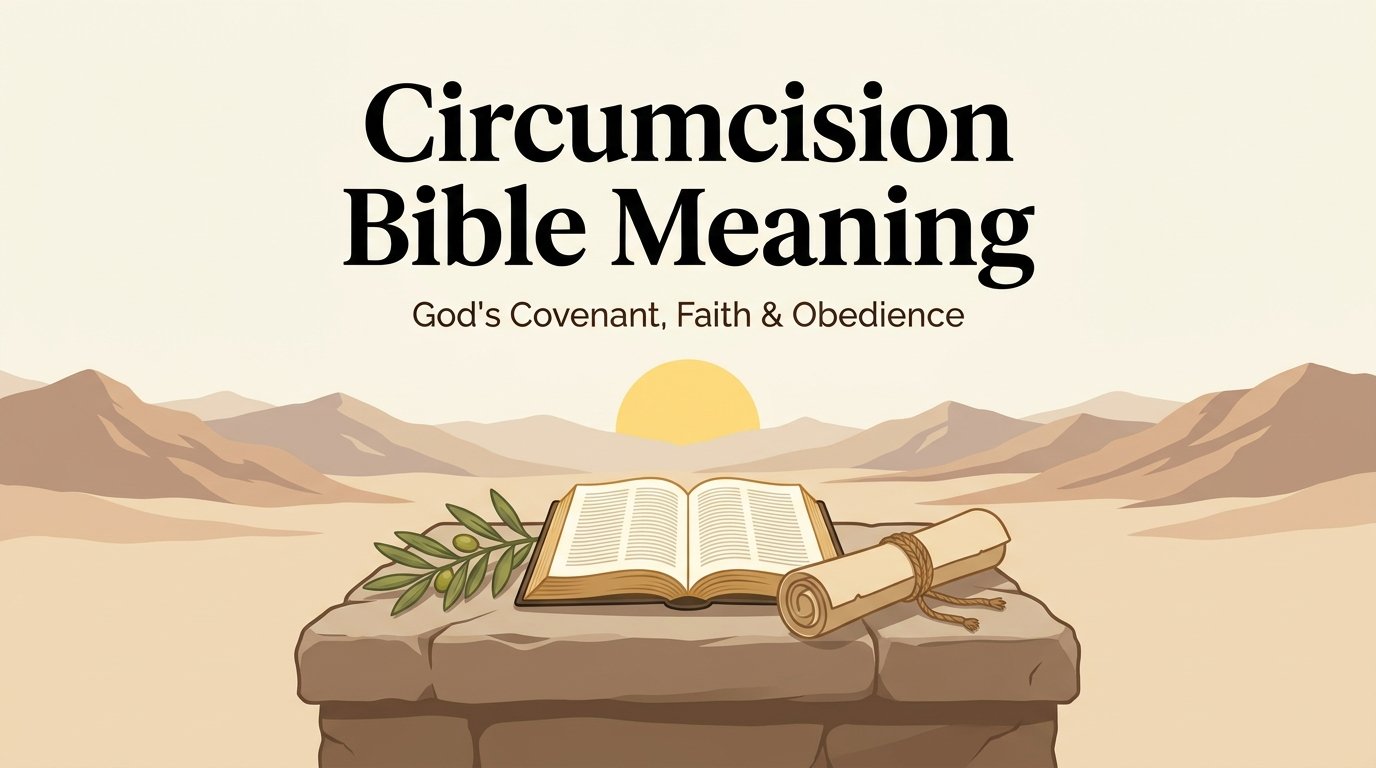
The circumcision Bible meaning centers on a physical act that God established as the outward sign of His covenant with Abraham, later fulfilled and transformed in the New Testament as a matter of the heart.
For American Christian authors, publishers, editors, and ministry leaders creating Bible study resources, devotionals, and commentaries, grasping this truth equips you to teach Scripture with clarity and faithfulness.
In the pages ahead you will discover the historical roots, key passages with full context, the shift from physical to spiritual circumcision, common misunderstandings, and practical ways to present this topic accurately in your books and materials.
Quick Reference Table
| Aspect | Old Testament Focus | New Testament Focus |
| Primary Meaning | Physical sign of Abrahamic covenant | Spiritual cutting away of the sinful nature |
| Key Command | Genesis 17:10-14 | Romans 2:28-29; Colossians 2:11 |
| Who It Applied To | Male descendants of Abraham and household | Every believer in Christ by faith |
| Requirement for Belonging | Necessary for covenant membership in Israel | Not required for salvation or church membership |
| Heart Connection | Called for in Deuteronomy 10:16; 30:6 | Fulfilled by the Spirit (Romans 2:29) |
This table offers a fast overview. The rest of the article unpacks each point with Scripture so you can teach with confidence.
Biblical Meaning
In the Bible, circumcision is first and foremost a covenant sign. God gave it to Abraham as a visible mark that he and his male offspring belonged to the people God had chosen. Genesis 17 records the moment clearly. God appeared to Abraham, changed his name from Abram, and declared an everlasting covenant. The physical act of removing the foreskin became the seal of that promise. Every male born in Abraham’s household or bought with money was to be circumcised on the eighth day. Failure to do so meant being cut off from the people.
This was never presented as a way to earn God’s favor. Abraham already believed God, and that faith was counted to him as righteousness long before the command of circumcision (Genesis 15:6). The rite simply marked the covenant relationship that already existed by God’s gracious choice. Later, under the Mosaic Law, circumcision remained the entry sign into the community of Israel. It was required for participation in the Passover (Exodus 12:48) and became part of Israel’s national identity.
The prophets and the Law itself already pointed beyond the physical act. Moses urged the people to circumcise their hearts (Deuteronomy 10:16). Jeremiah repeated the call (Jeremiah 4:4). God Himself promised to perform that deeper work (Deuteronomy 30:6). The physical sign always pointed toward an inward reality of belonging to God and living in obedience to Him.
Hebrew and Greek Meaning
The Hebrew word most often translated “circumcision” is milah, from the root mul, meaning “to cut off” or “to circumcise.” The related noun orlah refers to the foreskin itself. These terms appear throughout the Pentateuch and historical books whenever the covenant sign is discussed.
In the Greek New Testament the word is peritome, literally “a cutting around.” Paul uses it frequently, sometimes to describe the physical practice and sometimes to describe the spiritual reality. He also employs the opposite term akrobustia for “uncircumcision.” Understanding these original words helps authors avoid treating circumcision as a vague religious custom. It was a deliberate, covenantal cutting that marked identity and belonging.
Biblical Context
The story begins with Abraham around 2000 BC. God chose one man and his descendants to be the channel of blessing for all nations (Genesis 12:1-3). Circumcision set Abraham’s family apart from the surrounding peoples. It was not a health practice invented by Israel; neighboring cultures sometimes practiced forms of circumcision, yet God gave it unique covenantal meaning for His people.
Under the Law given through Moses, circumcision continued as the sign of belonging to the nation that carried the promises. Joshua 5 records the mass circumcision of the wilderness generation before they entered the landan act of renewed covenant commitment. Throughout Israel’s history the physical mark remained, even when the people’s hearts often wandered.
When Jesus came, He was circumcised on the eighth day according to the Law (Luke 2:21). He fulfilled every requirement of the covenant. After His death and resurrection, the early church faced a defining question: Must Gentile believers be circumcised to be saved and fully included? The Jerusalem Council in Acts 15 settled the matter. Salvation is by grace through faith in Christ alone. Physical circumcision is not required. Paul later wrote with strong clarity on this point, especially in Galatians and Romans, because some teachers insisted that Gentile Christians must keep the Jewish ceremonial law.
Key Bible Verses with Full Explanation
Genesis 17:10-14
“This is my covenant, which you shall keep, between me and you and your offspring after you: Every male among you shall be circumcised. You shall be circumcised in the flesh of your foreskins, and it shall be a sign of the covenant between me and you. He who is eight days old among you shall be circumcised.
God Himself institutes the sign. The eighth day became the standard. The phrase “cut off from his people” shows the seriousness of the covenant. This passage is foundational for any Bible study book or commentary that treats the Abrahamic covenant.
Deuteronomy 10:16
“Circumcise therefore the foreskin of your heart, and be no longer stubborn.”
Moses already points beyond the flesh. External obedience without internal change is incomplete. Authors writing on spiritual formation can use this verse to show continuity between the Testaments.
Romans 2:28-29
“For no one is a Jew who is merely one outwardly, nor is circumcision outward and physical. But a Jew is one inwardly, and circumcision is a matter of the heart, by the Spirit, not by the letter. His praise is not from man but from God.”
Colossians 2:11-12
“In him also you were circumcised with a circumcision made without hands, by putting off the body of the flesh, by the circumcision of Christ, having been buried with him in baptism, in which you were also raised with him through faith in the powerful working of God, who raised him from the dead.”
Galatians 5:6
“For in Christ Jesus neither circumcision nor uncircumcision counts for anything, but only faith working through love.”
Spiritual Meaning and Application
The spiritual meaning of circumcision is the decisive removal of the old, sinful nature and the creation of a new heart that belongs fully to God. Just as the physical act cut away flesh, the Spirit cuts away the power of sin and self-rule. Believers are no longer defined by ethnic or ceremonial markers. They are defined by their union with Christ.
This truth encourages every Christian. You do not earn God’s acceptance by external performance. You receive a new heart by grace. At the same time, the call remains to live in a way that matches the new identityputting off the old self and putting on the new (Ephesians 4:22-24). For pastors and teachers, this balance prevents both legalism and license.
Symbolism
Circumcision symbolizes belonging, purity, and covenant loyalty. The cutting away of flesh pictures the need to put to death the deeds of the body (Romans 8:13). The eighth-day timing, coming after a full week, has been understood by many as pointing to a new beginning. In the New Testament the symbol is transferred to the heart and linked with baptism as the public sign of entrance into the new covenant community. The symbolism never encourages self-mutilation or pride in external marks. It always points to God’s gracious initiative and the believer’s response of faith and obedience.
Practical Application for Bible Book Creators and Authors
When you write a Bible study, devotional, or commentary that touches this topic, begin with the clear narrative of Genesis 17 and move carefully through the progressive revelation. Show your readers that physical circumcision was never the means of salvation. Highlight the prophets’ call for heart circumcision and Paul’s teaching that the Spirit fulfills that call. Avoid both extremes: do not treat the Old Testament command as irrelevant, and do not impose it as a requirement for Christians today.
Use the full context of each passage. When discussing Galatians, explain the historical pressure the Galatian churches faced. When treating Colossians, connect spiritual circumcision to the believer’s complete identification with Christ’s death and resurrection. Provide discussion questions that help small groups move from information to heart application: “Where do I still rely on external performance rather than the Spirit’s work?” “How does my identity in Christ free me from comparing myself with others?”
Include the original language terms sparingly and explain them in plain English. American readers appreciate accuracy without feeling overwhelmed by technical detail. Finally, always point beyond the sign to the Savior. Circumcision, whether physical or spiritual, finds its ultimate meaning in the One who was cut off for our sins so that we might be brought near.
Common Misunderstandings
One common error is to treat circumcision as a health or cultural practice that just happened to be adopted by Israel. Scripture presents it as a divine command with covenantal weight. Another misunderstanding is that New Testament believers must still practice physical circumcision to be fully obedient. The Jerusalem Council and Paul’s letters reject that view. A third mistake is to spiritualize the Old Testament texts so thoroughly that the historical reality disappears. The physical act happened; it mattered; and it pointed forward. Good teaching holds both the historical fact and the spiritual fulfillment together.
FAQs
Q: What is the meaning of circumcision in the Bible in the New Testament?
A: In the New Testament, circumcision symbolizes faith and a transformed heart rather than being required for salvation.
Q: What does circumcised mean?
A: Circumcised means the foreskin has been removed, and in the Bible it often represents belonging to God’s covenant people.
Q: What is the spiritual meaning of circumcision in the Bible?
A: Spiritually, circumcision represents inner purity, obedience to God, and a heart devoted to Him.
Q: What is the spiritual significance of circumcision?
A: The spiritual significance of circumcision is the inward transformation of the heart through faith and obedience to God.
Q: What is the meaning of circumcision in the Bible in Galatians 5?
A: In Galatians 5, circumcision teaches that salvation comes through faith in Christ, not by keeping the law.
Q: What do circumcised and uncircumcised mean in the Bible?
A: In the Bible, circumcised and uncircumcised refer to covenant identity, but in Christ, faith matters more than physical circumcision.
Q: Is circumcision in the Bible the same as today?
A: Physically, circumcision is similar today, but biblically it also carried covenant and spiritual significance beyond the medical procedure.
Q: What is the meaning of circumcision in the Bible in the Old Testament?
A: In the Old Testament, circumcision was the sign of God’s covenant with Abraham and a mark of belonging to His chosen people.
Conclusion
The circumcision Bible meaning ultimately leads us to the grace of God. What began as a physical mark on Abraham’s descendants finds its fulfillment in the Spirit’s work within every believer.
For those of you who write, edit, and publish resources for the church, this doctrine offers a rich opportunity to display the unity of Scripture and the sufficiency of Christ.
Teach it with care, root every claim in the text, and let your readers see that the same God who called Abraham is still cutting away the old and creating new hearts today.
As Paul wrote, “neither circumcision nor uncircumcision counts for anything, but only faith working through love.” May your books and studies help many walk in that freedom.
Discover More Post
- Christ Meaning in Bible: Origin, Purpose & Truth
- Anoint Meaning in Bible: Symbolism, Purpose & Meaning
- Consecration Meaning in the Bible: A Complete Biblical Guide
- Gentiles Meaning in Bible: What Does It Really Mean?

Hi, I’m James Patterson, a storyteller who loves creating thrilling mysteries, unforgettable characters, and page-turning adventures. Through TheBiblimeaning, I share insights about authors, books, literary meanings, biographies, and the stories behind famous writers. My goal is to help readers discover the deeper world of literature while enjoying engaging and informative content.