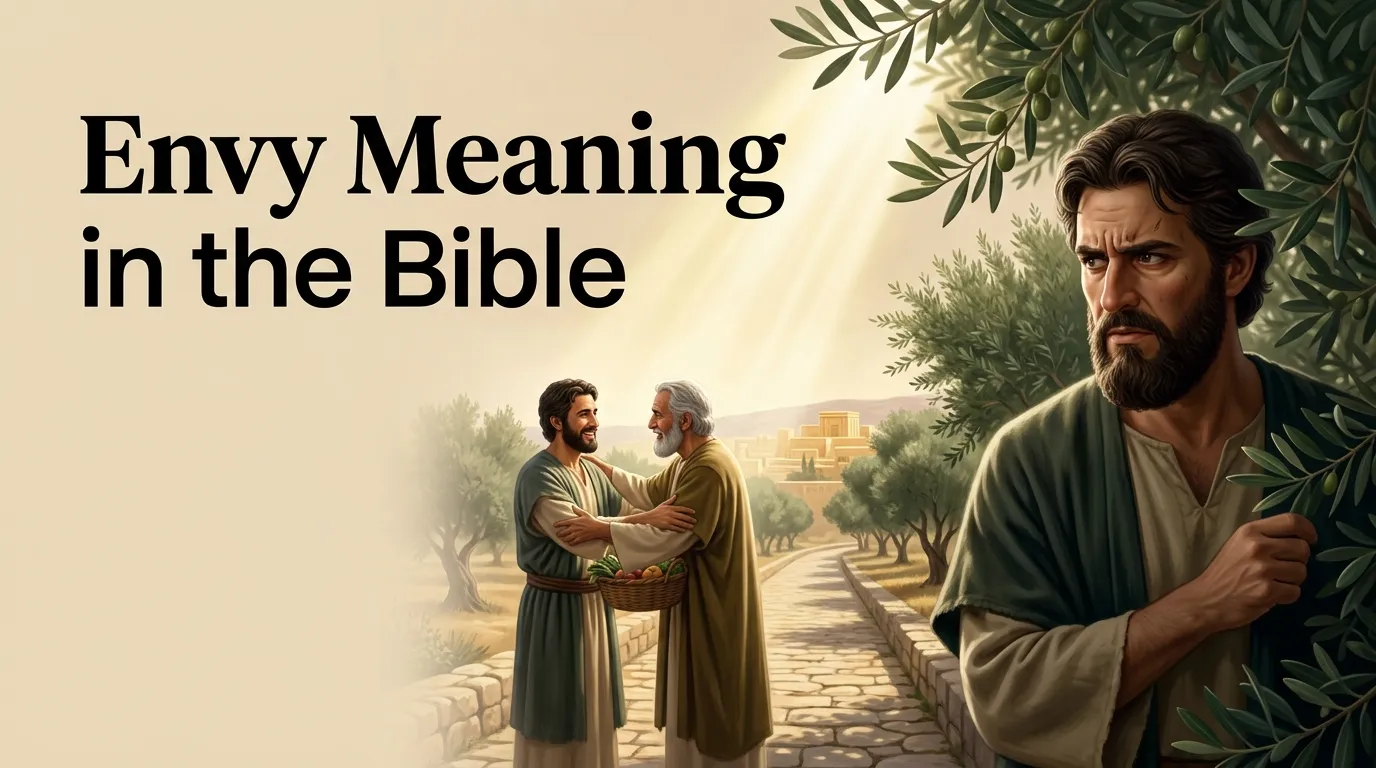
What does the Bible mean by envy? Envy is a resentful longing for what another person has whether possessions, position, success, favor, or spiritual blessing paired with displeasure that they enjoy it.
Scripture never treats envy as a neutral emotion or a mild character flaw.
It consistently presents envy as a work of the flesh that corrodes the heart, damages relationships, and opposes the love that God calls His people to walk in.
Quick Reference Table
| Aspect | Biblical Insight | Key Reference |
| Core Definition | Resentful desire for another’s good + displeasure at their having it | Proverbs 14:30; Galatians 5:21 |
| Hebrew Root | qin’ah (can mean zeal or envy depending on context) | Proverbs 14:30 |
| Primary Greek Term | phthonos (always negative) | Galatians 5:21; Matthew 27:18 |
| Opposite | Love that does not envy; contentment in God | 1 Corinthians 13:4 |
| Result if Unchecked | Rot of the bones; disorder and every evil practice | Proverbs 14:30; James 3:16 |
| Remedy | Put off the old self; walk by the Spirit; rejoice with those who rejoice | 1 Peter 2:1; Galatians 5:16, 22–23 |
Biblical Meaning of Envy
The Bible distinguishes envy from legitimate desire and from godly jealousy. Envy is not simply wanting something good. It is the painful awareness that someone else already possesses a good thing, joined with a desire that they lose it or that you take it from them.
Classic English definitions capture the idea well: “We are jealous of our own; we are envious of another man’s possessions. Jealousy fears to lose what it has; envy is pained at seeing another have. Scripture agrees. Envy looks at a neighbor’s blessing and feels diminished by it. It is the opposite of love, which “does not envy (1 Corinthians 13:4).
From the first pages of Genesis, envy appears as a deadly force. Cain’s face fell when God accepted Abel’s offering. Rather than examine his own heart, Cain nursed resentment until it produced murder (Genesis 4). Joseph’s brothers could not speak peaceably to him because of the favor their father showed him and the dreams God gave him (Genesis 37). Saul’s heart turned against David the moment the women sang that David had slain his tens of thousands (1 Samuel 18). In the New Testament the religious leaders handed Jesus over to Pilate “out of envy (Matthew 27:18; Mark 15:10).
Envy is never portrayed as a private struggle that stays private. It produces strife, disorder, and “every evil practice (James 3:16). It is listed among the works of the flesh that keep people from inheriting the kingdom of God (Galatians 5:19–21). Believers are therefore commanded to put it away completely (1 Peter 2:1; Galatians 5:26).
Hebrew and Greek Meanings
In the Old Testament the primary Hebrew word behind envy is qin’ah (from the root qana’). The root carries the idea of intense emotion that makes the face flush or burn. Context decides whether the intensity is holy zeal or sinful envy. When the same word describes God’s jealousy for His people or a husband’s rightful jealousy for his wife, it is positive. When it describes human resentment toward another’s success or favor, it is negative. Proverbs 14:30 uses qin’ah in the destructive sense: “A tranquil heart gives life to the flesh, but envy makes the bones rot.
The New Testament employs two main Greek terms. Phthonos is the clearer word for envy. It appears only in a negative sense and refers to the ill will that arises when someone else prospers. It is the term used in Galatians 5:21, Romans 1:29, Titus 3:3, and 1 Peter 2:1. Zelos can mean either healthy zeal or sinful jealousy/envy, depending on the context. Modern translations often render the negative uses of zelos as “jealousy to keep the distinction clear.
Scholars note that phthonos never describes a good emotion in the New Testament. It is always a vice. That consistency helps Bible teachers and authors speak accurately when they address the subject.
what does envy mean in the bible
In the Bible, envy means wanting what another person has while feeling unhappy about their good. It can grow when we compare our life with others. Envy may affect the heart, words, and actions. Proverbs warns that envy can harm a person from within. God calls us to be thankful for what He gives us. We can fight envy by trusting God and loving others. Their blessings do not lessen what God has planned for us.
Bible Verse: “A tranquil heart gives life to the flesh, but envy makes the bones rot.” — Proverbs 14:30
envyings definition bible
In the Bible, “envyings” means strong feelings of jealousy toward another person. It may happen when someone has more honor, wealth, success, or gifts. Galatians lists envy among works that can pull people away from a life led by the Spirit. Envy turns our eyes toward what others have instead of what God has given us. Scripture calls us to walk in love, kindness, and contentment. A thankful heart helps us see God’s gifts with joy.
Bible Verse: “Let us not become conceited, provoking one another, envying one another.” — Galatians 5:26
envy definition
Envy is a deep desire for what belongs to someone else, often mixed with sadness or anger over their good. The Bible treats envy as a heart problem, not only an outward act. James shows that envy can lead to conflict and harmful desires. It can make us compare our lives with others and forget God’s care for us. Biblical wisdom points us toward peace, humility, and love. Instead of envying others, we can thank God for His gifts.
Bible Verse: “Where jealousy and selfish ambition exist, there will be disorder.” — James 3:16
envy bible definition
The Bible defines envy as a sinful desire that can rise when we see another person receive something good. It is more than simple admiration. Envy can make us wish that another person did not have their blessing. Titus warns believers about living in envy and hatred. God wants His people to leave such ways behind and live with kindness and grace. When envy appears, we can bring our thoughts to God and choose love instead.
Bible Verse: “We ourselves were once foolish… living in malice and envy.” — Titus 3:3
what is envy in the bible
Envy in the Bible is a wrong desire that grows when we compare ourselves with others. A person may envy another’s money, beauty, position, gifts, family, or success. Genesis gives a clear picture of envy in the story of Joseph. His brothers became jealous because their father showed Joseph special love. Their envy led to deep harm. This shows why envy should be dealt with early. God calls us to love others and rejoice in what is good.
Bible Verse: “His brothers were jealous of him, but his father kept the saying in mind.” — Genesis 37:11
envy in the bible meaning
The meaning of envy in the Bible points to a heart that struggles with another person’s good. Instead of being glad for them, envy can bring sadness, anger, or resentment. 1 Corinthians teaches that love does not envy. This gives a simple answer to the problem: love changes how we see others. When someone is blessed, we can thank God for them rather than compare ourselves with them. Love helps us celebrate their good without feeling that we have less.
Bible Verse: “Love does not envy or boast.” — 1 Corinthians 13:4
envy biblical definition
A biblical definition of envy is a sinful desire for another person’s place, gift, blessing, or success. It can begin in the heart before it appears in our actions. Psalm 37 gives a wise answer to this struggle. It tells us not to fret because of people who seem to prosper. Instead, we should trust the Lord and do good. Envy loses its power when we stop comparing our path with others and rest in God’s care.
Bible Verse: “Fret not yourself because of evildoers; be not envious of wrongdoers!” — Psalm 37:1
Key Bible Verses with Full Explanation
Proverbs 14:30
“A tranquil heart gives life to the flesh, but envy makes the bones rot.
Solomon contrasts two internal conditions. A heart at peace produces health. Envy produces decay from the inside out. The image is vivid: the very structure that should support life is eaten away. This is not poetic exaggeration; it is pastoral diagnosis. Envy quietly destroys the person who carries it.
Galatians 5:19–21
Paul lists the works of the flesh and includes “envy (and in some manuscripts “envyings). He warns that those who practice such things will not inherit the kingdom of God. Envy sits alongside sexual immorality, idolatry, strife, and drunkenness. It is not a lesser sin. It is evidence of a life still ruled by the flesh rather than the Spirit.
James 3:14–16
“But if you have bitter jealousy and selfish ambition in your hearts, do not boast and be false to the truth. This is not the wisdom that comes down from above, but is earthly, unspiritual, demonic. For where jealousy and selfish ambition exist, there will be disorder and every vile practice.
James connects envy (bitter jealousy) with selfish ambition and shows the fruit: chaos and every kind of evil. He labels the “wisdom that produces envy as demonic in origin. The pastoral implication is clear: envy is never merely a personality quirk; it is spiritual poison.
1 Corinthians 13:4
“Love is patient and kind; love does not envy or boast.
Paul places the absence of envy at the heart of Christian love. If love is present, envy cannot thrive. This verse becomes a diagnostic tool for believers and a standard for Christian authors writing about relationships and community.
Matthew 27:18 and Mark 15:10
Pilate “knew that it was out of envy that they had delivered him up. The religious leaders’ envy of Jesus’ popularity and authority moved them to seek His death. Envy can drive people to oppose even the Son of God.
1 Peter 2:1
“So put away all malice and all deceit and hypocrisy and envy and all slander.
Peter commands believers to rid themselves of envy the same way they would discard dirty clothes. It belongs to the old way of life that has been left behind in Christ.
Spiritual Meaning and Application
Envy reveals a heart that has not yet rested fully in God’s goodness and sovereignty. When we envy, we implicitly question whether God has given us enough, whether His timing is wise, and whether His distribution of gifts is just. Contentment, by contrast, trusts that the Father who did not spare His own Son will also graciously give us all things (Romans 8:32).
The gospel offers the only lasting remedy. In Christ we receive an inheritance that cannot be diminished by anyone else’s blessing. The Spirit produces love, joy, and peacethe very qualities that starve envy. Walking by the Spirit (Galatians 5:16) is not a vague spiritual slogan; it is the daily practice of setting our minds on things above, giving thanks in all circumstances, and rejoicing with those who rejoice (Romans 12:15).
For mature believers and pastors, the call is to examine not only obvious envy of material success but the subtler forms: envy of another’s ministry platform, book sales, speaking invitations, or apparent spiritual fruit. These forms of envy still “rot the bones and still produce disorder in the body of Christ.
Common Misunderstandings
Some readers assume envy and jealousy are identical. Scripture allows a distinction: jealousy can be righteous when it guards a covenant relationship (as God’s jealousy for His people or a husband’s jealousy for his wife). Envy is never righteous.
Others treat envy as a private emotion that does not require confession or repentance. James and Paul disagree. Envy is listed among sins that must be put to death and put away.
Still others believe envy is mainly a problem for the immature. The New Testament addresses it to churches and mature leaders. Even apostles faced the temptation when others preached Christ from envy (Philippians 1:15). The issue is not maturity level but ongoing dependence on the Spirit.
Practical Application for Bible Book Creators and Authors
When you write devotionals, study guides, or commentaries on passages that touch envy, aim for both clarity and pastoral warmth.
- Define terms carefully. Distinguish envy from jealousy and from healthy desire so readers are not confused.
- Use the full context of key verses rather than isolated slogans. Readers need to see how envy functioned in Cain’s life, Saul’s life, and the religious leaders’ opposition to Jesus.
- Offer concrete gospel remedies. Contentment, gratitude, and rejoicing with others are not mere positive thinking; they flow from the finished work of Christ and the indwelling Spirit.
- Address subtle forms of envy that appear in ministry and publishing circlescomparison of platforms, book sales, or perceived influencewithout becoming harsh.
- Include reflection questions that invite honest self-examination while pointing readers to the sufficiency of Christ.
- In children’s or family resources, illustrate the danger of envy through the biblical stories while always highlighting God’s grace and the better way of love.
Accurate, Scripture-saturated writing on this topic equips pastors, small-group leaders, and everyday believers to recognize envy early and to fight it with gospel truth.
FAQs
Q: What does drunkenness mean in the Bible?
A: In the Bible, drunkenness is the sinful act of losing self-control through excessive drinking and is repeatedly condemned.
Q: Is envy a sin according to the Bible?
A: Yes, the Bible teaches that envy is a sin because it leads to resentment, selfishness, and broken relationships.
Q: What are the consequences of envy in the Bible?
A: The Bible says envy can produce conflict, bitterness, spiritual harm, and separation from God’s will.
Q: What does the Bible say about envy and jealousy?
A: The Bible warns against envy and sinful jealousy, encouraging believers to pursue love, contentment, and humility instead.
Q: How can you overcome envy according to the Bible?
A: The Bible teaches that envy is overcome by trusting God, practicing gratitude, loving others, and focusing on His blessings.
Q: What does murders mean in the Bible?
A: In the Bible, murders refer to the intentional and unlawful taking of human life, which God clearly forbids.
Q: What does jealousy mean in the Bible?
A: In the Bible, jealousy can describe either sinful human envy or God’s righteous desire for His people’s faithful devotion.
Q: What causes envy according to the Bible?
A: The Bible shows that envy often comes from pride, selfish desires, discontentment, and comparing ourselves with others.
Conclusion
Envy is a quiet thief that steals joy, poisons relationships, and blinds us to the goodness of God. Yet the same Scripture that diagnoses the disease also points to the cure. In Christ we have been given every spiritual blessing in the heavenly places. The Spirit who raised Jesus from the dead lives in us and produces the fruit of love that “does not envy.
For every Bible author, editor, publisher, and ministry leader, the call is the same: handle this topic with accuracy, pastoral care, and gospel hope.
Discover More Post
- Christ Meaning in Bible: Origin, Purpose & Truth
- Anoint Meaning in Bible: Symbolism, Purpose & Meaning
- Consecration Meaning in the Bible: A Complete Biblical Guide
- Gentiles Meaning in Bible: What Does It Really Mean?

Hi, I’m James Patterson, a storyteller who loves creating thrilling mysteries, unforgettable characters, and page-turning adventures. Through TheBiblimeaning, I share insights about authors, books, literary meanings, biographies, and the stories behind famous writers. My goal is to help readers discover the deeper world of literature while enjoying engaging and informative content.