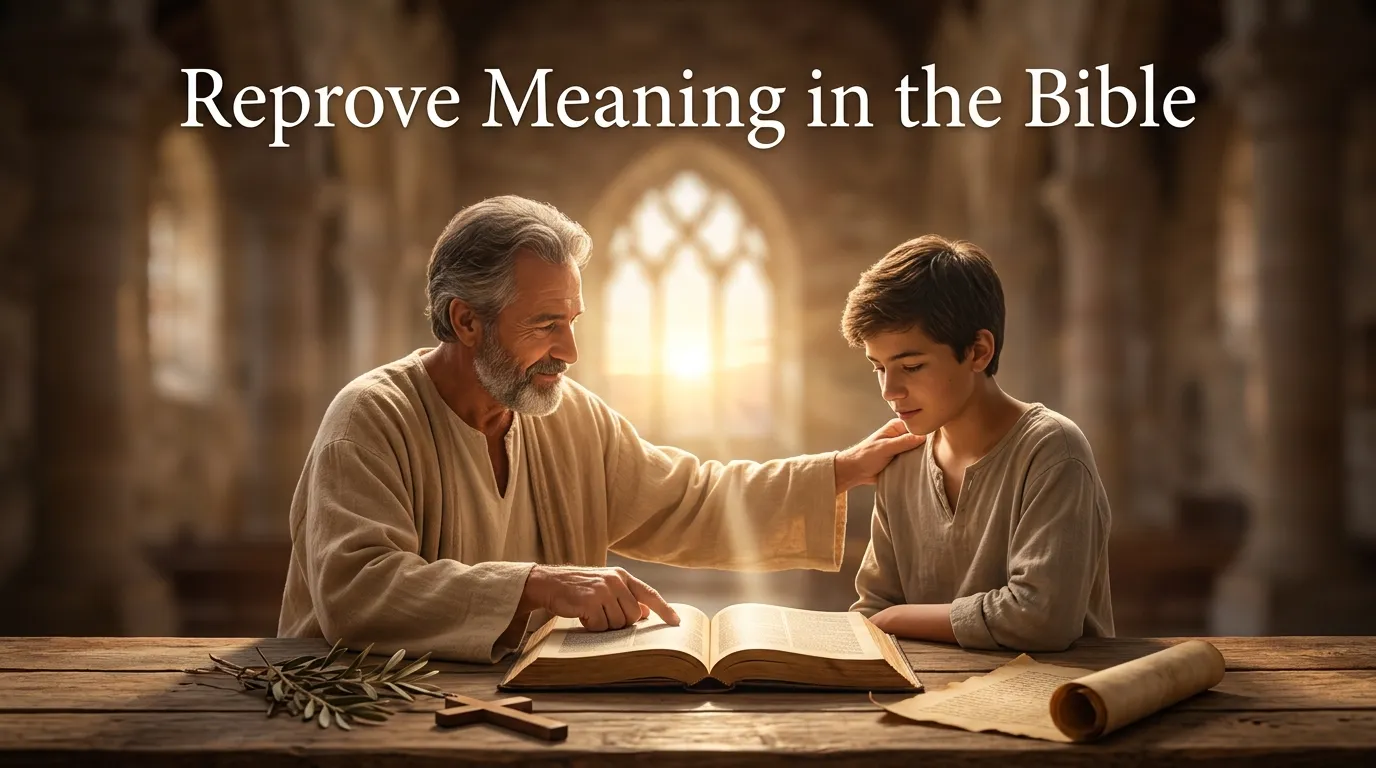
The reprove meaning in the Bible centers on loving correction pointing out sin, error, or wrongdoing with the goal of restoring someone to right living, not shaming them.
In Scripture, to reprove means to convict, rebuke, or convince someone of a fault so they can turn from it and grow closer to God.
It appears in both the Old Testament and New Testament, tied to God’s discipline, the Holy Spirit’s work, and how believers are called to correct one another in love.
This article breaks down what “reprove” means in its original Hebrew and Greek, walks through the key Bible verses that use the word, and explains its spiritual significance.
If you write Bible studies, devotionals, or commentaries, you’ll also find practical guidance for handling this word accurately and helpfully in your own content.
Reprove meaning in the bible
In the Bible, reprove means to correct someone when their words or actions are wrong. It is not meant to shame a person. It is meant to help them turn back to what is right. Scripture shows that wise correction can lead to growth and a better path. In 2 Timothy 3:16, Paul says that Scripture is useful for “reproof” and teaching. This shows that God’s Word can reveal sin and guide us toward truth. Biblical reproof should come with love, wisdom, and a desire to help.
Bible Verse: “All scripture is given by inspiration of God, and is profitable for doctrine, for reproof…” — 2 Timothy 3:16 (KJV)
What does reprove mean
To reprove means to point out a wrong and call someone toward what is right. The Bible uses this idea as part of loving correction. Reproof can help a person see a sin that they may not have noticed. It should not come from pride or anger. Proverbs 27:5 shows that open correction can be better than love that stays silent. When done with care, reproof can protect a person from harm and help them grow in wisdom. God also uses His Word to correct our hearts and actions.
Bible Verse: “Open rebuke is better than secret love.” — Proverbs 27:5 (KJV)
Reprove definition bible
The Bible meaning of reprove is to correct, expose, or show that something is wrong. It can refer to correcting sinful actions, false ideas, or harmful choices. Reproof is meant to lead a person toward truth, not simply make them feel bad. Ephesians 5:11 tells believers to have no part in works of darkness but to “reprove” them. This teaches that Christians should not approve of sin. At the same time, correction should be guided by truth and love. Biblical reproof points people back to God’s good ways.
Bible Verse: “Have no fellowship with the unfruitful works of darkness, but rather reprove them.” — Ephesians 5:11 (KJV)
Reproves meaning in the bible
Reproves means corrects, exposes, or shows that something is wrong. In the Bible, God may reprove people because He wants them to leave a wrong path. His correction is not a sign that He has stopped caring. Proverbs 3:11–12 teaches that the Lord corrects those He loves. This gives reproof a deeper meaning. God’s correction can be an act of love that leads to wisdom and change. The same principle can guide believers when they correct others. True reproof should seek healing, truth, and spiritual growth.
Bible Verse: “Whom the LORD loveth he correcteth.” — Proverbs 3:12 (KJV)
Reprove in the bible
The word reprove appears in the Bible in places where wrong must be faced with truth. Jesus also taught His followers to deal with sin in a wise and direct way. Luke 17:3 says, “If thy brother trespass against thee, rebuke him.” This shows that believers should not ignore serious wrong. Yet correction should not become harsh or proud. The goal is to help restore what is broken. Biblical reproof calls attention to sin while leaving room for repentance, grace, and a changed life through God’s help.
Bible Verse: “If thy brother trespass against thee, rebuke him; and if he repent, forgive him.” — Luke 17:3 (KJV)
Reproved meaning in the bible
Reproved means that someone was corrected, shown to be wrong, or warned about a wrong action. The Bible often presents reproof as a chance to learn and change. In John 3:20, Jesus explains that people may avoid the light because their deeds are evil. God’s truth can expose what we would rather hide. Being reproved may feel hard, but it can lead to honest repentance. A wise person does not reject every correction. Instead, they examine it and seek to follow God’s truth.
Bible Verse: “He that doeth truth cometh to the light, that his deeds may be made manifest.” — John 3:21 (KJV)
What does reprove mean?
Reprove means to correct someone by showing that a thought, word, or action is wrong. In Scripture, reproof is often linked with wisdom and growth. Proverbs 9:8–9 teaches that a wise person can receive correction and become wiser. This gives us an important lesson: correction is not always an attack. Sometimes it is a gift that helps us grow. Christians should be willing to receive godly correction and give it with care. The purpose is not to win an argument but to help a person walk closer to God.
Bible Verse: “Reprove not a scorner, lest he hate thee: rebuke a wise man, and he will love thee.” — Proverbs 9:8 (KJV)
Reproves definition
Reproves means corrects or exposes something that is wrong. In a biblical sense, it can describe how God’s truth reveals sin and calls people to change. Hebrews 12:6 teaches that the Lord disciplines those He loves. His correction has a purpose. It can turn our hearts away from harmful choices and back toward His ways. This also teaches us how to view godly correction from others. Reproof should be honest, but it should also be kind and wise. Good correction helps a person grow instead of pushing them away.
Bible Verse: “For whom the Lord loveth he chasteneth.” — Hebrews 12:6 (KJV)
Quick Reference Table
| Aspect | Details |
| English Word | Reprove |
| Hebrew Root | yakach (יָכַח) to correct, rebuke, decide, convince |
| Greek Root | elegchō (ἐλέγχω) to convict, expose, correct, rebuke |
| Core Meaning | Loving correction aimed at repentance and restoration |
| Key OT Verses | Proverbs 3:12; Proverbs 27:5; Psalm 141:5; Leviticus 19:17 |
| Key NT Verses | John 16:8; Ephesians 5:11; 2 Timothy 4:2; Revelation 3:19 |
| Who Reproves | God, the Holy Spirit, parents, friends, church leaders |
| Purpose | Repentance, growth, restored fellowship not condemnation |
| Related Words | Rebuke, correct, convict, admonish, chasten |
Biblical Meaning
To reprove someone in the Bible means to point out their sin or error clearly and honestly, with the purpose of helping them see it and turn away from it. It’s not the same as criticism for its own sake, and it’s not gossip or public shaming. Biblical reproof carries a redemptive purpose. The goal is always restoration, not condemnation.
Scripture presents reproof as an act of love. Proverbs 27:5 says plainly, “Open rebuke is better than secret love.” That verse captures the heart of biblical reproof a caring person who tells you the truth is doing you a greater kindness than someone who stays silent to avoid conflict.
Reproof shows up in a few different relationships throughout the Bible:
- God reproves His people through His Word, His discipline, and circumstances that get their attention.
- The Holy Spirit reproves the world of sin, righteousness, and judgment, as Jesus explained in John 16:8.
- Believers are called to reprove one another in love, with humility and gentleness, aiming for repentance rather than defeat.
Understanding this word matters for anyone writing Bible studies or devotionals, because “reprove” often gets confused with harsh criticism. The biblical picture is far warmer and more purposeful than that.
Hebrew and Greek Meaning
The Old Testament word most often translated “reprove” is the Hebrew yakach (יָכַח). This word carries a legal and relational sense. It can mean to decide a matter, to argue a case, to correct, or to convince someone of wrongdoing. It shows up in courtroom-style contexts as well as personal relationships, which tells us that biblical reproof is meant to establish truth clearly, not just express disapproval.
In the New Testament, the Greek word is elegchō (ἐλέγχω). This word means to convict, expose, or bring to light. It’s the same word Jesus uses in John 16:8 when He describes the Holy Spirit’s work of convicting the world “of sin, and of righteousness, and of judgment.” The word implies more than pointing something out it means bringing clarity so the truth becomes undeniable.
Both the Hebrew and Greek roots share a common thread: reproof exposes what’s hidden so it can be dealt with honestly. It’s diagnostic before it’s corrective. You can’t repent of a sin you don’t see clearly, and that’s exactly what biblical reproof is designed to help someone do.
Key Bible Verses with Full Explanation
Proverbs 3:11–12 “My son, despise not the chastening of the LORD; neither be weary of his correction: For whom the LORD loveth he correcteth; even as a father the son in whom he delighteth.”
This passage frames reproof as evidence of God’s love, not His anger. Just as a good father corrects a child he loves, God reproves believers to shape their character and protect them from harm. This verse is often quoted alongside Hebrews 12:5–6, which repeats the same truth in the New Testament.
Proverbs 27:5–6 “Open rebuke is better than secret love. Faithful are the wounds of a friend; but the kisses of an enemy are deceitful.”
Here, Solomon contrasts honest correction with silent affection that never speaks up. A true friend will risk an uncomfortable conversation for your good. This verse is frequently used in Bible studies on friendship, accountability, and community life within the church.
John 16:8 “And when he is come, he will reprove the world of sin, and of righteousness, and of judgment.”
Ephesians 5:11 “And have no fellowship with the unfruitful works of darkness, but rather reprove them.”
2 Timothy 4:2 “Preach the word; be instant in season, out of season; reprove, rebuke, exhort, with all longsuffering and doctrine.”
Revelation 3:19 “As many as I love, I rebuke and chasten: be zealous therefore, and repent.”
Leviticus 19:17 “Thou shalt not hate thy brother in thine heart: thou shalt in any wise rebuke thy neighbour, and not suffer sin upon him.”
Spiritual Meaning & Application
Biblical reproof teaches believers something important about how God relates to His people. He doesn’t correct out of frustration or rejection. He corrects because He’s committed to their growth. This should shape how Christians view discipline in their own lives not as punishment to fear, but as evidence they belong to a Father who’s paying attention.
For everyday application, reproof also shapes how believers treat each other. It calls Christians to a kind of honesty that avoids two extremes: harsh, joyless criticism on one side, and passive silence on the other. Galatians 6:1 captures the right posture: restoring someone “in the spirit of meekness,” while watching your own heart at the same time.
Reproof also has a personal, internal dimension. Believers are called to let the Holy Spirit reprove them privately through Scripture and prayer, staying sensitive rather than defensive when conviction comes.
Common Misunderstandings
A few misunderstandings come up often, especially in modern devotional writing:
- Reproof is not the same as condemnation. Condemnation ends in guilt with no way forward. Biblical reproof always points toward repentance and restoration.
- Reproof is not harshness for its own sake. Scripture consistently pairs correction with love, humility, and gentleness (Galatians 6:1; 2 Timothy 2:24–25).
- Reproof is not optional silence disguised as kindness. Leviticus 19:17 makes clear that staying quiet about sin out of comfort or avoidance isn’t loving it’s neglect.
- Reproof is not only for leaders. While pastors and teachers have a specific calling to reprove (2 Timothy 4:2), Scripture also calls believers in general relationships to speak truth to one another.
Getting these distinctions right matters for accuracy in any Bible study or devotional content that touches on correction, discipline, or accountability.
Practical Application for Bible Book Creators & Authors
If you’re writing devotionals, Bible studies, or commentary material that touches on reproof, a few practices will help you stay both accurate and pastorally sound:
- Always pair reproof with restoration. Any teaching on correction should point readers toward repentance and hope, not just guilt.
- Cite the Hebrew and Greek carefully. Yakach and elegchō both carry nuance beyond a simple English translation take the space to explain that nuance rather than flattening it.
- Distinguish reproof from rebuke and chastening where relevant. These words overlap but aren’t always identical in usage, and careful writers note that without overcomplicating the text for readers.
- Use real cross-references. Passages like Proverbs 3:12, John 16:8, and 2 Timothy 4:2 give readers a fuller picture than any single verse alone.
- Write with a pastoral tone. Readers studying this topic are often processing personal experiences with correction or conflict. Keep the tone warm and hope-filled, consistent with how Scripture itself presents reproof.
FAQs
Reprove definition
To reprove means to correct, warn, or point out a fault in someone’s actions or behavior.
Reprove meaning in the Bible kjv
In the KJV Bible, reprove means to expose wrongdoing, correct a person, or warn them to turn from sin.
Reprove definition in Hebrew
The Hebrew idea of reprove often carries the sense of correcting, reasoning with, or showing someone their error.
Scorner meaning in the Bible
A scorner in the Bible is a proud person who mocks wisdom, rejects correction, and treats instruction with contempt.
Reprove definition in greek
The Greek word often translated as reprove means to expose, convict, or bring wrongdoing to light so it can be corrected.
Reprove synonym
Common synonyms for reprove include correct, admonish, rebuke, warn, reprimand, and criticize.
Reprove a scoffer meaning
To reprove a scoffer means to correct someone who mocks wisdom, though Proverbs warns that such a person may reject correction.
Reprove vs rebuke Bible
In the Bible, reprove often focuses on exposing or correcting wrong, while rebuke can express a stronger and more direct warning against it.
Conclusion
The reprove meaning in the Bible points to something far more hopeful than harsh criticism. From the Hebrew yakach to the Greek elegchō, Scripture consistently frames reproof as an act of love whether it comes from God, the Holy Spirit, or a caring friend willing to speak the truth. As Proverbs 3:12 reminds us, correction is a mark of relationship, not rejection.
For anyone writing or teaching on this topic, that’s the message worth carrying through every page: God’s correction always leads somewhere good.
Discover More Post
- Envy Meaning in the Bible: Definition, Lessons & Warnings
- Circumcision Bible Meaning: Spiritual Meaning & Purpose
- Fortress Meaning in the Bible and Its Spiritual Significance
- Ezekiel Meaning in Bible: Full Bible Meaning

I’m Nicholas Sparks, and storytelling has always been my passion. Through TheBiblimeaning, I share insights about my books, unforgettable characters, romance, emotions, and the deeper meanings behind my stories. This platform brings readers closer to my writing journey, latest releases, and the inspiration that shapes every novel I create.