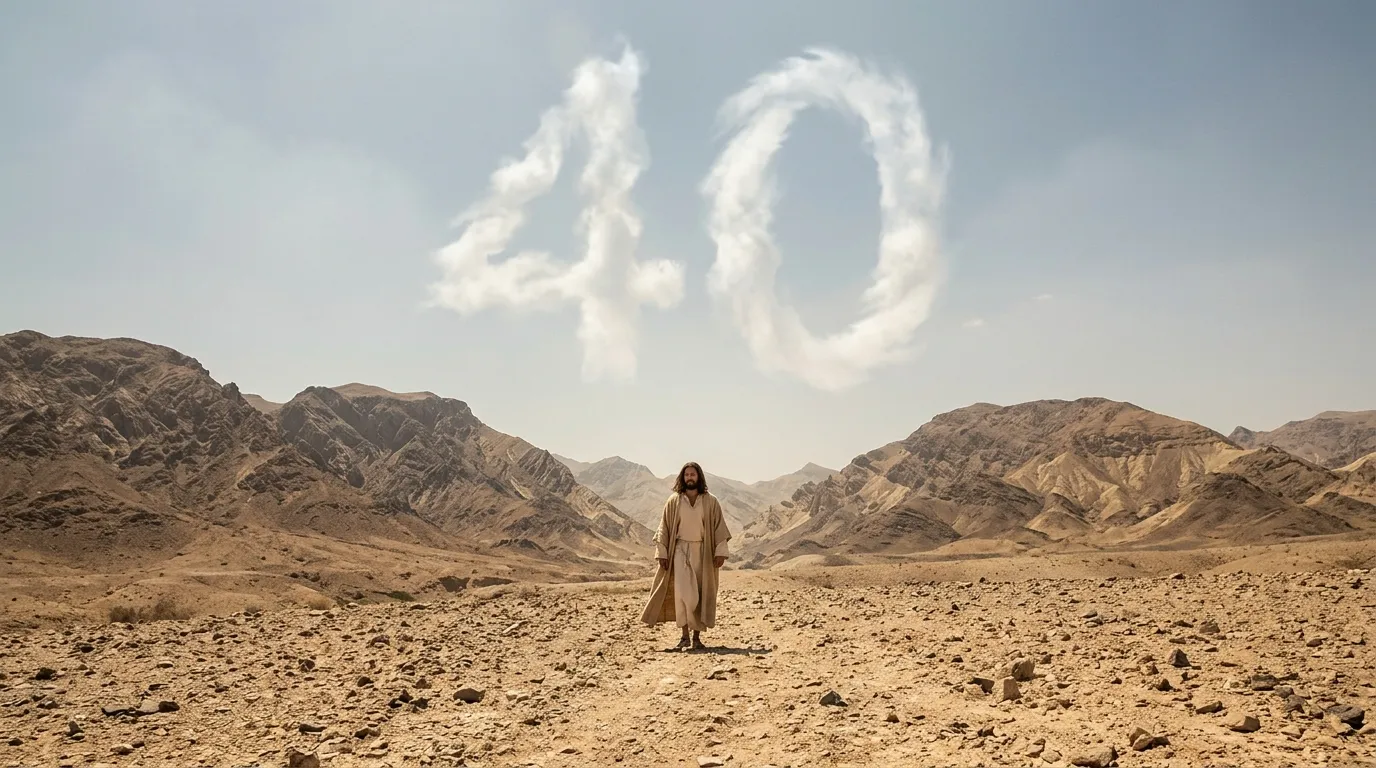
Have you noticed the number 40 showing up in your life? Maybe you saw it in a dream, read it in a Bible verse, or kept seeing it in different places.
When something appears again and again, it is natural to wonder if it carries a deeper meaning.
In the Bible, numbers often have special symbolism. They are not just used for counting. Many numbers point to important spiritual truths and lessons. The number 40 is one of the most powerful examples.
Throughout Scripture, God used periods of 40 days or 40 years during times of testing, growth, waiting, and preparation.
These moments often came before a great blessing or a new beginning. Because of this, many Christians see the number 40 as a sign of God’s work in a person’s life.
If you have been seeing this number, you may be asking questions. Is God teaching me something? Am I going through a season of change? Is there a spiritual message behind it?
The Bible gives clear insight into the meaning of this number. As we explore its symbolism, you will discover how the number 40 connects to faith, transformation, and God’s perfect timing.
Biblical Meaning of Number 40

The biblical meaning of number 40 is often linked to testing, preparation, waiting, purification, and spiritual growth. In many Bible stories, the number 40 marks a period when God was preparing people for something important.
One of the most well-known examples is the story of Noah. God sent rain upon the earth for 40 days and 40 nights. This flood cleansed the world and prepared the way for a fresh beginning (Genesis 7:12).
Another example is the nation of Israel. After leaving Egypt, the Israelites wandered in the wilderness for 40 years. During this time, God taught them to trust Him and follow His ways before entering the Promised Land.
The number 40 also appears in the life of Moses. He spent 40 days and 40 nights on Mount Sinai while receiving God’s commandments (Exodus 24:18). This was a sacred time of prayer, waiting, and receiving divine guidance.
Perhaps the most powerful example comes from Jesus. Before beginning His public ministry, Jesus fasted in the wilderness for 40 days and 40 nights (Matthew 4:2). During this period, He faced temptation and remained faithful to God.
These Bible verses show a common pattern. The number 40 often represents a season that may feel difficult, but it has a purpose. God uses these times to strengthen faith and prepare people for His plans.
The number can also serve as a warning. Sometimes a period of testing reveals areas where spiritual growth is needed. It may remind believers to stay close to God through prayer and obedience.
At the same time, the number 40 carries a message of hope. Every biblical period of 40 eventually led to something better. Noah saw a renewed earth. Israel entered the Promised Land. Moses received God’s law. Jesus began His ministry.
This is why many Christians view the number 40 as a symbol of God’s preparation. It reminds believers that difficult seasons are often part of a larger divine purpose.
Spiritual Significance and Symbolism

The spiritual symbolism of the number 40 points to transformation. It often appears when God is shaping a person’s heart and leading them into a new season.
Life sometimes brings periods of waiting. Prayers may seem unanswered. Doors may remain closed. During these moments, people can feel discouraged.
The number 40 reminds believers that God is still working, even when progress seems slow.
Think of a seed growing beneath the soil. Nothing appears to be happening on the surface, yet important growth is taking place. In the same way, God often works quietly during seasons of preparation.
This number also reflects faith and endurance. It encourages believers to keep trusting God’s promises even when the journey feels long.
For many Christians, seeing the number 40 can be a reminder to spend time in prayer, seek God’s guidance, and remain faithful during challenges.
Its spiritual message is simple: God is preparing you, teaching you, and leading you toward His purpose.
Biblical Interpretations in Dreams or Real Life

When the number 40 appears in dreams or everyday life, many people wonder if it carries a spiritual message.
In a dream, the number 40 may symbolize a season of growth, testing, or preparation. It could suggest that God is working behind the scenes in an area of your life. You may be learning patience, gaining wisdom, or preparing for a future opportunity.
If the dream feels peaceful, it may point to God’s presence and guidance through a season of change. It can be a comforting reminder that He is with you.
If the dream feels difficult or stressful, it may reflect a challenge you are currently facing. Even then, the message is often one of hope. Just as biblical periods of 40 came to an end, your season of struggle will not last forever.
In real life, repeatedly noticing the number 40 may encourage deeper prayer and reflection. Rather than focusing only on the number itself, believers are encouraged to seek God’s wisdom and trust His timing.
Practical Lessons & Faith Insights
The number 40 teaches several important faith lessons:
- Trust God during seasons of waiting.
- Stay faithful when life feels difficult.
- Use challenges as opportunities for growth.
- Spend time in prayer and reflection.
- Remember that God’s preparation often comes before blessing.
Every season has a purpose in God’s plan.
FAQs
What does the number 40 mean in the Bible?
The number 40 usually symbolizes testing, preparation, spiritual growth, and transformation. It often marks a season before a new beginning.
Why is the number 40 important in Scripture?
It appears many times in key Bible events, including Noah’s flood, Israel’s wilderness journey, Moses’ time on Mount Sinai, and Jesus’ fasting in the wilderness.
Is seeing the number 40 a message from God?
It may encourage spiritual reflection, prayer, and trust in God’s timing. However, Christians should seek God’s guidance rather than relying only on numbers.
What does the number 40 mean in dreams?
It often symbolizes a period of growth, testing, waiting, or preparation for a future change in life.
Does the number 40 represent hope?
Yes. In the Bible, periods of 40 often ended with renewal, blessing, guidance, or a fresh start from God.
More Searched Questions About the Number 40 in the Bible
Why does the Bible say “40 days and 40 nights” so often?
The phrase appears at some of the Bible’s great turning points. It is said of the flood rain: “And the rain was upon the earth forty days and forty nights” (Genesis 7:12). It is said of Moses on the mountain: he “was in the mount forty days and forty nights” (Exodus 24:18). Elijah’s journey to Horeb is measured in the same words (1 Kings 19:8), and so is the fast of Jesus: “And when he had fasted forty days and forty nights, he was afterward an hungred” (Matthew 4:2). The wording itself does simple work. Joining “days” and “nights” together stresses that the period ran right through, day and night without a break, a complete stretch of time and not a round number guessed at afterwards. One honest limit belongs with the answer. No verse explains why this length, or this phrase, is used so often, and the Bible never treats the phrase as a code to be cracked. What a reader can fairly observe is where the phrase is placed: again and again it marks a full, measured period that ends in something new, a cleansed earth, the giving of the law, a prophet restored, a ministry about to begin.
Why did Israel spend 40 years in the wilderness?
The wilderness years were not the length of the journey. The distance itself was short: “There are eleven days’ journey from Horeb by the way of mount Seir unto Kadeshbarnea” (Deuteronomy 1:2). The forty years were measured out as a sentence, and the measure is stated in the text. The spies had searched the land for forty days: “And they returned from searching of the land after forty days” (Numbers 13:25). Because Israel believed their fearful report and refused to enter, God answered in the same units: “even forty days, each day for a year, shall ye bear your iniquities, even forty years” (Numbers 14:34). The years would run until that unbelieving generation had died in the wilderness (Numbers 14:23, 14:32-33). God also states the years’ purpose in His own words, looking back: He led Israel “these forty years in the wilderness, to humble thee, and to prove thee, to know what was in thine heart” (Deuteronomy 8:2). So the searched question has a text answer, not a symbolic one. Forty years was the day for a year price of forty days of unbelief, and a schooling in trust that lasted one full generation.
Who fasted for 40 days and 40 nights in the Bible?
Three men are described at that length, and the texts describe them differently. The first is Moses, receiving the law on Mount Sinai: “And he was there with the LORD forty days and forty nights; he did neither eat bread, nor drink water” (Exodus 34:28), a fast the record repeats for his first ascent as well (Deuteronomy 9:9). The second is Elijah, and his case is not a chosen fast in the same way. Fed by an angel in the wilderness, “he arose, and did eat and drink, and went in the strength of that meat forty days and forty nights unto Horeb the mount of God” (1 Kings 19:8). One meal, given by God, carried him through the whole journey to the mountain where God would speak to him. The third is Jesus, at the opening of His ministry: “And when he had fasted forty days and forty nights, he was afterward an hungred” (Matthew 4:2), and His fast was followed at once by temptation (Matthew 4:3-11). Moses and Jesus fast on mountains and in wilderness at the start of great callings, and Elijah travels on heaven’s food to the mountain of God. The forty days are never presented as a target for readers to copy; each belongs to its own moment in God’s dealings with His servants.
Why did Goliath challenge Israel for 40 days?
The record gives the duration without giving a symbolic reason: “And the Philistine drew near morning and evening, and presented himself forty days” (1 Samuel 17:16). Twice a day, for forty days, Goliath came out and defied the armies of Israel, and twice a day Israel’s soldiers heard him and did nothing: Saul and all Israel “were dismayed, and greatly afraid” (1 Samuel 17:11), and when the challenge was repeated the men of Israel fled from him (1 Samuel 17:24). Read on its own terms, the forty days measure how long the reproach stood unanswered. Every day of delay deepened the shame of it, until David arrived, heard the defiance, and asked what would be done for the man “that taketh away the reproach from Israel” (1 Samuel 17:26). That the deliverance came at the end of a measured forty day period fits the familiar pattern of the number in Scripture, a full stretch of trial closed by God’s intervention. But that is an observation drawn from the story, not a meaning the verse itself announces, and this article states it no more firmly than that.
What was Jonah’s warning of 40 days to Nineveh?
Jonah walked into the great enemy city of Nineveh with the shortest sermon in the Bible: “Yet forty days, and Nineveh shall be overthrown” (Jonah 3:4). The forty days were a countdown. Nineveh was given a fixed, measured space in which judgment was certain unless the city turned, and the whole city did turn: the people believed God, proclaimed a fast, and put on sackcloth, from the king down (Jonah 3:5-9). Then the countdown ran out into mercy instead of destruction: “And God saw their works, that they turned from their evil way; and God repented of the evil, that he had said that he would do unto them; and he did it not” (Jonah 3:10). This forty stands apart from many others in the Bible. It is not a time of testing for God’s own servants but a deadline of grace held out to a pagan city, and its lesson is the one Jonah himself had to learn: a period God measures out can end in mercy when people repent inside it.
What did Jesus do during the 40 days after His resurrection?
Luke, who wrote the fullest account, sums the period up in one sentence: Jesus showed Himself alive “by many infallible proofs, being seen of them forty days, and speaking of the things pertaining to the kingdom of God” (Acts 1:3). In those forty days the risen Jesus taught His apostles, opened their understanding of the Scriptures, commanded them to wait in Jerusalem for the promise of the Father, and commissioned them as His witnesses “unto the uttermost part of the earth” (Acts 1:4-8). The Gospels fill in appearances inside that window: to Mary Magdalene at the tomb (John 20:16-17), to two disciples on the Emmaus road (Luke 24:13-31), to the gathered disciples, and to Thomas a week after the first Easter evening (John 20:26-29). At the end of the forty days He led them out toward Bethany and was taken up into heaven while they watched (Acts 1:9-11). This is the last forty of the New Testament, and its shape is the opposite of the wilderness forties. Those were years and days of proving that ended in rest; this one is forty days of risen life that end with a mission handed over.
What are the three 40-year periods in the life of Moses?
Stephen, in his speech in Acts 7, divides Moses’ long life into three stretches of forty years, and the texts bear the stages out. The first forty years are Egypt: Moses is raised in Pharaoh’s house, and “when he was full forty years old, it came into his heart to visit his brethren the children of Israel” (Acts 7:23). After he fled for killing an Egyptian overseer (Exodus 2:11-15), the second forty years are Midian, where he keeps the flock of Jethro in obscurity until, “when forty years were expired, there appeared to him in the wilderness of mount Sina an angel of the Lord in a flame of fire in a bush” (Acts 7:30). The third forty years are the wilderness leadership, of which Stephen says Moses showed wonders and signs “in the land of Egypt, and in the Red sea, and in the wilderness forty years” (Acts 7:36). Moses died at the end of them: “Moses was an hundred and twenty years old when he died” (Deuteronomy 34:7). Readers often add the three forties into his 120 years, and the arithmetic is simple, but the division itself is Stephen’s summary, drawn from the record, rather than a chart printed in Exodus. The stages are real in the texts: a prince’s forty years, a shepherd’s forgotten forty years, and a leader’s forty years, and the middle, hidden stretch is the one so many searchers ask about.
Is the 40 days of Lent in the Bible?
Not as a season. No Bible text names Lent, and no command in Scripture appoints a yearly forty day fast for God’s people. Lent is a season of prayer, fasting and repentance kept by many churches in the weeks before Easter, and it developed in the church’s life after the New Testament was written. Its length is deliberate, and it looks back to the Bible’s own forties, above all to the fast of Jesus: “And when he had fasted forty days and forty nights, he was afterward an hungred” (Matthew 4:2), with Moses on the mountain (Exodus 34:28) and Elijah’s journey to Horeb (1 Kings 19:8) also in view. How the forty days are counted is church custom, and it varies between traditions; in Western practice Sundays are commonly not counted as fast days, so the season runs longer than forty calendar days. Readers who search for Lent in the Bible will therefore find its pattern and its reason there, the forty day fasts of God’s servants before great moments, but the season itself belongs to church tradition, and this article reports it as exactly that, neither a Bible command nor a practice the Bible forbids.
How many times does the number 40 appear in the Bible?
This is one of the most searched questions about the number, and it has no single agreed answer, so this article does not print a total as fact. The reason is method, not modesty. Any count changes with the translation counted, because versions word numbers differently. It changes with the tool used, because searching the word “forty” and searching the digits “40” give different results. And it changes most of all with what the counter decides to include: the bare word forty on its own; compound numbers that contain it, such as forty two and forty five and a hundred and forty; and large phrases like “forty days” and “forty years”, which some lists count as one topic and others count as dozens of separate appearances. Totals printed in books and on websites therefore disagree with one another, sometimes widely, and a figure is only as good as the rules behind it. What can be said from the texts themselves, and what this article’s answers show, is the spread: forty runs from the flood (Genesis 7:12) to the embalming of Jacob (Genesis 50:3), through Sinai, the spies, the wilderness years, the rests of the judges, Goliath’s challenge, Jonah’s warning, and both the fast and the resurrection days of Jesus. The number’s weight in the Bible is proven by the company it keeps, not by a total nobody can fix.
Does the number 40 always mean testing and trial in the Bible?
No, and the honest answer protects the true pattern from being overstated. Begin with what can be said firmly. No verse in the Bible announces that forty means testing, and there is no passage that hands out meanings for numbers as a code. The testing pattern is read from the passages themselves, and it is genuinely there: God Himself describes the wilderness forty years as a proving, “to humble thee, and to prove thee, to know what was in thine heart” (Deuteronomy 8:2), and the flood, Sinai, the spies, Elijah’s flight and the temptation of Jesus all gather trial, waiting and preparation around the number. But other forties in the Bible carry no such label at all. “And the land had rest forty years” (Judges 3:11) is a generation of peace, not a trial. “And Isaac was forty years old when he took Rebekah to wife” (Genesis 25:20) is a plain age in a family record. And of Jacob’s body in Egypt, “forty days were fulfilled for him; for so are fulfilled the days of those which are embalmed” (Genesis 50:3), an embalming period with no symbolism stated. The safe rule is the one this whole section follows: let each passage say what its forty is doing there. Where the text shows proving, the pattern may be named with confidence. Where it does not, forty is simply the number that was true.
Why did God limit punishment to forty stripes in the Bible?
The law itself sets the limit: “Forty stripes he may give him, and not exceed: lest, if he should exceed, and beat him above these with many stripes, then thy brother should seem vile unto thee” (Deuteronomy 25:3). Forty was the full measure of judgment a judge could order, and the limit protected the dignity of the man being punished, since even a guilty brother was not to be degraded beyond measure. In practice the Jews gave thirty nine, one short of the limit, so that a miscount could never break the law, and Paul says of his own sufferings, “Of the Jews five times received I forty stripes save one” (2 Corinthians 11:24). The number here is not a symbol to decode. It is a legal ceiling, and it shows the same pattern as the other forties: forty marks the full measure of something, here the full measure of punishment, held back from excess by mercy.
Why did Ezekiel lie on his side for 40 days?
God gave Ezekiel a living picture of judgment. First he lay on his left side for 390 days to bear the iniquity of the house of Israel (Ezekiel 4:4-5), and then, “when thou hast accomplished them, lie again on thy right side, and thou shalt bear the iniquity of the house of Judah forty days: I have appointed thee each day for a year” (Ezekiel 4:6). Each day of lying down stood for one year of Judah’s sin, so the forty days pictured forty years of guilt, the same day for a year measure God used when forty days of spying became forty years of wandering (Numbers 14:34). The forty days were not a fast or a test of the prophet himself. They were a sermon acted out in public, a warning that Judah’s sin had been measured and its judgment was coming, and they belong with the other forties that carry a fixed, God appointed length.
Which kings in the Bible reigned for 40 years?
The first three kings of the united kingdom each reigned forty years. Saul’s reign is stated by Paul: “God gave unto them Saul the son of Cis, a man of the tribe of Benjamin, by the space of forty years” (Acts 13:21). David’s reign is counted in the text: “David was thirty years old when he began to reign, and he reigned forty years. In Hebron he reigned over Judah seven years and six months: and in Jerusalem he reigned thirty and three years over all Israel and Judah” (2 Samuel 5:4-5). Solomon’s reign is stated the same way: “And the time that Solomon reigned in Jerusalem over all Israel was forty years” (1 Kings 11:42). Later kings also reached forty years: Joash reigned forty years in Jerusalem (2 Kings 12:1), and Eli judged Israel forty years (1 Samuel 4:18). The pattern is worth noticing. Forty years was a full generation of rule, long enough for a whole reign to be measured, and the three united kings together cover the whole age of the united monarchy in three forties.
What is the number 40 in Hebrew?
The Hebrew word for forty is arbaim (arbaim), the plural form built on arba, four, and it is listed in Strong’s Concordance as H705. In the Hebrew letter system, where letters also stand for numbers, the letter Mem carries the value of forty, and Mem is the thirteenth letter of the alphabet. Mem is also the first letter of mayim, the Hebrew word for water, which is why some teachers connect the number forty with water and cleansing, pointing to the flood and to baptism, though the Bible itself never makes that connection in so many words. What the Hebrew does show plainly is that forty is a round, complete number in the language of the Old Testament, a full measure used again and again for days, years, and reigns, and its meaning comes from how Scripture uses it, not from the letters that spell it.
Why did Israel eat manna for 40 years?
The manna lasted exactly as long as the wilderness years did. “And the children of Israel did eat manna forty years, until they came to a land inhabited; they did eat manna, until they came unto the borders of the land of Canaan” (Exodus 16:35). God gave the bread from heaven the morning after Israel left Egypt, and it never stopped until the day they ate the food of the Promised Land (Joshua 5:12). The forty years of manna were daily proof that God could feed a whole nation in a place where nothing grows, and Moses later explained the purpose: God humbled Israel and fed them with manna “that he might make thee know that man doth not live by bread only, but by every word that proceedeth out of the mouth of the LORD doth man live” (Deuteronomy 8:3). The manna stopped when the testing ended, which is the pattern of every forty in the Bible: the provision lasts for the whole season, and it ends when the season ends.
Why did Moses go up Mount Sinai for 40 days twice?
Moses spent forty days and forty nights on the mountain on two separate occasions, and the two visits tell one story of sin and mercy. The first is the giving of the law: “And Moses went into the midst of the cloud, and gat him up into the mount: and Moses was in the mount forty days and forty nights” (Exodus 24:18). While he was there, Israel made the golden calf, and Moses came down to a broken covenant. The second is intercession: Moses went up again for another forty days and forty nights, neither eating bread nor drinking water, and pleaded for the people until God renewed the covenant and gave the tablets a second time (Exodus 34:28; Deuteronomy 9:9, 9:18, 9:25). The first forty days brought the law; the second forty days brought forgiveness after the law was broken. Together they show both sides of the number: forty days can end in judgment, and forty days can end in mercy.
What does “the land had rest forty years” mean in Judges?
Three times in Judges the same sentence closes a deliverance: “the land had rest forty years.” It is said after Othniel defeated Cushanrishathaim (Judges 3:11), after Deborah and Barak’s victory, when the song ends, “And the land had rest forty years” (Judges 5:31), and after Gideon’s defeat of Midian, “the country was in quietness forty years in the days of Gideon” (Judges 8:28). Here forty measures peace, not trial, which is why this article’s earlier answer warns that forty does not always mean testing. A generation of rest followed each rescue, long enough for a whole generation to live without war, and each rest ended when the judge who won it died and Israel turned back to idols. The forty years of rest show the other face of the number: the same full measure that marks a trial can also mark the peace God gives when the trial is over.
What is angel number 40, and what does the Bible say about it?
Angel number 40 is a modern idea, not a Bible teaching. In numerology, 40 is read as the number 4, which stands for stability and hard work, joined to 0, which is said to amplify it, so seeing 40 repeatedly is taken as a message to stay disciplined and trust the process. The Bible never teaches that God sends messages through repeated numbers, and no verse gives 40 a meaning as an angel number. What the Bible does give is the pattern this article traces: forty marks seasons of testing, preparation, and new beginnings, from the flood to the wilderness to the fast of Jesus. A Christian who keeps noticing the number 40 can take it as a prompt to pray and to ask whether God is teaching patience in a long season, but the meaning must come from Scripture and prayer, not from a number chart. The number is a reminder to seek God, not a message from angels.
How does Jesus’ forty days in the wilderness connect to Israel’s forty years?
The connection is deliberate, and Jesus Himself draws it. Israel spent forty years in the wilderness, where God humbled them and proved them, “to know what was in thine heart, whether thou wouldest keep his commandments, or no” (Deuteronomy 8:2), and fed them with manna. Jesus spent forty days in the wilderness, “to be tempted of the devil” (Matthew 4:1), and answered every temptation with words from Deuteronomy, the book of the wilderness years: man does not live by bread alone (Deuteronomy 8:3), you shall not tempt the Lord your God (Deuteronomy 6:16), and you shall worship the Lord your God (Deuteronomy 6:13). Where Israel failed for forty years, complaining about bread, testing God at Massah, and worshipping other gods, Jesus stood firm for forty days on the very points where Israel fell. His forty days are a new Exodus in miniature: the same desert, the same hunger, the same temptations, and a different ending, which is why the Gospels place the fast at the very start of His ministry.
What happened in the 40 days after the flood rain stopped?
The rain fell for forty days and forty nights, but the flood story has a second forty that readers often miss. After the waters covered the earth and the ark rested on Ararat, Noah waited, and “it came to pass at the end of forty days, that Noah opened the window of the ark which he had made: and he sent forth a raven” (Genesis 8:6-7). The raven flew back and forth, and then Noah sent a dove, which returned, and a week later the dove came back with an olive leaf, the first sign of dry land (Genesis 8:8-11). The first forty days were judgment, rain falling without pause. The second forty days were waiting, a quiet stretch inside the ark while the waters went down. Together they show the two faces of the number in a single story: forty days of cleansing, then forty days of patience before the new beginning.
Conclusion
The biblical meaning of number 40 centers on testing, preparation, transformation, and faith. Throughout Scripture, God used seasons marked by this number to shape hearts and prepare people for His purposes.
If the number 40 has captured your attention, let it remind you that God is at work, even during times of waiting. Trust His timing, stay faithful in prayer, and move forward with hope, knowing that His plans are always good.
Discover More Articles
- Number 4 Meaning in the Bible: A Complete Biblical Guide
- Number 3 Meaning in the Bible: The Powerful Truth Revealed