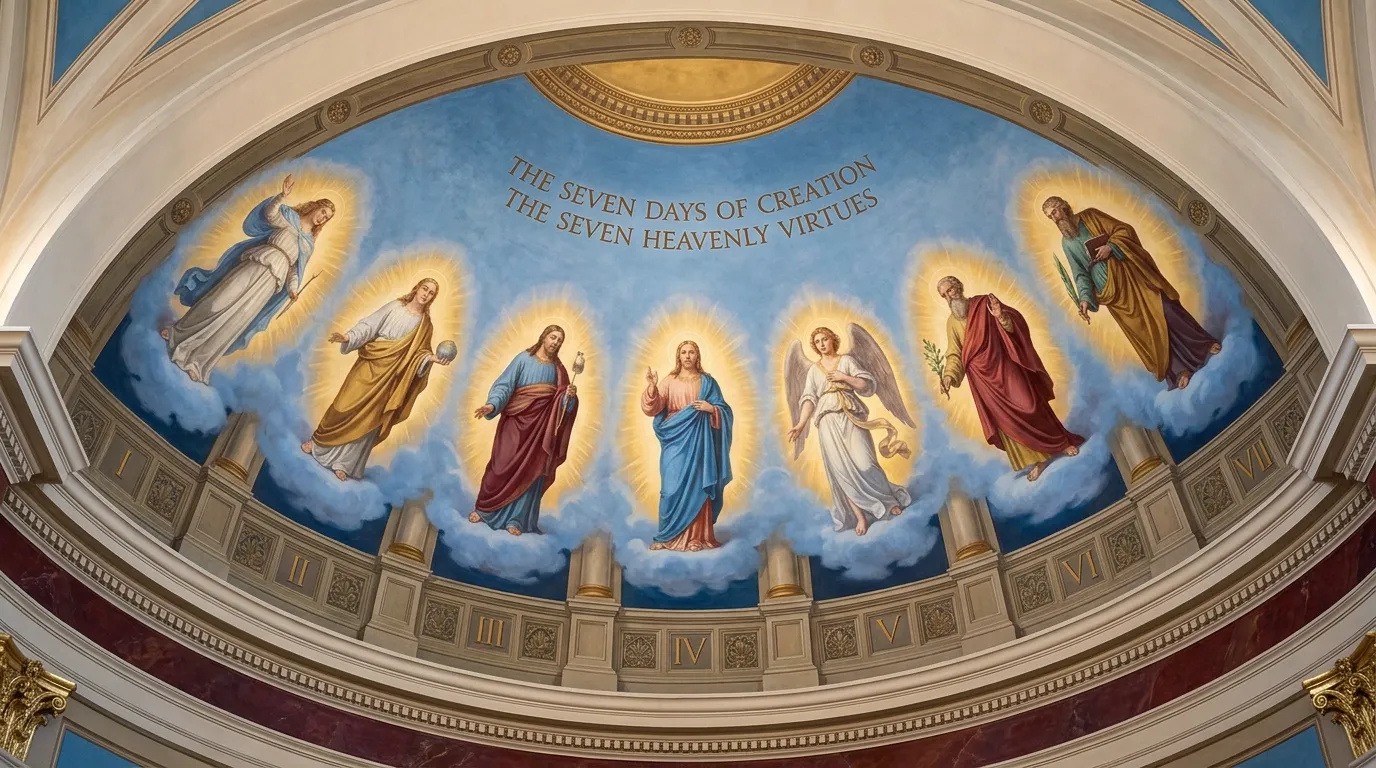
Have you ever noticed the number 7 showing up again and again? Maybe you saw it in a dream.
Perhaps it appeared on a clock, a page number, or during a special moment in your life. Many Christians wonder if there is a deeper meaning behind this number.
In the Bible, numbers often carry special meaning. They are not just used for counting. God sometimes uses numbers to teach spiritual truths and reveal His plans.
Among all the numbers found in Scripture, the number 7 stands out more than most.
The number 7 appears throughout the Bible. It is connected to creation, rest, worship, and God’s perfect work.
Because it appears so often, many believers see it as a powerful symbol of God’s presence and guidance.
When people notice this number repeatedly, they often ask, “What is God trying to tell me?” While every situation is different, the Bible gives us important clues about the spiritual symbolism of number 7.
Let’s explore the biblical meaning of number 7 and discover what this special number may reveal about faith, hope, and God’s perfect plan.
Biblical Meaning of Number 7
The biblical meaning of number 7 is often linked to completeness, perfection, and God’s finished work. Throughout Scripture, God uses this number to show that something is complete according to His will.
The first appearance of the number 7 is found in the creation story. God created the world in six days and rested on the seventh day.
In the book of Genesis, God blessed the seventh day and made it holy. This day became a symbol of rest, peace, and completion. God’s work was finished, and everything He made was good.
Because of this, many Christians see the number 7 as a reminder that God is in control and that His plans are perfect.
The number appears many times throughout the Bible:
- Six days of creation, with God’s rest on the seventh day.
- Seven lamps on the lampstand.
- Seven churches in Revelation.
- Seven seals, trumpets, and bowls in the book of Revelation.
- The seven sayings of Jesus from the cross, gathered from the four Gospels.
These examples show how often God uses this number to highlight important spiritual truths.
The number 7 can also symbolize God’s covenant and faithfulness. It reminds believers that God keeps His promises and completes what He begins.
In some situations, the number 7 brings a message of encouragement. If you feel lost or uncertain, it may remind you that God is working behind the scenes. Even when you cannot see the whole picture, His plan is moving forward.
At the same time, the number 7 can also serve as a call to spiritual growth. It may encourage believers to trust God more deeply and seek His wisdom through prayer and Scripture.
The book of Revelation uses the number 7 many times. There, it often points to God’s complete authority over history and His final victory over evil.
One key verse is Revelation 1:4, which mentions the seven spirits before God’s throne. Another important example is Revelation’s seven churches, which represent God’s message to His people.
Overall, the Christian meaning of number 7 centers on God’s perfection, divine order, and complete work. It is a beautiful reminder that God finishes what He starts and never abandons His people.
Spiritual Significance and Symbolism
The spiritual symbolism of number 7 goes beyond Bible stories. It speaks to the heart of every believer today.
Life often feels unfinished. We face struggles, delays, and unanswered questions. During these times, the number 7 can remind us that God sees the whole journey.
It points to faith, hope, and spiritual maturity. Just as God completed creation, He continues working in the lives of His children.
The number 7 can also symbolize spiritual awakening. It encourages believers to draw closer to God through prayer, worship, and trust.
Imagine planting a seed. At first, nothing seems to happen. Yet growth is taking place beneath the soil. In a similar way, God often works in ways we cannot see.
The number 7 reminds us to be patient. God’s timing is perfect.
For many Christians, this number becomes a symbol of peace. It helps them remember that God is guiding their path, even during difficult seasons.
When seen through the lens of faith, the number 7 becomes a powerful divine message of God’s completeness and loving care.
Biblical Interpretations in Dreams or Real Life
Seeing the number 7 in a dream can feel meaningful. Many Christians view it as a symbol of God’s guidance, protection, or completed work.
A peaceful dream involving the number 7 may point to spiritual growth, answered prayer, or a season of blessing. It can be a reminder that God is bringing something to completion in your life.
If the dream feels confusing or serious, it may encourage deeper prayer and reflection. God could be inviting you to trust Him more fully.
In daily life, repeatedly noticing the number 7 may simply encourage you to focus on God’s promises. Rather than treating it as a prediction, Christians are encouraged to seek wisdom through prayer and Scripture.
The Bible teaches believers to test everything against God’s Word. Any dream interpretation should always align with biblical truth and strengthen faith in Christ.
Practical Lessons & Faith Insights
The number 7 teaches us to trust God’s timing and His perfect plan.
When life feels incomplete, remember that God is still working. Spend time in prayer, stay faithful, and keep your eyes on Him. The same God who completed creation is able to complete His work in your life as well.
FAQs
What is the biblical meaning of number 7?
The biblical meaning of number 7 is completeness, perfection, and God’s finished work. It often represents divine order and fulfillment.
Why is the number 7 important in the Bible?
The number 7 appears throughout Scripture in creation, worship, prophecy, and God’s covenant promises, making it one of the Bible’s most significant numbers.
What does seeing number 7 repeatedly mean spiritually?
Many Christians see it as a reminder of God’s presence, guidance, and perfect timing. It often encourages faith and trust in Him.
What does number 7 mean in dreams?
In dreams, number 7 may symbolize spiritual growth, completion, blessing, or a call to draw closer to God through prayer.
Which Bible verse shows the importance of number 7?
Genesis 2:2-3 is a key passage where God rests on the seventh day, showing completion and holiness.
More Searched Questions About the Number 7 in the Bible
Why is 7 called the number of completion in the Bible?
The idea comes from the pattern the Bible sets in its first two chapters. God finished the work of creation and rested on the seventh day: “And God blessed the seventh day, and sanctified it” (Genesis 2:3). Seven is the number that closes the week, the work is done, the cycle is complete, and nothing is missing. That pattern then repeats through Scripture: Israel’s great feasts ran for seven days (Exodus 12:15; Leviticus 23:34), the land itself rested in the seventh year (Leviticus 25:4), and after seven sevens of years came the fiftieth year, the Jubilee, when debts were released and land returned (Leviticus 25:8-10). One honest caution belongs with the word “completion”: the Bible never prints a dictionary entry saying “seven means completion.” Completion is the lesson readers draw from the pattern of finished, God-ordered cycles, and many sevens in the Bible (Naaman’s seven dips, Jacob’s seven years) are simply the count of what happened. Seven is full and finished where God uses it to close a cycle; it is not a secret code stamped on every occurrence.
What does it mean that God rested on the seventh day?
It does not mean God was tired. The Hebrew verb used in Genesis 2:2 means He ceased, He stopped because the work was finished: “he rested on the seventh day from all his work which he had made.” Isaiah removes any thought of exhaustion: “the Creator of the ends of the earth, fainteth not, neither is weary” (Isaiah 40:28). God’s rest is the satisfaction of completed work, and He made the day itself holy, “because that in it he had rested from all his work which God created and made” (Genesis 2:3). Israel’s Sabbath command is built directly on this: “Remember the sabbath day, to keep it holy… For in six days the LORD made heaven and earth, the sea, and all that in them is, and rested the seventh day” (Exodus 20:8, 11). The seventh day of the biblical week is the Sabbath (Saturday). And the New Testament carries the theme forward: “There remaineth therefore a rest to the people of God” (Hebrews 4:9), God’s finished-work rest held out as a promise to His people.
How many times is the number 7 mentioned in the Bible?
Honestly, there is no single number everyone can agree on, and any website that quotes one exact total without explaining it is giving you the result of one particular way of counting, not a fact of the text. The total changes with the translation you use, and with what you decide to count: the word “seven” only, or also “seventh,” “seventy,” “sevenfold,” and combined numbers such as seventy-seven? Each choice produces a different answer, which is why the totals circulating online disagree with each other. What can be said safely is this: “seven” and its related forms appear hundreds of times across the Bible, more often than almost any other number, and the book of Revelation alone uses “seven” more than fifty times. The importance of seven in Scripture rests on where and how it is used, in creation, worship and prophecy, not on an exact tally.
What is the Hebrew word for seven?
The Hebrew word is sheva (in its fuller form, shiv’ah). The Bible itself plays on the closeness between this word and the Hebrew verb “to swear an oath,” which shares the same letters. At Beer-sheba, Abraham set seven ewe lambs apart as a witness, and he and Abimelech swore an oath there; the place was named for both, Beer-sheba means “well of the seven” and “well of the oath” (Genesis 21:28-31). So in the Bible’s own storytelling, seven is tied to covenant and to oaths sworn before God. The other famous word in this area should be kept distinct: Sabbath is shabbat, from a different verb meaning “to cease”, the very verb used when Genesis 2:2 says God ceased from His work on the seventh day. Sheva counts the day; shabbat names its rest.
What are the seven churches in Revelation?
They were seven real assemblies in the Roman province of Asia (modern-day Turkey), named by John in the order he was told to write to them: “unto Ephesus, and unto Smyrna, and unto Pergamos, and unto Thyatira, and unto Sardis, and unto Philadelphia, and unto Laodicea” (Revelation 1:11). Revelation chapters 2-3 contain a letter to each, most with a commendation for what the church was doing right, a correction for where it was failing, a call to repent, and a promise “to him that overcometh.” In John’s vision the churches appear as seven golden lampstands, and the seven stars in Christ’s right hand are explained as “the angels of the seven churches” (Revelation 1:20). Each letter ends by addressing every reader, “He that hath an ear, let him hear what the Spirit saith unto the churches”, which is why churches ever since have read them as speaking beyond those seven cities. Some teachers also read the seven letters as a preview of seven successive ages of church history; that is a scheme some hold, not something the text itself states, and Christians differ over it.
What are the seven seals, the seven trumpets and the seven bowls in Revelation?
They are three series of seven judgments that structure the heart of the book of Revelation. First, the Lamb opens the seven seals of a scroll (Revelation 6); when the seventh seal is opened there is silence in heaven, and out of it come seven angels with seven trumpets (Revelation 8:1-2). The trumpets sound through chapters 8-9, and at the seventh trumpet loud voices announce that “the kingdoms of this world are become the kingdoms of our Lord” (Revelation 11:15). Last come the seven bowls, which John introduces in the book’s own words: “seven angels having the seven last plagues; for in them is filled up the wrath of God” (Revelation 15:1), poured out in chapter 16. The structure itself preaches the book’s message: God’s judgments come in sevens, complete, ordered, and carried through to the end under His control. Christians read these chapters in different ways (as past, future, symbolic, or some pattern of the age), and this article does not settle that debate; what the text itself gives every reader is the ordered sevens and the finished outcome they move toward.
What are the seven Spirits of God in Revelation?
John greets the churches with grace and peace “from the seven Spirits which are before his throne” (Revelation 1:4), and later describes what he saw: “seven lamps of fire burning before the throne, which are the seven Spirits of God” (Revelation 4:5). The risen Lamb is pictured with “seven eyes, which are the seven Spirits of God sent forth into all the earth” (Revelation 5:6), and Jesus speaks of Himself as the one “which hath the seven Spirits of God” (Revelation 3:1). How should this be understood? The most common reading is that the seven Spirits are the Holy Spirit Himself, pictured in His sevenfold fullness and perfection, seven being the Bible’s number of completeness. Many connect this with Isaiah’s prophecy of the Spirit resting on the coming King: “the spirit of the LORD shall rest upon him, the spirit of wisdom and understanding, the spirit of counsel and might, the spirit of knowledge and of the fear of the LORD” (Isaiah 11:2), one Spirit, described there in a sevenfold way. Some other readers take the seven Spirits to be seven chief angels who stand before God’s throne. Christians have differed on this for centuries, and the honest answer presents the readings rather than pretending the text settles it; what is beyond dispute in the passage is that these seven Spirits belong entirely to God and to the Lamb, and that nothing in all the earth is outside their sight.
What does “seventy times seven” mean?
Peter came to Jesus with what he thought was a generous limit: “Lord, how oft shall my brother sin against me, and I forgive him? till seven times?” Jesus answered, “I say not unto thee, Until seven times: but, Until seventy times seven” (Matthew 18:21-22). A translation note matters here: the Greek can be rendered “seventy times seven” (490 times, as in the King James Version) or “seventy-seven times,” as many modern translations have it, the phrase deliberately echoes Genesis 4:24, where Lamech boasted that he would be avenged “seventy and sevenfold.” Jesus takes the number of limitless vengeance and turns it into the measure of forgiveness. Either way, the point is not arithmetic. Jesus is not handing His disciples a higher total to count up to and then stop; He is taking counting itself off the table. Forgiveness in His kingdom is not tallied, it is given as freely and as often as it is needed, the way God forgives.
What are the seven last words of Jesus on the cross?
The crucifixion accounts record seven sayings of Jesus, and the church has long gathered them together, especially in Good Friday services, as the “seven last words.” One thing should be stated plainly first: no single Gospel contains all seven. The list is a traditional grouping drawn from all four Gospels. The sayings are: “Father, forgive them; for they know not what they do” (Luke 23:34); “To day shalt thou be with me in paradise,” spoken to the dying thief (Luke 23:43); “Woman, behold thy son!” and to John, “Behold thy mother!” (John 19:26-27); “My God, my God, why hast thou forsaken me?” (Matthew 27:46; Mark 15:34); “I thirst” (John 19:28); “It is finished” (John 19:30); and “Father, into thy hands I commend my spirit” (Luke 23:46). Each saying stands in Scripture exactly where its Gospel places it; the “seven” is the church’s way of holding the whole record together, and it is fitting that the number of completeness is the number the tradition found, but it is the tradition’s grouping, not a list any one Gospel gives.
What happened with Naaman’s seven washings and the seven days at Jericho?
Two of the Bible’s best-known stories turn on doing something seven times. Naaman, the Syrian commander afflicted with leprosy, was told by Elisha: “Go and wash in Jordan seven times, and thy flesh shall come again to thee, and thou shalt be clean” (2 Kings 5:10). After initial anger, “went he down, and dipped himself seven times in Jordan… and he was clean” (2 Kings 5:14), the healing came at the completion of the full number, not before. At Jericho, God set the same pattern in the conquest: Israel was to march around the city once a day for six days, led by seven priests carrying seven trumpets; “and the seventh day ye shall compass the city seven times” (Joshua 6:4). When they did, the wall fell (Joshua 6:20). The same fullness of time appears in two quieter stories: Jacob “served seven years for Rachel” (Genesis 29:20), and Pharaoh’s dream of seven fat and seven thin cows and ears meant “seven years of great plenty” followed by seven years of famine (Genesis 41:25-30). In each case seven measures out the full period God had set, nothing short of it, and nothing beyond it.
Is 777 a special number in the Bible?
The number 777 itself appears in the Bible only as the length of a man’s life: “And all the days of Lamech were seven hundred seventy and seven years: and he died” (Genesis 5:31). The only other nearby passage is Lamech’s song in Genesis 4:24, which speaks of vengeance “seventy and sevenfold.” Scripture attaches no symbolic meaning to 777, predicts nothing by it, and never tells anyone to watch for it. The popular idea of 777 as an “angel number” carrying personal messages about luck, money or guidance comes from modern numerology, not from the Bible, and claims that 777 represents the Trinity in perfect form go beyond anything the text says. So the honest biblical answer is a short one: 777 is a number in a genealogy, nothing more is made of it, and no promise or warning should be read into seeing it.
Does the Bible list seven deadly sins?
Not in the form most people mean. The classic list of seven deadly sins, pride, greed, lust, envy, gluttony, wrath and sloth, was drawn up by early church teachers in the centuries after the apostles; it is a church tradition, not a list that appears in Scripture. But the Bible does have its own passage built on the number seven in this area, and its contents are different. Solomon writes: “These six things doth the LORD hate: yea, seven are an abomination unto him” (Proverbs 6:16), and then names them: a proud look, a lying tongue, hands that shed innocent blood, a heart that devises wicked plans, feet that run swiftly to mischief, a false witness who speaks lies, and one who sows discord among brethren (Proverbs 6:17-19). That is the Bible’s own list of seven, and it is worth noticing how much of it concerns speech, honesty and the damage done to other people.
Conclusion
The biblical meaning of number 7 points to God’s perfection, completeness, and faithful guidance. From creation to Revelation, this number reminds believers that God is always at work.
Whether you see it in Scripture, dreams, or daily life, let it encourage your faith. Trust that God knows your path, completes His plans, and leads you with wisdom, peace, and hope.
Discover More Articles
- Number 4 Meaning in the Bible: A Complete Biblical Guide
- Number 3 Meaning in the Bible: The Powerful Truth Revealed
- Number 3 Meaning in the Bible: The Powerful Truth Revealed