Have you ever noticed how certain numbers pop up again and again in stories that matter to you?
Maybe you keep seeing the same number on clocks, license plates, or even in old family tales that get passed down.
For many folks who love the Bible, the number 4 carries a special weight. It feels grounded, like something solid you can stand on.
I remember chatting with a friend once who was going through a tough season. She mentioned how everything in her life seemed to point back to four: four kids, four directions she felt pulled in, even four years since a big change.
It got me thinking about how numbers show up in Scripture not by accident, but as gentle reminders from God.
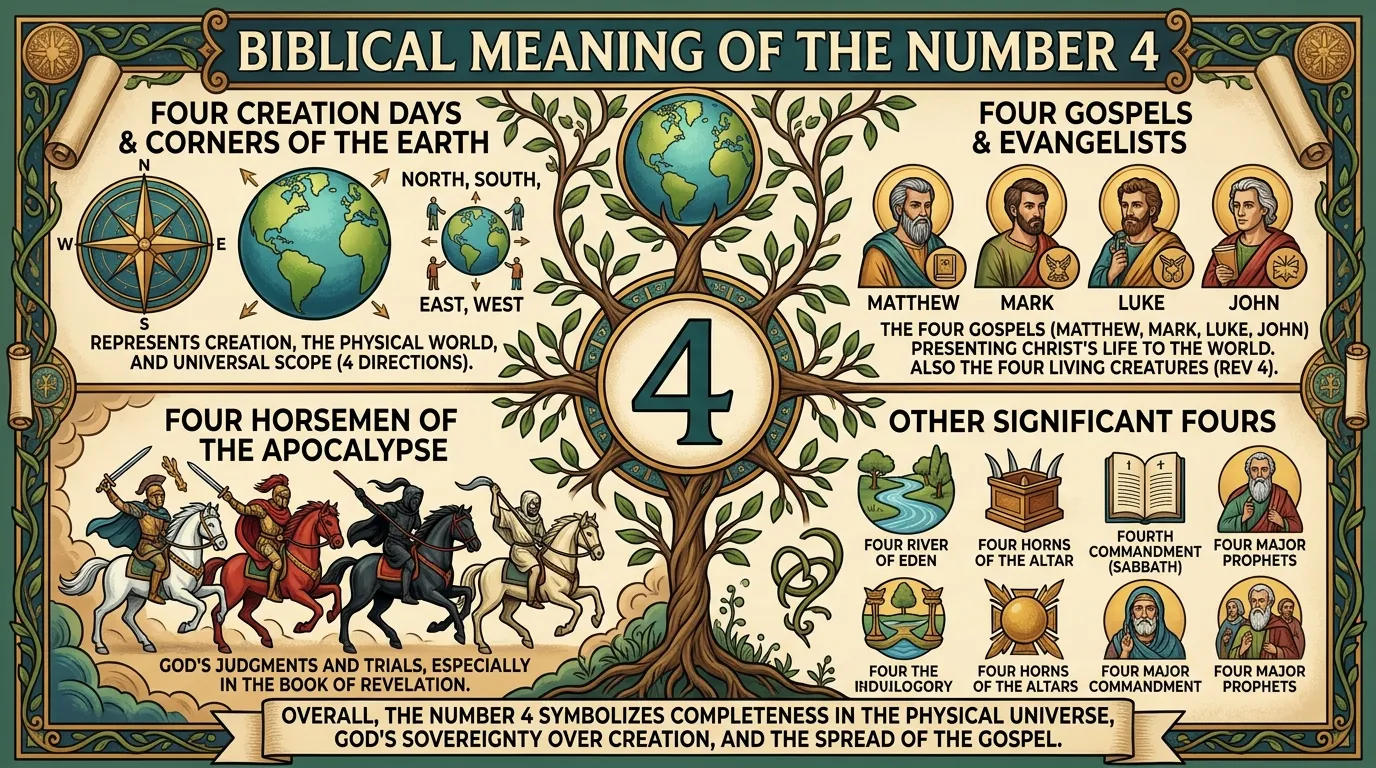
The number 4 meaning in the Bible speaks to creation, the world around us, and the completeness of what God has made.
It ties into the physical things we see every day: the earth, the seasons, the way life holds together.
If you’ve wondered why this number keeps appearing, you’re not alone. Many people sense there’s more to it than just counting.
Let’s explore what the Bible says about number 4 meaning in the Bible.
Biblical Meaning of the Number Four
In the Bible, the number four is often linked with the created world and things that reach in every direction. We see this idea in the four corners of the earth and the four winds. This can point to the wide reach of God’s creation and His rule over all the earth. The number itself is not given one fixed meaning in every passage. Its meaning depends on the context. For example, Ezekiel speaks of four living creatures and four wheels in a vision. This shows how the number can appear in scenes that reveal God’s power and order. See Ezekiel 1:5–6 for this picture.
Bible Verse:
“Four winds of the heavens, from the great sea.”
— Daniel 7:2
Number 4 Bible
The number 4 appears in several important places in the Bible. It is seen with the four winds, four directions, and four corners of the earth. These examples can help readers see a picture of the whole world or creation. In Revelation 7:1, John saw four angels standing at the four corners of the earth. The four winds were also held back. This does not mean that every use of four has a hidden message. Instead, the setting should guide our understanding. When four is connected with the earth or directions, it can show something spread across the whole world.
Bible Verse:
“I saw four angels standing at the four corners of the earth.”
— Revelation 7:1
Biblical Meaning of 4
The biblical meaning of 4 can often be understood through its connection with the created world. Scripture uses four directions and four winds to describe the earth in its full range. In Isaiah 11:12, people are gathered from the four corners of the earth. This gives a clear picture of people coming from every part of the world. So, when studying the number four in Scripture, it is wise to look at the passage instead of giving the number a fixed meaning. The Bible gives the context first. This helps us avoid meanings that Scripture does not directly teach.
Bible Verse:
“Gather together the dispersed of Judah from the four corners of the earth.”
— Isaiah 11:12
Meaning of 4 in the Bible
The meaning of 4 in the Bible is often connected with the earth, directions, and the full reach of creation. One clear example is found in Jeremiah 49:36, where four winds are sent toward the four parts of heaven. The picture shows movement in every direction. It reminds readers that God has authority over the whole earth. Still, Christians should be careful when studying biblical numbers. A number may have meaning in one passage without having the same meaning everywhere. The safest approach is to read the whole passage and understand the number within its biblical setting.
Bible Verse:
“I will bring the four winds upon Elam from the four quarters of heaven.”
— Jeremiah 49:36
Significance of 4 in the Bible
The significance of 4 in the Bible can be seen in the way Scripture uses it to describe things around the whole earth. In Revelation 20:8, the nations are described as being at the four corners of the earth. This wording gives a picture of people spread across the world. The number four can therefore help express a sense of worldwide reach when it appears with directions or the earth. But the Bible does not say that four always carries one secret spiritual meaning. Its significance comes from the passage. Looking at the surrounding words gives a much stronger understanding than using number rules alone.
Bible Verse:
“The nations which are in the four quarters of the earth.”
— Revelation 20:8
What Does the Number 4 Represent?
What does the number 4 represent in the Bible? In passages where it is linked with the earth, winds, or directions, it can picture the whole created world and movement in every direction. Zechariah 6:5 speaks of four spirits or winds of heaven going out from standing before the Lord. This image connects four with God’s work reaching outward. Yet we should not treat this as a rule for every verse containing the number four. Biblical meaning comes from context. The main lesson is that God is not limited to one place. His authority reaches across the earth and His creation.
Bible Verse:
“These are the four spirits of the heavens, which go forth from standing before the Lord.”
— Zechariah 6:5
Biblical Number 4
The biblical number 4 appears in images that help describe creation and the world. A strong example is found in Ezekiel 1:10, where each living creature has four faces. Ezekiel’s vision is filled with order and powerful symbols. The four faces show different creatures, including a man, lion, ox, and eagle. This passage reminds us that numbers in the Bible should be studied with the vision or story around them. Four can have a meaningful role without having one universal definition. Reading the full chapter helps us understand what the number is doing in that specific passage.
Bible Verse:
“As for the likeness of their faces, they four had the face of a man.”
— Ezekiel 1:10
Biblical Meaning of Number 4
The number 4 meaning in the Bible starts with its roots in the ancient languages. In Hebrew, the word for four is arba, which carries a sense of firmness and stability. The Greek equivalent, tessares, shows up in the New Testament with similar ideas of wholeness in the created order. This isn’t some fancy code. It’s a simple picture of how God brings order to our world.
The number 4 first appears early in Genesis. On the fourth day of creation, God finished the material universe in a special way. Genesis 1:14-19 tells how He made the sun, moon, and stars. These lights would mark days, seasons, and years. Before that day, the basics were there, but the fourth day brought the markers that help us live in time and space. It completed the stage for everything else.
That idea of completion runs deep. The Bible often uses four to show the fullness of the earth and God’s work in it. Think about the four rivers flowing out of Eden in Genesis 2:10-14. They watered the whole garden and spread out in different directions. Or the four winds mentioned in places like Ezekiel 37:9. These point to every corner of the world.
Here are a couple of verses that bring this home. In Revelation 7:1 (NIV), it says, After this I saw four angels standing at the four corners of the earth, holding back the four winds of the earth to prevent any wind from blowing on the land or on the sea or on any tree. You feel the sense of order and control God has over the whole created world.
Another one comes from Daniel 7:2 (ESV): Daniel said, ‘In my vision at night I looked, and there before me were the four winds of heaven churning up the great sea.’ These images show the number 4 connected to the breadth of creation: north, south, east, and west. It’s like God is saying His rule covers everything we can see and touch.
Quick Reference Table
| Aspect | Meaning | Key Bible Reference |
| Creation | Completion of material world | Genesis 1:14-19 |
| Directions | Four corners/winds of earth | Revelation 7:1 |
| Gospels | Complete picture of Jesus | Matthew, Mark, Luke, John |
| Living Creatures | Praise from all creation | Revelation 4:6-8 |
| Seasons & Order | Rhythm of life on earth | Genesis 1 & 8:22 |
| Authority & Structure | God’s rule over the world | Ezekiel 1, Daniel 7 |
This table gives a quick snapshot, but the real richness comes when you read the stories around them.
Dream & Real Life Meaning
Sometimes people dream about the number 4 and wonder what it means. In dreams, it often brings a sense of peace and grounding. You might see four doors, four trees, or just the number itself. It can feel like a reminder that God is establishing something stable in your life: maybe a new season with solid roots or protection over your home and family.
On the other hand, if the dream feels urgent, like four walls closing in or something shaking, it might nudge you to check where you’re putting your trust. Is it in earthly things that can shift, or in the God who holds the four corners steady? Peaceful dreams with four tend to encourage rest and order, while urgent ones call for prayer and realignment.
In real life, the number 4 meaning in the Bible shows up when life feels scattered. Maybe you have four big responsibilities pulling at you. Or you notice patterns of four in your family history. These can be invitations to slow down and seek God’s order.
To test if an experience is from God, hold it up to Scripture. Does it line up with His character of love, truth, and peace? The Holy Spirit brings clarity, not confusion. Spend time in prayer, asking for wisdom. Journal what you notice. Write down the verses that stand out. Over time, patterns become clear, and you grow in discernment. God loves to speak in ways we can understand, especially through His Word.
Faith Takeaways
- Pray for God’s order in your daily chaos, trusting He holds the four corners of your world.
- Trust that the Creator who finished His work on the fourth day is still at work in your life.
- Reflect on the four Gospels and let them give you a fuller picture of Jesus.
- Seek the Holy Spirit’s guidance when you see the number 4 repeating around you.
- Remember the Sabbath rest and the goodness of God’s creation every week.
FAQs
What is the number 4 meaning in the Bible?
The number 4 points to creation and the completeness of the world God made. It shows up on the fourth day when He set the sun, moon, and stars in place. This brings order, seasons, and the foundation for life. It’s a positive sign of stability and God’s care for the earth.
How does the biblical meaning of number 4 connect to everyday life?
It reminds us to look for God’s order in simple things like family, work, and nature. When life feels messy, the number 4 encourages us to lean on the steady foundation God provides. Many people find comfort knowing He cares about the physical world we live in.
Are there any warnings in the number 4 in scripture?
Yes, sometimes it highlights the limits of earthly kingdoms or the need for testing. The four beasts in Daniel show human power that doesn’t last forever. It gently warns us not to trust only in this world but to look to God’s eternal rule.
What about number 4 in dreams?
Dreams with four often speak of peace, foundation, or a call to order. Peaceful ones might mean God is building something stable. If it feels pressing, pray and check it against the Bible. The Holy Spirit helps sort it out through prayer and journaling.
Does the number 4 appear in the New Testament?
Absolutely. The four Gospels give us a complete view of Jesus. Revelation shows four living creatures and four angels. It carries the same theme of God’s full work reaching the whole world through Christ.
How can I apply the spiritual significance of number 4?
Look for ways to bring more balance and rest into your days. Honor creation by caring for it. Use the four directions as a prompt to pray for people in every part of your life and the world. Let it draw you closer in faith.
Why does God use numbers like 4 to speak to us?
Numbers in the Bible help us remember truths in a simple way. They aren’t magic, but tools that point to a God who loves order and relationship. The number 4 meaning in the Bible keeps pointing us back to His faithful presence in our world.
More Searched Questions About the Number 4
What are the four rivers of Eden in Genesis 2?
This article names the four rivers of Eden in passing, so here is the passage opened whole. One river watered the garden and then divided: “And a river went out of Eden to water the garden; and from thence it was parted, and became into four heads” (Genesis 2:10). The four are then named one by one, with the lands each one runs through. “The name of the first is Pison: that is it which compasseth the whole land of Havilah, where there is gold; And the gold of that land is good: there is bdellium and the onyx stone” (Genesis 2:11-12). “And the name of the second river is Gihon: the same is it that compasseth the whole land of Ethiopia” (Genesis 2:13). “And the name of the third river is Hiddekel: that is it which goeth toward the east of Assyria. And the fourth river is Euphrates” (Genesis 2:14).
Read as the text reads, the four here is the shape of the garden’s water going out into the wider world: one river, parted into four heads, each named, each tied to real lands and to what those lands hold, gold, bdellium and the onyx stone. It is geography inside the creation account, drawn so the reader can place it. No later verse returns to these rivers to load their number with a coded meaning, and the passage itself builds none. The weight the four carries here is the weight of the sentence it stands in: from one source in God’s garden, provision flows outward in every direction, and the Bible tells it with names and places, not with symbols.
What are the four living creatures in Ezekiel and Revelation?
Ezekiel meets them first, in the vision by the river Chebar: “Also out of the midst thereof came the likeness of four living creatures. And this was their appearance; they had the likeness of a man. And every one had four faces, and every one had four wings” (Ezekiel 1:5-6). The faces are named in the vision itself: “they four had the face of a man, and the face of a lion, on the right side: and they four had the face of an ox on the left side; they four also had the face of an eagle” (Ezekiel 1:10). When the same creatures appear again later in the book, Ezekiel recognises them and names what they are: “This is the living creature that I saw under the God of Israel by the river of Chebar; and I knew that they were the cherubims” (Ezekiel 10:20).
John sees four living creatures again, at the throne in heaven: “in the midst of the throne, and round about the throne, were four beasts full of eyes before and behind. And the first beast was like a lion, and the second beast like a calf, and the third beast had a face as a man, and the fourth beast was like a flying eagle. And the four beasts had each of them six wings about him; and they were full of eyes within” (Revelation 4:6-8). The two visions are kin, and they are not identical: Ezekiel’s creatures each carry all four faces and four wings, John’s carry one form each and six wings, and a careful reader keeps both accounts as they stand rather than merging them into one chart. The searches ask what the four creatures represent, and the honest answer from the chapters is that neither chapter hands the reader a decoding key assigning each face a meaning of its own. Ezekiel calls them cherubim, attendants of the glory of God; John sets them round the throne, full of eyes, never ceasing in their worship. Teachers in the church have long matched the four forms to the four evangelists, lion, calf, man and eagle to the four Gospel writers, and that matching is the church’s later reading, held here as theirs; the visions themselves are about the majesty of the God they surround, and their fours belong to the visions, not to a number chart.
Why does the Bible speak of the four corners of the earth?
The phrase stands at the centre of Revelation 7, and the chapter fixes its sense: “And after these things I saw four angels standing on the four corners of the earth, holding the four winds of the earth, that the wind should not blow on the earth, nor on the sea, nor on any tree” (Revelation 7:1). The winds are not being described for their own sake. They are being held back, and the next words give the reason: “Saying, Hurt not the earth, neither the sea, nor the trees, till we have sealed the servants of our God in their foreheads” (Revelation 7:3). Four angels, four corners, four winds: the whole earth is in view, every quarter from which a wind could rise, and judgement waits, held at all four corners at once, until God’s servants are sealed. Ezekiel uses the same shape for the whole land of Israel under its own judgement: “An end, the end is come upon the four corners of the land” (Ezekiel 7:2).
So why corners, the searches ask, when the earth is not a square with corners to stand on? Because “the four corners” is the Bible’s own idiom for the whole extent of a place, its farthest reach in every direction, the way we still say the four corners of a room or the ends of the earth without drawing a map. The texts that use it are not giving the planet’s geometry. They are saying that nothing lies outside the reach in view: God’s sealing covers his servants everywhere, and his judgement, when it comes, reaches everywhere. Read as the idiom it is, the phrase needs no defending as science and gives no ground for reading it as a claim about shape. Its four is the four of totality, every direction at once, and that is all the passages ask it to carry.
What are the four winds of the Bible? Does the Bible name them?
Daniel’s night vision opens with them: “Daniel spake and said, I saw in my vision by night, and, behold, the four winds of the heaven strove upon the great sea” (Daniel 7:2), and out of the stirred sea the vision’s actors rise: “And four great beasts came up from the sea, diverse one from another” (Daniel 7:3). Daniel does not leave his reader to guess at the beasts. Inside the same chapter the interpretation is given: “These great beasts, which are four, are four kings, which shall arise out of the earth” (Daniel 7:17). The four winds are the striving of heaven upon the sea of the nations, and the four beasts are four kings and their kingdoms, because the chapter says so itself. That is the honest ground for all four kingdoms teaching from this chapter: it stands on the interpretation Daniel records, not on the digit four carrying a meaning of its own. This article’s body also pins Jeremiah 49:36, where the four winds are sent to scatter Elam to every quarter of heaven; the winds in Scripture are God’s instruments, moving where he sends them, in every direction at once.
The names question can be answered exactly. The Bible never gives the four winds personal names as a set. It speaks of a wind by the quarter it blows from, an east wind, a north wind, in the ordinary way of its sentences, and in the whole book it names exactly one wind: a storm at sea in Paul’s voyage, “there arose against it a tempestuous wind, called Euroclydon” (Acts 27:14). The four named winds many readers have met, Boreas and his companions, belong to the classical Greek and Latin tradition, not to Scripture. A search for the names of the four winds in the Bible is looking for something the Bible does not contain, and the plain answer protects the reader from pages that supply the names from outside the book and print them as though they stood in it.
What is the fourth watch of the night in the Bible?
The phrase stands in the account of Jesus walking on the sea: “And in the fourth watch of the night Jesus went unto them, walking on the sea” (Matthew 14:25). Mark’s telling of the same night keeps the same hour: “about the fourth watch of the night he cometh unto them, walking upon the sea” (Mark 6:48). The night in that world was divided into watches, stretches of guard duty, and in the Roman reckoning used in Jesus’s day there were four of them across the night. The fourth watch was the last of them, running from about three in the morning until dawn. That reckoning is a fact of the time’s history, and it is all the phrase needs to be understood.
So the measure the four gives here is the length of the disciples’ night. They had rowed for hours against a contrary wind, through the first watches and the second and the third, and Jesus came to them in the last stretch before the light, when the night had been almost entirely spent in the straining. The passage’s weight sits exactly there, in who came walking on the water and at what point in their exhaustion he came, not in any meaning hidden inside the number of the watch. A watch is a measure of time, and the Bible uses this one the way it uses the ninth hour elsewhere, as a clock the reader can read, not as a code the reader must crack.
Why does John say Lazarus had been dead four days?
John fixes the time before he tells the miracle: “Then when Jesus came, he found that he had lain in the grave four days already” (John 11:17). Lazarus was not near death when Jesus arrived, and he was not newly dead. His sisters had sent for Jesus while he was sick, Jesus had waited, and by the time he reached Bethany the burial was four days old. Martha says what the number means out loud, at the tomb, when Jesus orders the stone taken away: “Lord, by this time he stinketh: for he hath been dead four days” (John 11:39).
The four days is John’s measure of how complete the death was. By the fourth day a body in a tomb in that climate was corrupting, as Martha’s plain words testify; this was no swoon to recover from and no appearance of death to be mistaken about. That is why the evangelist states the count twice, once as narrator and once on Martha’s lips: what follows, a dead man called out of the grave by name, is resurrection and not recovery. It stands beside the word Jesus had spoken to the same Martha earlier in the chapter: “I am the resurrection, and the life: he that believeth in me, though he were dead, yet shall he live” (John 11:25). No text builds a teaching on the four itself. The number does the quiet work of the whole story, which is to leave the reader in no doubt about what kind of act he is watching.
Where does the number four appear in the Bible as a plain count?
Some of the Bible’s best loved fours are not symbols at all but simple counts inside their stories, and they deserve an answer of their own, because they show how the book itself usually handles the number. A paralysed man is brought to Jesus in Capernaum: “And they come unto him, bringing one sick of the palsy, which was borne of four” (Mark 2:3). Four bearers, because a man’s stretcher has four corners and four friends to carry it. Blocked by the crowd, “they uncovered the roof where he was: and when they had broken it up, they let down the bed wherein the sick of the palsy lay” (Mark 2:4), and the sentence the passage turns on follows: “When Jesus saw their faith, he said unto the sick of the palsy, Son, thy sins be forgiven thee” (Mark 2:5). The four is four men’s friendship and effort, counted because it happened, and the faith Jesus saw was theirs as much as the sick man’s.
The feeding of the four thousand is the same kind of standing. After the seven loaves and the fishes were given to the crowd, “they did all eat, and were filled: and they took up of the broken meat that was left seven baskets full. And they that did eat were four thousand men, beside women and children” (Matthew 15:37-38). Four thousand is a crowd count, the evangelist’s measure of how many were fed and filled, and the passage stands distinct from the feeding of the five thousand told earlier in the same Gospel. Held together, these texts keep the number question honest at its root. In passage after passage the Bible’s fours are counts of rivers, bearers, men fed, days in a tomb, winds held back. The book uses four the way it uses every number, to say how many, and any reading that presses every four into a symbol has stopped listening to the sentences the number stands in.
Why are there four Gospels?
This article’s own table sets the four Gospels under the number 4, and the searches ask why four is important, so the question deserves its own careful answer. The first fact is about the texts themselves: no Gospel counts the Gospels, and none of the four presents itself as one of a numbered set. Each is its own witness to Jesus, written in its own order and voice. The fourfold gospel, Matthew, Mark, Luke and John read together as the church’s one account of Christ in four tellings, is the canon the churches received and kept. Their fourness is a fact of that receiving: God gave his church four true witnesses, not one and not forty, and the church recognised and guarded the four it was given.
The famous argument that there had to be exactly four belongs to a named man in a named century, and it should be held as his. Irenaeus, a church father of the second century, argued that the gospel must be fourfold because the world has four regions and four principal winds, and because the cherubim of the visions have four faces: as the creation is ordered in fours, so, he reasoned, is the gospel that renews it. It is a devout and beautiful argument, and it has shaped how Christians have spoken of the fourfold gospel ever since, but it is Irenaeus’s argument, drawn by a teacher from the scenes of Scripture; no Gospel and no apostle states it. Teachers also call the four together a complete picture of Jesus, and as a description of what the four accounts give the reader, four portraits of one Lord, each with its own emphasis, the description is fair. What it must not become is a meaning printed on the digit. The four accounts are complete because of who they testify of. The number follows that fact; it does not create it.
What does the number 4 symbolize in the Bible?
The symbolize, represent and signify searches are the largest cluster after the bare definition, so they get the plain answer first. No verse in the Bible assigns the number four a fixed symbol. The label the searches carry, that four means creation, the earth, the world, is a summary gathered afterwards by teachers out of the scenes this section has opened: the four rivers watering the world out of Eden, the four corners and the four winds naming the earth’s whole extent, the attendants of the throne in their fours. This site’s article on the number 444 held the same label the same way, and the judgement stands here unchanged: held as a teachers’ summary, the label describes real passages fairly; printed as the Bible’s own definition of the digit, it goes past every one of them, because none of them stops to define the number it uses.
Two of the label’s favourite supports show the same shape when they are read whole. The seasons are laid on Genesis 8:22, and here is the verse entire: “While the earth remaineth, seedtime and harvest, and cold and heat, and summer and winter, and day and night shall not cease” (Genesis 8:22). The promise names pairs: seedtime and harvest, cold and heat, summer and winter, day and night, the rhythms of the world God pledged to Noah after the flood. The tidy “four seasons” under which the verse is so often filed is our later frame laid over its pairs; the verse itself never counts to four at all. And the directions run the same way: east and west, north and south are the world’s extent spoken across its two axes, which is why the whole is so naturally a four. A number in Scripture means what its passage is doing with it. Four is rivers in Genesis, corners in Ezekiel and Revelation, bearers in Mark, a crowd in Matthew, winds and kings in Daniel. The reader who came for the symbolism of 4 leaves with something sturdier: the passages themselves, where the Bible’s fours actually stand, saying their own things in words.
Conclusion
At the heart of it, two big truths stand out. First, God created a good and ordered world, and the number 4 reminds us of that solid foundation. Second, He invites us to live in that world with trust, resting in His care while looking forward to eternity.
A powerful verse to hold onto is Genesis 1:19 (NIV): And there was evening, and there was morning: the fourth day. It marks the completion of something beautiful.
Discover More articles
- Refuge Meaning in the Bible: A Biblical Guide
- Variance Meaning in the Bible: What Does It Mean?
- Variance Meaning in the Bible: What Does It Mean?