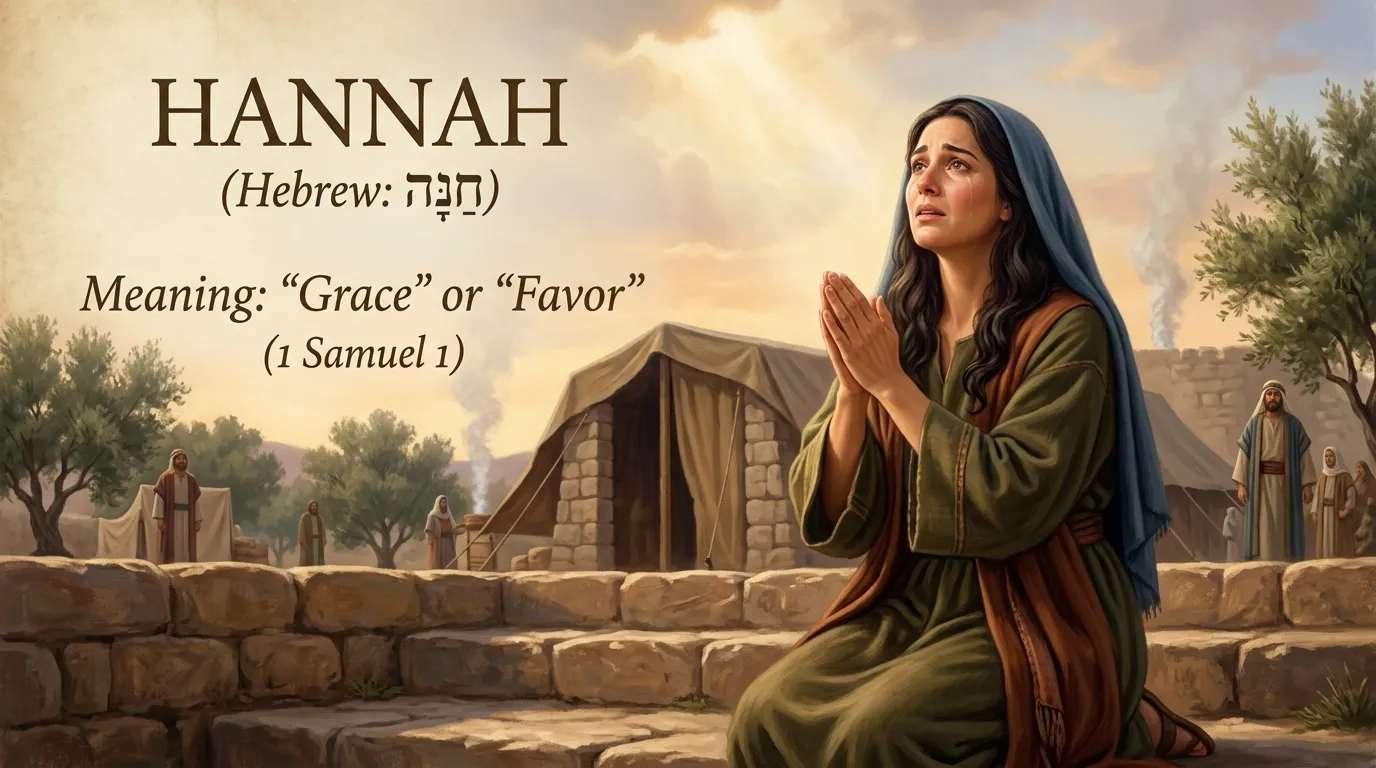
Have you ever felt like your deepest prayers went unheard?
Maybe you faced something hard, like waiting for a breakthrough that seemed impossible, and wondered if God really saw your tears.
I think many of us know that kind of ache. It can leave you feeling alone, even when life looks fine on the outside.
That’s why the story of Hannah touches so many hearts. People often search for the hannah meaning in bible because her life shows raw honesty mixed with strong trust. Hannah wasn’t a queen or a warrior at first glance.
She was a regular woman who carried heavy sorrow but found God’s kindness in the middle of it. Her name points straight to grace and favor, and her journey reminds us how God meets us right where we hurt most.
Hannah’s experience in the Old Testament speaks across time. She dealt with barrenness in a culture where having children meant everything.
Her rival mocked her year after year. Yet she kept turning to God. Her persistence in prayer and her willingness to give back what she received set her apart.
Let’s explore what the Bible says about Hannah meaning in bible.
Hannah Meaning in Bible
The meaning of Hannah in the Bible is “grace” or “favor.” Hannah is remembered as a faithful woman who trusted God during years of deep sorrow because she could not have children. Her heartfelt prayers and unwavering faith led to the birth of her son, Samuel, whom she dedicated to the Lord. Hannah’s story encourages believers to remain patient, pray sincerely, and rely on God’s perfect timing, even when facing difficult circumstances.
Hannah Meaning in Bible Hebrew
In Hebrew, the name Hannah comes from the word Channah (חַנָּה), which means “grace,” “favor,” or “kindness.” This beautiful meaning reflects God’s generous love and mercy toward His people. Hannah’s life perfectly illustrates these qualities, as God answered her persistent prayers and blessed her with a son. The Hebrew meaning reminds Christians that God’s grace is freely given and is often revealed through faith, humility, and steadfast trust in Him.
Hannah Meaning in Bible Verse
The biblical meaning of Hannah is best understood through the verses found in 1 Samuel 1–2, where her inspiring story unfolds. Hannah prayed earnestly for a child, made a vow to dedicate him to God, and faithfully kept her promise after Samuel was born. Her prayer of praise in 1 Samuel 2:1–10 celebrates God’s power, justice, and faithfulness. These verses reveal Hannah as a powerful example of prayer, gratitude, obedience, and unwavering confidence in the Lord.
Biblical Meaning of Hannah
The name Hannah comes from Hebrew roots. It derives from the word Channah, linked to the verb hanan, which means to be gracious or to show favor. So the biblical meaning of Hannah carries ideas of grace, favor, and God’s kindness extended to someone. It fits her story perfectly because she received God’s favor after years of pain.
Hannah first shows up in the Bible in the book of 1 Samuel. Right at the start of chapter 1, we meet her as one of Elkanah’s two wives. He had two wives. The name of the one was Hannah, and the name of the other, Peninnah. And Peninnah had children, but Hannah had no children. (1 Samuel 1:2, ESV). This short introduction sets up her struggle. In those days, people saw children as a sign of blessing. Without them, Hannah felt deep shame and sadness.
Her story unfolds at the tabernacle in Shiloh. Every year the family went there to worship. Peninnah would provoke Hannah badly, making her cry so much she could not eat. But Hannah did not fight back with words. She took her pain to God.
One powerful moment comes in 1 Samuel 1:10-11. She was deeply distressed and prayed to the Lord and wept bitterly. And she vowed a vow and said, ‘O Lord of hosts, if you will indeed look on the affliction of your servant and remember me and not forget your servant, but will give to your servant a son, then I will give him to the Lord all the days of his life, and no razor shall touch his head. (ESV). She poured out her soul completely. The priest Eli even thought she was drunk at first because her lips moved without sound. But she explained she was pouring out her heart in anguish.
God heard her. She conceived and gave birth to Samuel. Later she brought him back to the tabernacle just as she promised. In 1 Samuel 1:27-28 we read her words of gratitude: For this child I prayed, and the Lord has granted me my petition that I made to him. Therefore I have lent him to the Lord. As long as he lives, he is lent to the Lord. (ESV). She kept her word even though it meant giving up the son she wanted so badly. That kind of obedience shows real faith.
The spiritual significance of Hannah goes deeper than just getting what she asked for. Her name reflects God’s grace reaching down to someone who felt forgotten. But there is also a warning side. Life does not always give easy answers. Hannah waited and suffered first. Her story teaches that prayer matters, especially honest, persistent prayer. It also shows that blessings from God often come with responsibility. She dedicated Samuel fully, and he grew up to become a great prophet who anointed kings.
We can connect Hannah to other figures like David or even Mary in the New Testament. Both David and Hannah offered heartfelt prayers of praise after God moved in their lives. Hannah’s song in 1 Samuel 2 echoes themes of God lifting the humble and bringing down the proud. Mary’s Magnificat later picks up similar notes of joy in God’s salvation. Hannah stands as an example of a woman whose quiet faithfulness helped shape Israel’s history. Her son Samuel bridged the time of judges to the kings. Without her surrender, that path might have looked different.
The Hebrew background adds layers. Names in the Bible often carry weight. Hannah’s points to unearned favor. She did nothing to deserve a child after years of barrenness, yet God showed mercy. This ties into bigger Bible themes of grace and faith. God often chooses unlikely people and works through their weakness. Hannah’s barrenness mirrored Israel’s spiritual dryness at times, but her breakthrough brought new life and direction.
When you look at the hannah meaning in bible, you see more than a happy ending. You find a woman who learned to trust God’s timing. She moved from bitter tears to joyful praise. Her life encourages anyone waiting on God. It reminds us that our struggles can become part of something larger. Samuel’s leadership influenced the whole nation. One woman’s faithful prayers helped prepare the way for kings and eventually pointed toward God’s bigger plan of redemption.
Throughout Scripture, we see God remembering His people. He remembered Hannah. That same God listens today. The deeper meaning here involves surrender. Hannah received her son but gave him back. That act of trust opened more blessings. The Bible says God visited her again, and she had other children. Her story shows transformation through prayer and dependence on the Holy Spirit’s leading, even before the New Testament times.
Quick Reference Table
| Aspect | Details |
| Name Meaning | Grace, Favor (from Hebrew חַנָּה) |
| First Appearance | 1 Samuel 1:2 |
| Key Bible Verses | 1 Samuel 1:10-11, 1 Samuel 1:27-28, 1 Samuel 2:1-2 |
| Main Spiritual Lesson | Persistent prayer and full surrender to God |
| Family | Wife of Elkanah, Mother of Samuel |
| Outcome | Gave birth to Samuel, who became a prophet |
This table gives a fast look at the heart of Hannah’s story. Keep it handy when you want to remember the main points.
Dream & Real Life Meaning
Sometimes people wonder about Hannah in dreams or everyday experiences. In dreams, seeing someone like Hannah or hearing her story might point to a season of waiting and deep prayer. A peaceful dream could mean God is inviting you to pour out your heart honestly, just as she did. It might signal coming favor or grace after difficulty. An urgent dream, maybe with tears or waiting, could nudge you to keep praying without giving up, even when answers feel far away.
In real life, the hannah meaning in bible encourages us when we face delays or pain. It shows up in struggles like infertility, unmet hopes, or feeling mocked by circumstances. The lesson stays the same: bring everything to God. Test if an experience comes from God by checking it against Scripture. Does it line up with His character of love and truth? Does it lead you closer to Him and others? The Holy Spirit often brings peace, even in hard times, not confusion.
Make time to pray like Hannah did. Speak honestly. Journal your thoughts and prayers. Write down what you sense God saying. Over time you will notice patterns of His faithfulness. Many people today share how their own Hannah moments of surrender led to unexpected joy. It might not look exactly like having a child, but God can birth new purpose, peace, or ministry through your trust. Stay open. Keep praying. God hears.
Faith Takeaways
- Pray boldly and honestly, even when words come with tears, because God welcomes your whole heart.
- Trust God’s timing, knowing He sees your pain and can turn it into something beautiful.
- Reflect on past answers to prayer to build faith for what lies ahead.
- Seek to surrender what you receive back to God, just as Hannah dedicated Samuel.
- Remember that His grace and favor can reach you in your weakest place and bring new life.
FAQs
Spiritual meaning of the name Hannah
The spiritual meaning of the name Hannah reflects God’s grace, faithfulness, and the power of trusting Him through every season.
The story of Hannah in the Bible summary
Hannah’s story tells how God answered her faithful prayers by blessing her with Samuel after years of waiting.
Characteristics of Hannah in the Bible
Hannah is known for her faith, humility, patience, perseverance, and complete trust in God’s timing.
Lessons from Hannah in the Bible PDF
Hannah’s life teaches valuable lessons about prayer, faith, patience, surrender, and keeping promises to God.
What is special about Hannah in the Bible
Hannah is special because her unwavering faith and heartfelt prayers led to the birth of the prophet Samuel.
Peninnah and Hannah in the Bible
Peninnah and Hannah’s story highlights the contrast between outward success and deep faith, showing God’s care for the faithful.
Lessons from the story of Hannah in the Bible
The story of Hannah teaches believers to remain faithful, pray sincerely, trust God’s timing, and honor their commitments to Him.
Samuel and Hannah in the Bible
Samuel was Hannah’s promised son, dedicated to God’s service after He answered her persistent and faithful prayers.
More Searched Questions About Hannah
What does the name Hannah mean in Hebrew?
Hannah’s Hebrew name is Channah (Strong’s H2584), and the lexicons tie it to the verb chanan (Strong’s H2603), to be gracious or to show favour. Strong’s glosses the name itself “favoured”, and Brown-Driver-Briggs glosses it “grace”, which is why the name is given in English as “grace” or “favour”. That is the whole of what the lexicon carries: a name built on the Bible’s grace word, the word the Old Testament uses again and again for God stooping in kindness to someone beneath him. No lexicon gives the name a wider or more hidden sense, and no letter by letter reading of Channah stands in Scripture.
The name stands thirteen times in the Bible, every one of them in 1 Samuel 1-2: twice in 1:2, twice in 1:5, and once each in 1:8, 1:9, 1:13, 1:15, 1:19, 1:20, 1:22, 2:1 and 2:21. And the root inside her name sounds inside her own story, in her own mouth. After Eli blesses her she answers, “Let thine handmaid find grace in thy sight” (1 Samuel 1:18), using chen, the noun for grace that comes from the same root as Channah. Readers and teachers have long noticed how well the name fits the woman who received what she had not earned and could not repay. That fitting is their true and fair observation about the story. It is not a prophecy printed in the name, and this article does not present it as one: the lexicon gives the meaning, and the story gives the fitting, and the two should not be fused into a claim the text never makes.
Who was Hannah in the Bible? Who were her husband, her son and her rival?
Hannah was the wife of Elkanah, a man of Ramathaim-zophim in mount Ephraim whose own line the book names in its first verse: “his name was Elkanah, the son of Jeroham, the son of Elihu, the son of Tohu, the son of Zuph, an Ephrathite” (1 Samuel 1:1). Elkanah had two wives: “And he had two wives; the name of the one was Hannah, and the name of the other Peninnah: and Peninnah had children, but Hannah had no children” (1 Samuel 1:2). Elkanah loved the wife who had no children, and at the yearly offering he marked it: “But unto Hannah he gave a worthy portion; for he loved Hannah: but the LORD had shut up her womb” (1 Samuel 1:5).
Her son was Samuel, born after her prayer at Shiloh and lent to the LORD there, who grew up in the house of God and became the prophet through whom Israel passed from the judges to the kings. Her rival was Peninnah, the other wife, whom the text itself names with a harder word: “And her adversary also provoked her sore, for to make her fret, because the LORD had shut up her womb” (1 Samuel 1:6), and it went on at the feast year after year: “And as he did so year by year, when she went up to the house of the LORD, so she provoked her; therefore she wept, and did not eat” (1 Samuel 1:7). One searched form of this question has no answer, and the honest answer protects the reader: the Bible never names Hannah’s parents. The genealogy in the opening verse belongs to Elkanah, and no verse gives her father or her mother. Pages that supply her a family tree are adding what Scripture does not contain.
What was Hannah’s vow in 1 Samuel 1:11?
At Shiloh, in bitterness of soul, Hannah bound herself with a vow before she had any promise that a child would come. Here is the vow whole, in the words of the text: “And she vowed a vow, and said, O LORD of hosts, if thou wilt indeed look on the affliction of thine handmaid, and remember me, and not forget thine handmaid, but wilt give unto thine handmaid a man child, then I will give him unto the LORD all the days of his life, and there shall no razor come upon his head” (1 Samuel 1:11). Notice the shape of it. She asks for a son and, in the same breath, gives him away for the whole of his life. The vow is not a bargain struck after the gift. It is the gift surrendered in advance, by a woman who did not yet know whether there would be a gift at all.
The razor clause deserves its own care. Its words match the wording of the Nazirite separation in the law: “All the days of the vow of his separation there shall no razor come upon his head” (Numbers 6:5). Teachers therefore often call Samuel a lifelong Nazirite, and the echo in the wording is real. But 1 Samuel never calls Samuel a Nazirite, and the careful reader holds the two apart: the vow uses the law’s own razor words for a child set apart to the LORD all his days, and that is what the text says, neither more nor less. What the text also says is that she kept the vow to the letter when keeping it cost her the son’s company: “For this child I prayed; and the LORD hath given me my petition which I asked of him: Therefore also I have lent him to the LORD; as long as he liveth he shall be lent to the LORD” (1 Samuel 1:27-28).
Why did Eli think Hannah was drunk? What does her silent prayer teach?
Because her prayer made no sound. “Now Hannah, she spake in her heart; only her lips moved, but her voice was not heard: therefore Eli thought she had been drunken” (1 Samuel 1:13). Eli the priest, watching a woman’s lips move in the house of the LORD with no words coming out, read the worst into what he saw. Hannah’s answer to him is one of the Bible’s own descriptions of prayer from the inside: “No, my lord, I am a woman of a sorrowful spirit: I have drunken neither wine nor strong drink, but have poured out my soul before the LORD” (1 Samuel 1:15). She had come in bitterness and tears: “And she was in bitterness of soul, and prayed unto the LORD, and wept sore” (1 Samuel 1:10). The prayer the searches ask about is this one: spoken in the heart, carried on moving lips, heard by God and misread by the man of God standing nearest.
What followed shows what her prayer had already done before any answer arrived. Eli, corrected, blessed her: “Go in peace: and the God of Israel grant thee thy petition that thou hast asked of him” (1 Samuel 1:17). And Hannah, still childless, still with nothing in her hands, received the blessing as though the matter were settled: “And she said, Let thine handmaid find grace in thy sight. So the woman went her way, and did eat, and her countenance was no more sad” (1 Samuel 1:18). The teaching stands in the order of the verses. Prayer in the Bible is not measured by volume: a prayer with no audible words is a real prayer, poured out, not performed. And the peace came before the pregnancy. She ate, and her face changed, on the strength of having been heard and blessed, while the answer itself was still entirely in God’s hands.
What is the meaning of Hannah’s song in 1 Samuel 2?
When Hannah brought Samuel to Shiloh and left him there, she sang. The book calls it a prayer: “And Hannah prayed, and said, My heart rejoiceth in the LORD, mine horn is exalted in the LORD: my mouth is enlarged over mine enemies; because I rejoice in thy salvation” (1 Samuel 2:1). The song opens on God himself before it touches her circumstances: “There is none holy as the LORD: for there is none beside thee: neither is there any rock like our God” (1 Samuel 2:2). Its centre is a chain of reversals, God overturning every settled order of strength and fullness: “The bows of the mighty men are broken, and they that stumbled are girded with strength” (1 Samuel 2:4); “The LORD killeth, and maketh alive: he bringeth down to the grave, and bringeth up. The LORD maketh poor, and maketh rich: he bringeth low, and lifteth up” (1 Samuel 2:6-7); “He raiseth up the poor out of the dust, and lifteth up the beggar from the dunghill, to set them among princes, and to make them inherit the throne of glory” (1 Samuel 2:8).
Two parts of the song need careful handling. The first is its line about herself: “the barren hath born seven; and she that hath many children is waxed feeble” (1 Samuel 2:5). Seven here is the song’s sweeping language of reversal, and the book itself forbids turning it into her family count: the children the narrative later gives her are Samuel plus “three sons and two daughters” (1 Samuel 2:21), six children in all. The second is the ending, which reaches far past her own house: “the LORD shall judge the ends of the earth; and he shall give strength unto his king, and exalt the horn of his anointed” (1 Samuel 2:10). Israel had no king when Hannah sang. The song that began with one woman’s answered prayer ends looking to a king and an anointed one still to come, and that reach is why the church has always read this song as more than a thanksgiving: it is the Bible’s first great statement of the pattern, God bringing down the mighty and lifting the lowly, that runs from her lips to Mary’s.
How does Hannah’s song compare with Mary’s song in Luke 1?
Read side by side, the kinship is unmistakable. Mary begins where Hannah began, with joy in God himself: “My soul doth magnify the Lord, And my spirit hath rejoiced in God my Saviour. For he hath regarded the low estate of his handmaiden” (Luke 1:46-48). Hannah sang of the lowly lifted and the full sent down: “He raiseth up the poor out of the dust, and lifteth up the beggar from the dunghill, to set them among princes” (1 Samuel 2:8). Mary sings the same reversals in her own generation: “He hath put down the mighty from their seats, and exalted them of low degree. He hath filled the hungry with good things; and the rich he hath sent empty away” (Luke 1:52-53). Two women, separated by centuries in the Bible’s own timeline of events, each singing at the start of a story about a son given by God, and each singing not mainly about herself but about the God who reverses the world.
The honest limits matter as much as the likeness. Luke never quotes Hannah by name, never says Mary had Hannah’s song in mind, and Mary’s song is her own, spoken of her own son and her own moment. The echo is read by the church from the two texts placed side by side, in their shared shape, their shared reversals and, in places, their near shared words, and it is held here as exactly that reading: a true kinship between the songs that the texts themselves display, not a quotation the evangelist claims. Teachers are right to set the songs together, because the resemblance is in the words on the page. What no reader should add is a claim that Luke explains the connection, when he leaves it, beautifully, for the reader to hear.
Is Hannah in 1 Samuel the same person as Anna in Luke 2?
No. They are two different women, separated by the whole span between Samuel and the birth of Jesus, who carry the same name in its two Bible forms. Hannah of 1 Samuel is Channah, the wife of Elkanah and the mother of Samuel, whose story stands at the head of the books of Samuel. Anna of Luke 2 is introduced entirely on her own terms: “And there was one Anna, a prophetess, the daughter of Phanuel, of the tribe of Aser: she was of a great age, and had lived with an husband seven years from her virginity; And she was a widow of about fourscore and four years, which departed not from the temple, but served God with fastings and prayers night and day” (Luke 2:36-37). Meeting the infant Jesus in the temple, “she coming in that instant gave thanks likewise unto the Lord, and spake of him to all them that looked for redemption in Jerusalem” (Luke 2:38).
The confusion is understandable, and it has a simple root. Anna is the Greek form of the Hebrew name Channah, the name the Septuagint and the New Testament write in Greek letters, and Strong’s entry for Hannah notes exactly that Greek form. So the two women share a name, and with it its meaning of grace and favour, and nothing else. Hannah prayed at Shiloh for a son and gave him back to God; Anna, an elderly widow prophetess, watched in the temple for the redemption of Israel and recognised it in a child. A reader who merges them loses both stories: a young mother in the days of the judges, and an old prophetess at the turning of the ages, each with her own place in the Bible’s account.
Why was Hannah barren? Was her barrenness a punishment?
The text answers the first question as far as it intends to, and it refuses the second. Twice in two verses the narrative says whose hand closed her womb: “but the LORD had shut up her womb” (1 Samuel 1:5), and of Peninnah’s provoking, “because the LORD had shut up her womb” (1 Samuel 1:6). Beyond that statement the book gives no reason at all. It records no sin of Hannah’s, names no fault, and offers no explanation of why the LORD shut her womb or why he opened it when he did. Her husband’s love is stated, her adversary’s cruelty is stated, her own innocence of any named charge is the plain state of the text: Eli’s one accusation, drunkenness, is withdrawn the moment she explains herself. Any teaching that her barrenness was a punishment for something is a claim the passage never makes, and it should not be laid on women reading her story as though the Bible had said it.
She also does not stand alone. Hannah belongs to the Bible’s own line of women whose wombs were closed and then opened by God: Sarah, of whom the book says “the LORD visited Sarah as he had said” (Genesis 21:1); Rebekah, for whom “Isaac intreated the LORD for his wife, because she was barren: and the LORD was intreated of him, and Rebekah his wife conceived” (Genesis 25:21); Rachel, of whom it is written “God remembered Rachel, and God hearkened to her, and opened her womb” (Genesis 30:22); the wife of Manoah, introduced simply as barren (Judges 13:2), who bore Samson; and Elizabeth, who “had no child, because that Elisabeth was barren” (Luke 1:7), until the angel told Zacharias “thy prayer is heard; and thy wife Elisabeth shall bear thee a son” (Luke 1:13). In none of these stories is barrenness explained as the woman’s punishment. It is the closed door God opens in his own time, for his own purposes in the story, and Hannah’s place in that line is a matter of the texts themselves.
What can women who are struggling with infertility learn from Hannah?
First, what her story does not teach. It does not teach a formula. Hannah’s vow was her own, made by one woman in one moment, and no verse presents it as a pattern that obliges God, or suggests that a woman who vows enough, or believes enough, will receive a child. Her story is not a promise that every praying woman conceives: it is the account of one woman God remembered, told beside other women in Scripture whose waiting ended differently in timing and in kind. A teaching that turns her prayer into a fertility method, or quietly blames the still waiting woman for praying it wrongly, has left the text behind. The comfort her story honestly offers is of another kind, and it stands in the shape of the account itself.
That shape has three turns, each in the verses. Lament poured out honestly: Hannah does not tidy her grief before she brings it. She is “in bitterness of soul”, she weeps sore (1 Samuel 1:10), she calls herself a woman of a sorrowful spirit, and the book treats that rawness as prayer, not as a failure of faith. Worship before the answer: the morning after she conceived nothing and knew nothing, “they rose up in the morning early, and worshipped before the LORD, and returned, and came to their house to Ramah: and Elkanah knew Hannah his wife; and the LORD remembered her” (1 Samuel 1:19). The worship stands in the sentence before the remembering, and her eating with a face no longer sad stands before that (1 Samuel 1:18). And the gift received and given back: the child she begged for, she lent to the LORD for his whole life (1 Samuel 1:28), holding the answer with open hands. Lament, worship in the waiting, and surrender of the gift: that is what her story, read as it stands, holds out to anyone in a long and painful wait.
What happened to Hannah after she gave Samuel to the LORD?
She kept her vow to the letter, and the book tells the parting plainly. Hannah stayed home until the child was weaned, saying, “I will not go up until the child be weaned, and then I will bring him, that he may appear before the LORD, and there abide for ever” (1 Samuel 1:22). Then, “when she had weaned him, she took him up with her, with three bullocks, and one ephah of flour, and a bottle of wine, and brought him unto the house of the LORD in Shiloh: and the child was young” (1 Samuel 1:24). Searches often ask Samuel’s age at this moment, and the honest answer is that the Bible does not state it. “The child was young” is all the measure the text gives, and any exact age printed elsewhere is an estimate built on weaning customs, not a fact of the passage.
And her motherhood did not end at the door of the house of God. She went up with her husband to the yearly sacrifice, and she carried her son something made by her own hands: “Moreover his mother made him a little coat, and brought it to him from year to year, when she came up with her husband to offer the yearly sacrifice” (1 Samuel 2:19). The mother who had given him up still clothed him, year by year, in a coat sized for a growing boy she saw once a year. Eli blessed the couple for the loan: “The LORD give thee seed of this woman for the loan which is lent to the LORD” (1 Samuel 2:20), and the book records the answer in its next breath: “And the LORD visited Hannah, so that she conceived, and bare three sons and two daughters. And the child Samuel grew before the LORD” (1 Samuel 2:21). Her story closes where her song began, with God lifting up: the lent child growing “in favour both with the LORD, and also with men” (1 Samuel 2:26), and the mother who surrendered one son the mother of six children, remembered in the book by her prayer and her song long after her name last appears.
Conclusion
Hannah’s journey highlights two big spiritual truths. First, God hears persistent, honest prayers and shows favor to the hurting. Second, true blessing grows when we surrender what we receive back to Him. Her life moved from sorrow to song because she trusted the Lord completely.
One final powerful Bible verse comes from her own mouth: My heart exults in the Lord; my horn is exalted in the Lord. My mouth derides my enemies, because I rejoice in your salvation. (1 Samuel 2:1, ESV).
No matter what you carry today, remember Hannah. God sees you. His grace is enough. Keep praying, keep trusting, and watch Him bring beauty from your story. There is always hope.
Discover More Articles
- Number 4 Meaning in the Bible: A Complete Biblical Guide
- Number 3 Meaning in the Bible: The Powerful Truth Revealed
- Number 3 Meaning in the Bible: The Powerful Truth Revealed