Have you ever felt like something was missing in your daily routine? You go through the motions: work, family, maybe a quick prayer before bed, but deep down, you wonder if there’s more to life than just getting by.
I remember a friend who shared how she hit that wall after a tough year. She had a good job and loving kids, yet she felt empty inside.
One day, she picked up her Bible and stumbled across the word zoe. It changed how she saw everything.
Zoe meaning in the Bible points to a special kind of life. It’s not just breathing or going through your days.
Zoe Biblical Meaning — John 10:10
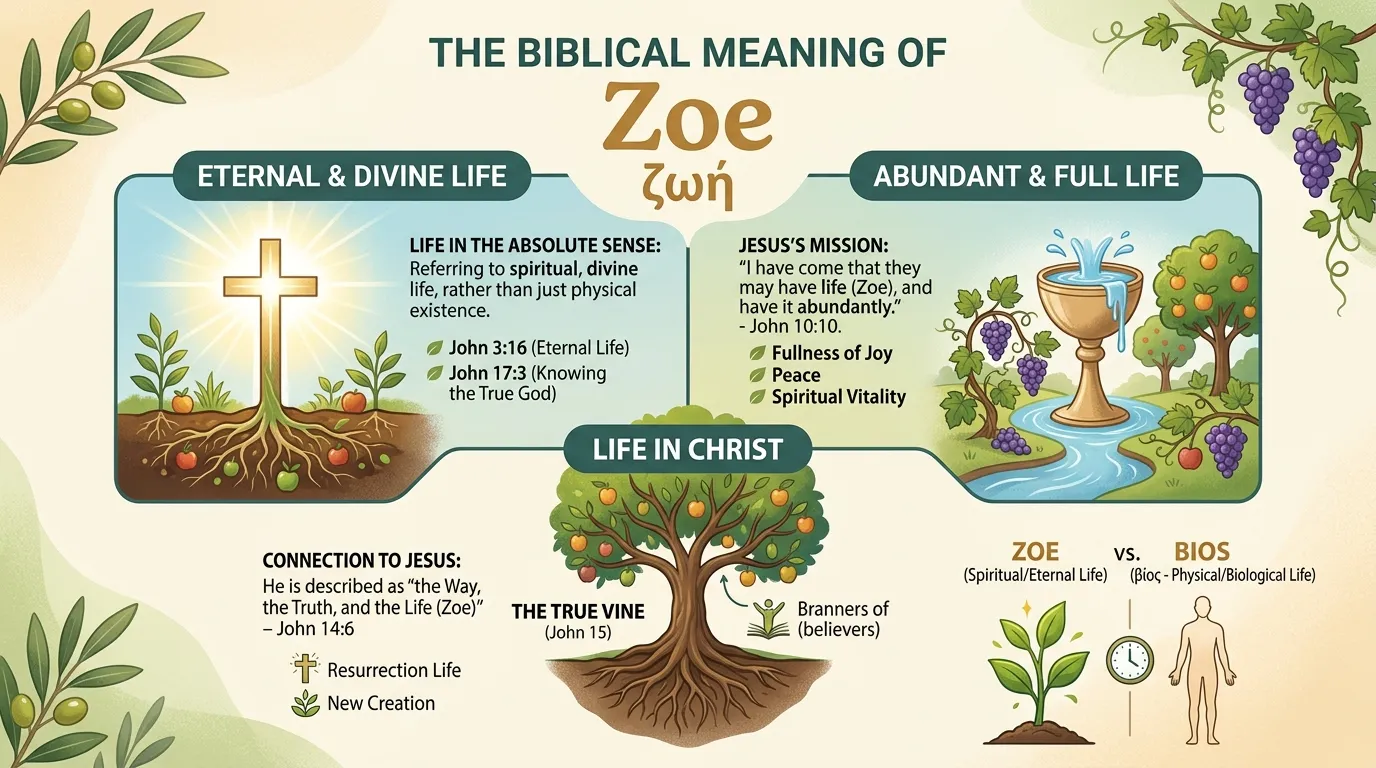
In the Bible, Zoe comes from the Greek word zōē, which means “life.” It often points to life that comes from God, especially eternal life through Jesus Christ. This is more than simply being alive. It speaks of a life joined to God and shaped by His grace. Jesus said He came so His followers could have life in abundance. The biblical idea of Zoe points to spiritual life, hope, and fellowship with God. It reminds believers that true life is found in Christ, not only in earthly things.
Bible Verse:
“I came that they may have life and have it abundantly.”
— John 10:10 (ESV)
Zoe Meaning in the Bible — John 1:4
The word Zoe has a rich meaning in the Bible because it is linked with life from God. John uses this word when he speaks about Jesus as the source of life. This shows that biblical life is not only about breathing or existing. It includes spiritual life and the light that comes through Christ. Zoe points to the life God gives and sustains. For Christians, this meaning offers hope because Jesus is not only the giver of life but also the source of true spiritual light.
Bible Verse:
“In him was life, and the life was the light of men.”
— John 1:4 (ESV)
Zoe Meaning in the Bible — Romans 6:23
The biblical meaning of Zoe is closely connected with eternal life. Scripture teaches that sin brings death, but God offers life through Jesus Christ. This makes Zoe more than a name or a simple word for living. It points to the lasting life God gives through His grace. Eternal life is not something people earn by good works. It is God’s gift through Christ. This meaning gives Zoe a strong biblical message of grace, hope, and a restored relationship with God.
Bible Verse:
“For the wages of sin is death, but the free gift of God is eternal life.”
— Romans 6:23 (ESV)
Zoe Meaning — John 6:35
Zoe means “life” in Greek and carries an important spiritual meaning in the New Testament. The Bible connects true life with Jesus Christ. He describes Himself as the bread of life, showing that people need Him for lasting spiritual nourishment. Zoe can therefore remind us that real life is found in a relationship with God. It points beyond temporary success, comfort, or earthly life. Through Christ, believers receive a life that has eternal value and a deeper purpose rooted in God’s love.
Bible Verse:
“I am the bread of life; whoever comes to me shall not hunger.”
— John 6:35 (ESV)
Biblical Meaning of Zoe
Zoe comes from the Greek language. It means life, but not in the everyday sense. Ancient Greeks had a few words for life. One was bios, which is like our biological existence: what we eat, sleep, and do each day. Another was psuche, tied to our soul or emotions. But zoe stands apart. It speaks of the vibrant, eternal, God-given life.
This term appears over 130 times in the New Testament. Its first clear use in a spiritual sense hits right away in John 1:4. Scholars point to this as a key spot where the deeper meaning shines through. Before that, in the Septuagint (the Greek Old Testament), similar ideas appear, but the New Testament writers, especially John, really unpack zoe.
Let’s look at some Bible verses that bring this to life. In the ESV, John 1:4 says, In him was life, and the life was the light of men. Here, life is zoe. Jesus carries God’s own life inside Him, and it lights up the world. It’s not dim or fading. It’s powerful and full of hope.
Another powerful one is John 10:10: The thief comes only to steal and kill and destroy. I came that they may have life and have it abundantly. Again, that life translates zoe. Jesus doesn’t promise just survival. He offers overflowing, abundant life. This verse always encourages me because it shows God’s heart. He wants good things for us, not just in heaven someday, but right now.
Quick Reference Table
| Aspect | Details |
| Greek Word | Zoe (ζωή) – Pronounced dzo-ay |
| Primary Meaning | Divine, eternal, abundant life from God |
| First Major Appearance | John 1:4 (In Him was life…) |
| Key Contrast | Vs. Bios (physical life) and Psuche (soul life) |
| Number of Occurrences | Over 130 times in NT |
| Central Theme | Life in Christ – full and overflowing |
| Related Concepts | Grace, faith, Holy Spirit, transformation |
| Example Verse | John 10:10 – Life abundantly |
Dream & Real Life Meaning
People sometimes wonder about zoe in dreams. A peaceful dream featuring light, water, or Jesus might point to God’s invitation for more of His life. It feels calm and hopeful. On the other hand, urgent dreams with struggle could remind you to seek zoe amid challenges. Dreams aren’t always direct messages, so test them against Scripture.
In real life, zoe shows up as inner peace during stress, unexpected joy, or strength to forgive. You might sense it when helping others or during quiet prayer. These experiences often come gently through the Holy Spirit.
To test if something is from God, check the Bible. Does it line up with love, truth, and Jesus’ teachings? Talk to trusted Christian friends. Prayer helps sort it out. Keep a journal of moments when you felt God’s life flowing. Over time, patterns emerge. This practice builds faith and helps you recognize divine messages.
Don’t overthink it. God speaks in many ways, but His main word is the Bible. Stay close through prayer, and zoe will become more real in your everyday walk.
Faith Takeaways
- Pray for the Holy Spirit to fill you with fresh zoe each morning.
- Trust that Jesus came to give you abundant life, even on hard days.
- Reflect on Bible verses about life and thank God for His gift.
- Seek deeper connection with Christ through daily reading and prayer.
- Remember that zoe starts now and lasts forever in Him.
FAQs
Zoe significado espiritual
Zoe tiene un significado espiritual relacionado con la vida, especialmente la vida plena y abundante que Dios ofrece.
Que significa Zoe en hebreo
Aunque Zoe es una palabra griega, su concepto bíblico de vida se relaciona con ideas hebreas sobre la vida dada y sostenida por Dios.
Zoe significado griego
En griego, Zoe (ζωή) significa “vida” y en el Nuevo Testamento puede referirse a la vida espiritual y eterna.
Que significa Zoé en el amor
Zoé en el amor puede expresar una vida llena de amor, conexión y propósito, especialmente desde una perspectiva cristiana.
Que significa Zoe en inglés
Zoe significa “life” en inglés y es un nombre asociado con la idea de vida.
Zoé en la Biblia versículos
La palabra griega zoé aparece en varios pasajes del Nuevo Testamento relacionados con la vida eterna y la vida que viene de Dios.
Zoe es nombre de niño o niña
Zoe es tradicionalmente un nombre femenino, aunque su significado de “vida” tiene un valor universal.
Como vivir la vida zoé
Vivir la vida zoé implica buscar una vida llena de fe, propósito, amor y una relación profunda con Dios
More Searched Questions About Zoe
What does the Greek word zoe mean in the Bible?
Zoe (Strong’s G2222, pronounced dzo-ay) is the New Testament’s chief word for life, and Strong’s glosses it simply: life, literally or figuratively. It is not a rare or hidden word. Strong’s concordance counts 134 standings of it in the Greek New Testament; in one place the King James renders it “lifetime” (Luke 16:25, “in thy lifetime”) and in every other place “life”. Its best known standing opens John’s Gospel: “In him was life; and the life was the light of men” (John 1:4). The “him” is the Word, Jesus Christ, and the sentence sets the word’s register from the start: zoe is life located in a person, which then gives light to everyone else.
No writer uses the word like John. In his Gospel and his letters zoe is the life God has in himself and gives in his Son. The Father’s own possession of it is stated in so many words: “For as the Father hath life in himself; so hath he given to the Son to have life in himself” (John 5:26). The lexicons note the same shape: zoe is life in its fullness, life as God has it, not the bare fact of being alive. That is why the word can carry both the life believers receive now and the life of the world to come without changing its meaning. It is one life, God’s life, shared with his people in Christ, and the answers below follow it through its own verses rather than through any system built over it.
Is Zoe a name in the Bible? Is Zoe a biblical name for a girl?
The searches ask this in several forms, and the exact answer protects the reader. No woman named Zoe stands in the New Testament, and no woman bears the name in the Hebrew Old Testament either. Where a first woman is named in Genesis, the Hebrew text names her Chavvah, which English Bibles write as Eve: “And Adam called his wife’s name Eve; because she was the mother of all living” (Genesis 3:20). So Zoe is not the name of a Bible character a daughter would be named after, the way Hannah or Mary is. Any page that describes a Bible woman called Zoe, her story, her family or her faith, is inventing her.
And yet Zoe does stand as her name in the Greek Bible, and the standing is a beautiful one. When the Hebrew Scriptures were translated into Greek, the translation the apostles themselves quote, the translators of Genesis rendered Chavvah by its sense and wrote Zoe: in the Septuagint Adam calls his wife Zoe, because she is the mother of all living. That is the name’s one biblical standing as a woman’s name, and it is a translation standing, not a second woman. The girl’s name used today, and its spelling variant Zoey, are taken from the Greek word for life itself, and parents choose it for that meaning and for the New Testament’s teaching about the life Jesus gives, which the answers below open. Women named Zoe appear later, among the martyrs and saints of the early church, which is church history after the Bible and is held here as exactly that.
What does Zoe mean in Hebrew?
Zoe has no meaning in Hebrew, because it is not a Hebrew word at all. It is Greek from first to last, and the searches that ask for its Hebrew meaning deserve that plain answer before anything else, because pages that print a Hebrew origin for Zoe are guessing. The Hebrew word for life is chay (Strong’s H2416), met most often in its plural form chayyim. It stands in the Bible’s second chapter, at the making of man: “And the LORD God formed man of the dust of the ground, and breathed into his nostrils the breath of life; and man became a living soul” (Genesis 2:7). The breath of life there is chayyim in the Hebrew, the same word that runs through the Old Testament wherever life is given, lengthened, or taken.
The real connection between chayyim and zoe is a connection of translation, and it can be stated exactly. When the Hebrew Scriptures were put into Greek in the Septuagint, the translators rendered chayyim with zoe. At Genesis 2:7 the breath of life in Greek is pnoe zoes, a breath of zoe, and at Genesis 2:9 the tree in the garden is “the tree of life also in the midst of the garden” (Genesis 2:9), in Greek xylon tes zoes, the tree of zoe. So the zoe of John’s Gospel is the Greek word that already carried the Old Testament’s life language to Greek readers for centuries. The New Testament word and the Old Testament word meet in translation, not in origin, and a reader loses nothing by keeping them straight: chayyim is the Hebrew Bible’s word, zoe is the Greek Bible’s word, and both are rendered “life” because both mean life.
What did Jesus mean by “I am the resurrection, and the life” and “I am the way, the truth, and the life”?
Twice in John’s Gospel Jesus takes this word onto his own lips with the words “I am” in front of it, and in both places the word is zoe. At the grave of Lazarus, speaking to Martha before he called her brother out, he said: “I am the resurrection, and the life: he that believeth in me, though he were dead, yet shall he live” (John 11:25). At the last supper, answering Thomas, he said: “I am the way, the truth, and the life: no man cometh unto the Father, but by me” (John 14:6). In the first saying the order matters. He does not only promise Martha a resurrection at the last day, which she already believed; he tells her the resurrection and the life are standing in front of her, in a person, and that believing in him reaches past death itself.
The claim is larger than giving. A giver of life could in principle hand the gift over and stand apart from it; Jesus says he is the life, so that the life is had by having him. John’s letter opens with the same confession: “For the life was manifested, and we have seen it, and bear witness, and shew unto you that eternal life, which was with the Father, and was manifested unto us” (1 John 1:2). The life was not a force or a feeling but someone who was seen and handled, who had been with the Father and appeared in the world. That is why the New Testament so often speaks of life as something located: life in the Son, life in himself (John 5:26), life hid with Christ. Zoe in these sayings is not an atmosphere around Jesus. It is Jesus, received by faith, as the next answers show in the chapters where the word works hardest.
What is zoe life, and what is the abundant life of John 10:10?
The phrase in the searches, “zoe life”, gathers around one verse, and the verse must be read inside its chapter. “The thief cometh not, but for to steal, and to kill, and to destroy: I am come that they might have life, and that they might have it more abundantly” (John 10:10). Life there is zoe. The sentence is a contrast, and the contrast defines the abundance: on one side a thief whose whole work is taking, on the other a shepherd whose whole work is giving. The chapter says what his giving costs and what it consists of. “I am the good shepherd: the good shepherd giveth his life for the sheep” (John 10:11), and again, “I lay down my life for the sheep” (John 10:15). The life in those two verses, the life laid down, is psuche, the shepherd’s own soul life; the life given in exchange, in 10:10 and in 10:28, is zoe.
And the chapter itself states what the given life is: “And I give unto them eternal life; and they shall never perish, neither shall any man pluck them out of my hand” (John 10:28). The abundance of John 10:10 is therefore measured by the text, not by the reader’s hopes. It is eternal life, given by the shepherd, kept in his hand, beginning in a present relationship with him (“My sheep hear my voice”, John 10:27). What the verse does not promise is wealth, health or success as the content of the abundance, and this fence needs stating plainly because modern teaching, including teaching that brands itself with this very word, often presents “zoe life” as God’s guarantee of prosperity. The chapter’s own thief steals and destroys; nothing in it says the shepherd’s sheep grow rich. The abundance is life itself, God’s life in the Son, fuller than the bare existence the thief leaves behind, and the text asks to be believed at exactly that size.
What is the difference between zoe, bios and psuche in the New Testament?
The New Testament has three words that English renders “life”, and the honest way to separate them is by their standings. Bios (Strong’s G979) is life as its course and its means: the living a person has, and the manner of life it supports. The disciples’ seed is choked by “the cares of this world, and the deceitfulness of riches, and the lusts of other things” in Mark, and Luke’s telling uses bios for the same tangle: seed “choked with cares and riches and pleasures of this life” (Luke 8:14). A sick woman “had spent all her living upon physicians” (Luke 8:43), all her bios, her whole livelihood. And John’s letter lists “the pride of life” (1 John 2:16) among the things that are of the world, bios again. Bios is never the Bible’s word for the life God gives in Christ; it is the outward course of a life, its resources and its show. (This article’s own contrast section calls bios “our biological existence”; the standings above are what the word actually does, and the English word biology, which descends from bios, is not what the New Testament means by it.)
Psuche (Strong’s G5590) is the soul, the self, the life a person has in himself, which he can keep or lay down. John 12:25 sets psuche and zoe side by side in a single sentence: “He that loveth his life shall lose it; and he that hateth his life in this world shall keep it unto life eternal” (John 12:25). The two “life”s that are loved and hated are psuche; the “life eternal” they are kept unto is zoe. The lexicons’ distinction, held here as theirs, runs the same way: zoe is life in its fullness, life as God has it and gives it; bios is life’s outward course; psuche is the soul life of the person. But the words overlap in honest use, and no verse builds them into a ladder of three levels of Christian life. Jesus lays down his psuche (John 10:11) and gives zoe (John 10:28), and the difference the texts carry is exactly that: what he surrendered, and what he gives.
What is eternal life in the Bible?
Eternal life in the New Testament is zoe carrying the word aionios: zoe aionios, life eternal, or in the King James order, everlasting life. Jesus defines it himself, in his prayer on the last night, and the definition is not first about length: “And this is life eternal, that they might know thee the only true God, and Jesus Christ, whom thou hast sent” (John 17:3). Eternal life is defined as knowing: knowing the only true God, and Jesus Christ whom he sent. It is also, in John’s Gospel, a present possession and not only a future hope: “He that heareth my word, and believeth on him that sent me, hath everlasting life, and shall not come into condemnation; but is passed from death unto life” (John 5:24). Hath, and is passed: the crossing from death to life is spoken of as already made for the believer, while its fullness still waits.
John’s first letter closes the subject with a testimony and a location. “And this is the record, that God hath given to us eternal life, and this life is in his Son” (1 John 5:11). “He that hath the Son hath life; and he that hath not the Son of God hath not life” (1 John 5:12). The life is in a person, and it is had by having him. And the letter states its own purpose in the same terms: “These things have I written unto you that believe on the name of the Son of God; that ye may know that ye have eternal life” (1 John 5:13). The last word of the testimony names the Son himself: “This is the true God, and eternal life” (1 John 5:20). Held together, the texts give eternal life a definition (knowing God and Christ), a tense (had now, in fullness later), and an address (in the Son). This article’s body sets Romans 6:23 beside it, eternal life as God’s free gift against the wages of sin, and the two standings agree: a gift, located in Christ, never earned.
What is the water of life in Revelation 22?
The Bible’s last chapter gives the word zoe its closing standings, and they are standings of open invitation. “And he shewed me a pure river of water of life, clear as crystal, proceeding out of the throne of God and of the Lamb” (Revelation 22:1). Water of life is hydor zoes in the Greek: a river whose water is life itself, flowing from the throne, in a city where the tree of life stands by the river again (Revelation 22:2), the garden’s furniture restored at the end of the book that began with a garden. Nothing in the chapter treats the river as a code to be decoded. It is the Bible’s final picture of the life God gives: clear, proceeding from his throne, and running where his people can reach it.
The chapter then turns the picture into an offer, in the Bible’s last invitation: “And the Spirit and the bride say, Come. And let him that heareth say, Come. And let him that is athirst come. And whosoever will, let him take the water of life freely” (Revelation 22:17). Freely is the word the long story lands on. The life that was in the Son at the Gospel’s opening (“In him was life”, John 1:4), that the shepherd gives to his sheep (John 10:28), that John locates in the Son for every believer (1 John 5:11-12), is at the end a river held out to whoever wills, at no price. A reader who follows the word zoe from Genesis in Greek dress to this river has followed the Bible’s own arc for it: life breathed, life lost, life manifested in Christ, life given, and life flowing freely at the last. No teacher’s system is needed to make that arc hold together, because the verses make it themselves.
What do the names Zoey and Zowie mean in the Bible?
Zoey and Zowie are modern variant spellings of Zoe, and they carry the same meaning: life. Zoe is the Greek word for life (Strong’s G2222), the divine and eternal life of God in the New Testament. So the name Zoey means “life”, and the same is true of Zowie. Zoey is the common modern spelling used for girls. Zowie is much rarer, and it is best known from David Bowie’s son, Duncan Zowie Haywood Jones, born in 1971, who was called “Zowie Bowie” as a child. His mother chose the spelling because Zoe means life, changing it so it would not be confused with the girl’s name. In the Bible, the word zoe is the life Jesus speaks of in John 1:4, “In him was life; and the life was the light of men”, and in John 10:10, “I am come that they might have life, and that they might have it more abundantly”.
Which Bible verses mention Zoe?
The word zoe, Greek for life, appears about 135 times in the New Testament, most often in the writings of John. These are the key verses where “life” is zoe: John 1:4, “In him was life; and the life was the light of men”; John 3:16, “everlasting life”; John 6:35, “I am the bread of life: he that cometh to me shall never hunger; and he that believeth on me shall never thirst”; John 10:10, “I am come that they might have life, and that they might have it more abundantly”; John 11:25, “I am the resurrection, and the life: he that believeth in me, though he were dead, yet shall he live”; John 14:6, “I am the way, the truth, and the life: no man cometh unto the Father, but by me”; John 17:3, “And this is life eternal, that they might know thee the only true God, and Jesus Christ, whom thou hast sent”; Romans 6:23, “the gift of God is eternal life through Jesus Christ our Lord”; Galatians 2:20, “the life which I now live in the flesh I live by the faith of the Son of God, who loved me, and gave himself for me”; and 1 John 5:11-12, “God hath given to us eternal life, and this life is in his Son. He that hath the Son hath life”. Note that Zoe itself is not the name of a person in the Bible. It is the Greek word for life, and that is why the name carries the meaning it does.
Conclusion
Zoe meaning in the Bible boils down to two big truths. First, God offers His own vibrant life through Jesus. Second, this life starts today and changes everything for the better. It brings hope, strength, and closeness to Him.
One final powerful Bible verse comes from John 17:3: And this is eternal life, that they know you, the only true God, and Jesus Christ whom you have sent.
No matter where you are right now, God’s zoe is available. Reach out in prayer today. You’ll find a life fuller than you imagined: warm, real, and full of promise.
Meta Description: Explore zoe meaning in the Bible – the divine, abundant life God offers through Jesus. Discover verses, spiritual insights, and practical faith takeaways.
Discover More Articles
- Number 4 Meaning in the Bible: A Complete Biblical Guide
- Number 3 Meaning in the Bible: The Powerful Truth Revealed
- Number 3 Meaning in the Bible: The Powerful Truth Revealed

I’m Nicholas Sparks, and storytelling has always been my passion. Through TheBiblimeaning, I share insights about my books, unforgettable characters, romance, emotions, and the deeper meanings behind my stories. This platform brings readers closer to my writing journey, latest releases, and the inspiration that shapes every novel I create.










