Have you ever read an old Bible verse and wondered what loins really means? This word shows up again and again in Scripture, yet many readers today skip right past it.
The loins meaning in the Bible goes far deeper than a body part. It touches on strength, family, obedience, and even spiritual readiness.
Ancient writers used this word to describe where a man’s descendants would come from. They also used it to picture a heart prepared for God’s work. Understanding this word helps us read the Bible with fresh eyes.
This article walks through the biblical meaning of loins, its Hebrew and Greek roots, and how God used this simple word to teach powerful truths.
Let’s explore what the Bible says about loins.
Biblical Meaning of Loins
In the Bible, loins refers to the lower part of the body, near the hips and reproductive area. But the word carries much more weight than its physical meaning alone. It often symbolizes strength, inheritance, offspring, and spiritual preparation.
The Hebrew word most often translated as loins is mothnayim (מָתְנַיִם), which points to the waist or hip area, the seat of physical power in the ancient world. In the Greek New Testament, the word osphys (ὀσφῦς) carries a similar meaning. Both words describe more than anatomy; they describe the source of a person’s strength and future generations.
The very first appearance of this concept in Scripture comes early in Genesis, where God speaks about descendants coming from a man’s own body. This connects loins directly to the idea of family lineage and promise. When Scripture says someone came from the loins of another, it means they were that person’s direct descendant.
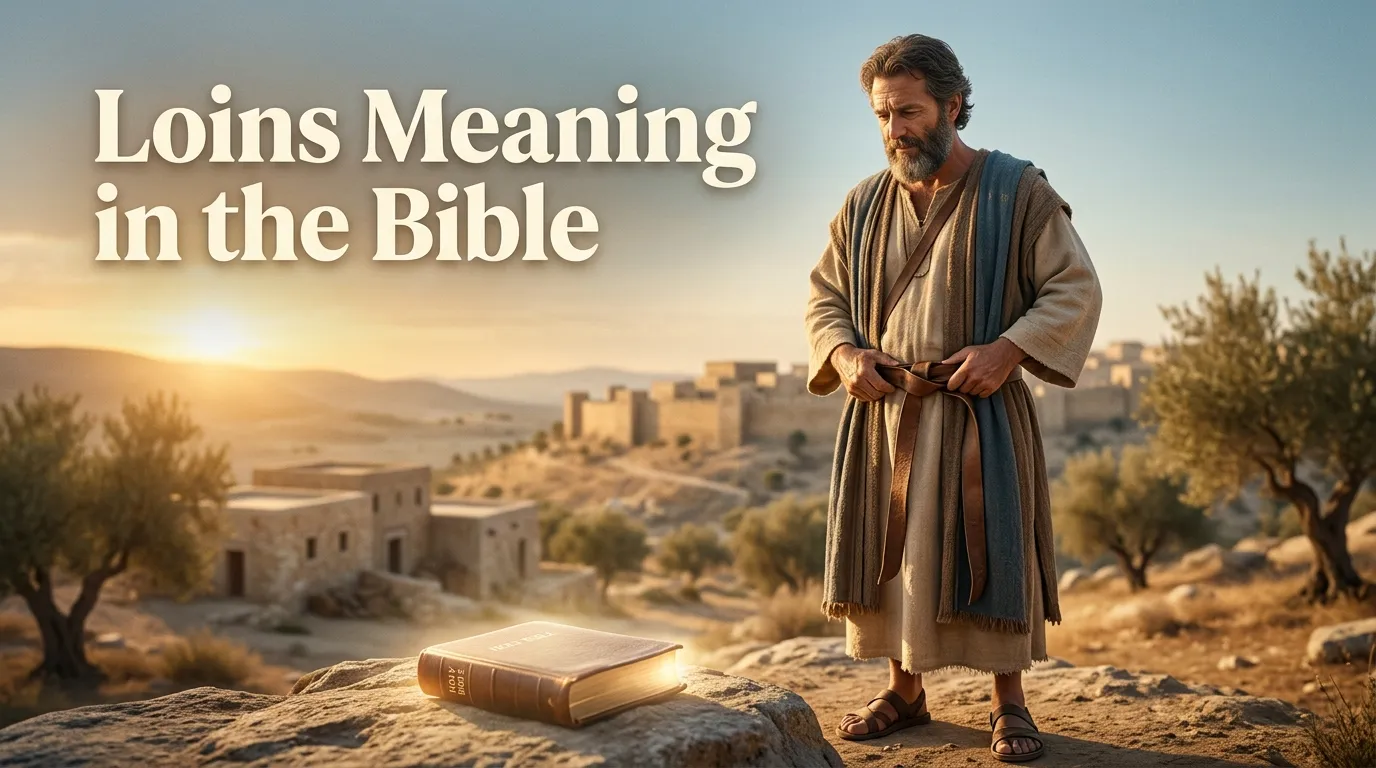
This word also shows up in commands about clothing and readiness. God often told His people to gird up their loins, meaning to tuck their long robes into their belt so they could move quickly and work without being tangled. This picture became a powerful spiritual lesson about being ready for action and ready for God.
Quick Reference Table
| Aspect | Meaning |
| Hebrew Word | Mothnayim (מָתְנַיִם) |
| Greek Word | Osphys (ὀσφῦς) |
| Literal Meaning | Waist, hips, lower body |
| Symbolic Meaning | Strength, offspring, readiness |
| First Appearance | Genesis (descendants from the body) |
| Positive Meaning | Spiritual readiness, strong faith, godly inheritance |
| Warning Meaning | Weakness, fear, unpreparedness |
| Related Figures | Abraham, Jacob, Elijah, John the Baptist, Paul |
| New Testament Use | Gird up the loins of your mind (1 Peter 1:13) |
Key Bible Verses
Genesis 35:11 (ESV) And God said to him, ‘I am God Almighty: be fruitful and multiply. A nation and a company of nations shall come from you, and kings shall come from your own body (loins).’
Exodus 12:11 (ESV) In this manner you shall eat it: with your belt fastened, your sandals on your feet, and your staff in your hand. And you shall eat it in haste. It is the Lord’s Passover.
1 Peter 1:13 (ESV) Therefore, preparing your minds for action, and being sober-minded, set your hope fully on the grace that will be brought to you at the revelation of Jesus Christ.
These verses show how the loins meaning in the Bible connects both to physical family lines and spiritual readiness. God used a simple, everyday picture to teach eternal truth.
Biblical Context
The people of the Old Testament wore long, flowing robes. When they needed to run, work, or fight, they would gather up the loose fabric and tuck it into their belt at the waist. This act was called girding the loins.
It made a person ready to move fast without being slowed down. Farmers girded their loins before working the field. Soldiers girded their loins before going to battle. This simple action became a picture of readiness in Scripture.
The word also described family lines. In Hebrew culture, saying someone came from another person’s loins meant they were a direct blood descendant. This is why God’s promise to Jacob about kings coming from his loins carried such deep meaning about inheritance and covenant.
Kings and priests were often described this way to show their rightful place in a family line. When Scripture traces a genealogy back to a person’s loins, it points to God’s careful plan across many generations. This shows that God’s promises are not random; they are woven through families over time.
The Passover meal in Exodus gives one of the clearest pictures of this custom. God told His people to eat with their belts fastened and sandals on, ready to leave Egypt at a moment’s notice. This posture of readiness became a lasting symbol of trust and obedience whenever loins are mentioned in later Scripture.
Spiritual Meaning
The spiritual meaning of loins centers on readiness and inner strength. Just as ancient people prepared their bodies for action, God calls believers to prepare their hearts and minds for His work. This is not about physical strength alone; it is about spiritual alertness.
1 Peter 1:13 tells believers to gird up the loins of your mind. This means clearing away distraction and confusion so we can think clearly about God’s truth. A mind ready for God is like a runner tightening their belt before a race.
This word also connects to inheritance in a spiritual sense. Just as physical descendants came from a person’s loins, believers are called children of God through faith and the work of the Holy Spirit. Galatians reminds us that all who belong to Christ are Abraham’s true spiritual offspring.
The loins meaning in the Bible teaches us that God cares about both our physical readiness and our spiritual posture. He wants a people who are alert, prepared, and free from things that slow down their walk with Him.
Biblical Symbolism
Loins symbolize several powerful ideas throughout Scripture. First, they represent strength, since the waist area was seen as the center of physical power for lifting, running, and fighting. Second, they represent generational blessing, since children and descendants were said to come from this part of the body.
Third, loins symbolize preparedness. Elijah girded up his loins and outran a chariot by the power of God (1 Kings 18:46). This picture reminds us that God can give supernatural strength when we prepare ourselves and trust Him fully.
Fourth, this word can symbolize vulnerability when left ungirded. A person with loose robes and an unbound waist could trip, fall, or be caught off guard. This warning meaning teaches believers to stay spiritually alert rather than careless.
Dream Meaning
Some Christians wonder about the meaning of loins appearing in a dream. While the Bible does not give a direct dream dictionary, its symbolic themes can guide our understanding. Dreaming about strength in the waist or hips may reflect a season of needed spiritual preparation.
A dream involving being girded or dressed for action could point to God calling someone toward readiness for a new season. On the other hand, a dream showing weakness in this area might reflect fear, fatigue, or a need to seek God’s strength through prayer.
Believers should always weigh dream interpretations against Scripture and seek godly counsel. The Holy Spirit often uses simple, familiar pictures to speak comfort or correction into our lives.
Common Misunderstandings
Many readers assume the word loins is only about physical anatomy, but that misses its full meaning. In Scripture, this word almost always points toward a deeper spiritual or symbolic truth. It is rarely used in a purely clinical or crude sense.
Another common misunderstanding is thinking girding the loins was only a practical clothing tip with no spiritual value. In truth, God used this everyday action to teach lasting lessons about faith, obedience, and readiness for His calling.
Some also confuse loins with the heart or soul, treating them as identical. While they are connected in symbolic meaning, loins specifically point to strength, generational line, and physical readiness, while the heart more often points to inner devotion and love for God.
A final misunderstanding is thinking this word only appears in the Old Testament. In truth, the New Testament carries the same picture forward, especially through Peter’s call to gird up the mind and Paul’s teaching about spiritual armor. This shows that the loins meaning in the Bible remains consistent across both Testaments, always pointing toward readiness and strength found in God.
Daily Christian Application
Understanding the loins meaning in the Bible can shape how believers live each day. Just as ancient people girded their loins before work, Christians can gird up their minds each morning through prayer and Scripture reading. This means clearing away distraction before starting the day.
When facing a hard season, believers can remember Elijah’s example of supernatural strength after girding his loins in obedience. This teaches us to trust God for strength beyond our own ability. Prayer and faith prepare us the same way physical girding prepared ancient workers and soldiers.
Parents can also apply this truth by teaching children about spiritual inheritance, the blessing of belonging to God’s family through Christ. Just as physical descendants came from one’s loins, spiritual descendants are born through sharing the gospel and living out transformation in Christ.
Faith Takeaways
- Pray for a mind that is girded and ready for God’s purpose each day.
- Trust that God gives strength when we prepare ourselves in obedience.
- Reflect on your spiritual inheritance as a child of God through faith.
- Seek clarity and readiness through the Holy Spirit’s guidance.
- Remember that God’s promises pass down through generations of faith.
More Searched Questions About Loins in the Bible
What are the Hebrew and Greek words for loins in the Bible?
Two Hebrew words carry the word loins in the Old Testament, and they are not interchangeable. Motnayim (H4975) is the common one, standing 47 times in the tagged Hebrew text. It names the loins or waist, the part of the body the belt goes around, and the word itself is a dual form, a pair. It is the word at the Passover, “with your loins girded” (Exodus 12:11), and at Jeremiah’s call, “gird up thy loins” (Jeremiah 1:17). Chalatsayim (H2504) stands 10 times, and it leans toward the loins as the seat of strength and of offspring. It is the word of the promise, “kings shall come out of thy loins” (Genesis 35:11), and the word of God’s challenge to Job, “Gird up thy loins like a man” (Job 40:7).
A third Hebrew word must be kept apart from both. Kilyoth (H3629) is the kidneys, and the King James renders it “reins” where it speaks of the inner life: “my reins also instruct me in the night seasons” (Psalm 16:7), and “I the LORD search the heart, I try the reins” (Jeremiah 17:10). It is never rendered loins. One exception belongs to the loins words themselves: at Isaiah 11:5 the King James renders chalatsayim as “reins”, “and faithfulness the girdle of his reins”, the one place where the reins word rests on a loins word. In the New Testament one Greek word carries the whole field: osphys (G3751), standing eight times, from John’s girdle (Matthew 3:4) to “the loins of your mind” (1 Peter 1:13). The verbs of girding are separate words again: perizonnnumi (G4024), to gird around, at Luke 12:35 and Ephesians 6:14, and anazonnnumi (G328), to gird up, used once only, at 1 Peter 1:13.
How many times does the word loins appear in the King James Bible?
Counted word by word through the whole King James text, the word loins stands 63 times. Its first standing is the promise at Bethel, “kings shall come out of thy loins” (Genesis 35:11), and its second is Jacob’s mourning, “and put sackcloth upon his loins” (Genesis 37:34). From there it runs through the Law, the histories, the Psalms, the prophets and the New Testament, in commands, promises, descriptions of dress and pictures of strength and pain.
The English word does not rest on one original word, and keeping that straight is what makes the count honest. Most standings render motnayim or chalatsayim, the two Hebrew words of the previous answer. A few rest on other words: yerekh (H3409), the thigh, at Genesis 46:26 and Exodus 1:5, where Jacob’s family “came out of his loins”; kesel (H3689) at Psalm 38:7; and the Aramaic charats (H2783) at Daniel 5:6, where the joints of the king’s loins are loosed with fear. In the New Testament all eight standings rest on the one Greek word osphys (G3751).
What does gird up your loins mean?
To gird up the loins was to gather the long robe and tuck it into the belt at the waist, so that the legs were free to run, to work or to fight. The picture stands first at the Passover: “And thus shall ye eat it; with your loins girded, your shoes on your feet, and your staff in your hand; and ye shall eat it in haste: it is the LORD’s passover” (Exodus 12:11). That is a people dressed to leave at a moment’s notice. The same readiness is bodily at Carmel: “the hand of the LORD was on Elijah; and he girded up his loins, and ran before Ahab to the entrance of Jezreel” (1 Kings 18:46).
From there the phrase becomes God’s call to be ready for a task. To Jeremiah at his call: “Thou therefore gird up thy loins, and arise, and speak unto them all that I command thee” (Jeremiah 1:17). To Job it is a challenge to stand and answer: “Gird up now thy loins like a man; for I will demand of thee, and answer thou me” (Job 38:3), and the challenge is repeated at Job 40:7. The searches also return the forms “guard your loins” and “guide your loins”, and honesty requires saying that no such verse stands in the Bible. Those are this phrase misheard. The word is gird, and in every standing it is about preparing to move, to work or to answer.
What does out of his loins mean in the Bible?
The phrase names descent. A child, or a whole line, comes out of a man’s loins because the loins were pictured as the source of offspring. Its first standing is the promise spoken to Jacob at Bethel, in the verse after God renames him Israel: “I am God Almighty: be fruitful and multiply; a nation and a company of nations shall be of thee, and kings shall come out of thy loins” (Genesis 35:11). The same shape of promise is spoken to David about the temple: “thy son that shall come forth out of thy loins, he shall build the house unto my name” (1 Kings 8:19).
The New Testament builds on the phrase in Hebrews 7. The priests who take tithes are men “though they come out of the loins of Abraham” (Hebrews 7:5), and Levi himself, Abraham’s descendant not yet born, “was yet in the loins of his father, when Melchisedec met him” (Hebrews 7:10), which is the writer’s ground for saying Levi honoured Melchisedec in Abraham generations before his own birth. Peter uses the phrase of David’s promised descendant: God had sworn to David “that of the fruit of his loins, according to the flesh, he would raise up Christ to sit on his throne” (Acts 2:30). In every standing the sense is the same: real descent from a real ancestor.
What does loins girt about with truth mean in Ephesians 6:14?
Paul’s sentence is this: “Stand therefore, having your loins girt about with truth, and having on the breastplate of righteousness” (Ephesians 6:14). The Greek keeps the parts of the picture separate: the loins are osphys (G3751), and the girding verb is perizonnnumi (G4024), to gird around. In the armour list the belt is named first, before the breastplate, the shoes, the shield, the helmet and the sword, and the thing the believer’s loins are wrapped in is truth.
The verse stands inside the whole armour passage, Ephesians 6:10-18, whose stated purpose is “that ye may be able to stand against the wiles of the devil” (Ephesians 6:11). The text assigns no further hidden meaning to the belt, and none should be invented for it: the post’s title speaks of hidden meaning, but Paul’s verse is plain. What he says is that truth, girded around the loins as the soldier’s belt gathered his dress and made him ready to stand and move, is where the standing begins. The searches’ forms “loins girded with truth” and “loins girt about with truth kjv” are this one verse, and its answer is the verse read inside its passage.
What does gird up the loins of your mind mean in 1 Peter 1:13?
Peter takes the Passover and battlefield picture and turns it inward: “Wherefore gird up the loins of your mind, be sober, and hope to the end for the grace that is to be brought unto you at the revelation of Jesus Christ” (1 Peter 1:13). The verb is anazonnnumi (G328), to gird up, and it stands nowhere else in the New Testament. The loins are osphys (G3751), and what has loins in this verse is the mind, dianoia (G1271), the understanding. A robe could be gathered up so that a man could run; Peter says a mind can be gathered up the same way.
The verse explains its own picture by the commands joined to it. The gathered mind is a sober mind, the verse’s own word, and a mind that hopes fully: the Greek joins the word fully (teleios, G5049) to the hoping, so the hope is not partial or occasional but complete, fixed on the grace to be brought at Christ’s revelation. No technique is given in the verse, and none is needed. Peter’s application is stated in the same breath as the picture: gather the mind, be sober, hope fully. The searches that ask how to gird up the loins of the mind are answered by those three commands, in the verse’s own order.
Why does John the Baptist wear a leather girdle about his loins?
Matthew describes John’s dress plainly: “the same John had his raiment of camel’s hair, and a leathern girdle about his loins” (Matthew 3:4), and Mark describes it the same way (Mark 1:6). A leather belt around the loins was a working man’s dress, not ceremony, and in the Old Testament it is the dress by which a prophet was recognised on sight. When King Ahaziah’s messengers described the man who had met them, they said: “He was an hairy man, and girt with a girdle of leather about his loins. And he said, It is Elijah the Tishbite” (2 Kings 1:8). The king knew his prophet by the girdle.
The matching dress is not left as a coincidence by the Gospels. Jesus says of John, “And if ye will receive it, this is Elias, which was for to come” (Matthew 11:14). John’s loins are girded with the same leather girdle as Elijah’s because John stands in Elijah’s place and office, the forerunner dressed as the forerunner was dressed. Nothing hidden is being signalled by the belt. It is the ordinary dress of a prophet of the wilderness, and the two descriptions, word for word alike, are the whole of what the texts say.
What do the loins mean as strength and as pain in the Bible?
The loins were treated as the body’s strong centre, so Scripture speaks of strength given there, struck there and failing there. Moses prays for Levi’s tribe, “smite through the loins of them that rise against him” (Deuteronomy 33:11). Of the behemoth God says, “his strength is in his loins” (Job 40:16). The woman of Proverbs 31 “girdeth her loins with strength” (Proverbs 31:17). And besieged Nineveh is taunted with the command, “make thy loins strong, fortify thy power mightily” (Nahum 2:1). To be strong in the loins is to be able to stand, lift and endure.
The same seat of strength is where deep pain is felt, which is what the searches for burning and painful loins are meeting. Isaiah, at the seeing of judgment: “Therefore are my loins filled with pain: pangs have taken hold upon me, as the pangs of a woman that travaileth” (Isaiah 21:3). David in sickness: “For my loins are filled with a loathsome disease” (Psalm 38:7), a verse where the Hebrew word is not motnayim but kesel (H3689). David also prays against his enemies, “make their loins continually to shake” (Psalm 69:23), and Nahum says of falling Nineveh, “much pain is in all loins” (Nahum 2:10). The picture is consistent from first to last: what is struck or shaken in the loins cannot stand.
Why is sackcloth put on the loins in mourning?
When the Bible’s people mourned, the garment of mourning went where the belt normally went: on the loins. The word’s second standing in the whole Bible is this use: “And Jacob rent his clothes, and put sackcloth upon his loins, and mourned for his son many days” (Genesis 37:34), mourning for Joseph, whom he believed dead. The loins that should have been girded for work are wrapped instead in the rough cloth of grief.
The picture becomes a summons to whole peoples. To the careless women of Jerusalem: “strip you, and make you bare, and gird sackcloth upon your loins” (Isaiah 32:11), where the loins word is chalatsayim (H2504), the strength and offspring word, now wrapped in mourning cloth. Of Moab under judgment: “upon the loins sackcloth” (Jeremiah 48:37). And God himself speaks it as a threat: “I will bring up sackcloth upon all loins, and baldness upon every head” (Amos 8:10). Sackcloth on the loins means that the place of strength and readiness has been given over to grief, and in the prophets it is the dress of a people called to mourn before judgment falls.
FAQs
What does loins mean in the Bible?
In the Bible, loins refer to the waist and hip area, symbolizing physical strength, family descendants, and spiritual readiness. The word appears often in stories about inheritance and being prepared for God’s work.
What is the biblical meaning of loins in Genesis?
In Genesis, loins describe the source of a person’s offspring, as seen in God’s promise that kings would come from Jacob’s own body. This shows the deep link between loins and covenant blessing.
What does girding the loins mean spiritually?
Girding the loins spiritually means preparing the mind and heart for God’s calling by removing distraction and staying alert. First Peter 1:13 uses this picture to describe readiness through sound, sober thinking.
Why does the Bible use loins to describe strength?
Ancient people saw the waist as the center of physical power for lifting, running, and battle. This made loins a natural symbol for strength and courage throughout Scripture.
What is the spiritual significance of loins in 1 Peter?
The spiritual significance of loins in 1 Peter is mental and spiritual readiness. Peter calls believers to prepare their minds, stay sober, and place full hope in God’s grace.
Conclusion
The loins meaning in the Bible teaches us far more than an old expression about clothing or family lines. It points to strength, inheritance, and spiritual readiness that still matter today. God calls His people to gird up their hearts and minds, staying prepared for whatever He calls them to do.
From Abraham’s promised descendants to Peter’s call for a ready mind, this simple word carries a lasting message of faith and trust. May we walk each day with hearts girded for God’s purpose, ready to receive His grace and share it with others.
Discover More Post
- Supplication Bible Meaning: A Powerful Biblical Guide
- Bible Belt Meaning: Everything You Need to Know
- What Does Subdue Mean in the Bible? Full Biblical Meaning
- Owl Meaning in the Bible: What Scripture Really Says