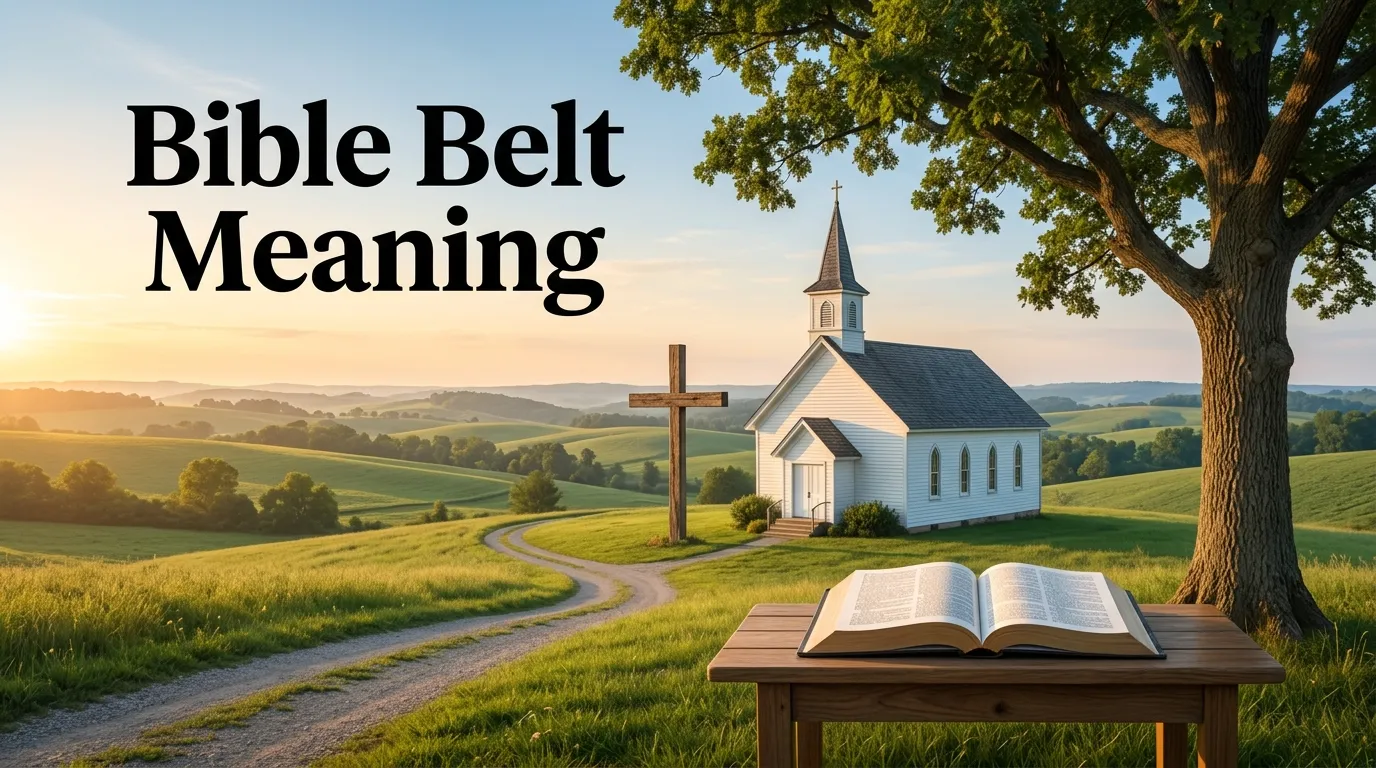
Many people hear the phrase Bible Belt and wonder if it comes from Scripture itself. It does not appear in the Bible as a verse or a title.
The Bible Belt meaning actually points to a region, mostly in the southern United States, known for strong Christian faith and church life.
Still, this term carries deep spiritual lessons worth exploring with an open heart.
Understanding the biblical meaning of Bible Belt helps us see what true faith, community, and witness should look like.
Let’s explore what the Bible says about bible belt meaning.
Biblical Meaning of Bible Belt
The term Bible Belt is not a phrase found anywhere in Scripture. There is no Hebrew or Greek word behind it, because it was not written by a prophet or an apostle. It is a modern nickname, first used in American writing during the 1920s, to describe areas where church attendance and Christian belief run especially strong.
Even though the Bible Belt is not a scriptural term, its meaning touches something very biblical: the idea of a faithful community living out their beliefs openly. The Bible often speaks about believers gathering together, worshiping God, and being known by their faith. So while the label itself is cultural, the heart behind it connects to real biblical truth.
Featured Snippet Answer: The Bible Belt meaning refers to a region, mainly in the southern and central United States, known for high levels of Christian faith, frequent church attendance, and conservative evangelical culture. It is not a biblical phrase but a modern cultural term describing strong Christian influence in daily life.
The spiritual significance of Bible Belt lies in what it represents rather than where the words came from. It reminds us of communities built around faith, prayer, and scripture. It also reminds us that outward religious culture is not the same as inward transformation through the Holy Spirit.
Quick Reference Table
| Aspect | Details |
| Term | Bible Belt |
| Origin of Phrase | Coined by American journalist H.L. Mencken in the 1920s |
| Region Described | Southern and parts of central United States |
| Biblical Term? | No, it is a cultural nickname, not found in Scripture |
| Related Biblical Idea | Faithful community, visible witness, light of the world |
| Positive Meaning | Strong faith culture, active churches, gospel presence |
| Warning Meaning | Risk of outward religion without inward change |
| Key Verse | Matthew 5:14-16 |
Key Bible Verses
Scripture does not mention the Bible Belt directly, but it speaks clearly about faithful living in a community. These verses help us understand the spiritual truth behind the idea.
Matthew 5:14-16 (ESV) says, You are the light of the world. A city set on a hill cannot be hidden… let your light shine before others, so that they may see your good works and give glory to your Father who is in heaven.
Acts 2:42 (NIV) tells us, They devoted themselves to the apostles’ teaching and to fellowship, to the breaking of bread and to prayer. This shows what a truly faithful community looks like.
Romans 12:2 (ESV) reminds believers, Do not be conformed to this world, but be transformed by the renewal of your mind. This verse warns that religious culture alone is never enough without real transformation.
Biblical Context
To understand the Bible Belt meaning, we need some historical background. The phrase was first used by writer H.L. Mencken to describe areas of the South with heavy religious influence, especially evangelical Protestant Christianity. Over time, the name stuck and became common in American culture and news writing.
While this history is not biblical, the Bible does describe what strong faith communities should look like. In Acts 2, the early church devoted themselves to teaching, prayer, and fellowship. That early community was known for real faith, not just outward tradition. This gives us a picture to compare against modern religious culture, including places called the Bible Belt.
The Bible also warns believers not to rely on appearances. In Matthew 15:8 (NIV), Jesus says, These people honor me with their lips, but their hearts are far from me. This verse is important when thinking about any region known for religion, because God always looks at the heart.
Throughout history, God has often worked through specific places and peoples to spread His truth. Israel was called to be a light to the nations. The early church spread the gospel from Jerusalem outward, city by city. In the same way, regions like the Bible Belt can serve as launching points for missionaries, Bible teaching, and Christian service, even though the label itself is only a modern invention. This historical pattern shows that God can use a culture of faith for good, as long as hearts stay humble and sincere before Him.
It also helps to remember that no single nation or region holds a special claim on God’s favor. Acts 10:34-35 (ESV) says, God shows no partiality, but in every nation anyone who fears him and does what is right is acceptable to him. This truth applies fully to the Bible Belt conversation. A strong church culture is a blessing, but it is never a guarantee of righteousness before God.
Spiritual Meaning
The deeper Bible Belt meaning for Christians today is about the difference between religious culture and true faith. A region can be full of churches, yet each person still needs a personal relationship with God through grace. Going to church or living where Christianity is common does not save anyone; only faith in Jesus Christ does.
This spiritual meaning reminds believers to check their own hearts. 1 Samuel 16:7 (ESV) says, The Lord looks on the heart. No matter where someone lives, God cares about sincere faith, not just outward religious identity.
The Bible Belt can be a place of real gospel light and encouragement. It can also be a warning if faith becomes more about tradition than transformation. Both truths can exist together, and Scripture calls every believer to examine their own walk with God.
Paul wrote about this exact tension in 2 Timothy 3:5 (ESV), describing people who have the appearance of godliness, but denying its power. A culture full of church buildings and Sunday routines can still miss the true power of the gospel if hearts are not changed. This is why the spiritual significance of Bible Belt conversations should always point believers back to genuine surrender, not comfort in tradition alone.
At the same time, Scripture never discourages a community from gathering around faith. Hebrews 10:24-25 (NIV) urges believers not giving up meeting together, but instead encouraging one another. A region strong in church attendance can be a wonderful support system for spiritual growth, prayer partnerships, and accountability. The key is making sure that support system leads people closer to Christ, not just closer to routine.
Biblical Symbolism
Though the Bible Belt is not a biblical symbol, we can connect it to real symbols found in Scripture. Light and salt are two powerful biblical pictures of faithful living.
Matthew 5:13 (ESV) says, You are the salt of the earth. Salt represents preserving what is good and adding value to the world around us. A community strong in faith should act like salt, bringing goodness and truth to others.
Light is another biblical symbol tied closely to the idea of a visible, faithful people. John 8:12 (NIV) records Jesus saying, I am the light of the world. Whoever follows me will never walk in darkness. Any region known for Christian faith, including the Bible Belt, is called to reflect this same light through real love and truth, not just religious labels.
Common Misunderstandings
Many people misunderstand the biblical meaning of Bible Belt by assuming it comes straight from Scripture. It does not. It is simply a nickname describing a region’s religious culture, created by a writer many centuries after the Bible was completed.
Another misunderstanding is thinking that living in the Bible Belt automatically means someone is saved or spiritually strong. The Bible teaches that salvation comes through personal faith in Jesus Christ, not by location or culture. Ephesians 2:8-9 (ESV) says, For by grace you have been saved through faith… it is the gift of God, not a result of works.
Some also assume the term is always positive, while others assume it is always negative. In truth, it simply describes a cultural pattern. The real spiritual value depends on each person’s heart, not the region they live in.
Another common mix-up is confusing cultural Christianity with saving faith. Someone can grow up around church, hear Bible stories every week, and even sing worship songs, yet never come to real faith in Jesus. James 2:19 (ESV) points out, Even the demons believe—and shudder. Head knowledge of the Bible, even in a place full of churches, is not the same as trusting Christ with your whole heart. This is one of the most important lessons the biblical meaning of Bible Belt can teach us today.
Finally, some assume this phrase is only about the United States, but the deeper lesson applies anywhere in the world. Any community, church, or family can fall into the same pattern of outward religion without inward faith. The warning is universal, not limited to one country or one culture.
Daily Christian Application
Understanding the Bible Belt meaning can help believers reflect honestly on their own faith, no matter where they live. It is a good reminder to ask whether faith is truly personal, or just cultural habit.
Christians can use this topic to grow deeper in prayer and scripture study, rather than relying on tradition alone. Reading God’s Word daily, like Psalm 119:105 (ESV), Your word is a lamp to my feet and a light to my path, keeps faith alive and real. This truth applies whether someone lives in a strongly religious region or somewhere with little Christian influence at all.
Believers everywhere are called to be salt and light, sharing real faith through love, honesty, and service to others. This calling does not depend on geography, but on a heart surrendered to God.
A practical step is to ask hard questions in personal prayer time. Is my faith shaped mostly by culture and habit, or by a real relationship with Jesus? Am I only religious on Sundays, or is my walk with God present in daily choices, words, and actions?
Another helpful practice is joining a small group Bible study, where believers can encourage each other toward real growth instead of just routine attendance. Proverbs 27:17 (ESV) says, Iron sharpens iron, and one man sharpens another. This kind of honest fellowship helps guard against empty tradition, whether someone lives in the Bible Belt or anywhere else in the world. Christian growth always works best in community, paired with personal devotion to God’s Word.
Faith Takeaways
- Pray for a sincere heart, not just outward religious habits.
- Trust that salvation comes through faith in Jesus, not location or culture.
- Reflect on whether your faith is personal and real, not just tradition.
- Seek God’s truth daily through Scripture and prayer.
- Remember that true light and salt come from a transformed heart.
FAQs
What is the Bible Belt meaning in simple terms?
The Bible Belt meaning refers to a nickname for a region, mostly in the southern United States, known for strong Christian faith, frequent church attendance, and conservative evangelical culture. It is not a term found in Scripture but describes a modern cultural pattern.
Is the Bible Belt mentioned in the Bible?
No, the Bible Belt is not mentioned anywhere in Scripture. It was coined by journalist H.L. Mencken in the 1920s to describe strong religious culture in certain American regions.
What is the spiritual significance of Bible Belt today?
The spiritual significance of Bible Belt lies in reminding believers about the difference between outward religion and real, inward faith. It encourages Christians to examine their hearts rather than rely on cultural or regional identity.
Does living in the Bible Belt make someone a true Christian?
No, salvation comes only through personal faith in Jesus Christ, not by living in a certain region. Ephesians 2:8-9 teaches that salvation is a gift of grace through faith alone.
What does the Bible say about the Bible Belt in scripture terms?
Since Bible Belt in scripture does not exist as a phrase, the closest biblical connection is the idea of a faithful, visible community, as described in Acts 2:42 and Matthew 5:14-16.
Why is the American South called the Bible Belt?
The American South earned this nickname because of its historically high rates of church attendance, evangelical Christian culture, and public expressions of Christian faith, especially compared to other U.S. regions.
How should Christians respond to the term Bible Belt?
Christians should see it as a reminder to seek real transformation through the Holy Spirit, rather than relying on cultural Christianity. True faith is shown through a changed heart and life, not simply geography.
Conclusion
The Bible Belt meaning may not come directly from Scripture, but it still points us to something deeply spiritual. It challenges every believer to ask whether their faith is real, personal, and rooted in grace, rather than just cultural habit or tradition.
We live, the calling remains the same: to be salt and light, walking closely with God through daily prayer and trust in His Word.
Discover More Articles
- Shaddai Meaning in the Bible: What Does It Really Mean?
- What Is Circumcision in the Bible Meaning? A Simple Biblical Guide
- Glory Meaning in the Bible: What God’s Glory Really Means

I’m Nicholas Sparks, and storytelling has always been my passion. Through TheBiblimeaning, I share insights about my books, unforgettable characters, romance, emotions, and the deeper meanings behind my stories. This platform brings readers closer to my writing journey, latest releases, and the inspiration that shapes every novel I create.