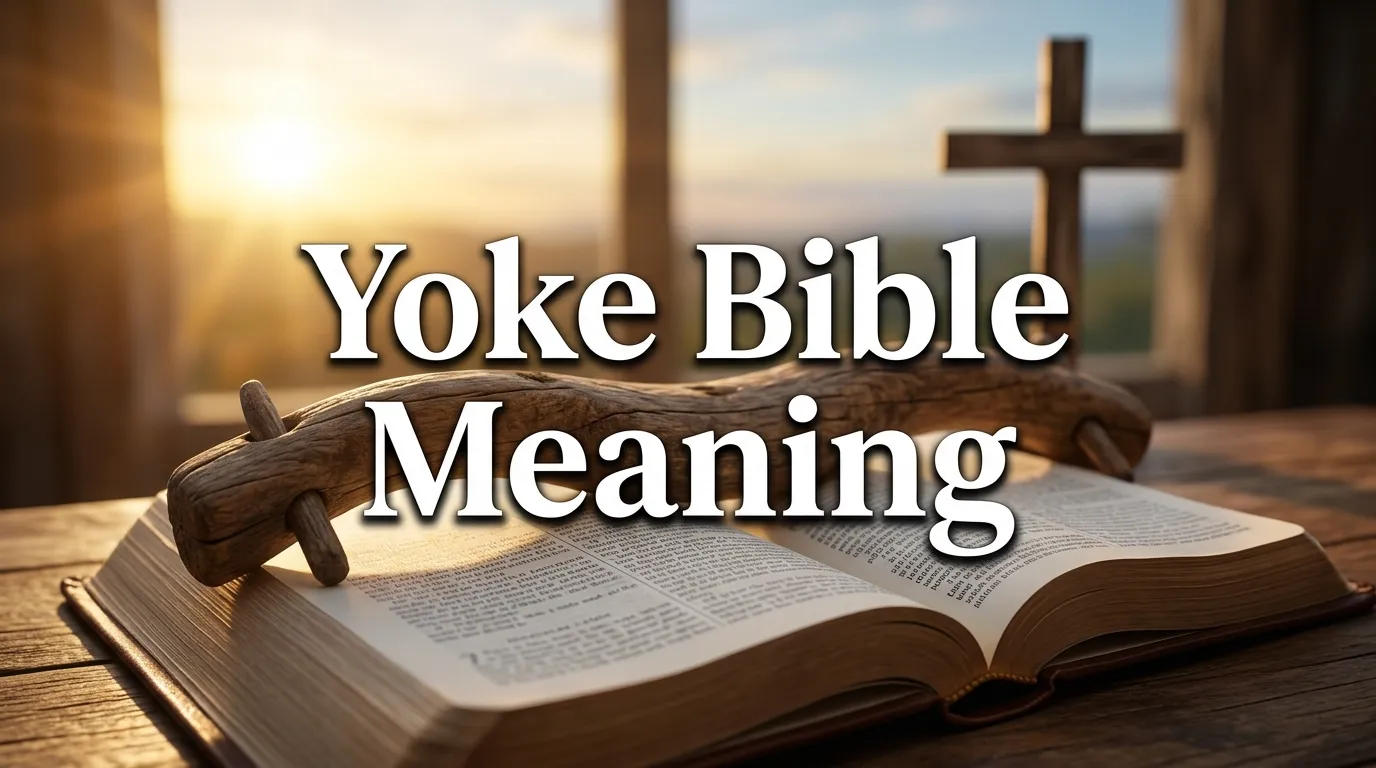
Have you ever felt weighed down, like a heavy load sits on your shoulders? The Bible uses a simple farm tool to describe that feeling. It’s called a yoke.
A yoke was a wooden frame placed on oxen to help them pull together. In Scripture, it becomes a picture of both bondage and partnership. Jesus even used this word to describe following Him.
Let’s explore what the Bible says about yoke.
Yoke Meaning in the Bible Matthew 11:29
In the Bible, a yoke is a wooden tool used to join animals for work. It can also show a person’s burden, rule, or duty. Jesus gives the word a deeper meaning. He calls people to take His yoke and learn from Him. His way leads to rest, not fear. A yoke can show who guides our lives and what we choose to carry. Scripture reminds us that following Christ brings peace when we trust His care and walk in His ways.
Bible Verse:
“Take my yoke upon you, and learn from me.”
Matthew 11:29 (ESV)
Biblical Yoke Deuteronomy 21:3
A biblical yoke often points to work, service, or control. In Bible times, a yoke helped two animals work together under one direction. Scripture also uses the image to teach lessons about people and their choices. A yoke may represent a duty that someone carries or a power placed over them. The Bible warns against harmful bonds and calls God’s people to follow Him with faith. This picture helps us see that what we join ourselves to can shape our lives.
Bible Verse:
“The heifer that has not been working and that has not pulled in the yoke.”
Deuteronomy 21:3 (ESV)
Yoke in the Bible Meaning Isaiah 9:4
The yoke in the Bible can point to a burden, hard service, or rule. In Isaiah, the yoke shows the heavy power placed on God’s people by their enemies. Yet God promises to break that burden and bring freedom. This gives the image a hopeful meaning. A yoke is not only about work. It can also show the weight a person carries. Scripture teaches that God sees those burdens and has the power to bring His people into freedom and peace.
Bible Verse:
“For the yoke of his burden, and the staff for his shoulder, the rod of his oppressor, you have broken.”
Isaiah 9:4 (ESV)
Yoke Bible Galatians 5:1
The Bible uses the word yoke in both physical and spiritual ways. Paul warns believers not to return to a form of slavery after finding freedom in Christ. Here, the yoke points to a burden that keeps a person under bondage. The message is clear: Christ gives real freedom, and believers should stand firm in it. This does not mean living without guidance. It means trusting Christ instead of returning to rules or ways that cannot give true spiritual freedom.
Bible Verse:
“Do not submit again to a yoke of slavery.”
Galatians 5:1 (ESV)
Yoke in the Bible 2 Corinthians 6:14
The Bible also uses the idea of a yoke when teaching about close relationships. Paul tells believers not to be unequally yoked with unbelievers. The picture comes from two animals joined together to pull in the same direction. When their direction or strength differs, the work becomes hard. Paul uses this image to teach about spiritual unity and influence. The passage calls Christians to think with care about the deep bonds they form and the values that guide those relationships.
Bible Verse:
“Do not be unequally yoked with unbelievers.”
2 Corinthians 6:14 (ESV)
Yoke Meaning Bible Matthew 11:30
The Bible gives the word yoke a beautiful meaning through the words of Jesus. He says His yoke is easy and His burden is light. Jesus does not promise a life with no trials. Instead, he offers a better way to walk through them. His yoke means learning from Him, trusting Him, and following His gentle rule. This gives hope to people who feel worn out. When we place our lives in Christ’s hands, we do not have to carry every burden alone.
Bible Verse:
“For my yoke is easy, and my burden is light.”
Matthew 11:30 (ESV)
Biblical Meaning of Yoke
The biblical meaning of yoke centers on connection and control. A yoke joined two animals together so they could work as one. It also described anything that controlled or bound a person, like slavery or hard labor.
In Hebrew, the word is ol (עֹל), meaning a wooden bar or burden. In Greek, the word is zygos (ζυγός), used in the New Testament. Both words carry the idea of being joined to something, whether good or bad.
The first appearance of yoke is in Genesis 27:40. Isaac tells Esau he will one day break free from his brother’s yoke. From that point forward, yoke becomes a picture of authority, submission, and sometimes oppression.
Spiritual Yoke Meaning (Galatians 5)
A spiritual yoke is a heavy load that weighs on the heart and mind. It can be fear, guilt, or wrong teaching that keeps a person from true freedom. God never meant for His children to carry such weight. In Scripture He calls us to walk in the Spirit instead. When we trust Jesus, the old hard yoke comes off. Peace and rest take its place. This change happens inside and shows in daily life. We learn to live light and free under God’s kind care.
Galatians 5:1
It is for freedom that Christ has set us free. Stand firm, then, and do not let yourselves be burdened again by a yoke of slavery.
Yoke Meaning in the Bible from Matthew 11 (Matthew 11)
In Matthew 11 Jesus talks about a yoke that is easy and light. A yoke was a wooden bar placed on oxen so they could pull together. Jesus uses this picture to show how He helps us. He does not give hard rules that crush the soul. Instead He invites tired people to come and learn from Him. His way brings rest for the heart. We walk with Him side by side and find real peace.
Matthew 11:29-30
Take my yoke upon you and learn from me, for I am gentle and humble in heart, and you will find rest for your souls. For my yoke is easy and my burden is light.
Yoke Meaning in the Book of Jeremiah (Jeremiah 27)
In Jeremiah a yoke stands for control and hard rule by another nation. God told the people they would wear the yoke of Babylon for a time. Some false teachers said the yoke would break soon. Jeremiah wore a real wooden yoke to show the truth. God was teaching His people to submit for a season. Later He promised to break that yoke and bring them home. The lesson is clear: trust God’s timing even when the load feels heavy.
Jeremiah 27:2
This is what the Lord said to me: “Make a yoke out of straps and crossbars and put it on your neck.”
My Yoke Meaning (Matthew 11)
When Jesus says “my yoke,” He means the way of life He offers. It is not a heavy list of rules. It is a shared path where He walks with us. We learn His gentle heart and humble ways. The load becomes light because He carries most of it. Anyone who feels tired can take this yoke and find rest. It is personal and kind. Jesus Himself becomes our partner every day.
Matthew 11:29
Take my yoke upon you and learn from me, for I am gentle and humble in heart, and you will find rest for your souls.
Jesus’ Yoke Meaning (Matthew 11)
Jesus’ yoke is His invitation to live close to Him. In the farming world a yoke joined two animals so the stronger one helped the weaker. Jesus is the strong One who pulls with us. His teaching is kind and full of grace. He removes the crushing weight of trying to earn God’s love. Instead we rest in what He has already done. Following Him brings quiet strength and lasting joy.
Matthew 11:30
For my yoke is easy and my burden is light.
Picture of a Yoke in the Bible (Deuteronomy 28)
The Bible often uses a yoke as a clear picture of control or partnership. Farmers placed a wooden bar on the necks of oxen to guide them. In the same way God sometimes allowed hard times to teach His people. Other times the yoke shows how we can walk with Jesus in gentle teamwork. The image helps us see both the weight of sin and the freedom Christ gives. It is a simple farm tool that teaches deep truth.
Deuteronomy 28:48
Therefore you will serve your enemies the Lord will send against you in hunger and thirst and nakedness and dire poverty. He will put an iron yoke on your neck until he has destroyed you.
Yoke Meaning in Hebrew (Lamentations 1)
In the Hebrew language the word for yoke is “ol.” It means a bar or beam that rests on the neck. This word appears when the Bible speaks of hard rule or heavy service. It can also point to the kind partnership God offers. The simple farm word carries a big message. God sees every load we carry and knows how to lift it. The Hebrew term reminds us that He understands both pain and freedom.
Lamentations 1:14
My sins have been bound into a yoke; by his hands they were woven together. They have been hung on my neck, and the Lord has sapped my strength.
Breaking the Yoke Meaning (Isaiah 9)
Breaking the yoke means God removes the heavy load that once controlled His people. In the Bible He promises to shatter the bar that kept them down. This happens when He sends help and sets captives free. Jesus fulfills the deepest part of this promise by freeing us from sin. The old power loses its hold. We stand straight again and walk in new strength. God Himself does the breaking so we can live free.
Isaiah 9:4
For as in the day of Midian’s defeat, you have shattered the yoke that burdens them, the bar across their shoulders, the rod of their oppressor.
Quick Reference Table
| Aspect | Meaning |
| Hebrew Word | Ol (עֹל) – burden, wooden bar |
| Greek Word | Zygos (ζυγός) – yoke, balance |
| First Mention | Genesis 27:40 |
| Key New Testament Verse | Matthew 11:29-30 |
| Positive Meaning | Partnership with Christ, gentle discipline |
| Negative Meaning | Slavery, oppression, spiritual bondage |
| Symbolizes | Submission, labor, covenant, freedom in Christ |
| Related Figures | Isaac, Esau, Jeremiah, Paul, Jesus |
Key Bible Verses
The yoke in scripture appears in both warning and comfort. Here are three verses that show its full range of meaning.
Take my yoke upon you, and learn from me, for I am gentle and lowly in heart, and you will find rest for your souls. For my yoke is easy, and my burden is light. Matthew 11:29-30 (ESV)
For freedom Christ has set us free; stand firm therefore, and do not submit again to a yoke of slavery. Galatians 5:1 (ESV)
Is not this the fast that I choose: to loose the bonds of wickedness, to undo the straps of the yoke, to let the oppressed go free, and to break every yoke? Isaiah 58:6 (ESV)
These verses show that a yoke can trap you or it can carry you gently. Jesus offers the second kind.
Biblical Context
To understand the spiritual significance of yoke, we need to picture the farm setting. Farmers placed a wooden yoke across two oxen so they could plow together evenly. The stronger ox often carried more of the weight, helping the weaker one.
This picture appears often in the Old Testament. Israel’s disobedience sometimes led to a yoke of foreign rule, as seen with Assyria and Babylon. Jeremiah wore a wooden yoke as a prophetic sign of coming captivity.
Thus says the LORD of hosts, the God of Israel: Make yourself straps and yoke-bars, and put them on your neck. Jeremiah 27:2 (ESV)
In the New Testament, Jesus flips the image completely. Instead of a yoke of punishment, He offers a yoke of partnership. When we are yoked to Christ, He walks beside us and carries the heavier load.
The Apostle Paul also warns against being unequally yoked with unbelievers in 2 Corinthians 6:14. This teaches believers to guard close relationships and partnerships carefully.
Farmers in ancient Israel knew this tool well. Two oxen of similar size and strength worked best together under one yoke. If one animal was weaker or wilder, the pull became uneven and painful for both.
This detail matters for understanding Scripture. God cares about balance in our relationships and burdens. He never designed His people to be crushed by mismatched weight or unfair labor.
The prophet Elijah also connects to this image. When he called Elisha into ministry, Elisha was found plowing with twelve yoke of oxen. He immediately left his old life behind to follow God’s calling.
So he departed from there and found Elisha the son of Shaphat, who was plowing with twelve yoke of oxen in front of him… Then he arose and followed Elijah and assisted him. 1 Kings 19:19-21 (ESV)
This story shows how a yoke, a farming tool of daily labor, became a doorway into spiritual calling. What once bound Elisha to his fields became the very picture of surrender to God’s purpose.
Spiritual Meaning
The spiritual meaning of yoke points to who, or what, controls your life. Everyone carries a yoke of some kind. The question is whether it brings freedom or bondage.
A yoke of sin leads to exhaustion and shame. A yoke of Christ leads to grace, rest, and peace. This is the heart of the gospel message.
So if the Son sets you free, you will be free indeed. John 8:36 (ESV)
When Jesus says His yoke is easy, the Greek word actually means well-fitting or kind. It’s like a custom-made tool that doesn’t rub or chafe. His yoke fits us perfectly because He designed it with love.
Being yoked to Christ means walking in step with the Holy Spirit daily. It means trusting His pace, His timing, and His strength instead of our own.
Biblical Symbolism
The yoke symbolizes several deep truths throughout Scripture. First, it represents submission to authority, whether godly or ungodly. Second, it symbolizes partnership, since two oxen shared the same wooden frame.
Third, the yoke symbolizes discipleship. In ancient Jewish tradition, a rabbi’s teaching was sometimes called his yoke. When Jesus invited people to take His yoke, He was inviting them to become His students and followers.
Fourth, breaking a yoke symbolizes liberation. God repeatedly promises to break the yoke of oppression off His people.
And it shall come to pass in that day, that his burden shall be taken away from off thy shoulder, and his yoke from off thy neck. Isaiah 10:27 (KJV)
This verse reminds believers that no yoke of bondage is permanent under God’s power.
Dream Meaning
Some Christians wonder about the yoke Bible meaning when it appears in a dream. While Scripture doesn’t give a direct dream-interpretation formula, biblical symbolism can offer guidance through prayer and reflection.
Dreaming of a heavy or broken yoke may reflect feelings of burden, stress, or a need for release. Dreaming of being yoked with someone, like an animal pulling together, might point to a partnership, marriage, or ministry connection God is highlighting.
Always test dream impressions against Scripture and seek godly counsel. God still speaks through dreams, as seen with Joseph and Daniel, but discernment matters. Prayer and Scripture remain the safest guide.
Common Misunderstandings
Many people think yoke only means something bad, like slavery or oppression. That’s only half the picture, though. Scripture shows a yoke can also mean loving partnership, especially with Christ.
Another misunderstanding is that Jesus removes all burdens completely. Actually, He replaces our heavy burden with His lighter one. Life still has responsibility, but His yoke makes it bearable through grace.
Some also confuse unequally yoked in 2 Corinthians 6:14 as only about marriage. It actually applies to any close partnership, including business or ministry, where values conflict with faith.
Do not be unequally yoked with unbelievers. For what partnership has righteousness with lawlessness? 2 Corinthians 6:14 (ESV)
Finally, some think taking Christ’s yoke happens once and never again. In truth, it’s a daily choice to walk closely with Him.
There’s also a mistaken idea that a yoke always involves two equal partners. In the case of Christ, the partnership is not equal in strength, and that’s actually good news. He carries the greater portion of the weight, while we simply learn to walk at His pace and trust His guidance.
Some readers also assume the Old Testament only shows yokes as punishment. Yet even there, God promised restoration and freedom to His people. The prophet Nahum and Isaiah both spoke of yokes being lifted and broken through God’s mercy, not just placed as judgment.
Daily Christian Application
Understanding the biblical meaning of yoke should change how we live each day. Start by asking what yoke you’re currently carrying. Is it self-reliance, fear, people-pleasing, or old habits?
Bring that burden honestly to God in prayer. Ask Him to help you exchange it for His easy yoke instead. This isn’t a one-time prayer but a daily surrender.
Cast your burden on the LORD, and he will sustain you; he will never permit the righteous to be moved. Psalm 55:22 (ESV)
Also examine your close relationships and partnerships. Are you yoked with people who pull you toward faith, or away from it? Choose companions who strengthen your walk with Christ.
Finally, remember that being yoked to Jesus means learning from Him daily. Read His Word, listen for the Spirit’s leading, and follow His pace instead of rushing ahead alone.
Faith Takeaways
- Pray and ask God to reveal any heavy yoke you’re carrying alone.
- Trust that Christ’s yoke is easy and His burden is light.
- Reflect on relationships and partnerships that may be unequally yoked.
- Seek daily closeness with Jesus through prayer and Scripture.
- Remember that God breaks every yoke of bondage in His timing.
FAQs
What is the biblical meaning of yoke?
The biblical meaning of yoke refers to a wooden tool joining two oxen for shared labor. Spiritually, it represents submission, partnership, or bondage. Jesus used it to describe discipleship, offering His followers an easy yoke of grace instead of burdensome religious rules.
What does it mean to take up Christ’s yoke?
Taking Christ’s yoke means becoming His disciple and learning from Him daily. It means trusting His strength instead of striving alone. Matthew 11:29-30 promises rest for the soul when we walk in step with Jesus.
What is the yoke of slavery in Galatians 5:1?
The yoke of slavery refers to returning to strict religious law instead of living by grace. Paul warned believers not to go back under legalistic bondage. True freedom comes through faith in Christ, not rule-keeping alone.
What does unequally yoked mean in the Bible?
Being unequally yoked means forming a close partnership with someone who doesn’t share your faith values. This appears in 2 Corinthians 6:14 regarding marriage, friendships, and business relationships. It warns believers to guard their spiritual walk carefully.
Why did Jeremiah wear a yoke?
Jeremiah wore a wooden yoke as a prophetic symbol of coming captivity under Babylon. It warned Israel and surrounding nations to submit rather than resist God’s judgment. This act showed obedience even when the message was hard to deliver.
Is the yoke in scripture always negative?
No, the yoke in scripture carries both positive and negative meanings. It can represent oppression and slavery, but also gentle discipleship with Christ. Context determines whether the yoke brings bondage or blessing.
What is the spiritual significance of yoke for Christians today?
The spiritual significance of yoke today points to daily surrender and partnership with Jesus. It reminds believers to release heavy burdens and walk closely with Christ. This brings rest, peace, and strength for everyday struggles.
More Searched Questions About the Yoke in the Bible
What is the Hebrew word for yoke, and what is a yoke bar?
The common Hebrew word is ol (Strong’s H5923), the yoke itself: the wooden frame laid on the neck of an animal for its work, and, in figure, the rule or burden laid on a man or a nation. Its first standing is inside Isaac’s blessing of Esau, where it already carries the figurative sense: “and it shall come to pass when thou shalt have the dominion, that thou shalt break his yoke from off thy neck” (Genesis 27:40). From there the word runs across the whole range of this subject, the heavy yoke of Solomon that his son made heavier (1 Kings 12:4, 11), the yoke borne in youth (Lamentations 3:27), and the yoke of iron laid on the nations (Jeremiah 28:14). Where the Old Testament says yoke, ol is usually the word standing there, and it always names the thing borne on the neck, whether by an ox, a king’s subjects, or a suffering man.
A second word names the yoke’s beam and bands. Motah (Strong’s H4133), and its shorter form mot (Strong’s H4132), is the yoke bar, the pole across the neck and the straps that made it fast. It is the word of Jeremiah’s sign: “Make thee bonds and yokes, and put them upon thy neck” (Jeremiah 27:2), the word of God’s promise to Judah, “For now will I break his yoke from off thee, and will burst thy bonds in sunder” (Nahum 1:13), and it stands beside ol in the Exodus memory: “I have broken the bands of your yoke, and made you go upright” (Leviticus 26:13), where the bands are motah and the yoke is ol. The searches that ask what a yoke bar is are asking for this word: ol is the yoke as a whole upon the neck; motah is the bar of it, the piece a breaking would have to break.
What is the Greek word for yoke? Does it ever mean anything else?
The New Testament word is zygos (Strong’s G2218), a yoke, the coupling beam that joins two animals to one load, and in figure any binding tie or obligation. It is the word of Christ’s invitation, “Take my yoke upon you” (Matthew 11:29), and of Paul’s warning, “be not entangled again with the yoke of bondage” (Galatians 5:1). The same word also names the beam of a pair of scales, the bar that joins the two pans, and the King James renders it so once: at the opening of the third seal, the rider on the black horse “had a pair of balances in his hand” (Revelation 6:5). That standing belongs to its own vision and is left there: it is the scales of the scene, not a yoke of service, and the two senses of zygos meet only in the beam that couples.
Two companion words stand at their own verses, and each is used only there. At 2 Corinthians 6:14 the verb is heterozygeo (Strong’s G2086), to be yoked up differently, unevenly matched: “Be ye not unequally yoked together with unbelievers”. And at Philippians 4:3 Paul turns to a fellow worker with the noun syzygos (Strong’s G4805): “And I intreat thee also, true yokefellow, help those women which laboured with me in the gospel”. Whether Paul is addressing a man whose name was Syzygus or describing an unnamed brother as a true yokefellow, the verse does not say, and teachers differ; the word itself is plain either way, one who pulls in the same yoke beside another. The family is therefore small and exact: zygos the yoke, heterozygeo the mismatched yoking, syzygos the fellow under the yoke.
What does Jesus mean by “my yoke is easy”? Matthew 11:28-30 read whole
The words stand at the end of Matthew 11, and they should be read whole, because this article’s verse 28 is the half of them most often left off: “Come unto me, all ye that labour and are heavy laden, and I will give you rest. Take my yoke upon you, and learn of me; for I am meek and lowly in heart: and ye shall find rest unto your souls. For my yoke is easy, and my burden is light” (Matthew 11:28-30). The order of the saying is its meaning. First the coming, to Christ himself, by those already labouring under a load. Then rest given, before anything is taken up: “I will give you rest”. Then, and only then, the taking of a yoke, his yoke, and the learning of him, with a second rest, rest found, promised to the soul that learns.
Easy renders the Greek word chrestos (Strong’s G5543), kind, good and serviceable: a yoke that does its bearer good, the opposite of a yoke that galls the neck it rides on. What Christ promises must be stated exactly as he states it, because the searches ask for it plainly. He does not promise to take the yoke off altogether, or to give his disciples a life without burden: he exchanges loads. Their crushing labour and heavy laden state is answered by his yoke and his burden, and the burden is called light by the one who lays it on. The rest he gives is rest unto souls, under a teacher who is meek and lowly in heart, and the yoke is the form that rest takes: discipleship, walking under his direction and learning of him, rather than the removal of every weight a disciple carries.
Why did Jeremiah wear a wooden yoke, and what did the iron yoke mean?
Jeremiah’s yoke was a sermon worn on the neck. At God’s command he made the sign and carried it before the kings’ messengers gathered at Jerusalem: “Make thee bonds and yokes, and put them upon thy neck” (Jeremiah 27:2). Its message was submission for a season: the nations, Judah among them, were to put their necks under the yoke of Nebuchadnezzar, king of Babylon, whom the chapter calls God’s servant, and to serve him, because God had given the lands into his hand for that time. The wooden yokes on the prophet’s neck were the picture of a real subjection God himself was imposing, and the false prophets who promised a quick release were contradicted by the wood on Jeremiah’s shoulders before he spoke a word.
Then the yoke was broken, and the breaking is the half of the story most often left out. Hananiah, a prophet from Gibeon, took the yoke from off Jeremiah’s neck in the temple, broke it before the priests and the people, and promised that God would break Babylon’s yoke the same way within two full years (Jeremiah 28:10-11). God’s answer came in the terms of the sign itself: “Go and tell Hananiah, saying, Thus saith the LORD; Thou hast broken the yokes of wood; but thou shalt make for them yokes of iron” (Jeremiah 28:13). “For thus saith the LORD of hosts, the God of Israel; I have put a yoke of iron upon the neck of all these nations, that they may serve Nebuchadnezzar king of Babylon; and they shall serve him” (Jeremiah 28:14). The chapter closes with Hananiah dead within the year. The iron yoke means this: a burden God has appointed for a season is not lightened by being denied, and the man who breaks the wooden sign by declaration, against God’s word, leaves the nations with iron.
What is the yoke of bondage in Galatians 5:1?
Paul’s sentence is the conclusion of an argument, and it must be read with the sentences that follow it or it will be read wrong: “Stand fast therefore in the liberty wherewith Christ hath made us free, and be not entangled again with the yoke of bondage” (Galatians 5:1). The very next breath names the yoke: “Behold, I Paul say unto you, that if ye be circumcised, Christ shall profit you nothing” (Galatians 5:2). The yoke of bondage is circumcision, and with it the whole law, taken up as the ground on which a man is justified before God: “he is a debtor to do the whole law” (Galatians 5:3), and “Christ is become of no effect unto you, whosoever of you are justified by the law; ye are fallen from grace” (Galatians 5:4). It is not religious rules in general, and it is not the Old Testament as such. It is one specific exchange refused: Christ’s liberty traded back for a yoke whose terms are justification by law keeping.
Behind Paul’s phrase stands the Exodus memory he expects his readers to carry: “I am the LORD your God, which brought you forth out of the land of Egypt, that ye should not be their bondmen; and I have broken the bands of your yoke, and made you go upright” (Leviticus 26:13). The first yoke broken in Israel’s story was Egypt’s, and God broke it. The Galatians, Gentiles who had themselves been in bondage before they knew God, are warned against being entangled again, this time with a yoke drawn from God’s own law misused as a means of justification. A yoke imposed by an oppressor and a yoke taken up by a believer’s own choice are different things in these texts, and Paul’s warning is aimed at the second: the liberty Christ made is not to be handed back, least of all for a yoke that promises righteousness and delivers debt.
What does it mean to bear the yoke in your youth? Lamentations 3:27
The verse stands in a book of grief, and its place in the book fixes its sense: “It is good for a man that he bear the yoke in his youth” (Lamentations 3:27). Lamentations is written over the ruins of Jerusalem, and the third chapter’s speaker is a man who has seen affliction under the rod of God’s wrath, speaking from inside the city’s judgment and not from a study. The yoke he commends is neither an oppressor’s tax nor Christ’s discipleship. It is affliction and discipline borne while a man is young, carried under God’s hand in a ruined city, in the chapter that also confesses that God’s compassions do not fail and counsels the sufferer to sit alone, keep silence, and wait quietly for the salvation of the LORD.
Read at its own place, the verse makes no promise and offers no technique. It does not say that hardship borne young purchases ease later, and it is not a motto about working hard early in a career: its subject is a sufferer’s schooling under judgment, in which the bearing itself, borne in youth rather than first met in old age, teaches the mouth-in-the-dust humility the surrounding verses describe. The same book holds the other yoke of Lamentations, the transgressions bound by God’s hand into a yoke on the city’s neck (Lamentations 1:14), and the two should not be merged: the first is sin’s yoke laid on in judgment; the second is the discipline a man is counselled to bear under that judgment without complaint. Both belong to the lament, and neither is lifted out of it honestly as a rule for other men’s lives.
What was the heavy yoke of Solomon that Rehoboam made heavier?
It was the yoke of a king’s service, and the complaint against it opens the chapter that split the kingdom: “Thy father made our yoke grievous: now therefore make thou the grievous service of thy father, and his heavy yoke which he put upon us, lighter, and we will serve thee” (1 Kings 12:4). The people do not ask to serve no king. They name Solomon’s grievous service, the levies and labour of his building years laid on the tribes as a yoke on the neck, and they offer Rehoboam their service in exchange for its lightening. The old men who had stood before Solomon counsel the new king to be a servant to the people that day and lighten it; the young men he had grown up with counsel the opposite, and he takes their counsel.
His answer is the Bible’s standing portrait of a yoke made heavier by folly: “And now whereas my father did lade you with a heavy yoke, I will add to your yoke: my father hath chastised you with whips, but I will chastise you with scorpions” (1 Kings 12:11), and he speaks it to the people a second time in the same words (1 Kings 12:14). Ten tribes walk out of his kingdom over that answer, and Israel is divided from that day. The political yoke in Scripture is therefore not a metaphor borrowed from the farm for spiritual use; it is a thing in itself, real rule laid on real necks, and the texts weigh kings by what they do with it. Set in the same word beside it is the other king’s offer, “my yoke is easy, and my burden is light”: the two sayings are the measure of each other, and this article’s subject is the distance between them.
What does the Bible mean by breaking the yoke?
The phrase begins as a blessing over a younger brother: “and it shall come to pass when thou shalt have the dominion, that thou shalt break his yoke from off thy neck” (Genesis 27:40). Isaac’s word to Esau is the Bible’s first yoke breaking, one brother’s rule over another ending in its season. Its fullest statement stands in the fasting chapter of Isaiah, where God describes the fast he has chosen: “Is not this the fast that I have chosen? to loose the bands of wickedness, to undo the heavy burdens, and to let the oppressed go free, and that ye break every yoke?” (Isaiah 58:6). The yoke broken there is the yoke men lay on other men. The fasters themselves are the ones holding the bands, and the breaking God asks of them is not a ceremony but a ceasing: loose, undo, let go, in their own dealings with the oppressed around them.
And the breaking is, in its greatest standings, God’s own act. To Judah under Assyria’s shadow he promises: “For now will I break his yoke from off thee, and will burst thy bonds in sunder” (Nahum 1:13). Across these texts the agents are kept straight, and a study of this phrase should keep them straight too: God breaks the yokes of oppressors off his people, in his time and by his hand; and men break yokes, at Isaiah 58, by repenting of the oppression they themselves practise. No verse turns yoke breaking into a formula to be spoken over a life, or a technique by which one believer declares another’s yokes broken; the deliverances the Bible records are acts of God in history, and the one breaking assigned to men is the justice of the fasting chapter. Anything built past that has left the texts behind.
What do the Bible’s yoked animals teach? The ox and the ass, the kine, and the five yoke of oxen
The law of the field gives the picture its plainest form: “Thou shalt not plow with an ox and an ass together” (Deuteronomy 22:10). The verse states the rule and gives no reason for it, and none is invented here. It is the Bible’s own picture of a mismatched team, two animals of different strength, gait and nature under one yoke, and it stands in the law as a farming command before it stands anywhere as a figure. What later teaching draws from it should be drawn carefully, because the verse itself simply forbids the unequal team in Israel’s fields.
The ark of God came home behind animals that had never worn one: “take two milch kine, on which there hath come no yoke, and tie the kine to the cart, and bring their calves home from them” (1 Samuel 6:7). The Philistine priests chose unbroken cows, still nursing calves, as their test: if such animals, against every instinct, drew the cart straight toward Israel, the plague that had followed the ark was God’s hand and not chance. The yoke’s absence is the point of the sign; the kine were fit for the errand precisely because no yoke had ever trained them to it. And the word’s last farm standing is an excuse at a feast: “And another said, I have bought five yoke of oxen, and I go to prove them: I pray thee have me excused” (Luke 14:19), where the word is zeugos (Strong’s G2201), pairs or teams, and the five new teams are one man’s property and business pleaded against the great supper’s call. A law of the field, a sign at the ark’s return, and an excuse in a parable: the animal standings keep their own places, and none of them is a teaching about yokes in general.
Conclusion
The yoke Bible meaning teaches us something beautiful about God’s heart. He never wants us crushed under impossible weight. Instead, He invites us into a gentle partnership with His Son.
If you’re carrying stress, fear, or old patterns of sin, Jesus offers a better yoke. His is easy. His is filled with grace and rest for your soul.
Take a moment today and bring your burdens to Him in prayer. Ask Him to walk beside you, step by step, just like two oxen pulling together. His yoke was designed with you in mind, and it fits perfectly.
Discover More Articles
- Shaddai Meaning in the Bible: What Does It Really Mean?
- What Is Circumcision in the Bible Meaning? A Simple Biblical Guide
- Glory Meaning in the Bible: What God’s Glory Really Means