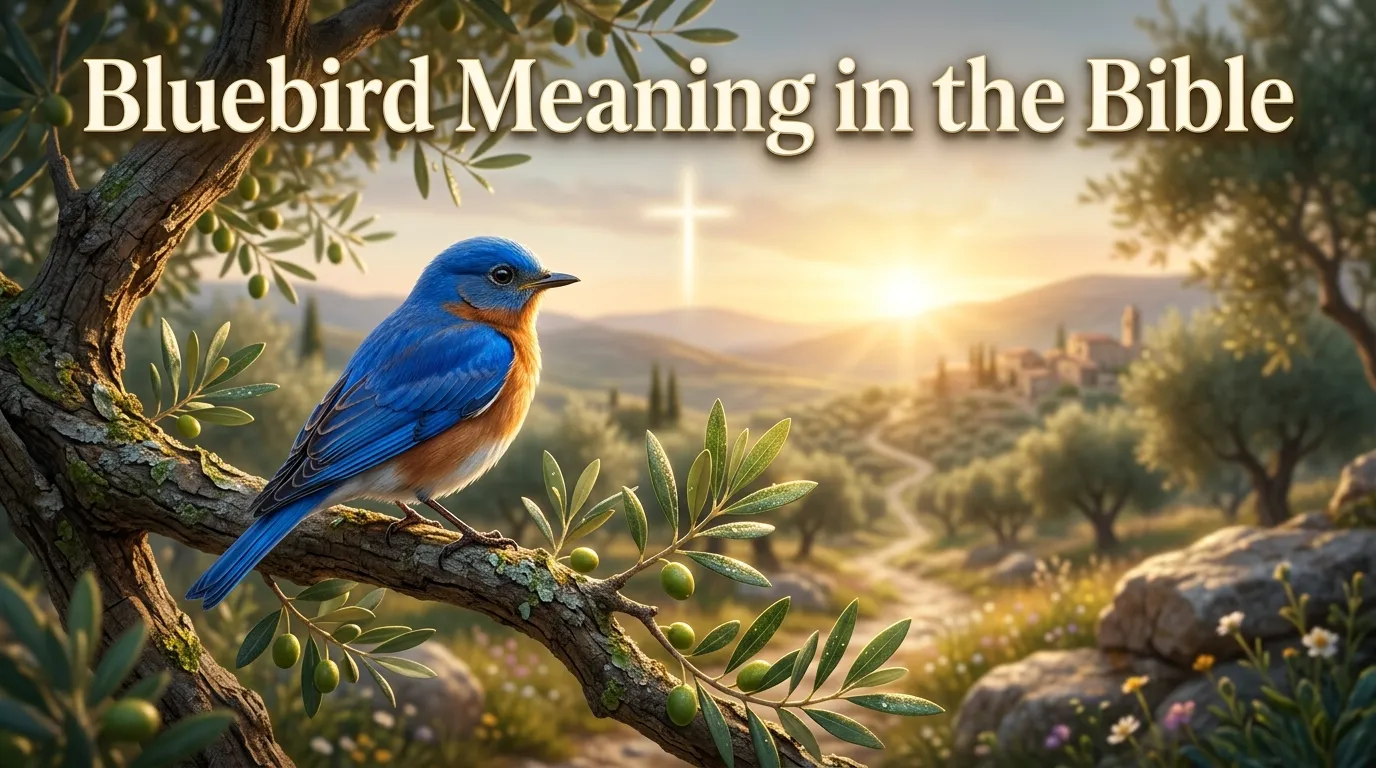
Have you ever seen a bluebird and felt a quiet sense of peace? Many Christians wonder about the bluebird meaning in the Bible after a surprising encounter with this little bird.
While the word bluebird is not written in Scripture by name, God’s Word teaches us much about birds, color, and His care for small creatures.
The Bible often uses nature to reveal spiritual truth. Understanding the biblical meaning of bluebird can help us see God’s hand in everyday moments.
This article looks at Bible verses about birds, the meaning of the color blue, and what these teachings show us about hope, faith, and God’s provision.
Let’s explore what the Bible says about bluebird.
Bluebird Meaning in Bible
The Bible does not name the bluebird as a special biblical symbol. Still, birds can point us to God’s care, freedom, and creation. Jesus used birds to teach trust in God’s care: “Look at the birds of the air” (Matthew 6:26). A bluebird may remind a Christian to notice God’s gifts in creation and trust Him in daily life. Its blue color can also bring thoughts of the sky and God’s majesty, but Scripture does not give bluebirds a fixed spiritual meaning. The main lesson is to look to God, not to signs (Psalm 19:1).
Blue Bird Biblical Meaning
A blue bird has no set biblical meaning because the Bible does not mention bluebirds by name. Yet Scripture often uses birds to teach spiritual truths. Birds can show God’s care and His power as Creator. Jesus said that God feeds the birds, reminding His followers that they are also precious to Him (Matthew 6:26). Seeing a blue bird may inspire thoughts of peace, beauty, or trust, but these ideas should not be treated as biblical promises about a personal event. Scripture calls believers to seek God’s wisdom through His Word (Proverbs 3:5–6).
Bluebirds in the Bible
Bluebirds are not specifically mentioned in the Bible. The Scriptures do speak about many kinds of birds, including doves, sparrows, ravens, and eagles. These birds appear in different settings and can teach different lessons. For example, Jesus used sparrows to show how deeply God cares for His creation and His people (Matthew 10:29–31). So, while a bluebird is not a biblical symbol, it can still point a believer toward the beauty of God’s creation. Genesis 1:20 shows that God created birds as part of His good work. The focus should remain on the Creator rather than the bird itself.
Blue Bird Prophetic Meaning
The Bible does not teach that seeing a bluebird has a fixed prophetic meaning. Some people connect birds with hope, peace, or new beginnings, but these ideas come from personal or cultural symbolism rather than a clear biblical teaching. Christians should be careful about treating an ordinary bird as a prophecy from God. Scripture teaches that God speaks with authority through His revealed Word (2 Timothy 3:16–17). If seeing a bluebird encourages someone to praise God, that can be a meaningful personal response. However, it should not be used to predict the future or claim a message that Scripture does not give.
What Does It Mean When You See a Bluebird
Seeing a bluebird does not have one guaranteed meaning in the Bible. It may simply be part of the beauty of God’s creation. Psalm 104:12 speaks of birds living among God’s works, showing the rich life He has made. A bluebird can remind you to slow down, notice creation, and give thanks. It may also bring a personal thought of hope or peace, but that does not make it a divine sign. Christians are called to trust God rather than search for hidden messages in every event (Deuteronomy 29:29). Let the sight of the bird lead you toward gratitude, not fear or superstition.
Biblical Meaning of Blue Bird
There is no specific biblical meaning assigned to a blue bird. The Bible gives spiritual meaning to some birds in certain passages, but it never says that bluebirds represent one particular message. Scripture does, however, teach that creation reveals God’s glory. Psalm 19:1 says the heavens declare His glory, and nature can help us remember His greatness. The blue color may remind some people of the sky or heavenly beauty, but this is a personal reflection, not a biblical rule. A sound biblical approach is to enjoy the bird, thank God for His creation, and seek spiritual truth from Scripture.
Blue Bird Prophetic Meaning in Hebrew
There is no Hebrew word in the Bible that means “bluebird” as a prophetic symbol. Biblical Hebrew has words for birds and for colors, but Scripture does not connect a bluebird with a special prophecy. For example, ʿôph is a general Hebrew word related to a flying creature or bird, depending on context (Genesis 1:20). The Bible also uses birds in many different ways, so their meaning must come from each passage. It is not wise to create a Hebrew prophetic meaning that Scripture does not provide. Christians should test spiritual claims by God’s Word (Isaiah 8:20).
Biblical Meaning of Bluebird
The bluebird is not directly named in the original Hebrew or Greek texts of the Bible. However, birds in general carry deep spiritual meaning throughout Scripture. The Bible often speaks of birds as symbols of freedom, provision, and God’s watchful care. In Hebrew, the general word for bird is tzippor (צִפּוֹר), and in Greek, it is peteinon (πετεινόν).
The color blue also holds special meaning in the Bible. Blue was used in the tabernacle and in the priestly garments, representing heaven, holiness, and divine revelation. When we combine these two ideas, the bluebird can symbolize God’s heavenly presence carried through a small, faithful creature. Many believers see a bluebird as a gentle reminder that God notices even the smallest details of our lives.
The spiritual significance of bluebird sightings often points believers back to trust and peace. Just as Jesus taught that God cares for the birds of the air, a bluebird can serve as a quiet nudge toward faith. This is not a doctrine, but a devotional lesson drawn from biblical principles about nature and God’s care.
Quick Reference Table
| Aspect | Meaning |
| Literal mention in Bible | Not named directly |
| General bird symbolism | God’s provision and care |
| Color blue symbolism | Heaven, holiness, divine truth |
| Positive meaning | Peace, hope, God’s presence |
| Warning meaning | Do not worship signs over God |
| Related figures | Noah, Elijah, Jesus (teaching on birds) |
| Key verse | Matthew 6:26 |
Key Bible Verses
Matthew 6:26 (NIV) Look at the birds of the air; they do not sow or reap or store away in barns, and yet your heavenly Father feeds them. Are you not much more valuable than they?
Psalm 84:3 (ESV) Even the sparrow finds a home, and the swallow a nest for herself, where she may lay her young, at your altars, O Lord of hosts, my King and my God.
Exodus 26:1 (NIV) Make the tabernacle with ten curtains of finely twisted linen and blue, purple and scarlet yarn, with cherubim woven into them by a skilled worker.
These verses do not mention the bluebird by name. Yet they show us how God uses birds and the color blue to teach spiritual truth. The Bible consistently reminds us that nature reflects God’s glory and His personal care for His people.
Biblical Context
Birds appear often throughout the Old and New Testaments. In Genesis 8:8-12, Noah sent out a dove to find dry land after the flood. The dove returned with an olive leaf, showing hope and new beginnings. This is one of the first bird symbols in Scripture, and it set a pattern for birds representing messages from God.
In 1 Kings 17:6, ravens fed the prophet Elijah bread and meat by the brook. This shows God using birds as tools of provision during a difficult season. While the bluebird is not part of these stories, the pattern remains the same. God often speaks through small, unexpected creatures.
The color blue also has deep roots in biblical history. Blue thread was commanded for the tassels on the corners of garments in Numbers 15:38-39. This blue thread reminded the Israelites to remember and obey God’s commandments. So when we ask about the bluebird meaning in the Bible, we are really exploring two threads of truth: bird symbolism and color symbolism woven together.
The high priest’s ephod in Exodus 28:31 was also made with blue cloth. This garment was worn when entering the presence of God, showing that blue was closely tied to worship and holiness. Understanding this background helps us see why many believers connect the color of a bluebird to something sacred, even though the bird itself is not part of the original biblical record.
Spiritual Meaning
The spiritual significance of bluebird encounters often centers on peace and reassurance. Many Christians describe seeing a bluebird during a hard season and feeling a sense of calm. This lines up with the biblical truth that God cares deeply for His creation, including us.
Philippians 4:6-7 (ESV) says, Do not be anxious about anything, but in every situation, by prayer and petition, with thanksgiving, present your requests to God. And the peace of God, which transcends all understanding, will guard your hearts and your minds in Christ Jesus.
A bluebird sighting can serve as a small reminder to bring worries to God rather than trust in signs. The Holy Spirit often works through quiet, gentle moments to draw our hearts toward prayer and trust. This is the true heart behind the biblical meaning of bluebird encounters in Christian devotional life.
It is also worth remembering that transformation is a big theme connected to birds in Scripture. Just as a bird moves freely between earth and sky, believers are called to rise above worry and walk in faith. This does not mean the bird itself has power, but it can point our hearts toward the God who does.
Biblical Symbolism
Blue in the Bible often represents heaven and holiness. The sky above us is blue, and Scripture uses sky imagery to point toward God’s throne and His majesty. In Exodus 24:10, the elders of Israel saw something like a pavement of sapphire, as clear as the sky itself, under God’s feet.
Birds, more broadly, symbolize several things in Scripture:
- Freedom birds fly above earthly troubles
- Provision God feeds even the smallest sparrow
- Messages doves and ravens carried meaning in key Bible stories
- Watchfulness birds see from above, much like God watches over us
When people ask about bluebird in scripture, they are often blending these two rich symbols together. The bluebird becomes a modern devotional image, even though it is not a named creature in the ancient biblical text. This is similar to how many Christians today reflect on nature signs like rainbows, sunrises, or feathers as gentle reminders of God’s presence.
Dream Meaning
Some Christians wonder about the meaning of dreaming of a bluebird. While the Bible does not directly address bluebird dreams, Scripture does teach that God can speak through dreams. In Genesis 37, Joseph received dreams that carried prophetic meaning.
Joel 2:28 (NIV) says, Your old men will dream dreams, your young men will see visions. This shows that dreams can sometimes carry spiritual weight, though not every dream holds deep meaning.
If someone dreams of a bluebird, it may reflect a season of hope, peace, or an upcoming change. However, believers should always test dreams against Scripture and seek wisdom through prayer rather than assuming every dream is a divine message. The safest approach is to focus on what the Bible clearly teaches rather than building doctrine from dream symbols alone.
Common Misunderstandings
Many people search for the biblical meaning of bluebird thinking it is a literal Bible symbol with a fixed definition. This is a common misunderstanding. The bluebird is not named in the original Hebrew or Greek texts, so any meaning drawn from it is devotional reflection, not direct doctrine.
Another mistake is treating bird sightings as messages that replace prayer and Scripture reading. Deuteronomy 18:10-12 warns against relying on omens and divination instead of trusting God directly. Christians should enjoy nature as a reminder of God’s goodness, but never place it above His Word.
Some also confuse the bluebird with the dove, which does have clear biblical symbolism tied to the Holy Spirit, as seen in Matthew 3:16. It’s important to separate cultural symbolism from confirmed biblical teaching. The bluebird meaning in the Bible is best understood as an encouraging reflection, not a scriptural fact.
Daily Christian Application
Seeing a bluebird can become a small daily reminder to slow down and thank God. 1 Thessalonians 5:18 (NIV) says, Give thanks in all circumstances; for this is God’s will for you in Christ Jesus. A simple bird sighting can turn into a moment of gratitude.
Believers can also use nature moments like this to pause and pray. Instead of searching for hidden meanings, use the sighting as an invitation to talk with God. This keeps the focus on faith and relationship rather than superstition.
Parents can teach children about God’s care using birds as an example, just as Jesus did in Matthew 6:26. This turns a simple nature moment into a lesson about trust, provision, and God’s love. The goal is always to point back to Scripture and to Christ, not to the bird itself.
Colossians 3:2 (NIV) reminds us, Set your minds on things above, not on earthly things. A bluebird flying across a blue sky can gently point our thoughts upward. This small habit of turning nature into a prayer prompt can strengthen daily faith over time.
Faith Takeaways
- Pray Bring your worries to God instead of searching for hidden signs.
- Trust Believe that God provides for you just as He provides for the birds.
- Reflect Let nature remind you of God’s beauty and care, not replace His Word.
- Seek Look to Scripture first for spiritual truth and guidance.
- Remember God sees the smallest sparrow, and He sees you too.
More Searched Questions About the Bluebird in the Bible
Is there a bluebird in the Bible at all?
No, and this answer has to come first, because every other search about the bluebird in the Bible rests on it. The word bluebird does not stand anywhere in the King James Bible, not once, in either testament. Search the whole text and you will find blue as a colour and birds of many kinds, but never a bluebird. There is also no Hebrew or Greek word behind it: no word in either original language means bluebird, and no verse can be quoted for one, because no verse contains one.
That negative is not a gap in the Bible’s teaching; it is the teaching, for this search. The Bible names its birds plainly and gives each of them its own passage, and the bluebird is simply not among them. What the searches are really asking about is three different things that have been folded together: the blue of the tabernacle cloth, the birds of the flood and of the Gospels, and the modern popular symbol of happiness. The next answers unfold those three threads one by one, so that nothing is credited to Scripture that Scripture never said.
What Bible verse do people mean by a “bluebird Bible verse”?
There is no bluebird verse, but there are two passages the searches keep landing on, and both are worth reading whole. The first is the flood story. “And it came to pass at the end of forty days, that Noah opened the window of the ark which he had made: And he sent forth a raven, which went forth to and fro, until the waters were dried up from off the earth” (Genesis 8:6-7). The raven went first, and it is not a bluebird. Then Noah sent the dove, three times: the dove found no rest for the sole of her foot and returned (Genesis 8:8-9); sent again, she returned “and, lo, in her mouth was an olive leaf pluckt off” (Genesis 8:11); sent a third time, she “returned not again unto him any more” (Genesis 8:12). The dove, not a bluebird, is the bird of that story, and the olive leaf is the sign of dry land, not of a bluebird’s message.
The second passage is Jesus’ teaching on trust: “Behold the fowls of the air: for they sow not, neither do they reap, nor gather into barns; yet your heavenly Father feedeth them. Are ye not much better than they?” (Matthew 6:26). The birds there are fowls in general, unnamed, and the point is the Father’s care, not any one species. So when a search asks for a bluebird Bible verse, the honest answer is that the verses people mean are the raven and dove of Genesis 8 and the fowls of Matthew 6, and none of them names a bluebird.
Is there a Hebrew or Greek word for bluebird?
No. Biblical Hebrew has general words for birds, and none of them means bluebird. The commonest is ‘oph (H5775), a flying creature, a fowl, a bird in general, the word used when God creates the birds in Genesis 1:20. Another is tsippor (H6833), a small bird, a sparrow, the word behind the sparrow of Psalm 84:3. The Greek of the New Testament likewise has peteinon (G4071), a bird, a fowl, the word behind the fowls of the air in Matthew 6:26. Put the three together and you have the Bible’s whole bird vocabulary at this level: flying creature, small bird, fowl. There is no compound in either language that joins blue to bird, and no lexicon entry for a bluebird.
The word that does carry blue in Hebrew is tekheleth (H8504), and it is a colour word, not a bird word. It names the blue dye and the blue cloth dyed with it: the blue of the tabernacle curtains, the blue of the priest’s garments, the blue ribband on the fringes. It is never attached to a bird, never used of feathers, and never joined to any bird word. So the searches for a bluebird meaning in Hebrew are answered by a clean negative on both sides: no Hebrew bird word means bluebird, and the Hebrew blue word means cloth and dye, not a bird.
What does the colour blue mean in the Bible?
Blue in the Bible is a cloth colour before it is anything else, and its passages are all about the tabernacle and the priesthood. “Moreover thou shalt make the tabernacle with ten curtains of fine twined linen, and blue, and purple, and scarlet: with cherubims of cunning work shalt thou make them” (Exodus 26:1). The priests’ garments take the same colours: “And they shall take gold, and blue, and purple, and scarlet, and fine linen” (Exodus 28:5). The people themselves wore blue at the edge of their clothes: “Speak unto the children of Israel, and bid them that they make them fringes in the borders of their garments throughout their generations, and that they put upon the fringe of the borders a ribband of blue” (Numbers 15:38). In every one of these passages blue is tekheleth, a dye, a thread, a curtain, a ribband. It is never a bird.
The one passage where blue leaves the workshop and touches heaven is the elders’ vision at Sinai: “And they saw the God of Israel: and there was under his feet as it were a paved work of a sapphire stone, and as it were the body of heaven in his clearness” (Exodus 24:10). The sapphire pavement is blue like the sky, and that is the whole of what Scripture gives for blue as a heavenly colour: a pavement under God’s feet, seen once, by elders, on a mountain. It is not a symbol assigned to a bird, and it is not a code to be read onto a bluebird sighting. The colour’s biblical meanings are cloth, dye, fringe and pavement, kept at their verses, and nothing in them names or describes a bluebird.
What birds does the Bible actually name?
The Bible names its birds one by one, and the list is worth having, because it shows exactly where the bluebird is absent. The dove stands at Genesis 8 and at the baptism of Jesus, where “he saw the Spirit of God descending like a dove, and lighting upon him” (Matthew 3:16). The raven stands at the flood (Genesis 8:6-7) and at the brook, where “the ravens brought him bread and flesh in the morning, and bread and flesh in the evening; and he drank of the brook” (1 Kings 17:6). The sparrow and the swallow stand together at the altar: “Yea, the sparrow hath found an house, and the swallow a nest for herself, where she may lay her young, even thine altars, O LORD of hosts, my King, and my God” (Psalm 84:3).
The list goes on: the eagle, the owl, the stork, and the pelican and owl of the desert in the psalm of loneliness, “I am like a pelican of the wilderness: I am like an owl of the desert. I watch, and am as a sparrow alone upon the house top” (Psalm 102:6-7). Every one of these birds has its own verse, its own passage, its own meaning in its own context. None of them is a bluebird, and none of them can be renamed as one. A reader who wants a biblical bird has a full aviary to choose from, but the bluebird is not in it.
What does seeing a bluebird mean spiritually?
No verse assigns a meaning to seeing a bluebird, and that includes the number and condition forms of the search. Seeing two bluebirds, or three, carries no sign value in Scripture, because Scripture never counts bluebirds at all, and it never reads a number of birds as a message. Seeing a dead bluebird is answered the same way, with the Bible’s own sparrow text rather than with an invented omen: “Are not two sparrows sold for a farthing? and one of them shall not fall on the ground without your Father” (Matthew 10:29). The verse is about the Father’s knowledge of a small bird’s fall, not about a sign for the watcher, and it gives comfort, not a code.
The fence around all of this is plain in the law: “There shall not be found among you any one that maketh his son or his daughter to pass through the fire, or that useth divination, or an observer of times, or an enchanter, or a witch” (Deuteronomy 18:10). Reading a bird sighting as an omen, a guarantee, or a message about love or money is exactly the kind of sign reading that verse forbids. A bluebird sighting may still move a believer to gratitude, to prayer, or to trust in the Father who feeds the fowls of the air, and this article’s own body says so honestly. But that movement is a personal devotional response, not a meaning Scripture assigns, and it must never be preached as one.
What does dreaming of a bluebird mean in the Bible?
The Bible does not address bluebird dreams at all, and that has to be said before anything else, because the searches assume a dream dictionary that Scripture never supplies. The Bible records dreams that carried messages, and they were specific historical revelations to specific people: Joseph’s dreams in Genesis 37, which his own family heard and resented, and Daniel’s visions, which came with interpretation from God. None of them is a key to decoding a modern dream about a bird, and none of them teaches that every dream holds a meaning, let alone that a bluebird in a dream means hope, or change, or a coming event.
What Scripture does give for dreams in general is a warning and a test, not a symbol list. Dreams are to be tested against God’s Word, and a dream that contradicts Scripture, or that is treated as an authority above Scripture, fails the test whatever bird appears in it. A person who dreams of a bluebird may wake with a sense of peace or hope, and may fairly take that feeling to prayer and thanksgiving, as this article’s body suggests. But the dream itself carries no biblical meaning for a bluebird, because the Bible gives the bluebird no meaning at all, asleep or awake.
Where does the “bluebird of happiness” come from?
The “bluebird of happiness” comes from popular culture, not from Scripture, and its history is well documented. The phrase entered widespread English usage largely through Maurice Maeterlinck’s 1908 symbolist play The Blue Bird, in which children search for a blue bird that stands for happiness, and it was reinforced by the 1934 American song “Bluebird of Happiness” and by the 1939 film song “Over the Rainbow”, with its line about bluebirds flying over the rainbow. The symbol then travelled through songs, films and stories for a century, until happiness and bluebirds felt naturally joined. None of that history touches the Bible, and none of it may be quoted as biblical teaching.
The bird behind the symbol is a real bird, and it is worth naming properly. The eastern bluebird, Sialia sialis, is a North American thrush, described by Cornell Lab of Ornithology’s All About Birds as brilliant royal blue on the back and head in the male, with a warm red-brown breast, living in open country and around nest boxes. That is a bird fact from a bird source, and it belongs in a bird guide, not in a Bible study. The bluebird of happiness is a lovely phrase from a play and a song, carried by a real North American bird, and it has no standing in Scripture, where the birds are the dove, the raven, the sparrow and the rest, each at its own verse.
FAQs
Is the bluebird mentioned in the Bible?
No, the bluebird is not directly named in the Bible. However, birds in general symbolize God’s care and provision, as seen in verses like Matthew 6:26.
What is the spiritual significance of bluebird sightings?
Many Christians view bluebird sightings as gentle reminders of peace and God’s presence, though this is a devotional reflection rather than a direct biblical teaching.
What does the color blue mean in the Bible?
Blue often represents heaven, holiness, and divine revelation. It was used in the tabernacle curtains and priestly garments throughout the Old Testament.
What is the biblical meaning of bluebird in dreams?
The Bible does not directly address bluebird dreams, but dreams in general can sometimes carry spiritual meaning, as shown in the stories of Joseph and Daniel.
Does the Bible say birds carry messages from God?
Yes, in stories like Noah’s dove and Elijah’s ravens, birds served as tools of provision and hope, though these were specific, historical events rather than general rules.
How is the bluebird different from the dove in scripture?
The dove has clear biblical symbolism tied to the Holy Spirit, as seen in Matthew 3:16. The bluebird does not have this same direct scriptural connection.
Should Christians look for signs like bluebirds instead of praying?
No, Scripture warns against relying on omens instead of God. Nature can inspire gratitude, but prayer and God’s Word should always come first.
Conclusion
The bluebird meaning in the Bible is not found in a direct verse, but it can still point our hearts toward biblical truth. Birds throughout Scripture remind us of God’s provision, care, and watchful love.
The color blue reminds us of heaven and holiness. When we see a bluebird, it can become a small, peaceful invitation to trust God more deeply.
Let it lead you back to prayer, gratitude, and the truth found in His Word, rather than becoming a sign to chase. God’s care for you is far greater than any bird, and His Word remains the surest place to find peace.
Discover More Post
- Supplication Bible Meaning: A Powerful Biblical Guide
- Bible Belt Meaning: Everything You Need to Know
- What Does Subdue Mean in the Bible? Full Biblical Meaning
- Owl Meaning in the Bible: What Scripture Really Says