Have you ever noticed the number 144000 while reading the Bible or hearing someone talk about prophecy?
Maybe you saw it during a Bible study, in a sermon, or while reading the Book of Revelation.
Numbers in Scripture often carry deep meaning, and 144000 is one of the most talked-about numbers in the Bible.
For many Christians, this number sparks curiosity. Is it a literal number? Does it represent a special group of people? Could it hold a spiritual message for believers today?
The Bible uses numbers to teach important truths. Some numbers point to God’s promises, while others reveal His plans for the future.
The number 144000 appears in a powerful prophetic vision that speaks of God’s protection, faithfulness, and ultimate victory.
When people search for the biblical meaning of number 144000, they often want to understand what God may be saying through this unique number. They want to know how it connects to faith, hope, and the Christian journey.
The good news is that the Bible gives us valuable insight into this number and its spiritual symbolism.
As we explore its meaning, we can discover encouraging truths about God’s care for His people and His perfect plan for the future.
Biblical Meaning of Number 144000
The biblical meaning of number 144000 comes primarily from the Book of Revelation. This number appears in Revelation 7:4 and Revelation 14:1-5.
In Revelation 7:4, the Apostle John writes:
“Then I heard the number of those who were sealed: 144,000 from all the tribes of Israel.”
This group is described as being specially marked or sealed by God. The seal represents God’s protection, ownership, and blessing.
Many Bible scholars believe the number carries symbolic meaning. Others believe it refers to a literal group chosen by God during the end times. While Christians may hold different views, most agree that the number points to God’s faithfulness and His ability to preserve His people.
The number itself is significant. It is made up of 12 x 12 x 1,000.
In the Bible, 12 often symbolizes God’s people and divine order. There were 12 tribes of Israel and 12 apostles of Jesus.
When 12 is multiplied by 12 and then by 1,000, it creates a picture of completeness, fullness, and God’s perfect plan. This suggests that God knows every one of His faithful followers and keeps them under His care.
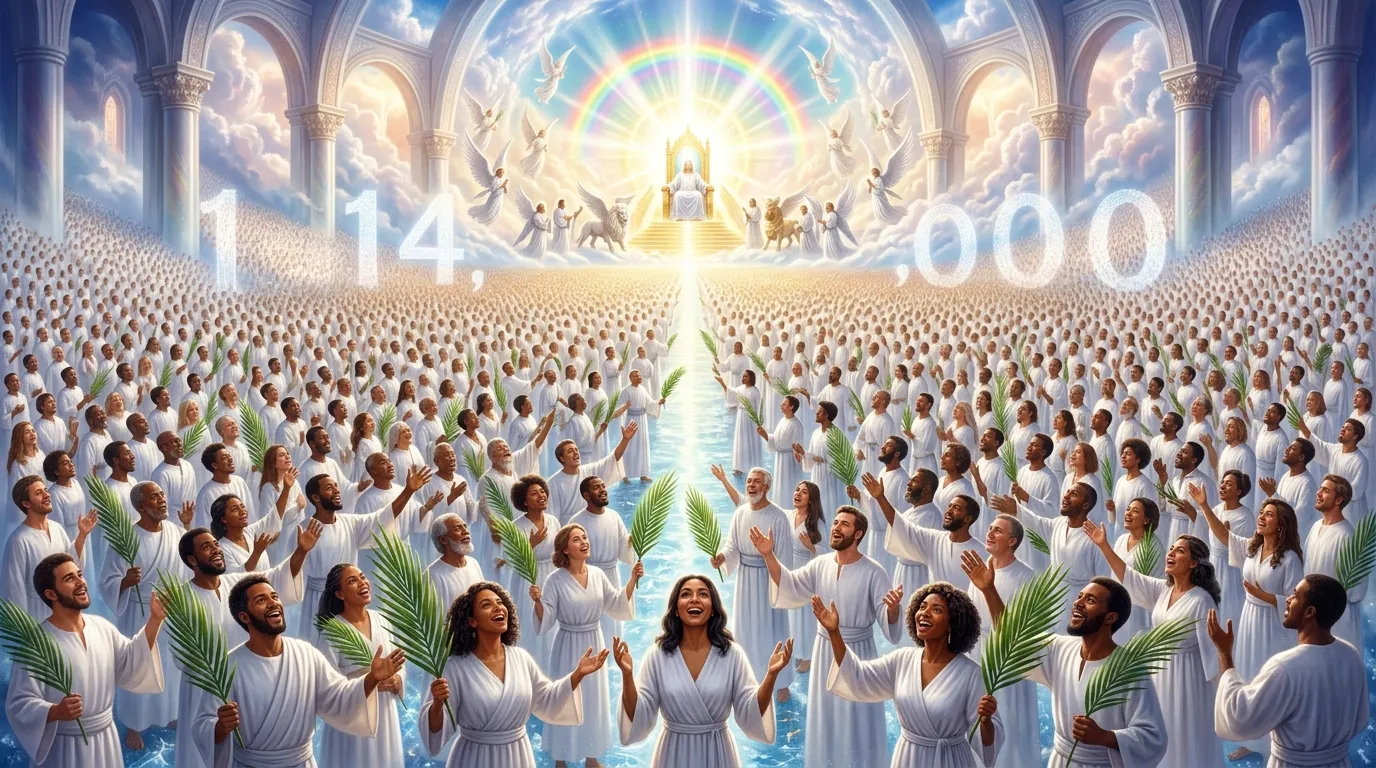
Revelation 14 describes the 144000 standing with Jesus on Mount Zion. They are shown as devoted followers who remain faithful to God.
This image brings a message of hope. It reminds believers that no matter what challenges come, God remains in control. He knows His people, protects them, and leads them toward eternal victory.
There is also a warning within this symbolism. The faithful followers of God are called to remain loyal and obedient. The number 144000 encourages Christians to stay strong in faith and not be led away by fear, temptation, or false teachings.
The spiritual message behind the number is not fear but confidence. It points to God’s power to save, protect, and fulfill His promises.
For Christians today, the number can serve as a reminder that God has a purpose for every believer. He sees those who trust Him and will never forget them.
The biblical symbolism of 144000 ultimately reflects God’s sovereignty, His covenant with His people, and His promise of redemption.
Spiritual Significance and Symbolism
The spiritual significance of number 144000 goes beyond prophecy. It carries important lessons about faith and spiritual growth.
First, it symbolizes God’s protection. Just as the 144000 were sealed by God, believers today can trust that God watches over them. His presence remains with His children even during difficult times.
Second, the number represents faithfulness. The people described in Revelation remained committed to God. Their example encourages Christians to stay close to the Lord through prayer, worship, and obedience.
Third, it points to spiritual completeness. The number reflects God’s perfect plan and reminds believers that He is working all things according to His purpose.
Many people experience seasons of uncertainty. They may wonder if God sees their struggles or hears their prayers. The symbolism of 144000 offers reassurance that God knows every detail of their lives.
This number can also remind believers of a future hope. God’s story does not end with suffering or hardship. His plan leads toward redemption, restoration, and eternal life.
For those seeking a spiritual awakening, the number encourages deeper trust in God’s promises and greater commitment to living according to His will.
Biblical Interpretations in Dreams or Real Life
Some people encounter the number 144000 in dreams, visions, Bible reading plans, or unexpected situations. While the Bible does not teach that every appearance of a number is a direct message from God, believers often use such moments as opportunities for prayer and reflection.
In dreams, seeing 144000 may symbolize God’s protection, calling, or reminder to remain faithful. It can encourage a person to focus on their relationship with Christ and trust His guidance.
A peaceful dream involving this number may reflect reassurance, hope, and confidence in God’s promises.
If the dream feels intense or urgent, it may serve as a reminder to examine one’s spiritual life, seek God’s wisdom, and stay grounded in biblical truth.
In everyday life, noticing this number can prompt believers to spend time in prayer and Scripture. Rather than focusing only on the number itself, Christians should focus on the God who speaks through His Word.
The greatest meaning comes not from the number alone but from the biblical truths connected to it.
Practical Lessons & Faith Insights
The number 144000 reminds believers that God knows His people and remains faithful to His promises.
Pray regularly, trust God’s timing, and stay rooted in Scripture. When life feels uncertain, remember that God’s plan is complete and perfect. He sees your journey, hears your prayers, and continues to guide you with love and wisdom.
FAQs
What does the number 144000 mean in the Bible?
The number 144000 appears in Revelation and represents a group of people sealed by God. It symbolizes divine protection, faithfulness, and God’s perfect plan.
Is the 144000 a literal or symbolic number?
Christians hold different views. Some believe it is a literal number, while others see it as symbolic of the complete people of God.
Why is 144000 important in Revelation?
It highlights God’s protection over His faithful followers and shows that He remains in control of future events.
What is the spiritual message of 144000?
The spiritual message is one of hope, faithfulness, divine protection, and trust in God’s promises.
What should I do if I keep seeing the number 144000?
Use it as an opportunity to pray, read Scripture, and seek God’s guidance. Focus on strengthening your relationship with Him rather than becoming overly focused on the number itself.
More Searched Questions About the 144,000 in the Bible
Where does the 144,000 appear in the Bible?
The number is named in two scenes, both in the book of Revelation, and the two scenes answer to each other. The first is in chapter 7, between the opening of the sixth and seventh seals. Four angels are holding back the winds of judgment from the earth, and they are told to wait: “Hurt not the earth, neither the sea, nor the trees, till we have sealed the servants of our God in their foreheads” (Revelation 7:3). Then John writes: “And I heard the number of them which were sealed: and there were sealed an hundred and forty and four thousand of all the tribes of the children of Israel” (Revelation 7:4), and the verses that follow count out twelve thousand from each of the twelve tribes (Revelation 7:5-8). The second scene is in chapter 14, where the same company is seen no longer being counted but standing in victory: “And I looked, and, lo, a Lamb stood on the mount Sion, and with him an hundred forty and four thousand, having his Father’s name written in their foreheads” (Revelation 14:1). There they sing a new song before the throne that no one else can learn (Revelation 14:3).
Notice how John reports the two scenes, because it shapes every other question in this section. In chapter 7 he hears the number; in chapter 14 he looks and sees the company. Hearing one thing and then seeing another is this book’s own habit: earlier, John hears that “the Lion of the tribe of Juda” has prevailed, and when he looks he sees “a Lamb as it had been slain” (Revelation 5:5-6). In chapter 7 itself the same pattern runs, because straight after hearing the counted 144,000, John looks and sees a multitude no one can count (Revelation 7:9). Readers have therefore always asked whether these sights and sounds are the same people of God shown in two ways, or different groups standing side by side. The next answer takes up that question directly.
Who is the great multitude in Revelation 7:9, and is it the same group as the 144,000?
The multitude appears in the very next verse after the tribal list ends: “After this I beheld, and, lo, a great multitude, which no man could number, of all nations, and kindreds, and people, and tongues, stood before the throne, and before the Lamb, clothed with white robes, and palms in their hands” (Revelation 7:9). John is then told who they are by one of the elders: “These are they which came out of great tribulation, and have washed their robes, and made them white in the blood of the Lamb” (Revelation 7:14). On how the multitude relates to the 144,000, readers have long held two main views, and this article does not settle between them. On one reading, they are two different groups: the 144,000 sealed out of Israel’s tribes, and then a separate, international company saved through the tribulation. On the other reading, they are the same people of God in two pictures: heard first as a perfectly counted Israel, then seen as what that counting really holds, a crowd from every nation too large for anyone to number. Both readings work from features of the text itself: the first from the way the list is limited to Israel’s tribes, the second from the heard and seen pattern that runs through the whole book.
One thing the chapter does settle is a question many searchers bring to it: whether only 144,000 people will ever be saved. Whatever a reader decides about the two groups, the chapter itself does not leave heaven holding only a counted company. In the same breath it shows a saved crowd standing before the throne that “no man could number”. The 144,000 are presented as a sealed and numbered company; the vision then sets beside them a multitude beyond counting, washed and robed and at home with the Lamb.
Why is the tribe of Dan missing from the list in Revelation 7?
First, the list itself. John counts twelve thousand sealed from each of these tribes, in this order: Judah, Reuben, Gad, Asher, Naphtali, Manasseh, Simeon, Levi, Issachar, Zebulun, Joseph and Benjamin (Revelation 7:5-8). Set beside the older tribal lists of Israel, three differences stand out. The tribe of Dan is not there at all. The name of Ephraim is not there either, yet his father Joseph is named, with Ephraim’s brother Manasseh listed separately. And Levi is counted in, although in the older arrangement Levi received no territory of its own among the tribes, and Joseph was counted through his two sons instead (Joshua 13:33). Even the order is unusual: Judah stands first, although Reuben was Jacob’s firstborn. The count still comes to twelve, but it is not the standard list, and readers have asked about Dan’s absence for as long as the book has been read.
The honest answer begins with a limit: Revelation gives no reason for Dan’s absence, and no verse elsewhere explains this list. What exists are explanations readers have proposed across the centuries, and they should be held as proposals, not as the text’s own answer. Some point to Dan’s early history: the tribe set up an idol of its own, when “the children of Dan set up the graven image” and kept priests for it (Judges 18:30-31), and Dan later became one of the two seats of Jeroboam’s calf worship (1 Kings 12:29-30). Some point to Jacob’s dying words about his son: “Dan shall be a serpent by the way, an adder in the path” (Genesis 49:17). Building on such passages, some early church writers, Irenaeus among them, suggested that the Antichrist would come from the tribe of Dan, and that this is why Dan is passed over in the sealing; they pointed also to Jeremiah’s picture of an enemy whose horses are first heard from Dan (Jeremiah 8:16). These are human explanations offered for a silence in the text. The text itself simply leaves Dan out, names Levi in, and keeps the number at twelve thousand from each of twelve tribes.
Is the 144,000 a literal number or a symbolic one?
This is the most argued question about the number, and the argument turns on real features of the text, which is why this article presents the case for each reading and adopts neither. Those who take the number literally point to how exact the passage is. The figure is stated plainly, then broken down tribe by tribe, twelve thousand from each named tribe, and the company is described as sealed “of all the tribes of the children of Israel” (Revelation 7:4). On this reading the list means what it says: a real company of that number, drawn from Israel’s tribes, sealed by God in the last days, and the same company later stands with the Lamb in chapter 14.
Those who take the number symbolically point to the kind of book Revelation is. It opens by saying its message was “signified” to John (Revelation 1:1), and it speaks in pictures from beginning to end. The list itself, they note, is not the standard tribal list: Dan is missing, Levi is counted, Joseph stands beside Manasseh, and Judah is placed first, which looks like a deliberate reshaping rather than a census. The arithmetic also looks designed rather than counted: twelve, the number of God’s people in both Testaments, multiplied by twelve, and then by a thousand, a fullness of the people of God in perfect order. And they point to what John sees immediately after the counting, a multitude that no man could number, as the same reality seen from the other side. Many readers in this camp hold that the 144,000 picture all of God’s sealed people, complete and not one missing. Both readings have been held by faithful Christians for centuries, and the difference between them is a difference about how this book’s numbers work, not about whether God keeps His people, which both sides affirm from the same verses.
What does Revelation 14 mean by calling the 144,000 virgins and firstfruits?
Chapter 14 describes the company on Mount Zion in words found nowhere else: “These are they which were not defiled with women; for they are virgins. These are they which follow the Lamb whithersoever he goeth. These were redeemed from among men, being the firstfruits unto God and to the Lamb. And in their mouth was found no guile: for they are without fault before the throne of God” (Revelation 14:4-5). The word “virgins” has been read in two main ways. On the literal reading, the verse describes a company of men who actually remained unmarried and celibate, set apart for God in body as well as in loyalty. On the figurative reading, the language is about purity from idolatry. Scripture often pictures unfaithfulness to God as adultery, and Paul tells a church he wants to present her “as a chaste virgin to Christ” (2 Corinthians 11:2), meaning pure in devotion. Revelation itself pictures the world’s false worship as a harlot and her corrupting wine (Revelation 14:8; 17:1-5), so on this reading the 144,000 are “virgins” because they never gave themselves to the beast’s worship; they belong to the Lamb alone, and they follow Him wherever He goes. This article presents both readings and settles neither, since the text does not pause to explain its own picture.
The second title is clearer in its background. Firstfruits were the first portion of a harvest, offered to God as His own, and standing as the pledge of the whole harvest to come. Israel itself once carried the title: “Israel was holiness unto the LORD, and the firstfruits of his increase” (Jeremiah 2:3). To call the 144,000 “the firstfruits unto God and to the Lamb”, and to say they were “redeemed from among men”, is to present them as a first portion taken out of humanity and belonging to God. That is one reason many readers, including many who take the number literally, do not treat the 144,000 as the whole of the saved: a first portion points to more of the harvest belonging to God than itself. The closing words, no guile in their mouths and no fault before the throne, complete the portrait: a company marked by truth and by purity of life.
What is the seal of God, and how is it different from the mark of the beast?
The 144,000 exist in the story because of the seal. Before any judgment is allowed to fall, an angel comes “having the seal of the living God” and orders the winds held back “till we have sealed the servants of our God in their foreheads” (Revelation 7:2-3). A seal in the ancient world marked ownership and gave protection, and both ideas run through the book. When the locust judgment of chapter 9 is released, its victims are limited to “those men which have not the seal of God in their foreheads” (Revelation 9:4): the sealed are passed over. The picture has an older root in Ezekiel, where, before judgment went through Jerusalem, God ordered a mark set “upon the foreheads of the men that sigh and that cry for all the abominations that be done in the midst thereof” (Ezekiel 9:4), and those marked were spared. What the seal actually writes is also stated: on Mount Zion the 144,000 have the Father’s name written in their foreheads (Revelation 14:1), and the book’s last picture of God’s servants says “his name shall be in their foreheads” (Revelation 22:4).
The mark of the beast is the deliberate opposite. In Revelation 13, the beast’s followers receive “a mark in their right hand, or in their foreheads”, and no one may buy or sell without the mark, “or the name of the beast, or the number of his name” (Revelation 13:16-17). So the two forehead markings stand over against each other through the whole book. God’s servants are sealed with God’s name before the storm, as His own property and under His protection. The beast’s worshippers are marked with the beast’s name and number, as his property, in a system where allegiance controls even buying and selling. The seal belongs to worship of God; the mark belongs to the worship of the beast (Revelation 14:9-11). Beyond this, neither passage describes what the seal or the mark is made of, and neither gives a shape, a material or a device. This article therefore identifies neither of them with any present day object or technology; in the text they are signs of the two allegiances between which the book sets every person.
What do Jehovah’s Witnesses teach about the 144,000?
This is one of the most searched questions about the number, because Jehovah’s Witnesses are the group most associated with it, and their teaching is specific. In their teaching, the number is literal and exact: the 144,000 are a limited class of Christians, often called the anointed, chosen by God beginning in the first century, who will be raised to life in heaven to rule as kings and priests with Christ. They base this on the passages in this article read in a literal way (Revelation 7:4; 14:1-4), together with texts about those who reign with Christ (Revelation 5:9-10; 20:6) and Jesus’ words to a “little flock” who would receive the kingdom (Luke 12:32). In their teaching, the great multitude of Revelation 7:9 is a different group, which they call the great crowd. Its hope is not heaven but everlasting life on an earth made into a paradise. So their teaching is not that only 144,000 people will be saved; it is that only 144,000 go to heaven to rule, while the great crowd is saved to life on earth. This is also why, at their annual Memorial of Christ’s death, only those who consider themselves members of the anointed class partake of the bread and the wine.
Other Christian traditions read these passages differently, as the answers above show: some take the 144,000 as a literal company from Israel’s tribes in the last days, and others as a symbolic picture of the complete people of God, and the great multitude as either the same company or a distinct one. This article describes the Jehovah’s Witnesses’ teaching as their doctrine, in their own terms, because it is one of the things most often searched about this number; it does not adopt that teaching, and it does not identify any modern group as the 144,000 itself.
Conclusion
The biblical meaning of number 144000 points to God’s faithfulness, protection, and perfect plan for His people.
If viewed literally or symbolically, this number carries a powerful message of hope and divine care. It reminds believers that God knows those who trust Him and will fulfill every promise He has made.
As you continue your faith journey, rest in the confidence that God’s guidance is sure, His love is constant, and His plans are always good.
Discover More Articles
- Number 4 Meaning in the Bible: A Complete Biblical Guide
- Number 3 Meaning in the Bible: The Powerful Truth Revealed
- Number 3 Meaning in the Bible: The Powerful Truth Revealed