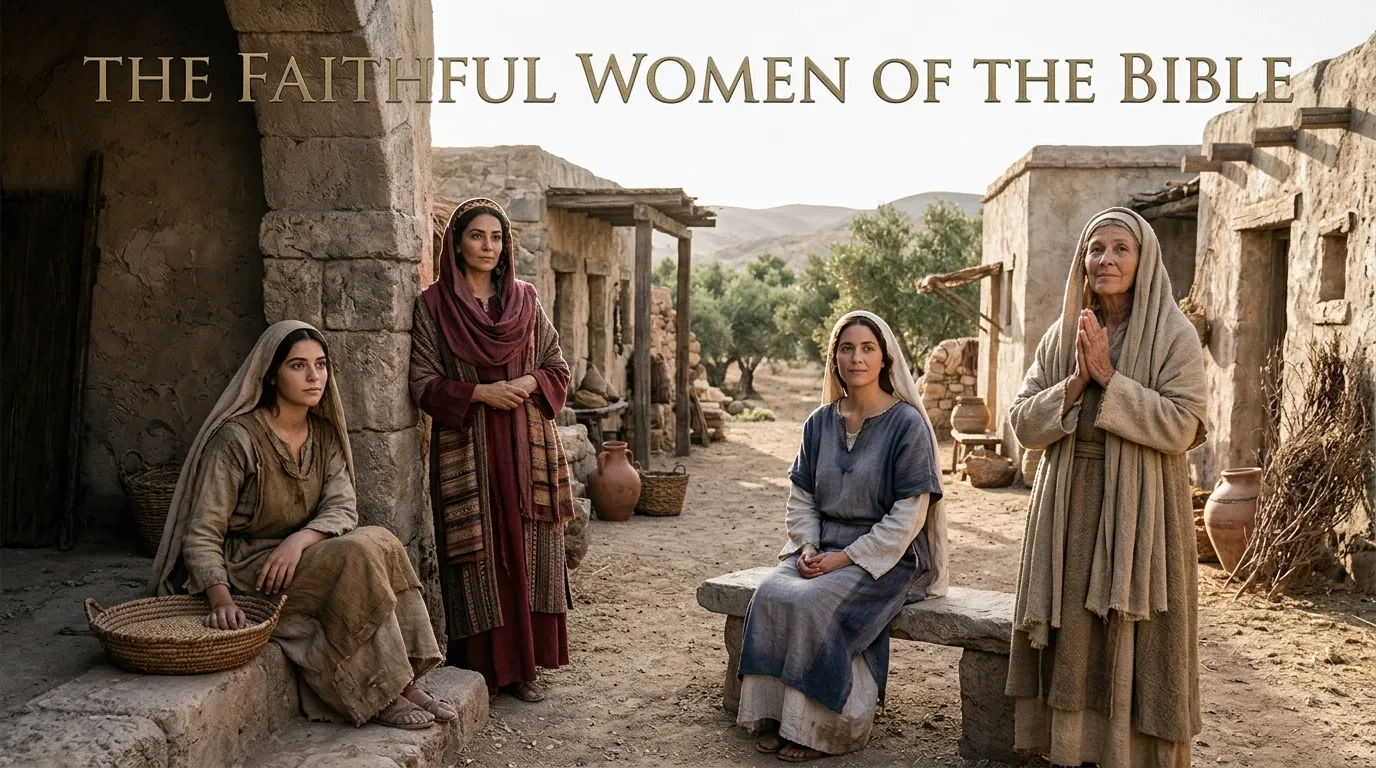
The faithful women of the Bible are ordinary women who trusted God in hard times and whose choices shaped the story of Scripture.
They include Sarah, Ruth, Hannah, Deborah, Esther, Mary the mother of Jesus, Mary Magdalene, and many lesser known women like Shiphrah, Puah, and the widow of Zarephath.
Their faith was not perfect and it was not easy. It showed up in waiting, in courage, in prayer, in loyalty, in leadership, and in obedience when the outcome was not clear.
The Bible book of Hebrews chapter 11 praises faith as trust in God even when we cannot see the result, and many of these women live out that kind of faith in their own stories.
What Does Faithful Mean in the Bible
In the Bible, faithful does not mean perfect. It means steady trust in God over time, even when life is hard, confusing, or painful. A faithful person believes God is who he says he is, and acts on that belief, even when the result is not immediate.
The Bible book of Hebrews gives the classic definition. Hebrews 11:1 says faith is confidence in what we hope for and assurance about what we do not see. Hebrews 11 goes on to list people of faith, including Sarah, Rahab, and others, and it praises them not because they never doubted, but because they kept trusting God through doubt, waiting, and suffering.
Faith in the Bible is also practical. It shows up in choices. A faithful woman in Scripture might wait for a child, leave her home country, hide spies, lead an army, risk her life before a king, pray for a son, or follow Jesus to the cross and to the empty tomb. Faith is not only a feeling in the heart. It is trust that moves feet, hands, and words.
It is also important to see that faithful women in the Bible come from many backgrounds. Some were queens. Some were widows. Some were foreigners. Some were young girls. Some were old. Some were rich. Some were poor. Some were mothers. Some never had children. Their diversity is part of the point. God works through ordinary people in ordinary and extraordinary circumstances.
Sarah: Faith That Waits a Long Time
Sarah is one of the first faithful women in the Bible, and her story is a story of long waiting. Sarah was the wife of Abraham. God promised Abraham that he would become the father of many nations, and that Sarah would have a son. Genesis 17:16 records that promise. But Sarah was barren for many years, and by the time the promise came true, she was well past childbearing age.
Ruth: Faith That Shows Loyalty
Ruth is one of the most loved faithful women in the Bible. Her story is told in the short Bible book of Ruth. Ruth was a Moabite woman, a foreigner, who married into an Israelite family. After her husband died, her mother-in-law Naomi decided to return to Bethlehem. Naomi told Ruth to go back to her own people, but Ruth refused.
Ruth 1:16 records Ruth’s famous words to Naomi, in plain form: where you go, I will go, and where you stay, I will stay. Your people will be my people, and your God will be my God. That is loyalty, and it is also faith. Ruth left her home, her culture, and her security to follow Naomi and to trust Naomi’s God.
Hannah: Faith That Prays Through Pain
Hannah’s story is found in 1 Samuel chapter 1 and 2. Hannah was married to Elkanah, but she could not have children. In her culture, that brought deep shame and pain. Another wife in the family mocked her. Hannah was so distressed that she wept and could not eat.
Deborah: Faith That Leads With Courage
Deborah is a powerful example of a faithful woman in leadership. Her story is in Judges chapter 4 and 5. Deborah was a prophetess and a judge in Israel at a time when Israel was oppressed by a Canaanite king named Jabin and his army commander Sisera.
Judges 4:4 to 5 says Deborah held court under a palm tree, and the Israelites came to her to settle disputes. She was not only a spiritual leader. She was a civic leader, a judge, and a military strategist. When God called her to act, she summoned Barak, the army commander, and told him to gather troops and fight. Barak said he would only go if Deborah went with him. Deborah agreed, and she also told him that the honor for victory would go to a woman, not to him.
Israel won the battle, and Sisera was killed by Jael, another brave woman. Deborah’s song in Judges chapter 5 celebrates the victory and praises God for giving Israel leaders who were willing to act. Deborah’s story breaks a common stereotype that faithful women in the Bible were only quiet and passive. Deborah was bold, wise, and decisive, and God used her leadership to free a nation.
Lesson from Deborah: Faithful leadership is not about gender, title, or popularity. It is about hearing God, speaking truth clearly, and acting with courage when others are afraid.
Esther: Faith That Risks Everything
Esther’s story is told in the Bible book of Esther. Esther was a young Jewish woman who became queen of Persia. She did not choose that role, and she kept her Jewish identity secret at first. When a royal official named Haman plotted to destroy all the Jews in the empire, Esther faced a terrible choice.
Persian law said no one could approach the king uninvited, on pain of death, unless the king extended his scepter. Esther had not been called by the king for thirty days. To go to him uninvited was to risk her life. Her cousin Mordecai sent her a message that has become famous. Esther 4:14, in plain form, says who knows whether you have come to your royal position for such a time as this.
Esther asked all the Jews in the capital to fast and pray for three days. Then she went to the king. The king received her favorably, and over a series of meals, Esther exposed Haman’s plot. Haman was punished, the Jews were saved, and the Jewish festival of Purim was established to remember that deliverance.
Esther’s story is unique because the name of God is never mentioned in the book of Esther. Yet God’s providence is clear throughout. Coincidences, timing, sleepless nights, and brave choices all point to a God working behind the scenes. Esther teaches that faith is not always loud or public. Sometimes it is quiet courage, careful planning, prayer, and a willingness to risk comfort for the good of others.
Lesson from Esther: You may be in a position, a job, a family, or a community for a reason you do not yet see. Faith asks you to use your influence for good, even when it costs you.
Mary, the Mother of Jesus: Faith That Says Yes
Mary, the mother of Jesus, is the most well known faithful woman in the New Testament. Her story begins in Luke chapter 1. Mary was a young woman in Nazareth, engaged to Joseph, when the angel Gabriel visited her and told her she would conceive and give birth to a son, Jesus, who would be called Son of the Most High.
Mary’s response is a model of faith. Luke 1:38 records her words in plain form: I am the Lord’s servant, may your word to me be fulfilled. She did not understand everything. She asked how this could happen, since she was a virgin. The angel explained that the Holy Spirit would come upon her. Mary said yes, even though saying yes meant possible shame, misunderstanding, and danger in her culture.
Mary’s song, the Magnificat, in Luke 1:46 to 55, praises God for lifting the humble and filling the hungry with good things. Mary stayed faithful through Jesus’ birth, through his childhood, through his ministry, and through his death on the cross. John 19:25 says Mary stood near the cross when Jesus died. That is faith that does not run away when following God becomes painful.
Lesson from Mary: Faith says yes to God before you understand the whole plan. It trusts God’s character, even when the path is costly and confusing.
Mary Magdalene and the Women Who Followed Jesus
Mary Magdalene is another key faithful woman in the New Testament. Luke 8:1 to 3 says Mary Magdalene, Joanna, Susanna, and many other women followed Jesus, supported his ministry from their own means, and traveled with him. Mary Magdalene had been healed by Jesus from seven demons, according to Luke 8:2. Her gratitude turned into loyal service.
Lesser Known Faithful Women You Should Not Miss
Many lists focus only on famous names, but the Bible also honors lesser known women whose faith changed history in quiet ways. Their stories fill important gaps in most online lists.
| Woman | Bible reference | Trial she faced | How her faith showed | Impact |
| Shiphrah and Puah | Exodus 1:15 to 21 | Pharaoh ordered them to kill Hebrew baby boys | They feared God and refused to obey an evil order | Hebrew babies lived, and God blessed their families |
| Rahab | Joshua 2, Hebrews 11:31 | She lived in Jericho, a city under judgment | She hid Israelite spies and trusted Israel’s God | Her family was saved, and she joined the line of Jesus |
| Jael | Judges 4:17 to 22 | Enemy commander sought shelter in her tent | She acted bravely to end oppression | Israel gained freedom from Sisera |
| Abigail | 1 Samuel 25 | Her husband insulted David and risked war | She acted wisely, humbly, and quickly to make peace | She prevented bloodshed and later married David |
| The widow of Zarephath | 1 Kings 17 | Famine, widowhood, and a dying son | She shared her last food with Elijah and trusted God | Her food did not run out, and her son lived |
| The Shunammite woman | 2 Kings 4 | Her promised son died suddenly | She sought Elisha with steady faith and refused to give up | Her son was raised to life |
| Anna | Luke 2:36 to 38 | Widowed after seven years of marriage | She served in the temple with fasting and prayer for decades | She recognized baby Jesus and spoke of him to others |
| Priscilla | Acts 18, Romans 16:3 | Life as a tentmaker and church planter in a hostile world | She taught, hosted a church, and risked her life for Paul | Churches grew through her teaching and hospitality |
| Dorcas, also called Tabitha | Acts 9:36 to 42 | She died, leaving a community in grief | Her life of good works and charity inspired many | Peter raised her, and many believed |
| Lois and Eunice | 2 Timothy 1:5 | Raising Timothy in faith in a mixed culture | They passed sincere faith to the next generation | Timothy became a key leader in the early church |
These women remind us that faith is not only for queens and prophets. It is for midwives who refuse evil, for widows who share food, for mothers who teach children, and for friends who serve quietly. God notices all of them.
Miriam and Jochebed: Faith That Protects Life
Two women at the start of the Exodus story show faith that protects life at great personal risk. Jochebed was the mother of Moses. When Pharaoh ordered Hebrew baby boys to be killed, she hid her son for three months, then placed him in a basket among the reeds of the Nile, trusting God with a child she could not keep safe by her own power. Exodus chapter 2 tells that story, and Hebrews 11:23 praises Moses parents for not fearing the king’s edict.
Miriam, Moses sister, watched over the basket from a distance, and when Pharaoh’s daughter found the baby, Miriam wisely offered to find a Hebrew nurse for him. That nurse was Jochebed herself, so a mother got to nurse her own son under the protection of the princess who had rescued him. Later, Miriam is called a prophet in Exodus 15:20, and she led the women of Israel in song and dance after the crossing of the sea. Micah 6:4 names Miriam alongside Moses and Aaron as a leader God sent to Israel. Her story also carries a warning, because Numbers chapter 12 records her challenge to Moses and her discipline for it. Faithful leaders can still fail, and God restores those who return to him.
Lesson from Miriam and Jochebed: Faith sometimes looks like quiet, clever courage at home, protecting life, watching over the vulnerable, and speaking up at exactly the right moment, rather than a public act of heroism.
The Faithful Women of the Bible DVD
The The Faithful: Women of the Bible DVD search is useful for viewers who want to own a physical copy of this biblical drama. The series premiered on FOX in March 2026 and features stories inspired by women in the Book of Genesis. Before purchasing, check major entertainment retailers and DVD marketplaces for official releases. Current TV listings do not confirm an available DVD edition, so check the product details carefully before placing an order.
The Faithful Women of the Bible Summary
The Faithful: Women of the Bible is a historical drama that explores the lives of five important women from Genesis: Sarah, Hagar, Rebekah, Leah, and Rachel. Their connected stories explore love, marriage, motherhood, family struggles, jealousy, difficult choices, and faith. The series presents familiar biblical events through the personal experiences of these women, showing how their decisions influenced future generations. It offers viewers a dramatic way to revisit important stories from the Old Testament.
The Faithful: Women of the Bible Cast
The cast of The Faithful: Women of the Bible includes several well-known television and film actors. Minnie Driver plays Sarah, while Natacha Karam portrays Hagar and Alexa Davalos appears as Rebekah. Millie Brady plays Leah, and Blu Hunt portrays Rachel. Other important cast members include Jeffrey Donovan as Abraham, Tom Mison as Isaac, Tom Payne as Jacob, Ben Robson as Esau, and James Purefoy as Laban. Together, they bring the Genesis stories to the screen.
The Faithful: Women of the Bible 2026
Released in 2026, The Faithful: Women of the Bible is a biblical drama produced by FOX Entertainment Studios. The series premiered on March 22, 2026, and concluded on April 5, 2026. It features six episodes presented in three two-part stories about Sarah and Hagar, Rebekah, and Leah and Rachel. The production combines historical drama with familiar biblical narratives, exploring the relationships, struggles, and faith of women whose stories shaped generations.
The Faithful: Women of the Bible Season 2
The Faithful: Women of the Bible was created as a limited series with six episodes in its first season. Its original story covers the experiences of Sarah, Hagar, Rebekah, Leah, and Rachel, leaving no officially confirmed second season in the available announcements. Viewers interested in more biblical dramas can explore other television adaptations inspired by Scripture. For the latest updates, check official FOX announcements and streaming platform listings rather than relying on unconfirmed season renewal rumors.
The Faithful: Women of the Bible Where to Watch
You can find The Faithful: Women of the Bible through selected streaming and digital entertainment platforms. Available listings include Hulu and Disney+, while other services may offer purchase or rental options depending on your country. Streaming availability can change because of regional licensing agreements and subscription packages. Before subscribing, search for the complete series on your preferred platform and check whether all six episodes are included. Official streaming listings are the best place to confirm current availability.
Cast of the Faithful
The cast of The Faithful features actors portraying important characters from the Book of Genesis. Minnie Driver stars as Sarah, Natacha Karam plays Hagar, and Alexa Davalos portrays Rebekah. Millie Brady and Blu Hunt appear as sisters Leah and Rachel. The male cast includes Jeffrey Donovan as Abraham, Tom Mison as Isaac, and Tom Payne as Jacob. These performances help bring the connected family stories, personal struggles, and biblical relationships to life.
The Faithful: Women of the Bible Wikipedia
The Wikipedia page for The Faithful: Women of the Bible provides an overview of the 2026 American biblical historical drama. Readers can explore information about its creators, cast members, production companies, release dates, episodes, and storyline. The series was created by René Echevarria and premiered on FOX on March 22, 2026. Its story focuses on five women from Genesis and their connected family experiences. Readers should compare Wikipedia information with official FOX and production sources for accuracy.
The Daughters of Zelophehad: Faith That Asks for Justice
The five daughters of Zelophehad, Mahlah, Noah, Hoglah, Milcah, and Tirzah, are among the most overlooked faithful women in the Bible, and their story is told in Numbers chapter 27. Their father had died in the wilderness and left no sons. Under the inheritance customs of the time, daughters did not normally inherit land, so the family name and land would pass away. Instead of accepting that loss quietly, the five sisters stood together before Moses, Eleazar the priest, the leaders, and the whole assembly at the entrance to the tent of meeting, and they made their case with humility and firmness. They asked why their father’s name should disappear from his clan simply because he had no son, and they asked for property among their father’s relatives.
Moses brought their case before the Lord, and God ruled in their favor. Numbers 27:7 records that ruling, and it changed inheritance law for Israel, so that a daughter could inherit when there was no son. The sisters appear again in Numbers chapter 36 and in Joshua 17:3, where they receive their inheritance. Their faith was not only personal trust. It was public, reasoned, and persistent, and it changed the law for generations after them.
Lesson from the daughters of Zelophehad: Faith can ask for justice respectfully and firmly, in the right place, with the right reasons, and with others standing beside you. Seeking what is fair is not unfaithful, when you seek it from God and through lawful, honest means.
Huldah: Faith That Speaks Truth to Power
Huldah is a prophetess whose story is told in 2 Kings chapter 22 and 2 Chronicles chapter 34, and she is one of the clearest examples of a woman trusted with God’s word at a national turning point. During the reign of King Josiah, workers repairing the temple found the Book of the Law. The king was shaken by what he heard, and he sent the high priest and his officials to inquire of the Lord. They went to Huldah, not to a male prophet, even though Jeremiah was already prophesying at that time.
Huldah spoke plainly. She confirmed coming judgment for Judah’s unfaithfulness, and she also told Josiah that because his heart was responsive and he had humbled himself, he would be gathered to his ancestors in peace and would not see the disaster. Josiah acted on her word, renewing the covenant and reforming worship. Huldah’s authority came from the truth of her message and from the trust leaders placed in her, not from a title she claimed for herself.
Lesson from Huldah: Faithful speech is clear, honest, and measured. It tells hard truth when hard truth is needed, and it also recognizes a humble heart. You do not need a platform to speak truth, you need faithfulness to God’s word and the courage to say it plainly.
Lydia, Phoebe, and Junia: Faith in the Early Church
The New Testament continues the pattern of faithful women, now in the life of the early church. Lydia was a merchant of purple cloth from Thyatira, a successful businesswoman living in Philippi. Acts 16:14 to 15 says the Lord opened her heart to respond to Paul’s message, she and her household were baptized, and she opened her home to Paul and his companions. Her house became a base for the church in Philippi. Lydia shows faith that combines work, wealth, hospitality, and an open home.
Phoebe is described in Romans 16:1 to 2 as a deacon of the church in Cenchreae and a benefactor of many people, including Paul himself. Paul commends her to the church in Rome and asks them to receive her and help her in whatever she needs. She was almost certainly the trusted carrier of Paul’s letter to the Romans, one of the most important letters ever written. Carrying a letter sounds small, but in the ancient world it meant explaining, defending, and delivering it faithfully across a long journey.
Junia is named in Romans 16:7, where Paul calls Andronicus and Junia outstanding among the apostles and his fellow prisoners. Scholars debate the exact sense of that phrase, but the plain point stands: a woman named Junia was so well known and so respected in apostolic work that Paul singled her out by name. Alongside her, Philip’s four daughters prophesied, according to Acts 21:8 to 9, and Euodia and Syntyche contended at Paul’s side in the gospel, according to Philippians 4:2 to 3.
| Woman | Bible reference | How her faith showed | Why she matters today |
| Miriam | Exodus 2, Exodus 15:20, Micah 6:4 | Protected Moses, led worship, led Israel | Faith can lead publicly and also fail and be restored |
| Jochebed | Exodus 2, Hebrews 11:23 | Hid Moses and trusted God with his life | Quiet courage at home can change history |
| Daughters of Zelophehad | Numbers 27, Numbers 36, Joshua 17:3 | Asked Moses and God for a just inheritance | Respectful persistence can change unjust rules |
| Huldah | 2 Kings 22, 2 Chronicles 34 | Spoke God’s word truthfully to king and priests | Truth spoken plainly can turn a nation back to God |
| Lydia | Acts 16:14 to 15 | Believed, was baptized, opened her home | Work and hospitality can anchor a new church |
| Phoebe | Romans 16:1 to 2 | Served as deacon, carried Paul’s letter | Faithful service often carries the most important work |
| Junia | Romans 16:7 | Labored with Paul, noted among the apostles | Women were respected co workers in gospel mission |
| Philip’s daughters | Acts 21:8 to 9 | Prophesied by the Spirit | God gives spiritual gifts to sons and daughters alike |
Lesson from these women: Faith in the early church was not only about famous apostles. It was carried by businesswomen, deacons, letter carriers, prophets, hosts, and co workers, and the church still runs on that same kind of faithful, often unseen, service today.
What All These Women Have in Common
When you look at these stories together, several patterns appear. These patterns are more useful than a simple list, because they help you recognize faith in your own life.
First, faithful women trusted God’s promises more than their circumstances. Sarah trusted a promise about a child when her body said it was impossible. Hannah trusted God when her rival mocked her. Esther trusted God’s timing when her life was at risk.
Second, faithful women acted. Faith was not passive. Ruth walked to Bethlehem. Deborah went to battle. Abigail rode to meet David. Mary Magdalene went to the tomb early in the morning. Action is a key sign of living faith.
Third, faithful women prayed and listened. Hannah prayed in anguish. Mary pondered things in her heart. Anna prayed for decades. Priscilla taught with accuracy and care. Prayer and listening shaped their decisions.
Fourth, faithful women cared for others. Ruth cared for Naomi. Abigail cared for her household and for David’s men. Dorcas made clothes for widows. Lois and Eunice cared for Timothy’s faith. Faith that only serves self is not the faith these women show.
Fifth, faithful women were not perfect. Sarah laughed in doubt. Rebekah schemed for her favorite son. Martha worried and was distracted. Peter’s mother-in-law and other women also had flaws. The Bible does not hide their flaws. It shows that God works through imperfect people who keep returning to trust.
How to Learn From Faithful Women Today
You do not need to live in ancient Israel to learn from these women. Their lessons apply to modern life in practical ways.
If you are waiting for something important, like a child, a job, healing, or a breakthrough, learn from Sarah and Hannah. Keep praying honestly. Keep doing the next right thing. Do not measure God’s faithfulness only by how fast an answer comes.
If you are loyal to family in a hard season, learn from Ruth. Loyalty in daily care, in hard work, and in staying when leaving would be easier, is a powerful form of faith.
If you lead at work, at church, at school, or at home, learn from Deborah and Abigail. Lead with wisdom, humility, and courage. Speak truth clearly. Act quickly when peace is at stake. Do not wait for perfect conditions.
If you have influence, even a small amount, learn from Esther. Ask who you can help with your position, your voice, your money, or your time. Courage often means using influence for others, not only for yourself.
If you are a mother, a mentor, or a teacher, learn from Lois and Eunice. Passing faith to the next generation happens in daily conversation, in prayer at home, in reading Scripture together, and in living with integrity when no one is watching.
If you have experienced loss, learn from Mary at the cross and from Mary Magdalene at the tomb. Stay near Jesus in grief. Grief and faith can live together. Hope does not mean pretending pain is not real. It means trusting that God is present in pain and that resurrection is real.
A simple weekly practice can help. Choose one woman each week. Read her story in the Bible. Write down one trial, one act of faith, and one lesson. Then write one concrete action you will take that week based on that lesson. Over ten weeks, you will have studied ten women and taken ten steps of faith. That is more useful than reading ten lists and forgetting them.
Frequently Asked Questions About Faithful Women of the Bible
Who is the most faithful woman in the Bible?
The Bible does not rank women in that way. Different women show faith in different situations. Mary, the mother of Jesus, is often honored for her obedience. Sarah is praised in Hebrews 11. Ruth is praised for loyalty. Deborah is praised for leadership. Each shows a different face of faith, and together they give a fuller picture.
Why are only a few women named in Hebrews 11?
Hebrews 11 is a selective list, not a complete list. It names examples to encourage readers, not to exclude others. Many faithful women, like Ruth, Hannah, Deborah, and Esther, are not named in Hebrews 11, but their stories are told elsewhere in Scripture and they are honored there.
Were women leaders in the Bible?
Yes. Deborah was a judge and prophetess. Miriam was a prophetess. Huldah was a prophetess. Priscilla taught Apollos. Phoebe was a deacon. Junia is called outstanding among the apostles in Romans 16:7. Women also funded Jesus’ ministry, witnessed the resurrection, and hosted churches in their homes. Leadership took many forms in the Bible.
Did faithful women in the Bible ever doubt?
Yes. Sarah laughed. Martha worried. Mary Magdalene wept at the tomb and did not recognize Jesus at first. Doubt is part of many faith stories in the Bible. Faith is not the absence of doubt. It is trust that continues through doubt, with honest prayer and a return to God.
What can men learn from faithful women of the Bible?
Men can learn the same lessons as women: trust, courage, loyalty, prayer, humility, and service. The stories are not only for women. They are for all readers, because they show how God works through people who trust him. A man who studies Ruth learns loyalty. A man who studies Deborah learns courageous leadership. A man who studies Hannah learns honest prayer.
How can I teach children about faithful women of the Bible?
Start with short, clear stories: Ruth and Naomi, Hannah and Samuel, Esther’s bravery, Mary saying yes to God, and Mary Magdalene at the empty tomb. Use simple language, ask children what the woman trusted God for, and what brave or kind choice she made. Then ask children what brave or kind choice they can make this week.
Are there faithful women in the Bible who were not mothers?
Yes. Deborah, Anna, Mary Magdalene, Priscilla, Phoebe, and many others are not primarily known as mothers in their stories. Motherhood is honored in the Bible, but it is not the only way a woman shows faith. Single women, widows, workers, leaders, and servants all show faith in the Bible.
Who was Huldah, and why does she matter?
Huldah was a prophetess in Jerusalem during King Josiah’s reign. When the Book of the Law was found in the temple, the high priest and royal officials went to her to inquire of the Lord. Her word, recorded in 2 Kings chapter 22, confirmed judgment for Judah’s sin and mercy for Josiah’s humble heart, and Josiah reformed worship on the strength of it. She matters because leaders trusted a woman to speak God’s word at a national crisis.
Who were the daughters of Zelophehad?
They were five sisters, Mahlah, Noah, Hoglah, Milcah, and Tirzah, whose father died without a son. In Numbers chapter 27 they stood before Moses and the whole assembly and asked for their father’s inheritance. God ruled in their favor, and inheritance law changed for daughters with no brother. Their story shows faith that asks for justice humbly, firmly, and together.
Who was Phoebe, and what did she do?
Phoebe was a deacon of the church in Cenchreae and a benefactor of many, including Paul. Romans 16:1 to 2 commends her to the church in Rome and asks them to help her. She most likely carried Paul’s letter to the Romans, a task that required trust, travel, and the ability to explain the letter faithfully.
Who was Junia?
Junia is named in Romans 16:7 alongside Andronicus, and Paul calls them outstanding among the apostles and his fellow prisoners. Whatever the exact sense of that phrase, Junia was a woman well known and respected for apostolic labor, not a background figure.
Did women prophesy in the Bible?
Yes. Miriam, Deborah, Huldah, and Anna are called prophetesses, Isaiah’s wife is identified as a prophetess in Isaiah 8:3, and Acts 21:9 says Philip had four daughters who prophesied. At Pentecost, Peter quoted Joel’s promise that God would pour out his Spirit on sons and daughters, and both would prophesy.
Why are some faithful women so little known?
Some women appear in only a few verses, like the daughters of Zelophehad, Huldah, or Phoebe, and short stories are easy to skip in a quick reading. Their brevity does not mean they mattered less. Reading whole books, not only famous chapters, is how these quiet stories come back into view.
Conclusion
The faithful women of the Bible are not distant saints with perfect lives. They are real people who faced barrenness, widowhood, war, oppression, grief, and danger, and who trusted God in the middle of those trials. Sarah waited. Ruth stayed loyal. Hannah prayed through tears. Deborah led with courage. Esther risked her life. Mary said yes. Mary Magdalene stayed near Jesus and witnessed resurrection.
Discover More Post
- KJV Bible: A Simple Guide to the King James Version, Its History, and How to Read It
- Museum of the Bible: A Complete Visitor Guide to History, Floors, and Faith
- Bible Verses About Strength: A Clear Guide for Hard Days and Everyday Life

I’m Nicholas Sparks, and storytelling has always been my passion. Through TheBiblimeaning, I share insights about my books, unforgettable characters, romance, emotions, and the deeper meanings behind my stories. This platform brings readers closer to my writing journey, latest releases, and the inspiration that shapes every novel I create.