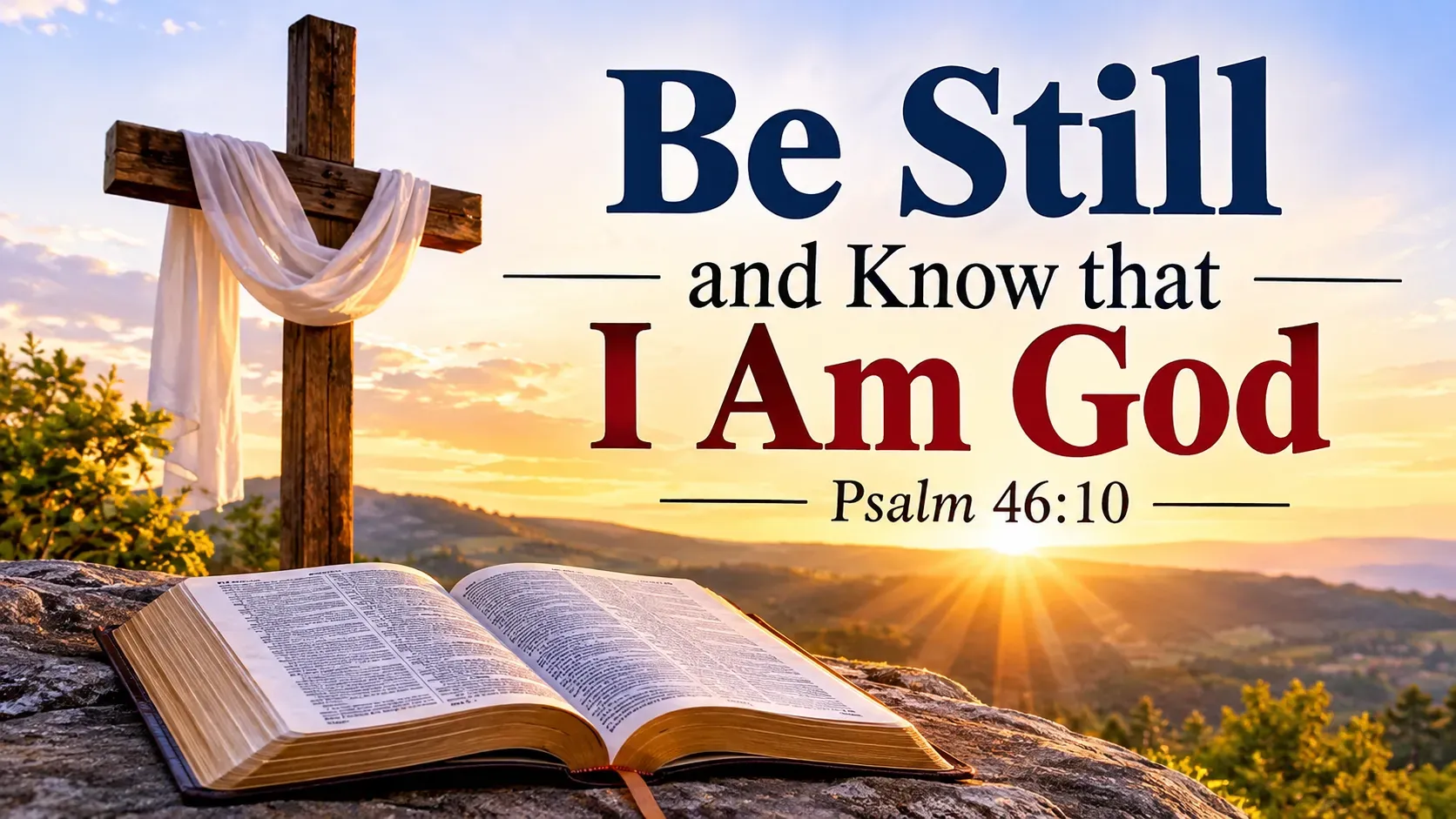
Be still and know that I am God means stop striving. Release your grip on control. And know that God alone is high.
It comes from Psalm 46:10, where God speaks into chaos.
And war, not only into quiet moments.
And vows that he will be high among the nations.
And in the earth.
Where the Verse Comes From
Psalm 46 is a song of confidence in God during upheaval.
It opens with God as refuge.
And strength, a very present help in hard times.
The psalm art earth giving way.
Mountains falling into the sea, waters roaring, nations raging.
And kingdoms tottering.
Into that shaking world, God speaks.
The command to be still is not first a suggestion to relax on a calm day.
It is spoken when all feels unstable.
The psalm has a clear group.
First, God is our refuge when creation shakes.
Second, God is present in his city, like a river bringing gladness.
Third, God ends wars, breaks bows.
And shatters spears.
Then God says, be still and know that I am God.
At last, the psalm repeats its confidence: the Lord Almighty is with us.
The God of Jacob is our fortress.
Reading only verse 10 without the rest of the psalm softens the verse into a slogan.
Reading the whole psalm restores its force.
Many folk first meet this verse on a wall print, a mug,.
Or a social media image.
That is understandable, because the words are beautiful and memorable.
But the first setting matters.
The audience first heard a command to stop fighting a fight they could not win.
And to acknowledge the God who ends war.
For faith folk today, the same command still applies when fear, conflict.
And pressure tempt us to control all us.
What Be Still Means in Hebrew
The Hebrew word behind be still is raphah.
Used here in the command form harpu.
It means to let go.
To drop your hands, to go slack, to cease striving, to refrain.
And to abandon an effort.
Picture a person gripping a rope with white knuckles,.
Or soldiers holding weapons in a fight.
The command is to release that grip.
That is why some Bible word books render the phrase as cease striving.
Both word books point to the same idea from other angles.
Be still points to the calm that follows letting go.
Cease striving points to the effort you must drop to get there.
Neither words means do nothing for all time, ignore job,.
Or pretend problems do not exist.
It means stop trying to hold the world by your own strength alone.
The second word, know, comes from the Hebrew word yada.
It means more than knowing facts in your head.
It means knowing by life, bond, recognition.
And trust.
To know that he is God is to acknowledge his rule, nature.
And true love in a own way.
Stillness and knowledge belong in this verse.
When striving stops, space opens to know who God really is.
Why the Command Is Stronger Than Relax
Modern culture often turns be still into advice to take a bath, light a candle,.
Or clear your mind.
Those ways may help you rest.
But they are not the main point of Psalm 46:10.
The psalm is about surrender to a high God.
Not about creating a peaceful mood.
A person can sit quietly.
At that same time still gripping control tightly inside.
True stillness, in this psalm.
Is a heart posture: I will stop fighting God.
Stop trusting only myself.
And trust the Lord who rules nations and past.
That gap brings relief.
You do not have to manufacture calm feelings before God accepts you.
You can come with fear, anger, grief, or doubt.
And still practice stillness by drops control step by step.
Stillness is learned in real life, not only in quiet rooms.
Who Is Being Addressed in Psalm 46:10
Scholars discuss whether God speaks mainly to hostile nations.
To fearful faith folk,.
Or to both.
The context supports both audiences in other ways.
For foes raging against God, be still means stop your rebellion.
And warfare,.
This is because God will be high whether you submit willingly.
Or not.
For Gods folk trembling in the middle of hard times.
Be still means stop panicking, stop trusting foreign powers.
Or your own plans alone.
And rest in the God who is your fortress.
That double address is helpful for daily life.
At times our own striving looks like worry, overwork, endless planning,.
Or trying to fix other folk.
At times it looks like conflict, defending us at all costs,.
Or turns from to forgive.
In both cases, the verse calls us to lay down the weapon we are holding.
Whether that weapon is fear, control, anger,.
Or self reliance.
And to let God be God.
It also guards against a common misuse.
Psalm 46:10 is not a vow that each problem will disappear if you sit still long enough.
The psalm does not say the waters stop roaring immediately.
It says God is present in the roaring.
Peace in this psalm is not the absence of hard times.
It is the presence of God in hard times.
How Be Still Helps With Anxiety
Fear often grows when we feel responsible for ends we cannot control.
We replay talks, imagine worst cases, check news constantly.
And try to prepare for each possibility.
Psalm 46 does not dismiss those feelings.
It names a world that shakes.
Then points to a refuge that does not shake.
Practicing stillness for fear can be plain and concrete.
Pause before reacting to a stressful message.
Name what you can control and what you cannot.
Pray about the part you cannot control.
Read Psalm 46 slowly, aloud if possible.
And notice the repeated truth that God is with us.
Talk to a trusted friend, pastor,.
Or counselor rather than carrying fear alone.
If fear is severe or persistent.
Seek professional help with prayer and Scripture.
Faith and wise care work, not against each other.
Stillness also protects decision making.
When we are frantic, we often make rushed choices, speak harshly,.
Or avoid key talks.
A short pause to breathe, pray.
And think of Gods nature can change the next step.
It does not vow an easy outcome.
But it helps us act from trust rather than panic.
| Anxious striving looks like. | Stillness in Psalm 46 looks like. |
| Replaying each worst case without rest. | Naming fears in prayer. |
| Trying to control other folk. | Drops ends you cannot control. |
| Constant checking and overworking. | Taking wise action, then resting. |
| Assuming God has left you. | Keeps in mind God is present as refuge. |
| Making rushed decisions in panic. | Pausing, seeking counsel, then deciding. |
Be still and know that I am God lyrics
“Be Still and Know That I Am God” is a popular Christian worship theme inspired by Psalm 46:10. Many worship songs use this Scripture to encourage believers to trust God, release their worries, and find peace in His presence. Different artists have created their own versions with unique melodies and additional verses. If you are looking for the lyrics, check the specific artist or recording because the words can vary. The original Bible verse remains a meaningful foundation for worship and reflection. praise.org.uk+2
Be still, and know that I am God.” Psalm 46:10
Psalm 46:10 is a powerful Bible verse that reminds readers of God’s authority, strength, and control over the world. In the King James Version, it says, “Be still, and know that I am God.” The verse continues by declaring that God will be exalted among the nations and throughout the earth. Its message encourages people to stop relying only on their own strength and recognize God’s power. Reading the entire psalm provides a deeper understanding of this promise. Bible Gateway+1
Be Still and Know That I Am God Sign
A “Be Still and Know That I Am God” sign is a meaningful decorative piece inspired by Psalm 46:10. It is often displayed in homes, prayer rooms, bedrooms, and churches as a daily reminder of God’s presence and power. These signs come in different styles, including wooden plaques, framed prints, canvas artwork, and modern wall decorations. Many people choose this Scripture-inspired design to create a peaceful atmosphere and keep their faith close during everyday activities.
Be still and know that I am God song
The song “Be Still and Know That I Am God” is inspired by the message of Psalm 46:10 and focuses on trusting God’s power. Christian worship versions often feature gentle melodies, meaningful Scripture-based words, and themes of peace, hope, and surrender. The song can be a beautiful choice for personal prayer, quiet reflection, or church worship. Different musicians have recorded their own arrangements, so the melody and lyrics may differ depending on the artist.
Be still and know that I am God; I will fight for you
The message of trusting God during difficult moments is closely connected to Exodus 14:14, which says that the Lord will fight for His people. Along with Psalm 46:10, this verse reminds believers that they do not have to face every challenge through their own strength. God encouraged the Israelites when they stood before the Red Sea with danger behind them. These Scriptures inspire faith, patience, and confidence in God’s protection during uncertain times. KJV Study+1
Be still, and know that I am God KJV
In the King James Version, Psalm 46:10 reads, “Be still, and know that I am God.” The verse continues by declaring that God will be exalted among the heathen and throughout the earth. This Scripture reminds readers that God’s authority is greater than human struggles, fear, and uncertainty. The KJV wording is especially familiar to many Christians because of its traditional language. Reading the complete chapter can help explain the verse’s message about God’s protection and sovereignty. Bible Gateway+1
Be still and know that I am God meaning
The meaning of “Be still and know that I am God” is closely connected to recognizing God’s power and trusting His authority. Found in Psalm 46:10, this verse encourages people to stop striving against God’s purposes and remember that He remains sovereign. It is often used as a reminder to seek peace during stressful situations and place faith above fear. The surrounding verses describe conflict, uncertainty, and God’s power to bring an end to war. QuotesFromBible+2
Be still and know that I am God Exodus
“Be still and know that I am God” is found in Psalm 46:10, not in the Book of Exodus. However, Exodus contains a closely related message in Exodus 14:14, where Moses tells the Israelites that the Lord will fight for them. This happens when the people face the Red Sea and fear the approaching Egyptian army. Both passages encourage trust in God’s power when circumstances seem impossible. Reading them together helps readers understand the biblical theme of faith and divine protection.
Practical Ways to Practice Stillness Today
Stillness is not a technique to master in one morning.
It is a habit formed over time.
Start small, so the practice lives busy days.
First, choose a short Scripture passage and read it slowly.
Psalm 46:1 to 11 takes only a few minutes.
Read it once for knowing, once for a phrase that stands out.
And once as prayer.
Second, build pauses into plain moments: before opening email.
Before a hard meeting.
Waiting in traffic, or before bed.
A sixty second prayer can reset a whole day.
Third, limit inputs that feed striving.
Constant news, comparison on social media.
And endless productivity advice can keep the mind in fight mode.
Set boundaries that protect sleep, kin time.
And worship.
Fourth, practice Sabbath rest in a way that fits your life: a regular time.
At that time work stops, even briefly.
And you enjoy Gods gifts without trying to earn them.
Fifth, join a group that ways stillness .
Corporate worship, shared prayer.
And honest talk remind us that we are not carrying life alone.
When one person is too weary to be still.
Others can hold faith for them, pray with them.
And sit with them in silence.
A Simple Five Minute Practice
Sit comfortably and breathe normally.
Read Psalm 46:10 slowly.
Ask yourself one question: what am I gripping too tightly today.
Name it in prayer in plain words.
Then read the second half of the verse: God will be high among the nations.
And in the earth.
End by asking God for help to trust him with that one thing today.
Not with your whole future at once.
Repeat the practice daily for a week.
And notice what changes in your reactions.
Even if circumstances stay the same.
Common Misunderstandings to Avoid
One wrong view is that be still means God wants passive faith folk who never act.
The Bible also calls faith folk to work.
Serve, speak truth, seek justice.
And care for neighbors.
Stillness and action belong .
Psalm 46 itself shows God acting powerfully to end war.
Faith folk act from trust, not from frantic self reliance.
One more wrong view is that knowing God means feeling peaceful all the time.
Feelings change with sleep, health, grief, and stress.
Knowing God in Psalm 46 is rooted in his nature.
And vows, not in a constant emotional state.
On hard days, trust may look like heed without warm feelings.
And that still counts as faith.
A third wrong view is using the verse to silence legitimate grief.
Or questions.
God asks honest prayer throughout the Psalms, with laments, complaints.
And cries for help.
Be still does not mean stop telling God the truth.
It means bring the truth to God.
And stop trying to be God yourself.
Be Still in the Rest of the Bible
The theme of stillness through trust appears across Scripture.
In Exodus, Moses tells frightened Israelites to stand firm.
And see the rescue of the Lord.
At that time Pharaoh army approaches.
In Isaiah, God says that in turning back.
And rest is rescue.
And in quietness and trust is strength.
In the New Testament, Jesus calms a storm.
And asks his learners why they are afraid.
Pointing them to trust in him.
In Philippians, faith folk are told not to be anxious.
But to present requests to God in prayer.
With the vow of peace that guards hearts.
And minds.
These parts do not vow a life without storms.
They show a pattern: God present.
Folk afraid, God speaking, folk learning to trust.
Psalm 46 fits that pattern fully.
The God who was a refuge for ancient Israel is the same God faith folk trust today through Jesus Christ.
Psalm 46:10 – Be still, and know that I am God; I will be exalted among the nations, I will be exalted in the earth.
That verse is the center of the psalm.
Hold both halves .
The command calls you to release striving.
The vow assures you that Gods exaltation does not depend on your effort.
He will be honored, even.
At that time nations rage and own plans fall apart.
How This Verse Fits Daily Life
At work, be still may mean doing excellent work without obsessing over promotion.
Or approval.
In parenting, it may mean loving children faithfully without trying to control each outcome.
In illness, it may mean seeking good medical care.
At that same time trusting God with results you cannot vow.
In conflict, it may mean speaking truth kindly.
Then drops the need to win each point.
In grief, it may mean sitting with loss without rushing to fix feelings that need time.
Each case asks a other question.
But the core move is the same: stop, know God.
And act from trust.
That move can be repeated many times a day.
In small ways that slowly reshape a life.
| Life case. | Striving response. | Stillness response. |
| Work pressure. | Overwork and fear of failure. | Work well, rest, trust God with results. |
| Kin worry. | Controlling each detail. | Love faithfully, pray, release ends. |
| Health fear. | Constant searching for proof. | Seek care, ask for prayer, trust daily. |
| Conflict. | Needing to win. | Speak truth kindly, forgive, release. |
| Grief. | Rushing feelings away. | Grieve, lean on God and group. |
Frequently Asked Questions
What does be still and know that I am God mean?
It means stop striving and release control.
And know by life and trust that God alone is high.
The Hebrew words point to letting go.
And to relational knowing, not only to sitting quietly.
Or learning facts.
Is Psalm 46:10 about meditation only?
No.
Quiet meditation can help.
But the psalm context is war, nations raging.
And God ending conflict.
The verse is first a command to cease fighting.
And acknowledge Gods rule.
And it also comforts faith folk who feel overwhelmed by chaos.
What is the Hebrew word for be still?
The Hebrew word is raphah, in the command form harpu.
It means to let go, drop your hands, go slack, cease striving.
And refrain from effort.
The word know comes from yada, which means knowing by life.
And bond.
How can I be still when I feel anxious?
Pause, name what you cannot control.
Pray, read Psalm 46 slowly, limit stressful inputs, seek counsel.
Or professional help when needed.
And take one wise next step at a time.
Stillness is a practice, not a feeling you must force.
Does be still mean I should do nothing about my problems?
No.
The Bible calls faith folk to wise action, work, service.
And care for others.
Stillness means acting from trust in God rather than from panic.
And self reliance.
Take responsible steps, then release ends you cannot control.
Who spoke Psalm 46:10?
Most of Psalm 46 speaks about God in the third person.
But verse 10 shifts to God speaking in the first person.
God himself commands stillness and vows his exaltation among the nations and in the earth.
Can I use this verse for daily prayer?
Yes.
Read Psalm 46:1 to 11 slowly.
Name one thing you are gripping tightly, pray about it.
And rest in the vow that God is your refuge.
And fortress.
A short daily practice often helps more than an occasional long one.
Conclusion
Psalm 46:10 does not offer a quiet mood for easy days.
It gives a command in the middle of war, hard times.
And shaking ground, to let go of striving.
And to know God by trust and life,.
This is because God himself vows to be high among the nations.
And in the earth.
The Hebrew idea behind be still is to drop your hands.
Discover More Post
- The Faithful Women of the Bible: Their Stories, Their Faith, and What We Can Learn Today
- Study Bible: What It Is, How to Choose One, and How to Use It Well
- Bible Belt : What It Means, Which States It Includes, and What the Bible Really Says About Faith