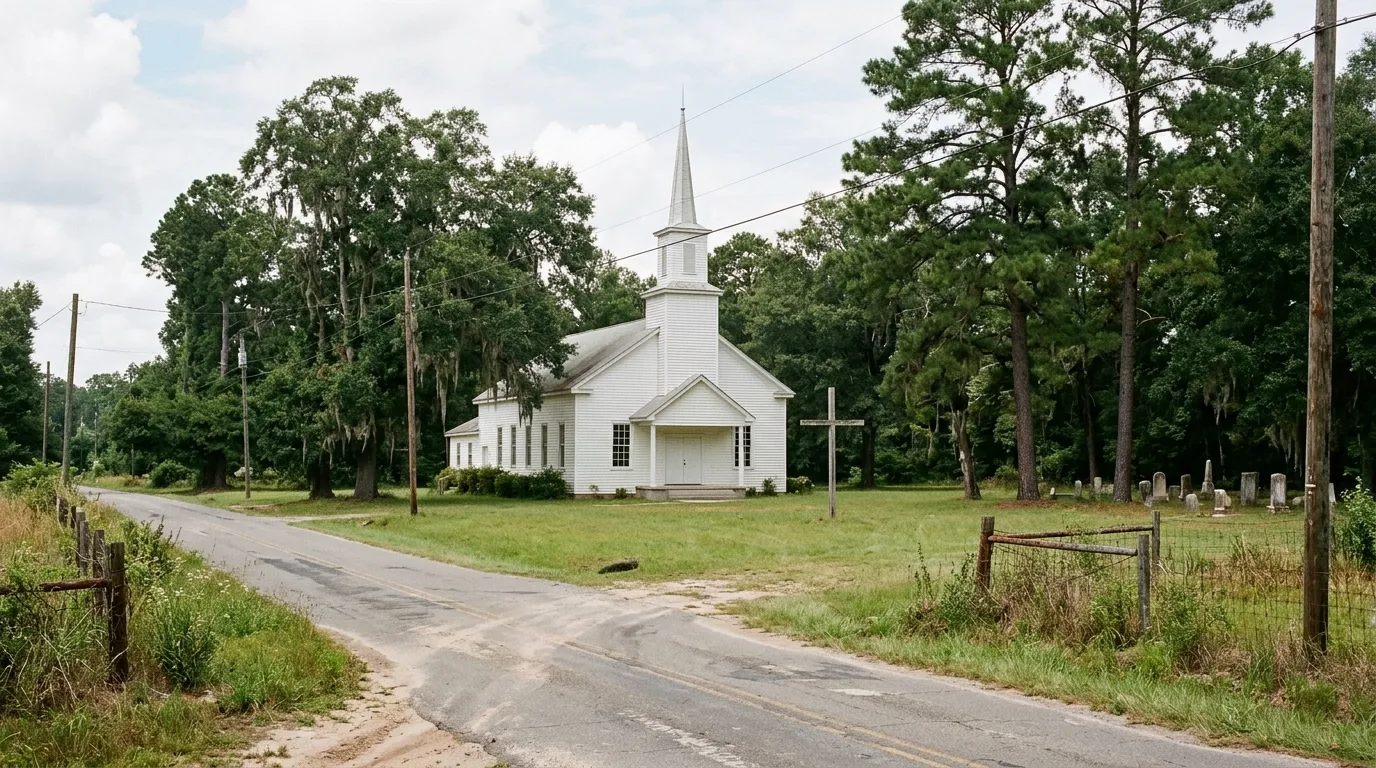
The Bible Belt is an informal name for a large region in the southern and south central United States where evangelical Protestant faith has a strong place in daily life, church life, and public culture.
It is not an official state, it has no legal border, and it does not mean that everyone in the region believes the same way.
The core states most lists include are Texas, Oklahoma, Arkansas, Louisiana, Mississippi, Alabama, Tennessee, Georgia, South Carolina, and North Carolina. Some lists also add parts of Missouri, West Virginia, Virginia, Kentucky, and Florida.
What Does Bible Belt Mean in Simple Words
In simple words, the Bible Belt is a nickname for a region, not a place you can find on an official map with a fixed border. The word belt here means a strip of land with a shared feature, in the same way people talk about the Corn Belt for corn growing areas or the Rust Belt for old factory areas. In this case, the shared feature is a strong Protestant Christian culture.
That culture shows up in many ways. Churches are common in small towns and large cities. Church attendance is often higher than the national average. Bible reading, prayer, gospel music, and church based community life are part of everyday conversation for many people. Many families in the region have a long church history that goes back several generations.
At the same time, the term is a general label. It does not describe every person, every church, or every town in the South. The South is diverse. It includes people of many faiths, people with no faith, Catholics, Orthodox Christians, mainline Protestants, evangelicals, Pentecostals, and many others. A label can help you understand a trend, but it should never be used to judge a whole population.
Where Did the Name Bible Belt Come From
The first known use of the term Bible Belt was in 1924. American journalist H. L. Mencken used it while writing about religion in the American South. He used it again in later writing, and by 1927 he claimed the term as his own creation. Mencken was reporting on the Scopes trial in Dayton, Tennessee, in 1925, a famous court case about teaching evolution in schools. He used the term in a critical and mocking way, to suggest that people in the region held a simple and uncritical belief in the literal words of the Bible.
That origin matters because the term started as an outsider label, not as a name people in the region chose for themselves. Over time, many people in the region began to use it in a neutral way, simply to describe where they live and the culture around them. Others still dislike it because it can sound like a stereotype. When you use the term today, it is wise to use it with care and to explain what you mean, rather than using it as a joke or an insult.
The word belt also tells you something important. A belt is wide in the middle and thinner at the edges. That is a good picture for this region. The center is strong and clear, but the edges fade into other cultures. That is why different maps show different borders. No single map is fully correct for all purposes.
Which States Are in the Bible Belt
Most lists agree on a core group of ten states. These are the states most often named in general guides, in news reports, and in academic work.
The core states are Texas, Oklahoma, Arkansas, Louisiana, Mississippi, Alabama, Tennessee, Georgia, South Carolina, and North Carolina. These states share a long Protestant history, a large number of evangelical churches, and a strong place for faith in public life.
Beyond the core, there is a wider and debated zone. Some lists include Missouri, West Virginia, and Virginia. Others include Kentucky, and parts of Florida, Illinois, Indiana, Ohio, Kansas, and New Mexico. The reason for the debate is simple. Faith culture does not stop at a state line. A county in southern Illinois can feel more like the Bible Belt than a large city in Texas, and a large city in Georgia can feel very different from a small town in the same state.
Geographers have tried to draw a more exact map. In 1961, Wilbur Zelinsky mapped the region as the area where Southern Baptist, Methodist, and other evangelical groups were dominant. In 1978, Charles Heatwole mapped it using data from 24 fundamentalist Protestant groups, and his map was very similar to Zelinsky’s map. Later, Stephen Tweedie studied television viewing for evangelical programs and found a western Bible Belt and an eastern Bible Belt, with a core from Little Rock, Arkansas to Tulsa, Oklahoma in the west, and a core in Virginia and North Carolina in the east.
A helpful way to think about the region is to use three layers: core, extended, and edge.
| Zone | What it means | Examples of places |
| Core Bible Belt | Evangelical Protestant life is strongest and most visible | Northern Georgia, Tennessee, Alabama, Mississippi, North Carolina, South Carolina, East Texas |
| Extended Bible Belt | Strong evangelical presence, but mixed with other cultures | Oklahoma, Arkansas, Louisiana, Kentucky, Missouri, West Virginia, parts of Virginia |
| Edge areas | Some Bible Belt traits, but not dominant | Southern Illinois, southern Indiana, southern Ohio, central Florida, South Texas |
This table does not settle every debate, but it helps you see why two honest maps can look different. They are using different rules for what counts as strong, mixed, or edge.
The Most Bible Minded Cities and the Most Religious States
Readers often ask which places are most Bible Belt in practice, not only on a map, and surveys give a clearer answer than a single border line. A study commissioned by the American Bible Society, based on 42,855 interviews between 2005 and 2012, named the ten most Bible minded cities as Knoxville, Tennessee, Shreveport, Louisiana, Chattanooga, Tennessee, Birmingham, Alabama, Jackson, Mississippi, Springfield, Missouri, Charlotte, North Carolina, Lynchburg, Virginia, Huntsville-Decatur, Alabama, and Charleston, West Virginia. Bible minded in that study meant a person had read the Bible in a typical week and believed it is accurate in its teachings.
Gallup polling points the same way at state level. In Gallup reporting based on a large national sample, Mississippi ranked as the most religious state, with 59 percent of residents counted as very religious and about 85 percent saying religion is an important part of daily life. Alabama, Louisiana, Arkansas, South Carolina, Tennessee, North Carolina, Georgia, Oklahoma, Texas, and Kentucky followed in the top group, while Vermont, New Hampshire, and Maine ranked lowest. Those figures are older survey snapshots, not a live ranking for today, but they explain why Mississippi and Alabama are so often named as the heart of the region.
Two cautions keep those rankings honest. First, a city ranking measures habits and beliefs, not church membership on paper, so a city with many churches can rank lower if fewer residents read the Bible weekly. Second, Texas illustrates the gap between reputation and ranking. In one American Bible Society and Barna Group round, no Texas city cracked the top 20, with Dallas-Fort Worth ranking 22nd, even though Texas is firmly inside most Bible Belt maps. Size, diversity, and large cities change the average, even in a strongly religious state.
Whose Bible Belt Was It
A deeper gap in many short guides is the question of whose Christianity the label described. In the early 1900s, Baptists and Methodists dominated the South in a way they did nowhere else, and tracing the bloc of states where more than half of congregation members were Baptist or Methodist traced the region with striking precision.
Beneath that shared label, religious life was divided by race and class. Black Baptists and Methodists met in their own churches, autonomous institutions that came to be known collectively as the Black church. After the Civil War, those churches became centres for building Black political power, education, mutual help, and racial consciousness, and later they played a central role in the civil rights movement. Poor white Christians, meanwhile, drew on inherited traditions and hardship to craft a folk version of Baptist and Methodist faith.
That division matters because the social order Mencken described reflected mainly elite and middle class white culture, the group with political power to enforce it, while poll taxes, literacy tests, and Jim Crow laws stripped Black and poor white Southerners of voting rights. A fair guide to the Bible Belt therefore names the Black church as a central part of the story, not as a footnote, and it notes that Mississippi today has the largest Black population of any state, and that Black Americans are among the most religious groups in national surveys.
What Is the Buckle of the Bible Belt
People sometimes ask about the buckle of the Bible Belt. A buckle is the center of a belt, the place where it is tightest. Different writers have named different buckles over time.
Mencken once suggested Jackson, Mississippi as the capital of the Bible Belt. Later writers suggested Oklahoma City, Oklahoma. Geographers found that the core moved over time. In the 1970s, the core was in eastern Tennessee. By 2000, research showed the core had moved west to north central Texas and southwestern Oklahoma. That shift happened because people moved, cities grew, and church patterns changed.
Today, cities like Chattanooga, Tennessee and Birmingham, Alabama have often been named among the most Bible minded cities in the United States in surveys by the American Bible Society and Barna Group. Bible minded in those surveys usually means a person attends church regularly, reads the Bible in a typical week, and believes the Bible is accurate in its teachings. Those surveys measure habits and beliefs, not just church membership on paper.
The idea of a buckle is useful, but it should not be taken too literally. The Bible Belt is not a belt with one metal buckle. It is a large region with several strong centers, and those centers change as people move and as cities grow.
A Short History of the Bible Belt
To understand the region today, it helps to know how it formed. In the colonial period, in the 1600s and 1700s, the Anglican church was strong in the South. After the American Revolution, other groups grew fast, especially Baptists and Methodists. Revival meetings, camp meetings, and traveling preachers spread through rural areas. Churches became centers for community life, education, music, and mutual help, not only for Sunday worship.
In the 1800s and early 1900s, Southern Baptists became the largest Protestant group in much of the region. Methodists, Pentecostals, and other evangelical groups also grew. The Bible was read at home, in Sunday school, and in church. Many families learned to read using the Bible, and many schools and colleges in the region were started by churches.
The Scopes trial in 1925 made the region famous across the country. The trial was about a teacher who taught evolution in a Tennessee school. Newspapers across America covered it, and Mencken’s writing spread the term Bible Belt far beyond the South. For many outsiders, the region became linked in their minds with a strict, literal reading of the Bible and with resistance to modern science and modern culture. That image was too simple, but it stuck in popular culture.
In recent years, researchers have noted that the Bible Belt is shrinking in some places, moving in others, and splitting into more than one core. Younger people in large southern cities are more diverse in faith than older generations in small towns. Immigration has added Catholic, Orthodox, Muslim, Hindu, Buddhist, and other communities to southern cities. Yet church life remains strong in many places, and the region still stands out in national surveys for prayer, Bible reading, and church attendance.
What Life Looks Like in the Bible Belt Today
If you visit the Bible Belt, you will notice faith in public life more than in many other parts of the United States. That does not mean everyone talks about faith all the time, but it does mean faith is a normal part of conversation for many people.
Churches are often large and visible. In a small town, the church may be the largest building on Main Street. In a city, a megachurch may draw thousands of people each Sunday. Wednesday night services, Sunday school, youth groups, and church meals are common. Many people know each other through church, school, and family, and those networks overlap.
Food, music, and community events often have a church link. A church fish fry, a gospel sing, a revival week, or a vacation Bible school in summer can be a major event for a town. Christian radio stations are common. Gospel music, southern gospel, and contemporary Christian music have deep roots in the region.
What the Bible Belt Is Not
Because the term is often used loosely, it helps to clear up common misunderstandings.
First, the Bible Belt is not a place where everyone agrees on the Bible. Baptists, Methodists, Pentecostals, Presbyterians, Catholics, and many other groups read the Bible differently. Some read it literally word by word. Others read it with attention to history, poetry, parable, and context. Some churches focus on personal salvation. Others focus on social justice, community service, or liturgy. The term hides that diversity if you use it without care.
Second, the Bible Belt is not only rural. Large cities in the region have diverse populations, universities, and global businesses. Atlanta, Houston, Dallas, Nashville, and Charlotte are major cities with people from all over the world.
Third, the Bible Belt is not the same as the South. The South is a larger geographic and cultural region. Parts of the South, like heavily Catholic southern Louisiana, central and southern Florida with many newcomers, and heavily Hispanic South Texas, are often left out of Bible Belt maps. At the same time, parts of the Midwest, like southern Illinois and southern Indiana, are sometimes included.
Fourth, the term is not a judgment about intelligence or goodness. People in the region include scholars, doctors, teachers, artists, farmers, and business leaders. Faith commitment does not tell you how smart, kind, or open minded a person is. Using the term to mock people is unfair and unhelpful.
Fifth, the Bible Belt is not unchanging. Church attendance, belief, and culture shift over time, as they do everywhere. A map from 1978 will not match a map from today, and a map from today will not match a map from 2050.
What the Bible Says About Real Faith
The Bible Belt is a cultural label, but the Bible itself points to a deeper idea of faith. Real faith in the Bible is not about living in a certain region, attending a certain church, or using certain words. It is about trust in God, love for God and neighbor, and a life shaped by that trust.
The Bible book of Hebrews gives a clear definition. Hebrews 11:1 describes faith as confidence in what we hope for and assurance about what we do not see. That definition applies to people in every place, not only in one region.
The Bible book of Micah gives a simple summary of what God asks. Micah 6:8 says God asks people to act justly, to love mercy, and to walk humbly with God. That is a useful test for any culture, including a Bible Belt culture. A region can have many churches and still miss justice, mercy, and humility if faith becomes only a label.
Jesus also warned against outward religion without inward change. In the Gospel of Matthew, Matthew 23, Jesus criticizes religious leaders who focus on outward rules while missing justice, mercy, and faithfulness. That warning is relevant for every church culture, in the South and elsewhere.
The Bible book of James adds a practical point. James 1:27 describes pure religion as caring for orphans and widows in their distress and keeping oneself from being stained by the world. James 2:17 says faith without works is dead. In other words, real faith shows up in how we treat people, not only in what we say we believe.
The Bible book of Romans speaks about faith for all people. Romans 10:12 says there is no difference between Jew and Gentile, because the same Lord is Lord of all and richly blesses all who call on him. That verse reminds us that faith is not limited by geography, ethnicity, or culture.
Bible Belt, Deep South, and Black Belt Are Not the Same
Three terms are often mixed up, and untangling them is a common search gap. The table below keeps them apart in one place.
| Term | What it means | What it does not mean |
| Bible Belt | A cultural zone of strong evangelical Protestant life, inside and partly outside the South | An official region, a church, or a test of faith |
| Deep South | A geographic and historical subregion, usually Alabama, Georgia, Louisiana, Mississippi, and South Carolina, sometimes plus parts of neighbours | The same as the Bible Belt, since parts of the Deep South are heavily Catholic or diverse |
| Black Belt | Originally a soil region, later a demographic region of Alabama and Mississippi with a high Black population | A religious label, though it overlaps with Bible Belt geography |
Utah is a useful edge case. Utah ranks among the most religious states in Gallup and Pew style surveys, yet it is not part of the Bible Belt, because its dominant tradition is Latter-day Saint, not Southern evangelical Protestantism. That distinction shows why a religion ranking alone cannot draw a Bible Belt map. Tradition matters, not only intensity.
Is the Bible Belt Shrinking or Only Changing
The short answer is that it is changing, splitting, and ageing at the same time, rather than simply disappearing. Older research found a single core, then later research found a western core and an eastern core. More recent survey analysis adds a generational warning. Among rural and nonmetropolitan Americans, the evangelical share among Generation Z is less than half the share among Baby Boomers, and about one fourth of rural Americans overall now claim no religious affiliation, rising toward one half among rural Generation Z adults in General Social Survey data from 2021 to 2024.
Those figures need care. A generational comparison is not a study that follows the same people over decades, so it does not prove that a given young adult left a church. Migration, delayed religious identification, and demographic change also play a part. Still, the gap is large enough that churches cannot read a full building as proof of a strong future. A community can hold dozens of church buildings, familiar Christian language, and faithful older members, while its youngest adults grow increasingly disconnected. Nondenominational growth can also hide losses in older denominations, because total church presence looks stable even as particular traditions shrink.
Bible Belt in Other Countries
The term Bible Belt is not only American. Other countries have regions with a similar nickname because they also have a strong evangelical or conservative Protestant culture in one area.
Examples often named are parts of Canada, the Netherlands, Norway, Finland, New Zealand, Slovakia, Russia, and Ireland. In each case, the meaning is similar: a region where church life and conservative Christian values are stronger than in the rest of the country. The details are different in each country, because history, churches, and politics differ.
When you hear the term for another country, ask the same questions you would ask for the American Bible Belt. Which churches are dominant? Is the term used by locals or only by outsiders? Is it a compliment, a neutral description, or a mocking label? Those questions will help you avoid a stereotype.
How to Visit or Move to the Bible Belt With Respect
If you are visiting or moving to the region, a few simple habits will help you learn and connect well.
First, do not assume everyone believes the same thing. Ask open questions and listen. People are often happy to talk about their church and their faith if you show genuine interest and respect.
Second, learn local customs. Sunday mornings are often quiet in small towns because many people are at church. Wednesday evenings may also be church time. If you plan a meeting or an event, check local church schedules.
Third, visit a variety of places. Go to a small country church, a large city church, a historic church, a gospel music event, and a local museum. Each will show you a different side of the region.
Fourth, avoid using the term Bible Belt as a joke in front of people you just met. Some people use it proudly. Others find it insulting. It is safer to use neutral language, like the South, or the name of the state or town, until you know how people there feel about the label.
Fifth, if you are looking for a church, visit several. Churches differ in music, preaching style, size, and theology. A good fit depends on your beliefs, your family, and your need for community, not only on a label.
FAQs
Bible Belt states
The Bible Belt includes states in the southeastern United States, where evangelical Protestant Christianity has a strong cultural influence. Commonly included states are Alabama, Mississippi, Georgia, Tennessee, and South Carolina.
Why is it called the Bible Belt
It is called the Bible Belt because Christianity, especially evangelical Protestant beliefs, has a strong influence on the region’s culture and daily life. The term became popular in the United States during the 20th century.
Bible Belt Netherlands
The Bible Belt in the Netherlands is a region where conservative Protestant Christianity has a strong presence. It stretches through parts of the country, including areas of Zeeland, the Veluwe, and the central Netherlands.
Bible Belt USA
The Bible Belt is a cultural region in the southern United States known for its strong Christian traditions. Churches, religious communities, and evangelical Protestant beliefs play an important role in many local communities.
Bible Belt map
A Bible Belt map typically highlights parts of the southeastern United States, including states such as Alabama, Mississippi, Tennessee, and Arkansas. The exact boundaries vary because the Bible Belt is a cultural region rather than an official geographic area.
Bible belt reddit
On Reddit, discussions about the Bible Belt often cover religion, culture, politics, and everyday life in the American South. Personal experiences and opinions vary depending on the community, location, and individual beliefs.
Bible Belt Europe
Europe has regions sometimes described as a Bible Belt because of their strong Christian traditions. Examples include the Dutch Bible Belt in the Netherlands and certain areas with historically high levels of religious observance.
Why is the Bible Belt so religious
The Bible Belt’s strong religious culture developed through generations of Protestant traditions, church communities, and religious revivals. Family practices, local institutions, and community life have also helped Christianity remain influential in the region.
Conclusion
The Bible Belt is a useful label if you use it carefully. It points to a real pattern: a large southern region where Protestant faith, church life, and Bible reading have shaped culture for a long time. It also hides a lot of diversity if you use it carelessly, because the region includes many kinds of churches, many kinds of people, and many kinds of towns and cities.
Discover More Post
- KJV Bible: A Simple Guide to the King James Version, Its History, and How to Read It
- Museum of the Bible: A Complete Visitor Guide to History, Floors, and Faith
- Bible Verses About Strength: A Clear Guide for Hard Days and Everyday Life

I’m Nicholas Sparks, and storytelling has always been my passion. Through TheBiblimeaning, I share insights about my books, unforgettable characters, romance, emotions, and the deeper meanings behind my stories. This platform brings readers closer to my writing journey, latest releases, and the inspiration that shapes every novel I create.