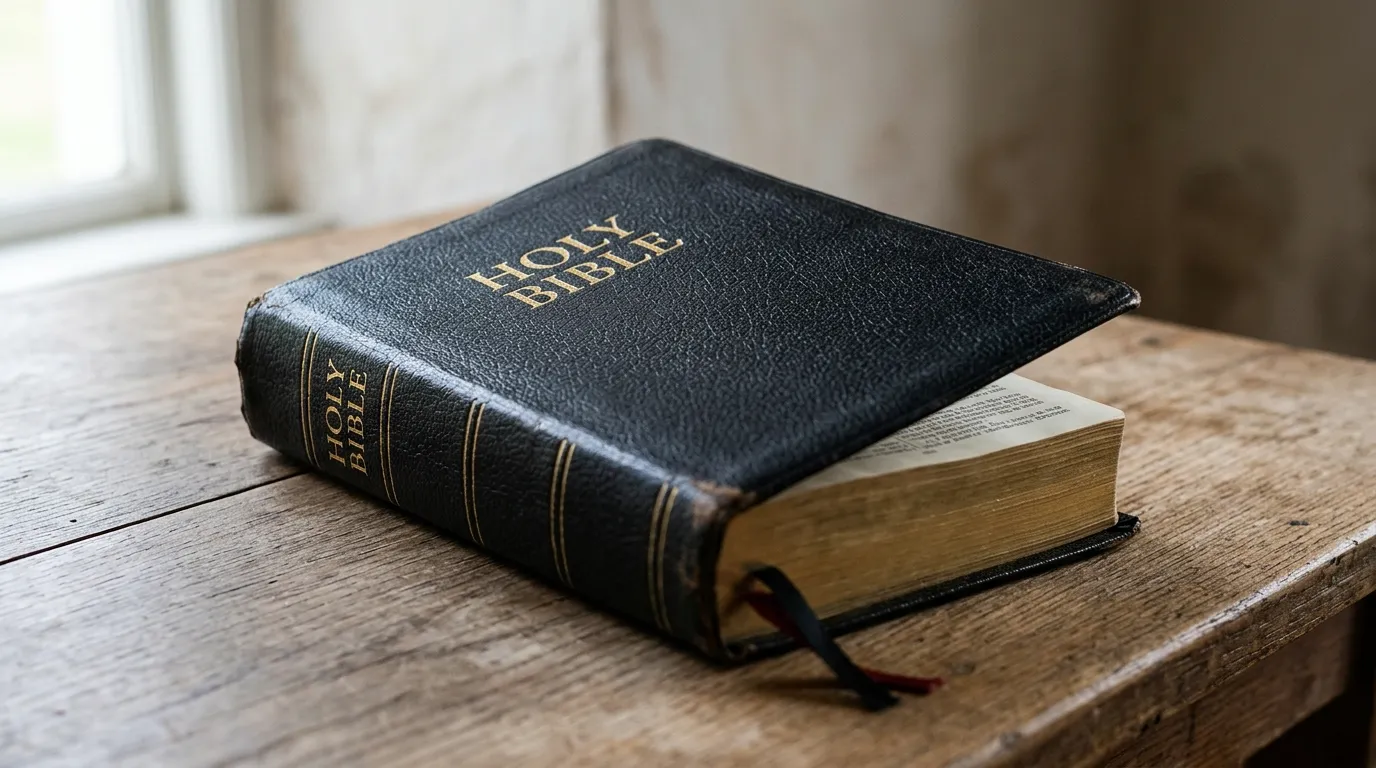
The KJV Bible, short for King James Version, is an English translation of the Bible first published in 1611.
It is also called the Authorized Version. It was commissioned after the Hampton Court Conference in 1604, translated by scholars from Oxford, Cambridge, and London, and based on Hebrew and Greek texts available at the time.
Most Bibles called KJV today use the standard text revised in 1769, not the exact spelling of 1611.
The KJV is famous for its beautiful, formal language, its influence on English literature, and its long use in churches. It can be hard for modern readers because some words have changed meaning. This guide explains its history in plain words, compares it with modern versions, gives a glossary of old words, and shows you how to start reading it with confidence.
What Does KJV Stand For
KJV stands for King James Version. King James VI of Scotland became King James I of England in 1603. In January 1604, he called a conference at Hampton Court Palace to discuss problems in the Church of England. Puritan leaders asked for a new English Bible because they believed existing versions had errors and biased notes. King James agreed to a new translation, and work began in 1607.
The result was published in 1611 with a long title that said it was newly translated out of the original tongues and compared with former translations, by his Majesty special commandment. It was appointed to be read in churches. Over time, people called it the King James Bible, the King James Version, and the Authorized Version. In Britain, Authorised Version is the more common name. In the United States, King James Version is more common.
It is important to know that the KJV was not the first English Bible. It was the third translation approved by the Church of England, after the Great Bible of 1535 and the Bishops Bible of 1568. It built on earlier work, especially William Tyndale New Testament of 1525 and the Geneva Bible of 1560. The translators did not start from nothing. They revised, compared, and improved.
Who Translated the KJV and How
About 47 to 54 scholars worked on the KJV, depending on how you count committees and replacements. They were divided into six companies, with groups in Oxford, Cambridge, and Westminster in London. Each company worked on a section of the Bible, then other companies reviewed their work. That review process was meant to catch errors and improve consistency.
The translators followed rules set by King James and church leaders. They were told to use the Bishops Bible as a base where possible, but to compare Hebrew and Greek texts and earlier English versions. They were told to keep traditional church words like church instead of congregation, and to avoid marginal notes that promoted one political view. The Geneva Bible had notes that King James disliked because they seemed to support resistance to kings. The KJV therefore has very few notes in its original form.
For the Old Testament, the translators used the Hebrew Masoretic Text, with reference to earlier versions. For the Apocrypha, a set of books between the Old and New Testaments in some Bibles, they used Greek and Latin sources. For the New Testament, they used the Textus Receptus, a Greek text compiled in the 1500s from manuscripts available then. Modern scholars now have access to older and more numerous manuscripts, which is one reason modern translations sometimes differ in small details from the KJV. Those differences do not change core Christian teaching, but they matter for careful study.
The translators also aimed for a formal style. They wanted a Bible that sounded dignified in church reading, not casual. That choice explains why the KJV still feels majestic today, even when it is hard to understand. They balanced accuracy with beauty, and their phrases entered everyday English.
The 1611 Bible and the 1769 Bible You Buy Today
Many people are surprised to learn that the KJV you buy today is not exactly the 1611 book. In 1611, English spelling and punctuation were not standardized. Words looked different, letters like long s were used, and sentences were longer. Over the next century, editors standardized spelling and punctuation. The most important revision was the Oxford edition of 1769, edited by Benjamin Blayney. That 1769 text is the standard KJV used in most modern printings.
The 1611 KJV also included 80 books, with 39 Old Testament books, 14 Apocrypha books, and 27 New Testament books. Most modern KJV printings omit the Apocrypha and include 66 books, which is the Protestant canon. If you buy a KJV with Apocrypha, it will be labeled as such. If you buy a standard KJV, it will usually have 66 books.
Another change is paragraphing. The original KJV started each verse on a new line, which can make reading feel choppy. In 1954, the British and Foreign Bible Society produced a paragraphed edition, keeping the 1769 text but grouping verses into paragraphs with headings. That edition is easier to read as continuous prose, and it was reprinted for the 400th anniversary in 2011 with a glossary and concordance.
Copyright is also different by country. In the United Kingdom, the KJV text is under Crown copyright, with permission granted through Cambridge University Press. In most other countries, including the United States, the KJV is in the public domain, which is why it is freely available online and in apps.
Why the KJV Language Sounds Old
The KJV uses Early Modern English, the English of Shakespeare time, not Old English from centuries earlier. You can learn it quickly if you know a few patterns. Thou means you when speaking to one person. Thee means you as an object. Thy and thine mean your. Hath means has. Doth means does. Verily means truly. Begotten means born as a son. Selah in Psalms is a musical or pause mark whose exact meaning is debated.
Some words are false friends. They look familiar but meant something different in 1611. For example, conversation in the KJV often means conduct or way of life, not talking. Prevent in older English could mean go before or precede, not stop. Charity in 1 Corinthians 13 means love, not only giving money. Suffer in phrases like suffer the little children to come means allow, not cause pain. Knowing these shifts prevents serious misunderstanding.
Verb endings also sound old. Verbs often end in eth, as in loveth, or est, as in lovest. That pattern is regular once you see it. Pronouns and verb forms are the main barrier, not vocabulary alone. After a few chapters, many readers find the rhythm becomes natural, especially when reading aloud.
The KJV also uses thee and thou to show singular you, while modern English uses you for both singular and plural. That distinction can actually help study. When Jesus says thou, he is speaking to one person. When he says ye, he is speaking to a group. Modern versions lose that distinction unless they add a note.
What the KJV Gave to English Language and Culture
The KJV has shaped English more than any other single book. Scholars estimate that about 400 words and phrases coined or popularized by the KJV are still in use today. Examples in plain form include salt of the earth, a thorn in the flesh, the powers that be, and by the skin of my teeth. These phrases come from specific Bible passages and entered sermons, literature, and everyday speech.
Writers from John Bunyan to Charles Dickens to Martin Luther King Jr. quoted or echoed KJV language. Hymns and church liturgy still use KJV phrases because they are memorable and musical. Even people who have never read the Bible may recognize KJV cadence from speeches, films, and songs. That cultural influence is one reason many churches keep the KJV for public reading, even when members study with a modern version at home.
The KJV also shaped how English speakers think about God, morality, and history. Its formal thou language created a sense of reverence. Its parallel phrases in Psalms and Proverbs taught a poetic way of thinking. Its stories of Exodus, David, and Jesus became shared cultural references. Understanding the KJV therefore helps you understand English literature and Western history, not only church life.
KJV Compared With Modern Translations
Modern translations like the New International Version, English Standard Version, New Living Translation, and Christian Standard Bible aim to make the Bible clear in current English. They use newer manuscript discoveries and modern scholarship. They also differ in translation philosophy.
Formal equivalence tries to stay close to the original word order and structure. The KJV and English Standard Version lean this way. Dynamic equivalence tries to convey meaning in natural modern language, even if word order changes. The New International Version balances both, while the New Living Translation leans more dynamic. Neither approach is automatically better. Formal versions help word study. Dynamic versions help fast reading and understanding.
Use this table to choose wisely for your purpose.
| Translation | Language style | Best for | Watch out for |
| King James Version | Formal, Early Modern English, 1611 and 1769 text | Public reading, memorization, literary beauty | Old words, false friends, older Greek base |
| New King James Version | Formal, modern English, same tradition | Readers who love KJV style but need modern words | Still formal, can feel stiff |
| English Standard Version | Formal, modern English | Word study, preaching, careful reading | Sentences can be long |
| New International Version | Balanced, modern English | Everyday reading, study, church use | Some interpretive choices in difficult passages |
| New Living Translation | Dynamic, very clear modern English | New readers, devotional reading | Less word for word detail for deep study |
| Christian Standard Bible | Balanced, modern English | Reading and study together | Newer, fewer classic resources |
A good practice is to read a difficult passage in two versions. Start with the KJV for beauty and tradition, then check a modern version for clarity. If they differ in an important word, look at a study note or ask a trusted teacher. That comparison builds understanding without undermining trust in Scripture.
How to Read the KJV for the First Time
Do not start at Genesis 1 and try to read straight through without a plan, unless you enjoy long genealogies and laws. Many new readers get stuck in Leviticus and quit. Start with a Gospel, such as Mark, which is short and action focused, or John, which is deep and clear about Jesus. Then read Psalms for prayer, Proverbs for wisdom, and Romans or Philippians for Christian teaching.
Read in paragraphs, not only verse by verse. Verses were added later for reference, not as original breaks. When you read a paragraph, ask three questions. What does this say about God. What does this say about people. What is one way I can live this today. Those questions keep reading practical.
Use a KJV with a glossary if you can. A glossary explains old words like besom, cruse, or wimple in simple terms. A concordance helps you find where a word appears elsewhere. A study Bible can help, but do not let notes replace the text. Read the text first, then check a note if you are confused.
Read aloud when possible. The KJV was made to be heard in church. Hearing its rhythm helps you understand its sentences. Try reading Psalm 23 aloud slowly. Notice how the short phrases create calm. Try reading John 3:16 aloud. Notice how the familiar words become fresh when spoken slowly.
Set a realistic plan. Ten minutes a day is better than one hour once a month. A simple plan is one chapter from a Gospel in the morning and one psalm at night. After a month, you will have read a large part of the New Testament story and many prayers. That steady habit matters more than speed.
Common Questions About the KJV
Many readers ask if the KJV is the only true Bible. Most scholars and churches do not teach that. The KJV is a faithful and historic translation, but it is a translation, not the original Hebrew and Greek. God word was first given in Hebrew, Aramaic, and Greek. Good modern translations are also faithful. The best Bible for you is one you will actually read, understand, and obey, with help from the church and careful study.
Readers also ask if the KJV is more accurate because it is older. Older does not always mean more accurate in translation terms. The KJV is old as a translation, but its Greek base, the Textus Receptus, is based on later manuscripts than those used today. Modern scholars have older manuscripts that were not available in 1611. That does not make the KJV bad. It means modern versions can correct small details with better evidence, while keeping the same core message.
Readers ask about thee and thou and whether we should still pray that way. You can pray in any honest language. God hears modern English just as he heard Early Modern English. Some people love thou language for reverence. Others find it distant. Both are fine. What matters is sincerity, not old pronouns.
Readers ask which KJV edition to buy. Look for a standard 1769 text, clear print, and a glossary if you are new. A red letter edition prints Jesus words in red, which some readers find helpful. A large print edition helps if your eyes tire. A study edition adds notes, maps, and cross references. Choose based on your eyes, your budget, and how you will use it daily.
Bible Passages to Start With in the KJV
If you want to taste the KJV beauty, start with these passages in plain reference form. Genesis 1:1-3 tells creation in majestic short sentences. Psalm 23 speaks of the Lord as shepherd in calm, memorable language. Isaiah 40:28-31 speaks of strength for the weary. Matthew 5:1-12, the Beatitudes, shows Jesus teaching about blessing. John 3:16 summarizes God love for the world. 1 Corinthians 13 describes love in poetic form. Romans 8:28-39 speaks of God purpose and unbreakable love. Revelation 21:1-4 speaks of a new heaven, a new earth, and God wiping away tears.
Read one passage slowly, then read it again in a modern version. Notice what the KJV adds in sound and what the modern version adds in clarity. That exercise will teach you more about translation than any lecture.
FAQs
KJV Bible for Sale
Physical and digital editions of the King James Version Bible are widely available for purchase from major retailers and Christian bookstores.
You can find new, used, large-print, study, and leather-bound versions in various price ranges.
King James Bible online free
The complete King James Version Bible is available to read free online on many public-domain websites.
Popular free sites include Bible Gateway, Bible Hub, and official public-domain Bible archives.
Download King James Bible
You can freely download the full KJV Bible in PDF, EPUB, or text formats from public-domain sources.
Reliable free download options include Project Gutenberg, Bible Hub, and several church or ministry websites.
KJV Bible online
The King James Version can be read online instantly through numerous free Bible websites and apps.
Simply search for “KJV Bible online” or visit sites like Bible Gateway for chapter-by-chapter access.
KJV Bible verses
Famous and commonly searched KJV verses include John 3:16, Psalm 23, and the Lord’s Prayer (Matthew 6:9-13).
You can look up any specific verse or topic using free online KJV Bible search tools.
KJV Bible Amazon
Amazon offers a wide selection of King James Version Bibles, including study editions, large-print, and gift versions.
You can filter by format, binding, price, and customer ratings directly on the Amazon website or app.
KJV Bible Offline free download
Free offline KJV Bible apps and downloadable files (PDF/EPUB) let you read without an internet connection.
Popular free options include apps on Google Play/App Store and downloadable files from public-domain Bible sites.
King James Bible app
Several free and paid King James Bible apps are available for iOS and Android devices.
Look for highly rated apps such as “KJV Bible” or “Bible Gateway” that offer offline reading, search, and bookmarking features.
Conclusion
The KJV Bible is a treasure of English faith and literature. It was made by scholars who loved Scripture, worked carefully in teams, and wanted a Bible worthy of church reading. Its language is beautiful but old, its history is rich but complex, and its influence is still felt every day in words we use without thinking.
You do not need to choose between loving the KJV and understanding the Bible. Use the KJV for its majesty, use a modern version for clarity, use a glossary for old words, and read with prayer and patience. Start with one Gospel, read a little each day, and let the words sink in. Over time, the old language will feel less like a barrier and more like a doorway into a living word that has guided believers for more than four hundred years.
Discover More Post
- Adversity Meaning in the Bible: A Biblical Guide
- Caleb Meaning in the Bible: Symbolism, Faith & Lessons
- Passover Meaning in the Bible: God’s Powerful Message