The Museum of the Bible in Washington, DC is a large history museum that explores the story, history, and impact of the Bible across 4,000 years.
It opened on November 17, 2017, at 400 4th Street SW, near the National Mall and the United States Capitol.
Inside you will find rare manuscripts, ancient artifacts, a recreated first century village, exhibits on how the Bible shaped America and world culture, and modern experiences like a flyover ride over Washington.
Plan at least three hours, start on the history floors, check current ticket prices on the official museum website before you go, and use the Metro to avoid downtown parking stress.
This guide gives you a floor by floor plan, family tips, honest history, and Bible connections that most short location pages leave out.
Many people search for Museum of the Bible only to find the address and hours. That is useful, but it does not help you decide what to see first, how to visit with children, or what the museum means for faith and history.
This guide fills those gaps in simple English. It explains what each floor offers, how long to spend, what to skip if time is short, and how to connect what you see with the Bible itself.
Where the Museum Is and How to Get There
The museum is located at 400 4th Street SW, Washington, DC 20024, in the United States. It sits just three blocks from the United States Capitol and a short walk from the National Mall and several Smithsonian museums. That central location makes it easy to combine with other Washington sights in one day, but it also means downtown traffic and parking can be difficult.
The simplest way to arrive is by Metro. The closest stations are Federal Center SW and L Enfant Plaza, with Smithsonian station also within walking distance. From Smithsonian station, allow about ten minutes on foot. If you drive, use a nearby parking garage and allow extra time, especially on weekends and holidays. The museum garage entrance is on 4th Street, and hourly rates apply. Check the official museum website on the morning of your visit for any changes to hours, closures, or special events, because hours and ticket prices in older blog posts are often out of date.
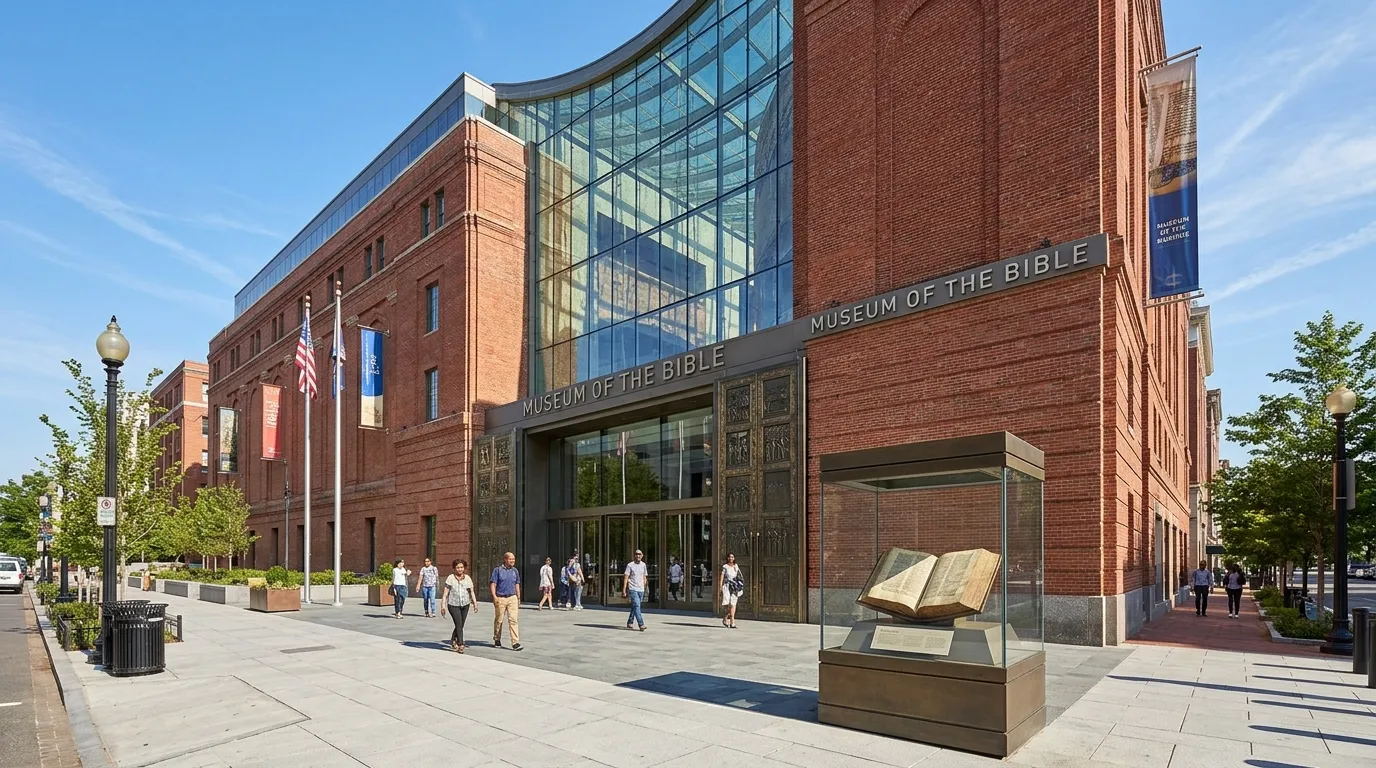
The building itself is part of the story. It preserves a 1923 brick warehouse building and adds modern floors, a glass rooftop, and tall bronze doors with art based on the creation account in Genesis 1. The lobby has a long LED ceiling that can show changing images and messages. Even before you reach the exhibits, the building tells you that this museum wants to connect an ancient book with modern life.
A Short History of the Museum
The Museum of the Bible was founded as a nonprofit organization in 2010 by the Green family, known for Hobby Lobby. Its stated mission today is to invite all people to engage with the transformative power of the Bible. The museum says it is nonsectarian and does not seek to tell visitors what to believe. At the same time, its board members affirm the truth of the Bible, and scholars have debated how that faith commitment shapes the exhibits. Knowing this background helps you visit with open eyes. You can enjoy the artifacts, ask questions, and form your own conclusions.
Construction cost was reported at about 400 million dollars. The project restored the historic building, added two floors, and created a rooftop garden and viewing area. The museum opened on November 17, 2017, with a dedication ceremony that included faith leaders, civic leaders, and artists. Since opening, total visitors have passed three million, with more than 450,000 guests reported in 2024 alone. That scale makes it one of the most visited Bible museums in the world.
The museum has also faced honest challenges about provenance, which means the history of ownership for artifacts. Before opening, questions were raised about Iraqi antiquities and clay artifacts. Later, testing showed that sixteen fragments presented as Dead Sea Scrolls were modern forgeries, and the museum removed them from display. Scholars praised the museum for being open about that finding. This history matters for trust. A good museum does not hide mistakes. It corrects them, explains the research, and improves its collecting practices. When you visit, look for labels that explain what scholars know, what is uncertain, and how an object was studied. That careful labeling is a sign of serious museum work.
What You Will See Floor by Floor
The museum has six main levels, with three large permanent exhibit floors of about 55,000 square feet each. Many visitors feel overwhelmed because they try to see everything in order without a plan. Use this floor guide to choose what matters most to you.
The first floor focuses on immersion and the story of Jesus time. Here you can walk through the World of Jesus of Nazareth, a recreated Galilean village with a first century home, a mikvah for ritual washing, a synagogue, and displays of daily food and work. Virtual reality experiences can take you to places like the Sea of Galilee. This floor helps the Bible feel real. You can imagine what a home smelled like, how bread was made, and why a parable about a shepherd or a farmer would make sense to its first hearers.
The second floor focuses on impact. It shows how the Bible has shaped science, justice, freedom, art, music, literature, and American history. A long tapestry and displays trace the Bible in America, from early colonial texts to the Liberty Bell inscription from Leviticus 25:10, which speaks of proclaiming liberty throughout the land. The Washington Revelations flyover ride is also part of this experience. It flies you over Washington landmarks and points out biblical imagery and verses in the city. This floor is good for visitors who ask how one book could influence so many parts of life.
The third floor tells the narrative of the Bible itself, from Abraham through Israel, through the ministry of Jesus, to the early church. It includes a large section on the Hebrew Bible and Jewish tradition. This floor is the best place to get the big story in order if you are new to the Bible. Take time here before you move to history and archaeology.
The fourth floor focuses on biblical history and archaeology. It presents artifacts, maps, and research about the ancient world. It also includes the Megiddo Mosaic, a third century mosaic floor from northern Israel that is believed to come from one of the earliest Christian worship sites. The mosaic includes an inscription that identifies Jesus as God, which makes it important for understanding early Christian belief. The museum has displayed this mosaic in partnership with the Israel Antiquities Authority.
The fifth floor has a performing arts theater with about 500 seats, plus space for lectures, concerts, and special exhibits. The sixth floor offers a rooftop garden with plants mentioned in the Bible, stained glass displays, a ballroom, and views of the National Mall and Capitol. If you need a quiet break, the rooftop garden is a good place to pause, pray, or simply rest.
The Collections and Rare Artifacts
The museum collection includes more than 40,000 items in total, with about 1,500 objects on display at any time, spanning 4,000 years. Highlights include biblical papyri, Torah scrolls, rare printed Bibles, Jewish artifacts, and contemporary treasures of Christian and Jewish culture. Manuscript highlights mentioned by the museum include early fragments, a Washington Pentateuch from around the year 1000, a Lipnice Bible from 1421, and a Wycliffite New Testament from the 1400s. These objects show how the Bible was copied by hand, printed, translated, and carried across cultures.
When you look at a manuscript, notice three things. First, notice the material. Papyrus, parchment, and paper tell you about technology and cost. Second, notice the script and language. Hebrew, Greek, Latin, and later English show how the Bible moved across languages. Third, notice the wear and repairs. A worn Bible often belonged to someone who read it daily. Those details make history personal.
The museum also works with scholars and partner institutions, including the Vatican Museum and Library and the Israel Antiquities Authority for some displays. An external board of advisors includes Jewish, Protestant, Catholic, and secular scholars. That breadth is important. It means the museum tries to present research, not only one tradition view, even if visitors may still disagree with some interpretations.
Tickets, Hours, and Practical Planning
Ticket prices change over time, so treat any price in an old article as a starting point only. The museum charges admission, and prices in recent official listings have been higher than the older 19.99 dollar figures found in many blogs. Some programs, such as a first floor free program for certain exhibits, have been offered for limited periods. The safest step is to check the official museum website for current adult, senior, student, child, and family prices, and to buy tickets online in advance during busy seasons.
Hours in many recent listings are Monday to Saturday from 9 or 10 in the morning to 5 in the evening, and Sunday from 10 or 12 to 5. Again, check the official site on the day of your visit, because hours can change for holidays and special events. Allow at least three hours for a good visit, and a full day if you want to see every floor slowly, attend a lecture, and eat at the museum.
The museum has dining options, a gift shop, guided tours, accessibility features, and family facilities. It is wheelchair accessible, with elevators and staff help available. If you need a quiet room, a wheelchair, or help with a stroller, ask staff at entry. Guided tours can help first time visitors understand the highlights in about one hour, which is useful if you have limited time.
Use this simple planning table to avoid common mistakes.
| Planning question | Best practical answer | Why it helps |
| How long should I plan | At least 3 hours, ideally 4 to 5 hours | Floors are large and exhibits are detailed |
| What should I see first | Third floor story, then first floor village, then second floor impact | You get the big story before details |
| When is it less crowded | Weekday mornings, off peak seasons | You can read labels without rushing |
| How do I get there | Metro to Federal Center SW or L Enfant Plaza | You avoid downtown parking stress |
| What should I check before I go | Official website for tickets, hours, and special exhibits | Older blogs often show outdated prices |
| What should families bring | Comfortable shoes, water, snacks for children | You will walk a lot and climb floors |
A Family Visit Plan That Actually Works
Families often ask if the museum is good for children. The answer is yes, with a plan. Children enjoy the village, the flyover ride, hands on displays, and the rooftop garden. They enjoy long text panels less. Plan in short blocks.
Start with the village on the first floor for 30 to 45 minutes. Let children touch, ask questions, and imagine life in Jesus time. Then go to the flyover ride if your children meet height and comfort requirements. Then take a snack break. After the break, choose one more floor based on your children ages. Younger children may enjoy the story floor with pictures and models. Older children may enjoy archaeology and the Megiddo Mosaic, because it feels like a discovery.
Give each child a simple mission. Ask them to find one object that is older than 500 years, one object that shows daily life, and one verse they recognize. That mission turns reading into a game. At the end, ask them what surprised them most. Their answers often lead to good family conversations about faith, history, and God.
If you visit with teenagers, ask them to think critically. Ask what the museum shows well, what it leaves out, and how they would explain the Bible impact to a friend who has never read it. Teenagers often enjoy that challenge more than a simple tour.
Bible Connections to Notice Inside the Museum
The museum is not only about objects. It is about a book that Christians believe is God word, and that Jews honor as sacred Scripture in its Hebrew form. As you walk, notice connections to specific Bible books.
Genesis 1 speaks of creation, and the museum doors and garden recall that story. Exodus tells of liberation from Egypt, and the Liberty Bell inscription from Leviticus 25:10 connects that theme to American ideas of freedom. The Psalms are songs of praise, lament, and trust, and the museum worship experiences recall how those songs have been sung for thousands of years. The Gospels tell the life, teaching, death, and resurrection of Jesus, and the village helps you picture his world. Acts tells how the early church spread, and the Megiddo Mosaic shows early believers worshipping Jesus as God within a few generations.
A helpful Bible practice after your visit is to read one passage that connects to something you saw. If you saw the village, read Luke 2 or Mark 1 slowly. If you saw the impact floor, read Micah 6:8, which calls for justice, mercy, and humility. If you saw the Megiddo Mosaic, read John 1:1-14, which speaks of the Word becoming flesh. Reading after seeing makes both the museum and the Bible more vivid.
Honest Questions Visitors Often Ask
Visitors often ask if the museum is only for Christians. The museum says it invites all people, and many Jewish, secular, and interfaith visitors have praised its breadth. You do not need to share the museum faith statement to learn from its history and art. You can engage respectfully, ask questions, and disagree where you think the evidence points another way.
Visitors also ask if everything on display is authentic. No large museum can guarantee every early claim forever. Research changes, and the museum Dead Sea Scrolls forgery case shows why careful testing matters. Look for clear labels, dates, and sources. If a label says scholars debate an object, that is a good sign, not a weakness.
Visitors ask if the museum is political. The museum says it is not political and will not proselytize. Scholars have noted that its mission and funding history create tension with that claim. A wise visitor can hold both facts together. Enjoy the exhibits, notice the perspective, and compare what you learn with other trusted sources, including the Bible itself and academic books.
FAQs
Museum of the Bible Tickets
General admission costs $28.50 for adults on weekdays (Mon/Wed/Thu) and $37.50 on weekends (Fri–Sun), with youth (5–17) at $20–$27 and children 0–4 free.
Tickets can be purchased online or at the door; members enter free, and half-price walk-up tickets are available after 3 p.m. most days.
Museum of the Bible photos
Official high-resolution photos of the exterior (red-brick building with glass roof), Grand Hall, exhibits, and galleries are available for media use on the museum’s website.
You can also find visitor and promotional images on the official site and social channels showing the immersive galleries and rooftop views of the U.S. Capitol.
Museum of the Bible scandal
The museum faced major controversies over the Green family’s (Hobby Lobby) acquisition of thousands of antiquities that lacked proper provenance, many later determined to be looted from Iraq and Egypt.
It also acquired Dead Sea Scroll fragments that scientific tests proved were modern forgeries; the museum has since returned thousands of items and publicly acknowledged the mistakes.
Museum of the Bible map
A downloadable floor map is available on the official website (museumofthebible.org/museum-maps) showing all seven floors, exhibits, dining, and facilities.
The museum itself is located at 400 4th Street SW, Washington, DC 20024, just steps from the Federal Center SW Metro station.
Museum of the Bible app
The free official Museum of the Bible app offers virtual tours, floor plans, exhibit information, self-guided audio tours, and members-only digital content.
It is available on iOS and Android and is recommended for planning visits and enhancing the on-site experience.
Museum of the Bible free admission
General admission is completely free every Tuesday through May 18, 2027; the entire first floor is free every day with no ticket required.
Children 0–4, museum members, and certain DC Ward 6 residents (with ID, limited tickets) also enter free.
Museum of the Bible locations
The primary and only permanent Museum of the Bible is located at 400 4th Street SW, Washington, DC 20024, three blocks from the U.S. Capitol.
It is easily reached via the Federal Center SW Metro station (Blue, Orange, and Silver lines).
Museum of the Bible membership
Individual membership starts at about $60 per year, dual at $90, and family at $150, granting unlimited free general admission for the covered guests.
Benefits include discounts on dining and the museum shop, early entry, free or discounted special attractions, and access to members-only digital content and events.
Conclusion
The Museum of the Bible is more than a building with old books. It is a place where history, art, technology, and faith meet. You can walk through a village from Jesus time, see manuscripts copied by hand centuries ago, learn how the Bible shaped America, and stand before a mosaic that early Christians made to honor Jesus as God. You can also learn to ask better questions about history, evidence, and belief.
Visit with a plan, start with the big story, check current tickets before you go, and leave time for quiet reflection. When you return home, open the Bible and read one passage with fresh eyes. That is the best souvenir from any Bible museum, a renewed desire to engage with the book itself.
Discover More Post
- Adversity Meaning in the Bible: A Biblical Guide
- Caleb Meaning in the Bible: Symbolism, Faith & Lessons
- Passover Meaning in the Bible: God’s Powerful Message

I’m Nicholas Sparks, and storytelling has always been my passion. Through TheBiblimeaning, I share insights about my books, unforgettable characters, romance, emotions, and the deeper meanings behind my stories. This platform brings readers closer to my writing journey, latest releases, and the inspiration that shapes every novel I create.