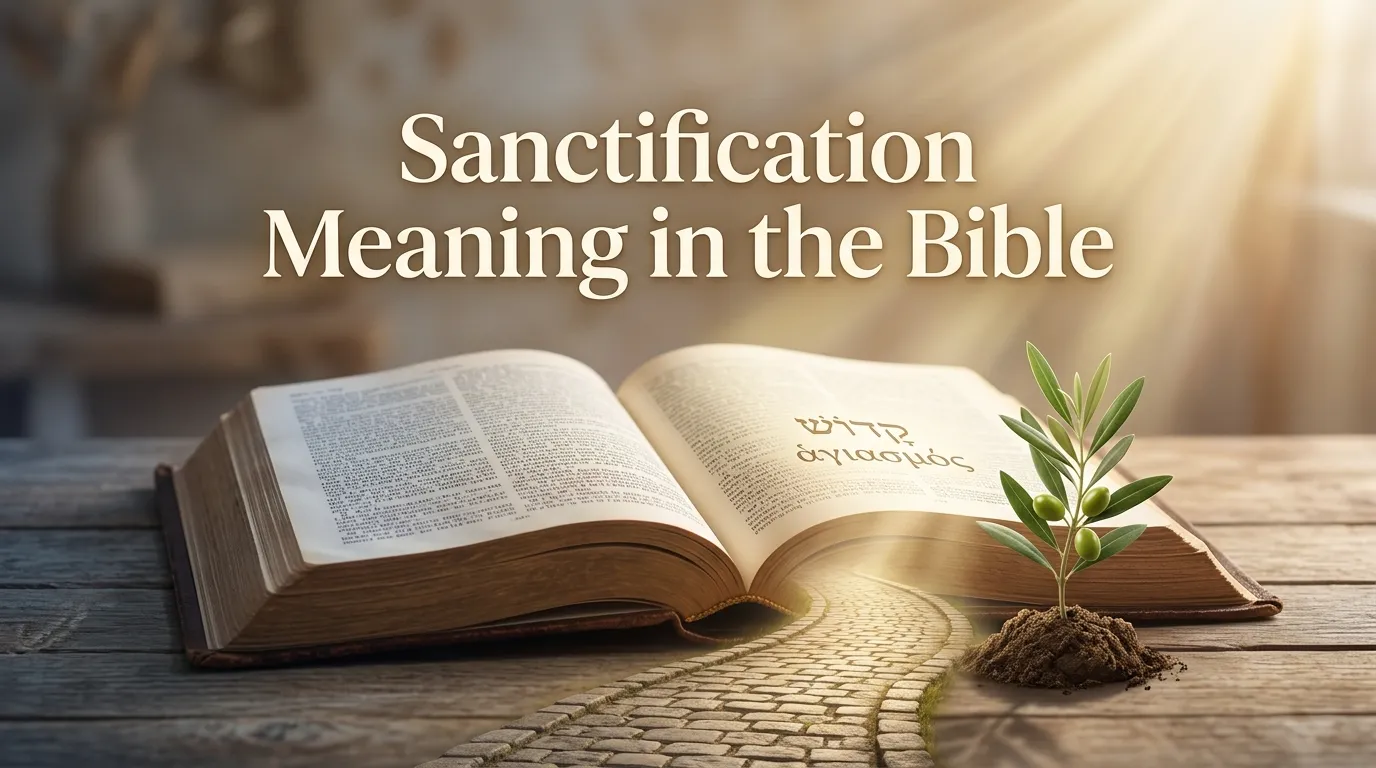
The heart of the Christian life has always drawn seekers and teachers toward one central truth: God sets His people apart for Himself.
When pastors, authors, and Bible study creators type sanctification meaning in the bible into a search bar, they are looking for more than a tidy definition.
They want clarity that can shape devotionals, commentaries, and teaching outlines that help believers grow.
Sanctification is the gracious work of God by which He sets believers apart from sin and unto Himself, both as a decisive act and as an ongoing process of becoming more like Christ.
In the pages ahead you will find the biblical meaning, key original-language insights, carefully explained verses, practical tables, and clear guidance written especially for those who create Bible resources for the church.
Biblical Meaning
Sanctification is God’s work of making His people holy. Scripture presents it in two complementary ways. First, it is a completed position. The moment a person trusts Christ, God declares that person holy and sets him or her apart for His own use. Second, it is a progressive transformation. The Holy Spirit continually shapes the believer’s character, desires, and conduct so that outward life increasingly matches the inward reality.
This dual reality keeps teaching balanced. Positional sanctification gives believers security and identity. Progressive sanctification calls them to active obedience and dependence on the Spirit. Both rest entirely on the finished work of Christ and the ongoing ministry of the Spirit. Any study material that emphasizes only one side risks either legalism or passivity.
Hebrew / Greek Meaning
In the Old Testament the primary Hebrew root is qadash, meaning to set apart or to make holy. Related forms describe objects, places, and people dedicated exclusively to God. The idea is separation from common use and consecration to sacred purpose.
In the New Testament the key Greek terms are hagiazō (to make holy or set apart) and hagiasmos (the state or process of being made holy). These words appear in contexts of both decisive cleansing and ongoing growth. They never suggest self-generated moral improvement. They always point to God’s action applied to those who belong to Christ.
Understanding these roots helps authors avoid reducing sanctification to mere behavior modification. The biblical terms keep the focus on God’s initiative and the believer’s response of faith and obedience.
Key Bible Verses with Full Explanation
1 Thessalonians 4:3
For this is the will of God, your sanctification: that you abstain from sexual immorality.
Paul writes to new believers in a pagan city filled with sexual license. He states that God’s clear will for them is sanctification, then immediately applies it to a specific area of life.
1 Corinthians 6:11
And such were some of you. But you were washed, you were sanctified, you were justified in the name of the Lord Jesus Christ and by the Spirit of our God.
Paul lists serious sins that once defined the Corinthian believers, then announces a decisive change.
John 17:17
Sanctify them in the truth; your word is truth.
In His high-priestly prayer Jesus asks the Father to sanctify the disciples through the truth of God’s Word. The request reveals the primary means of progressive sanctification: Scripture.s.
Hebrews 10:10
And by that will we have been sanctified through the offering of the body of Jesus Christ once for all.
The writer ties sanctification directly to the once-for-all sacrifice of Christ. The perfect tense of the verb underscores a completed reality.
Romans 6:19
For just as you once presented your members as slaves to impurity and to lawlessness leading to more lawlessness, so now present your members as slaves to righteousness leading to sanctification.
Quick Reference Table
| Aspect | Description | Key Scripture | Implication for Teaching |
| Positional | Completed act at conversion | 1 Cor 6:11 | Affirm identity and security |
| Progressive | Ongoing transformation by the Spirit | 1 Thess 4:3 | Call to daily obedience |
| Means | Word of God, faith, obedience | John 17:17 | Emphasize Scripture engagement |
| Goal | Christlikeness and usefulness to God | Rom 8:29 | Keep focus on becoming like Jesus |
| Source | Grace of God through Christ and Spirit | Heb 10:10 | Guard against self-effort |
Common Misunderstandings
Many believers and even some teachers carry incomplete ideas about sanctification. Clearing these up protects the people who use the materials you create.
| Misunderstanding | Biblical Truth | Helpful Correction for Creators |
| Sanctification is mainly self-effort | It is God’s work applied by the Spirit | Stress dependence on the Spirit from the start |
| It is only positional and requires no change | Progressive growth is expected and commanded | Pair identity texts with obedience texts |
| Perfection is possible in this life | Complete freedom from sin awaits glorification | Teach honest struggle and future hope |
| It happens automatically without effort | Believers must present themselves to God | Include practical how without legalism |
| Only certain spiritual elites experience it | Every believer is called and equipped | Make resources accessible to ordinary Christians |
Practical Application for Bible Book Creators & Authors
When you develop a Bible study, devotional series, or commentary section on sanctification, begin with the finished work of Christ. Readers need to know they are already set apart before they are asked to pursue holiness. Structure lessons so that identity always precedes responsibility.
Use the original-language insights sparingly but accurately. A single well-explained Hebrew or Greek term can open understanding without overwhelming non-specialists. Pair each major verse with clear context so teachers can trace the flow of the biblical author’s argument.
In study questions move from observation to interpretation to application. Ask what the text says about God’s action, what it requires of the believer, and how the truth shapes daily decisions. Provide short, realistic examples drawn from ordinary life rather than dramatic extremes.
For devotionals keep the tone warm and hopeful. Remind readers that the same Spirit who began the work continues it. Avoid both harsh pressure and soft excuses. For pastors preparing sermons, the dual nature of sanctification offers a natural outline: what God has done, what God is doing, and how we respond.
Include the tables above or adapt them for handouts. Visual summaries help busy leaders grasp and teach the material quickly. Finally, always point back to the sufficiency of Christ. Every call to growth must rest on the once-for-all sacrifice that made sanctification possible.
FAQs
Bible study on sanctification
A Bible study on sanctification explores how God sets believers apart, transforms their lives, and calls them to grow in holiness.
Sanctification Hebrew meaning
The Hebrew concept of sanctification centers on being set apart as holy for God’s purpose and service.
Sanctification in the Bible KJV
In the KJV, sanctification refers to being made holy or set apart for God and living according to His will.
Justification, sanctification Bible verse
Bible verses show that justification concerns being declared righteous by faith, while sanctification concerns growing in holiness after salvation.
Sanctification vs justification
Justification is God declaring a sinner righteous through faith, while sanctification is the ongoing process of becoming more like Christ.
Bible study on sanctification PDF
A Bible study on sanctification PDF can provide organized Scripture lessons and explanations for studying the believer’s growth in holiness.
3 types of sanctification
The three commonly discussed types are positional sanctification, progressive sanctification, and final sanctification.
Sanctification kjv definition
The KJV presents sanctification as being set apart or made holy for God, emphasizing a life devoted to Him.
Conclusion
Sanctification is God’s gracious gift and ongoing work. He sets His people apart in Christ and then transforms them into the likeness of His Son.
For those who write, edit, and teach the Bible, this truth offers rich material for studies that both comfort and challenge. Keep the finished work of the cross at the center, open the Scriptures carefully, and invite readers into Spirit-enabled growth.
As you do, the resources you create will help the church walk in the holiness to which it has already been called.
Discover More Post
- Debauchery Meaning Bible: A Clear Biblical Explanation
- Blessed Meaning in the Bible: 7 Powerful Truths
- Epistle Meaning in the Bible: Simple Guide & Truth

I’m Nicholas Sparks, and storytelling has always been my passion. Through TheBiblimeaning, I share insights about my books, unforgettable characters, romance, emotions, and the deeper meanings behind my stories. This platform brings readers closer to my writing journey, latest releases, and the inspiration that shapes every novel I create.