Have you ever walked through a difficult season and wished someone could guide you through it?
Life can feel like a long journey filled with uncertainty, fear, and questions. During those moments, many Christians turn to Psalm 23 for comfort and hope.
Psalm 23 is one of the most loved passages in the Bible. It paints a beautiful picture of a shepherd caring for his sheep.
The words are simple, yet they carry deep meaning. They remind us that God watches over His people, provides for their needs, and stays close even in life’s darkest moments.
Many people read Psalm 23 during times of loss, stress, illness, or change. Others find strength in its message during daily prayer and reflection.
Whether you are facing a challenge or simply seeking a deeper connection with God, this psalm offers encouragement and peace.
But what is the true Psalm 23 meaning? Why has it touched the hearts of believers for centuries? And what spiritual message does it hold for Christians today?
Let’s explore the biblical meaning, symbolism, and faith lessons found in this powerful chapter of Scripture.
Biblical Meaning of Psalm 23
Psalm 23 was written by King David, who understood the life of a shepherd firsthand. Through this psalm, David compares God to a loving shepherd and believers to sheep under His care.
The psalm begins with the famous words:
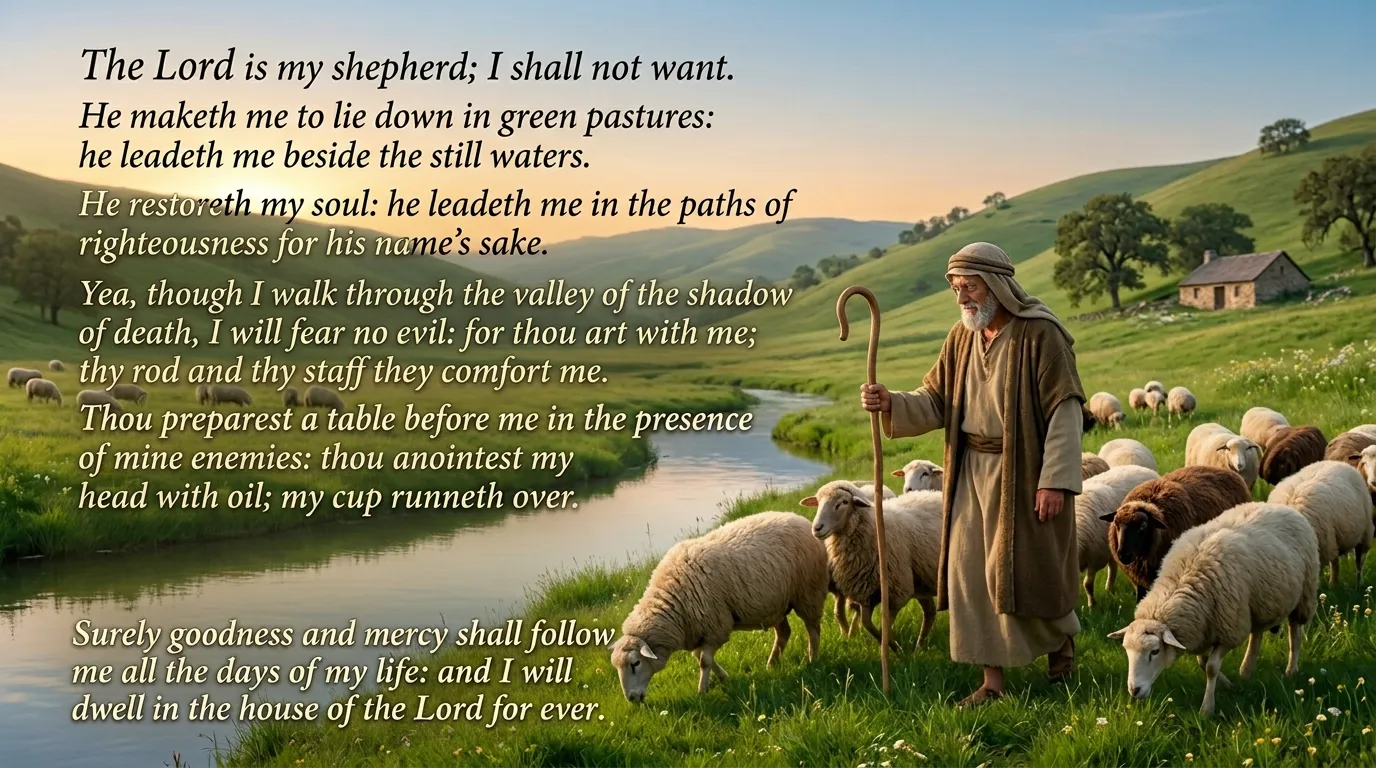
“The Lord is my shepherd; I shall not want.” (Psalm 23:1)
This verse reveals a powerful truth. God is not distant. He is personally involved in the lives of His people. Just as a shepherd guides, protects, and feeds his flock, God provides for those who trust Him.
The phrase “I shall not want” does not mean believers will have every desire fulfilled. Instead, it means God will supply what is truly needed according to His wisdom and love.
Another important verse says:
“He makes me lie down in green pastures. He leads me beside still waters.” (Psalm 23:2)
The green pastures symbolize spiritual nourishment, peace, and rest. The still waters represent calmness and refreshment. Together, they show God’s desire to restore weary hearts.
Psalm 23:3 continues:
“He restores my soul. He leads me in paths of righteousness for his name’s sake.”
This verse speaks about spiritual healing and renewal. God helps His people return to the right path when they feel lost, broken, or discouraged.
One of the most powerful parts of the psalm appears in verse 4:
“Even though I walk through the valley of the shadow of death, I will fear no evil, for you are with me.”
This does not promise a life without difficulties. Instead, it assures believers that God’s presence remains with them during trials. The valley represents seasons of fear, grief, uncertainty, or suffering. Yet God’s protection provides courage and hope.
The shepherd’s rod and staff symbolize God’s guidance and protection. Sometimes He comforts us, and sometimes He corrects us, but both actions come from His love.
Later, David writes:
“You prepare a table before me in the presence of my enemies.” (Psalm 23:5)
This verse demonstrates God’s blessing and favor. Even when challenges surround us, God can provide peace, strength, and victory.
The psalm concludes with a beautiful promise:
“Surely goodness and mercy shall follow me all the days of my life, and I shall dwell in the house of the Lord forever.” (Psalm 23:6)
This final verse points to God’s lifelong faithfulness and the eternal hope believers have in Him.
Overall, the Psalm 23 meaning centers on God’s guidance, provision, protection, comfort, and everlasting presence. It is a reminder that believers never walk alone.
Spiritual Significance and Symbolism
Psalm 23 contains rich biblical symbolism that speaks to the Christian journey.
The shepherd represents God’s loving leadership. Sheep are often unable to find their way alone, much like people need God’s wisdom and direction. This symbolism teaches humility and dependence on the Lord.
The green pastures symbolize spiritual growth and God’s provision. They remind believers that true peace comes from staying close to God through prayer and faith.
Still waters reflect inner peace. In a busy and stressful world, God offers rest for the soul.
The valley of the shadow of death symbolizes difficult seasons. Every believer faces challenges, but God’s presence brings strength during those times.
The overflowing cup mentioned in Psalm 23 symbolizes abundance and blessing. God’s grace is often greater than we expect.
These symbols point to a larger spiritual message: God faithfully guides His people through every stage of life. Whether the season is joyful or painful, His love remains constant.
For many Christians, Psalm 23 also represents a spiritual awakening. It encourages believers to trust God’s plan even when they cannot see the entire path ahead.
Biblical Interpretations in Dreams or Real Life
Many people encounter Psalm 23 during meaningful moments in life. Sometimes it appears during prayer, while reading Scripture, or even in dreams.
If you dream about a peaceful shepherd, green fields, or calm waters connected to Psalm 23, it may symbolize God’s guidance, protection, and reassurance. Such dreams often remind believers to trust Him more deeply.
A dream involving a dark valley may reflect current struggles or fears. Yet the message remains hopeful. Just as Psalm 23 teaches, God walks beside His people through every challenge.
In real life, many Christians feel drawn to this psalm during seasons of grief, uncertainty, or major decisions. Its words often serve as a reminder of God’s presence when circumstances feel overwhelming.
Whether experienced in a dream or daily life, Psalm 23 points believers back to faith, prayer, and confidence in God’s care.
Practical Lessons & Faith Insights
Psalm 23 teaches believers to:
- Trust God’s guidance each day.
- Find peace in His presence.
- Pray during difficult seasons.
- Remember that God provides what is needed.
- Hold on to hope even when life feels uncertain.
Its message encourages Christians to walk by faith and trust God’s timing.
FAQs
What is the main meaning of Psalm 23?
The main meaning of Psalm 23 is that God is a loving shepherd who provides guidance, protection, comfort, and care for His people.
Why is Psalm 23 so popular?
Psalm 23 offers hope, peace, and reassurance during difficult times. Its message is simple, comforting, and deeply meaningful for believers.
What do the green pastures symbolize in Psalm 23?
Green pastures symbolize spiritual nourishment, rest, peace, and God’s faithful provision.
What does the valley of the shadow of death mean?
It represents times of fear, suffering, uncertainty, or hardship. The verse teaches that God remains present even in life’s darkest moments.
How can Christians apply Psalm 23 today?
Christians can apply Psalm 23 by trusting God daily, seeking Him through prayer, and remembering His constant guidance and protection.
More Searched Questions About Psalm 23
Who wrote Psalm 23, and when did David write it?
The psalm carries its author in its own title: “A Psalm of David.” David was not writing about shepherding from a book. He had done the work himself as a boy on his father’s flock, and he could still describe it years later: “And David said unto Saul, Thy servant kept his father’s sheep, and there came a lion, and a bear, and took a lamb out of the flock” (1 Samuel 17:34). That background is inside the psalm itself: its writer knows what a shepherd carries, what sheep fear, and what a good shepherd actually does, because he had been one before he was a king.
When in David’s life he wrote it, the text does not say, and honesty requires leaving it there. Readers have made guesses: that he wrote it in old age, looking back over a whole life; or during the years he fled from Saul; or when he was driven from Jerusalem by his son Absalom’s rebellion, when enemies stood around him and the wilderness was his road. Each guess can point to something in the psalm that fits its season, such as the enemies of verse 5 or the calm of a man who has survived his valleys. But a fit is not a fact. The psalm gives no date, no place and no occasion, and this article settles for what its title gives: David wrote it, and its words carry the weight of a whole life rather than one afternoon.
What does “He restoreth my soul” mean?
The line stands in the middle of the shepherd’s care: “He restoreth my soul: he leadeth me in the paths of righteousness for his name’s sake” (Psalm 23:3). The Hebrew verb underneath “restoreth” means to bring back, to return something to where it belongs. A shepherd brings back the sheep that has wandered off, and he also brings back the sheep that is simply worn down, restoring its strength with rest, grass and water. The “soul” here is the whole inner life of a person, the self that gets tired, discouraged, frightened and lost. David is not saying God repaired one broken part of him once. He is saying the Shepherd keeps bringing him back: back from wandering, back from exhaustion, back from the state he falls into by himself.
That is why the next words follow at once: the God who brings His sheep back also leads them forward, into the right paths. Restoring and leading are one work in this verse. The sheep is not restored so it can stay where it fell; it is restored so it can walk again, in the right direction, with the Shepherd in front of it.
What does “he leadeth me in the paths of righteousness for his name’s sake” mean?
The paths of righteousness are the right paths: the tracks that lead where the flock needs to go, instead of the ones that end at a cliff, a thicket or a dry gully. The Hebrew word for paths can picture well worn tracks, the route a good shepherd knows by long use. David’s claim is that God does not leave his direction to guesswork. He leads, personally and ahead of the sheep, along routes that are right in every sense: safe for the sheep and righteous in themselves.
Then comes the searched phrase: “for his name’s sake”. God’s name, in the Bible’s way of speaking, is His character and His reputation, who He has shown Himself to be. David prays the same way elsewhere: “For thou art my rock and my fortress; therefore for thy name’s sake lead me, and guide me” (Psalm 31:3). A shepherd’s name rides on the condition of his flock: sheep that are lost, starved or scattered disgrace their shepherd, and sheep that are whole and home honour him. David’s confidence is that God guides him well not because David has earned good treatment, but because God is that kind of Shepherd, and He acts as who He is. The mercy rests on God’s character, not on the sheep’s record.
What is the valley of the shadow of death?
The verse in full: “Yea, though I walk through the valley of the shadow of death, I will fear no evil: for thou art with me; thy rod and thy staff they comfort me” (Psalm 23:4). The valley is not a named place you can find on a map, and the psalm points to no single ravine. It is a picture drawn from shepherd country: the deep, narrow valley where the walls shut out the light, where wild animals and robbers could hide, and through which the flock sometimes had to pass to reach better pasture. The Hebrew word behind “shadow of death” is one dark word, and many readers today understand it simply as “deep darkness”; either way, David is picturing the darkest stretch of the road, the place where the sheep cannot see what is around the next bend.
Two details in the verse keep it honest. First, David walks “through” the valley. It is a passage, not a home; he does not pitch his tent in it. Second, his reason for not fearing is not that the valley is harmless. He does not say no evil is there; he says “I will fear no evil: for thou art with me”. This psalm does not promise that God’s people will be kept out of every danger in this life. It promises something David valued more: that they will never go through any of it alone. Notice, too, how the psalm’s speech changes at exactly this point. In verses 1 to 3 David talks about God: “he” makes me lie down, “he” leads me. In the valley he talks to God: “thou art with me”, “thou preparest a table”. In the darkest place, talking about God turns into talking with Him, and that change is the verse’s own quiet lesson.
What do “thy rod and thy staff” mean, and why do they comfort?
They are the shepherd’s two tools, held for two different jobs. The rod was his weapon: a short, heavy club, often weighted at the head, carried to fight off the animals that came for the flock. David had done that fighting in earnest, against a lion and a bear (1 Samuel 17:34-35). The rod was also the tool of counting and authority, the thing the sheep passed under to be numbered: God Himself uses the picture when He says of Israel, “I will cause you to pass under the rod” (Ezekiel 20:37). The staff was his other tool: a long stick, used to lean on, to guide the sheep with a touch, to lift a lamb back to its mother, and to reach into a thicket or a cleft and draw out a sheep that had got itself stuck.
So the comfort is doubled, and it is practical comfort. The rod says the Shepherd can fight: nothing that comes for the sheep is stronger than the One walking beside them. The staff says the Shepherd pays attention: He notices the one that strays, hooks it gently back, and keeps the whole flock on the path. David, in death’s shadow, is comforted not by a feeling but by equipment: the God with him is both armed against his enemies and attentive to his wandering. Strength and nearness together are what remove the fear.
What does “Thou preparest a table before me in the presence of mine enemies” mean?
The verse turns the picture: “Thou preparest a table before me in the presence of mine enemies: thou anointest my head with oil; my cup runneth over” (Psalm 23:5). The shepherd gives way to a host, and the sheep is now a guest at a banquet. God spreads a feast for David, and He does it in front of David’s enemies, who are present but reduced to watching. They cannot stop the meal, spoil it or drive the guest away. The honour of the scene is exactly there: God’s goodness to His servant is not delayed until every enemy has been removed. It is displayed while they are still standing there, and they can do nothing about it.
Some teachers of this psalm picture something from shepherd life here: the high, flat summer pastures that shepherds reach after the valley climb, ground a good shepherd goes ahead to prepare, clearing what would harm the flock before it arrives. That is a picture drawn by teachers from the shepherd’s world, and it may help the imagination, but the verse itself does not explain it that way, and the words stand plainly on their own terms: a table, prepared by God, in full view of enemies. What the text itself celebrates is a feast nothing hostile could prevent.
What does “thou anointest my head with oil; my cup runneth over” mean?
Both halves of the line describe a host honouring his guest. In David’s world, oil was poured on a guest’s head as a mark of honour and welcome at a feast; Jesus refers to the custom as a courtesy a host owed his guest when He says to Simon, “My head with oil thou didst not anoint” (Luke 7:46). Shepherd writers add a background from the flock as well: a shepherd would pour oil on a sheep’s head and on its scrapes, to soothe its wounds and to keep the flies that tormented it away. Either way the picture lands in the same place: God treats David not as a tolerated visitor but as an honoured guest, cared for down to the small hurts.
“My cup runneth over” completes the scene. The host does not pour carefully up to the line; he pours until the cup overflows. It is the picture of giving beyond the measure of need: more than enough, given gladly. Read in its own verse, it is not a promise of riches or of getting everything one asks for. It is David’s testimony about the size of God’s hand at God’s own table: what the Shepherd provides, and what the Host serves, runs past the rim. Gratitude, not greed, is the note the verse strikes.
Do goodness and mercy only “follow” me in Psalm 23:6, or do they pursue me?
The whole verse first: “Surely goodness and mercy shall follow me all the days of my life: and I will dwell in the house of the LORD for ever” (Psalm 23:6). “Follow” is a fair English word, but it is weaker than the Hebrew underneath it. The verb there is radaph, the Bible’s regular word for pursuing, for chasing something down. It is the word used when Pharaoh pursued Israel to the Red Sea (Exodus 14:8), and it is most often the word for an enemy hunting a man, or a man hunting his enemy. David takes that chasing word and puts God’s goodness and mercy in the chasing place.
So the picture is stronger than two companions trailing along behind at a distance. God’s goodness and His mercy are pictured as actively pursuing David, overtaking him day after day, for the whole length of his life: “all the days of my life”. Even the first word carries weight: “surely” can also be read “only”, as if David were saying that when he looks back over his life, this is the only thing he finds behind him all the way: goodness and mercy, on his trail, sent by the Shepherd who walked in front of him. No wonder the psalm ends where it does, with the pursued man asking for nothing more than to stay: “and I will dwell in the house of the LORD for ever.”
Why is Psalm 23 read at funerals?
Because of all the psalms, this one walks straight up to death and does not flinch. It speaks of the valley of the shadow of death by name, and it says what mourners most need to hear about that valley: that God’s people walk through it, not into a dead end, and that they do not walk through it unaccompanied: “for thou art with me”. The shepherd psalm has therefore been read at gravesides for generations, by families who may know little else of the Bible, because its words fit the worst day of life exactly.
The last line is the other reason. The psalm does not end in the valley; it ends in a house: “and I will dwell in the house of the LORD for ever” (Psalm 23:6). A funeral reading is chosen for the living who are listening as much as for the one who has died, and this psalm gives them both the honesty of the shadow and the hope beyond it. It should be read for what it is: David’s own confession of trust in the Shepherd who was with him in life and would keep him beyond it. Families take comfort from it not because it explains everything about death, but because in six verses it says the essential thing: the Shepherd does not lose His sheep, in the valley or after it.
Conclusion
The Psalm 23 meaning is a beautiful reminder that God is our Shepherd, Provider, and Protector. Through every joy, challenge, and uncertainty, His presence brings peace and hope.
The psalm’s timeless message encourages believers to trust God’s guidance, rest in His care, and walk forward in faith. No matter where you are on your journey, God is with you, leading you with love every step of the way.