Have you ever felt trapped by fear, anger, or a habit you cannot shake?
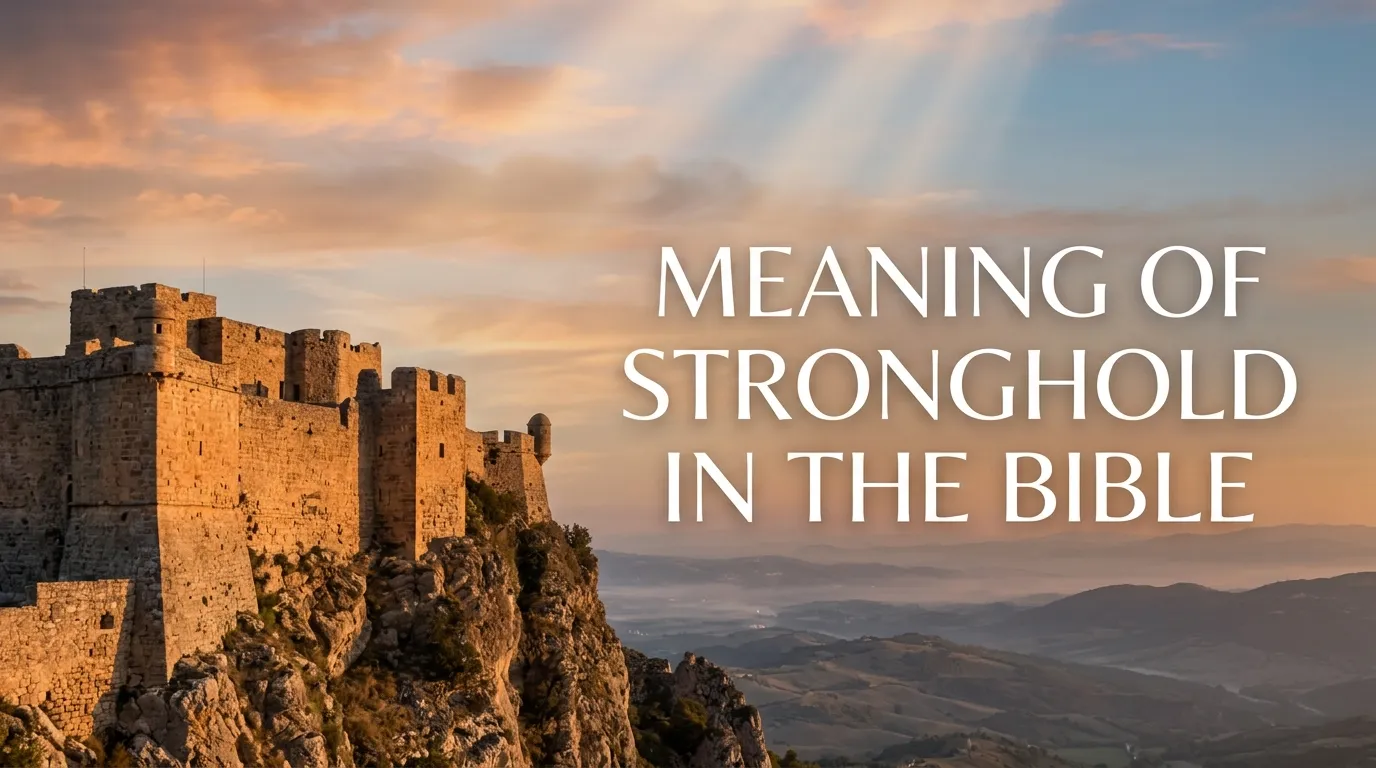
The Bible has a word for that. It calls it a stronghold. The meaning of stronghold in the Bible goes far beyond stone walls and army forts.
It touches your heart, your mind, and your daily walk with God.
This article walks through the Hebrew and Greek roots, key Bible verses, and what a stronghold means for your faith today.
What Is a Stronghold in the Bible?
A stronghold in the Bible is a place of safety, defense, or protection. People often used strongholds during war to hide from enemies. The Bible also uses this word to describe God as a safe place for His people. David called the Lord his “stronghold” when he faced danger (Psalm 18:2). The word can also describe a place of sin or a false belief that controls a person (2 Corinthians 10:4–5). So, context matters. A stronghold can point to physical safety, spiritual protection, or a sinful pattern that needs to be brought under God’s truth.
Bible Verse: “The LORD is my rock and my fortress and my deliverer.” — Psalm 18:2
Stronghold Meaning in the Bible
The biblical meaning of stronghold is closely linked with safety, defense, and refuge. In the Old Testament, strongholds were often fortified places where people could escape an enemy. David found this kind of safety in God. He trusted the Lord as his secure place when his life was in danger (Psalm 144:2). Scripture also speaks of strongholds in a spiritual sense. Some thoughts and sinful patterns can become powerful in a person’s life. Paul teaches believers to bring wrong thoughts under the rule of Christ (2 Corinthians 10:5). God’s truth gives freedom and strength.
Bible Verse: “The LORD is a stronghold for the oppressed, a stronghold in times of trouble.” — Psalm 9:9
Stronghold Bible Definition
A stronghold in the Bible can mean a fortified place used for protection. It could be a strong city, mountain area, or guarded place where people found safety from enemies. David used this idea to describe his trust in God. The Lord was not just a place of escape for him. God was his strength and defense (Psalm 18:2). Scripture also uses stronghold language in a spiritual way. Paul speaks of arguments and thoughts that oppose the knowledge of God (2 Corinthians 10:4–5). This shows why the Bible’s meaning depends on the passage.
Bible Verse: “God is my strong refuge and has made my way blameless.” — 2 Samuel 22:33
Stronghold Definition Biblical
The biblical definition of a stronghold includes the idea of a secure place that gives protection from danger. In ancient times, people could run to a fortified place when enemies attacked. David often used this picture when he spoke about God’s care. He knew that his true security came from the Lord, not from walls or weapons (Psalm 18:2). The Bible also warns about ideas that can become spiritual strongholds. Believers are called to reject false ideas and obey Christ (2 Corinthians 10:4–5). Thus, a stronghold may describe physical protection or a spiritual battle.
Bible Verse: “The LORD is my rock and my fortress and my deliverer.” — Psalm 18:2
Stronghold Biblical
The biblical idea of a stronghold points to a place of strength, safety, and defense. Many Bible passages use this picture to show God’s care for His people. David faced many enemies, yet he trusted God as his stronghold and refuge (Psalm 31:3–4). The image is powerful because a strong fortress gives people a place to stand when danger comes. The Bible also teaches that God’s truth can defeat wrong thinking. Paul says that believers should take thoughts captive to obey Christ (2 Corinthians 10:5). A biblical stronghold, then, should always be understood from its context.
Bible Verse: “You are my rock and my fortress; and for your name’s sake you lead me and guide me.” — Psalm 31:3
What Is Stronghold in the Bible?
In the Bible, a stronghold can be a fortified place where someone finds protection from an enemy. David used this word to describe God because he depended on Him during times of fear and danger (Psalm 18:2). The idea is simple: God is a secure place for those who trust Him. In another setting, Paul speaks about strong arguments and thoughts that stand against God’s truth (2 Corinthians 10:4–5). This does not mean every problem is a spiritual stronghold. The Bible calls us to look at our thoughts, follow God’s truth, and submit to Christ.
Bible Verse: “The LORD is my strength and my stronghold.” — Jeremiah 16:19
Stronghold Meaning
Stronghold means a place of strength, safety, or defense. In the Bible, the word can describe a real fortified place, but it is also used as a picture of God’s protection. David knew that enemies could attack him, yet he trusted the Lord as his safe place (Psalm 59:16). The Bible also gives a different use of the idea when it speaks about thoughts and arguments that must be brought under Christ’s rule (2 Corinthians 10:5). Therefore, stronghold does not always mean something evil. Its meaning comes from the passage where it appears.
Bible Verse: “But I will sing of your strength; I will sing aloud of your steadfast love in the morning.” — Psalm 59:16
Meaning of Stronghold in the Bible
The meaning of stronghold in the Bible is shaped by two main ideas: protection and spiritual resistance. A physical stronghold was a defended place where people could seek safety. David often used this picture for God because he trusted Him in danger (Psalm 144:2). Scripture also describes a battle of the mind. Paul teaches that false arguments must be brought down and thoughts must be taken captive to obey Christ (2 Corinthians 10:4–5). This reminds Christians that God is their true refuge and that His truth should guide their thinking. The Bible gives hope rather than fear.
Bible Verse: “He is my steadfast love and my fortress, my stronghold and my deliverer.” — Psalm 144:2
Strongholds Bible Definition
Strongholds in the Bible are fortified places that provide protection, but the term can also carry a spiritual meaning. In the Old Testament, people sometimes hid in strongholds when enemies pursued them. David experienced this kind of danger and looked to God as his greater refuge (Psalm 18:2). In the New Testament, Paul describes spiritual conflict in terms of arguments and thoughts that oppose God’s truth (2 Corinthians 10:4–5). A stronghold should not be used as a label for every struggle. Scripture points believers back to God’s truth, prayer, obedience, and faith in Christ.
Bible Verse: “The weapons of our warfare are not of the flesh but have divine power to destroy strongholds.” — 2 Corinthians 10:4
Stronghold Bible
The Bible uses the idea of a stronghold to teach about safety, strength, and spiritual conflict. David often described God as his stronghold because the Lord protected him when enemies came against him (Psalm 18:2). This shows that God is not distant from people who face fear or trouble. He is a refuge for those who trust Him. Paul later uses battle language to explain how believers should deal with false ideas and thoughts that oppose God (2 Corinthians 10:4–5). The main lesson is clear: God is our strength, and His truth helps us stand firm.
Bible Verse: “The LORD is my strength and my shield; in him my heart trusts.” — Psalm 28:7
What Does Stronghold Mean in the Bible
A stronghold is a place of safety or a place of control. In the Old Testament, it often means a fortress, a rock, or a high place where soldiers hid from enemies. In the New Testament, it takes on a deeper, spiritual meaning. Paul uses it to describe wrong thinking that traps the mind.
So the word carries two sides. God is a stronghold who protects His people. But sin, fear, and lies can also build strongholds that hold people captive. Understanding both sides helps you read Scripture with clearer eyes.
Hebrew Meaning of Stronghold
The Old Testament uses several Hebrew words for stronghold. Each one adds a shade of meaning.
Ma’oz (מָעוֹז) means a place of strength or a fortified refuge. It appears in Psalm 27:1, where David calls the Lord the strength of my life. The idea is a strong, safe base you can run to.
Metsudah (מְצוּדָה) points to a mountain fortress or a natural rock shelter. David hid in caves like this before he became king. It pictures a hideout built by nature, not by human hands.
Misgab (מִשְׂגָּב) means a high place or a secure height. Armies in ancient times built forts on hills because height gave them an advantage. Enemies could not climb up easily.
Mibtsar (מִבְצָר) refers to a walled city or a fortified town. Many Old Testament cities had thick walls for this exact purpose.
Each Hebrew word paints the same picture from a different angle. Safety. Height. Strength. Shelter from danger.
Greek Meaning of Stronghold
The New Testament uses one main Greek word: ochyroma (ὀχύρωμα). It appears in 2 Corinthians 10:4. This word means a fortress, a stronghold, or a place fortified against attack.
Paul used military language his readers understood well. Roman soldiers built forts across the empire. Everyone knew what a fortress looked like and how hard it was to break through one.
Paul flips this picture. He says the real fortress is not made of stone. It is made of thoughts, arguments, and pride that stand against the truth of God. This one verse shaped how Christians talk about spiritual strongholds today.
Biblical Context: Stronghold as a Literal Place
Before the Bible speaks of spiritual strongholds, it describes real ones. Judges 6:2 tells us the Israelites made dens, caves, and strongholds in the mountains because of the Midianites. These were places of physical hiding, not sin.
David also used a literal stronghold. First Samuel 22:4-5 says David kept his parents in the stronghold of Moab while he was on the run from King Saul. Later, he moved to the stronghold in the forest of Hereth. These were real, physical places of refuge during a dangerous season of his life.
Second Samuel 5:7 mentions the stronghold of Zion, which David captured and made his own city. This became the City of David, later known as Jerusalem. So strongholds were common features of ancient warfare and survival long before they became a spiritual symbol.
God as Our Stronghold: Key Bible Verses
The Bible often calls God Himself a stronghold. This is one of the most comforting truths in Scripture.
Psalm 18:2 says, The Lord is my rock, and my fortress, and my deliverer; my God, my strength, in whom I will trust; my buckler, and the horn of my salvation, and my high tower. David piles up image after image here. He had just been rescued from Saul and other enemies. He wanted his readers to know that safety comes from God, not from human strength.
Psalm 27:1 reads, The Lord is my light and my salvation; whom shall I fear? The Lord is the strength of my life; of whom shall I be afraid? David wrote this during a time of real threat. His answer to fear was not more weapons. It was trust in God as his stronghold.
Psalm 46:1 says, God is our refuge and strength, a very present help in trouble. This verse comes from a psalm often sung during national crisis. It reminds readers that God is not distant. He is present exactly when trouble hits.
Proverbs 18:10 states, The name of the Lord is a strong tower: the righteous runneth into it, and is safe. This verse pictures active faith. The righteous person does not wait for safety to arrive. They run toward God on purpose.
Nahum 1:7 declares, The Lord is good, a stronghold in the day of trouble; and he knoweth them that trust in him. This verse sits inside a book about God’s judgment on Nineveh. Even in a book about coming judgment, God shows mercy and safety to those who trust Him.
Psalm 144:2 calls God my goodness, and my fortress; my high tower, and my deliverer; my shield, and he in whom I trust. This verse ties God’s character (goodness) directly to His role as protector.
Each of these verses teaches the same lesson from a different angle. Safety is found in a relationship with God, not in circumstances.
Strongholds of the Enemy: The Spiritual Meaning
The clearest New Testament teaching on spiritual strongholds comes from Paul.
2 Corinthians 10:4-5 says, For the weapons of our warfare are not carnal, but mighty through God to the pulling down of strong holds; casting down imaginations, and every high thing that exalteth itself against the knowledge of God, and bringing into captivity every thought to the obedience of Christ.
Paul wrote this to a church facing false teachers and prideful arguments. He explains that some strongholds are not buildings. They are patterns of thought that resist God’s truth. Pride, false beliefs, and stubborn arguments can all become strongholds in a person’s mind.
This passage gives Christians a working definition of a spiritual stronghold. It is a mindset or belief system that stands opposed to the truth of God and refuses to bend, even when confronted with evidence.
Paul also says believers have real weapons against this. These are not swords or shields. They are prayer, truth, and the power of God working through the gospel.
Symbolism of a Stronghold
Throughout Scripture, a stronghold symbolizes two opposite things at once.
First, it symbolizes protection. God’s people are described as running to Him the way a soldier runs to a fortress during battle. This symbol shows up again and again in the Psalms.
Second, it symbolizes captivity. When strongholds belong to sin or wrong thinking, they trap a person instead of protecting them. Fear can become a stronghold. Bitterness can become a stronghold. Addiction can become a stronghold.
The same word, stronghold, can describe freedom or bondage. The difference lies in what the stronghold is built around. A stronghold built on God brings safety. A stronghold built on sin, pride, or fear brings captivity.
Practical Lessons from the Meaning of Stronghold
Scripture teaches several clear, practical lessons through the theme of strongholds.
First, safety is found in God, not in self-reliance. David did not survive Saul’s attacks through clever planning alone. He survived because he trusted God as his rock and fortress.
Second, not every stronghold is good. Some strongholds must be torn down, not defended. Paul’s teaching in 2 Corinthians makes this clear. Wrong beliefs need to be confronted and replaced with truth.
Third, spiritual battles are fought with spiritual weapons. You cannot argue your way out of a stronghold with human logic alone. Prayer, Scripture, and the truth of Christ are the tools God gives His people.
Fourth, running to God takes action. Proverbs 18:10 pictures a person actively running into the strong tower. Trusting God is not passive. It involves a daily choice to turn toward Him instead of toward fear.
How to Make God Your Stronghold in Daily Life
Faith grows when you practice trusting God the way David did. Start small. When fear rises, speak Psalm 27:1 out loud. Remind yourself who your strength really is.
Prayer plays a central role in tearing down spiritual strongholds. Paul’s weapons of warfare are mighty through God, which means prayer connects you to that power. Bring your anxious thoughts to God honestly, the way David did in the Psalms.
Hope grows from remembering God’s past faithfulness. David’s songs often list what God had already done for him. Keep your own list. Write down times God protected you. Read it back when fear returns.
Obedience matters too. A stronghold of pride cannot stand next to daily obedience. Paul links pulling down strongholds directly to bringing into captivity every thought to the obedience of Christ. Obedience is the doorway out of a mental stronghold.
Strongholds and Forgiveness
Unforgiveness often becomes one of the strongest mental strongholds a person can build. Bitterness feels protective at first. It feels like armor against being hurt again. But Scripture warns against this pattern.
Ephesians 4:31-32 calls believers to put away bitterness and forgive others, just as God forgave them through Christ. An unforgiving heart can quietly become a fortress that keeps both pain and peace locked out at the same time.
Letting go of a grudge is not weakness. It is one way believers tear down a stronghold that Paul described in 2 Corinthians 10. Forgiveness clears space for God’s peace to stand where bitterness used to live.
Common Misunderstandings About Strongholds
Many people assume a stronghold is always something demonic or supernatural. Scripture does not always support that idea. Often, a stronghold is simply a stubborn, wrong belief a person refuses to release. It can be pride. It can be a lie someone believed about themselves for years.
Another misunderstanding treats strongholds as always negative. As shown above, God Himself is called a stronghold many times in the Psalms. Context always decides whether a stronghold is a place of safety or a place of bondage.
Some also assume tearing down a stronghold happens instantly through one prayer. Paul’s language in 2 Corinthians 10 describes an ongoing battle, using present and active verbs. It is a process, not always a one-time event.
Dream Meaning of a Stronghold
Scripture does not give a direct teaching on strongholds appearing in dreams. The Bible records specific dreams, such as Joseph’s dreams in Genesis or Daniel’s visions, but it never defines a fixed meaning for a stronghold appearing in someone’s sleep.
Any interpretation of a stronghold in a modern dream should stay grounded in Scripture’s clear teaching rather than guesswork. If a stronghold appears in a dream, it is wise to reflect on the biblical themes covered here: God as a place of safety, or areas of stubborn thinking that may need to be surrendered to Him. Scripture encourages testing everything against God’s Word rather than relying on dream symbolism alone.
FAQs
What is a stronghold in the Bible?
A stronghold is either a fortified place of safety, often describing God’s protection, or a stubborn pattern of wrong thinking that resists God’s truth, as taught in 2 Corinthians 10:4.
What does it mean that God is our stronghold?
It means God offers real safety and refuge to those who trust Him, just as a fortress protects soldiers from attack. Psalm 18:2 and Psalm 46:1 both describe God this way.
What are spiritual strongholds according to Paul?
Paul describes spiritual strongholds as arguments and proud thoughts that stand against the knowledge of God. He teaches believers to tear these down through God’s power, not human effort, in 2 Corinthians 10:4-5.
How do you break a stronghold in your mind?
Scripture points to prayer, truth, and obedience to Christ as the tools for breaking a mental stronghold. Bringing every thought captive to Christ, as Paul instructs, is the ongoing process Scripture describes.
Is fear a stronghold in the Bible?
The Bible does not label fear a stronghold by name, but its pattern matches Paul’s description of a thought that resists trust in God. Many Christians apply the stronghold teaching to persistent fear for this reason.
What is the difference between a fortress and a stronghold in Scripture?
Both words describe similar ideas of protection and refuge. Scripture often uses them together, as seen in Psalm 18:2, where God is called both a fortress and a stronghold in the same verse.
Conclusion
The meaning of stronghold in the Bible carries both comfort and warning. God is described again and again as a safe stronghold for His people, a rock they can run to in fear or danger. At the same time, Scripture warns that wrong beliefs, pride, and bitterness can build their own strongholds that trap the heart and mind.
The path forward is simple, even if it takes daily practice. Run to God as your true stronghold. Bring every stubborn thought to Him in prayer. Choose obedience over pride, and forgiveness over bitterness. When you do, you begin to live the way David did, safe inside the one stronghold that never falls.
Discover More Post
- Bluebird Meaning in the Bible: What Scripture Teaches Us
- Avery Meaning in the Bible: Full Spiritual Guide (2026)
- Effeminate Meaning in the Bible: What Scripture Really Teaches

Hi, I’m James Patterson, a storyteller who loves creating thrilling mysteries, unforgettable characters, and page-turning adventures. Through TheBiblimeaning, I share insights about authors, books, literary meanings, biographies, and the stories behind famous writers. My goal is to help readers discover the deeper world of literature while enjoying engaging and informative content.