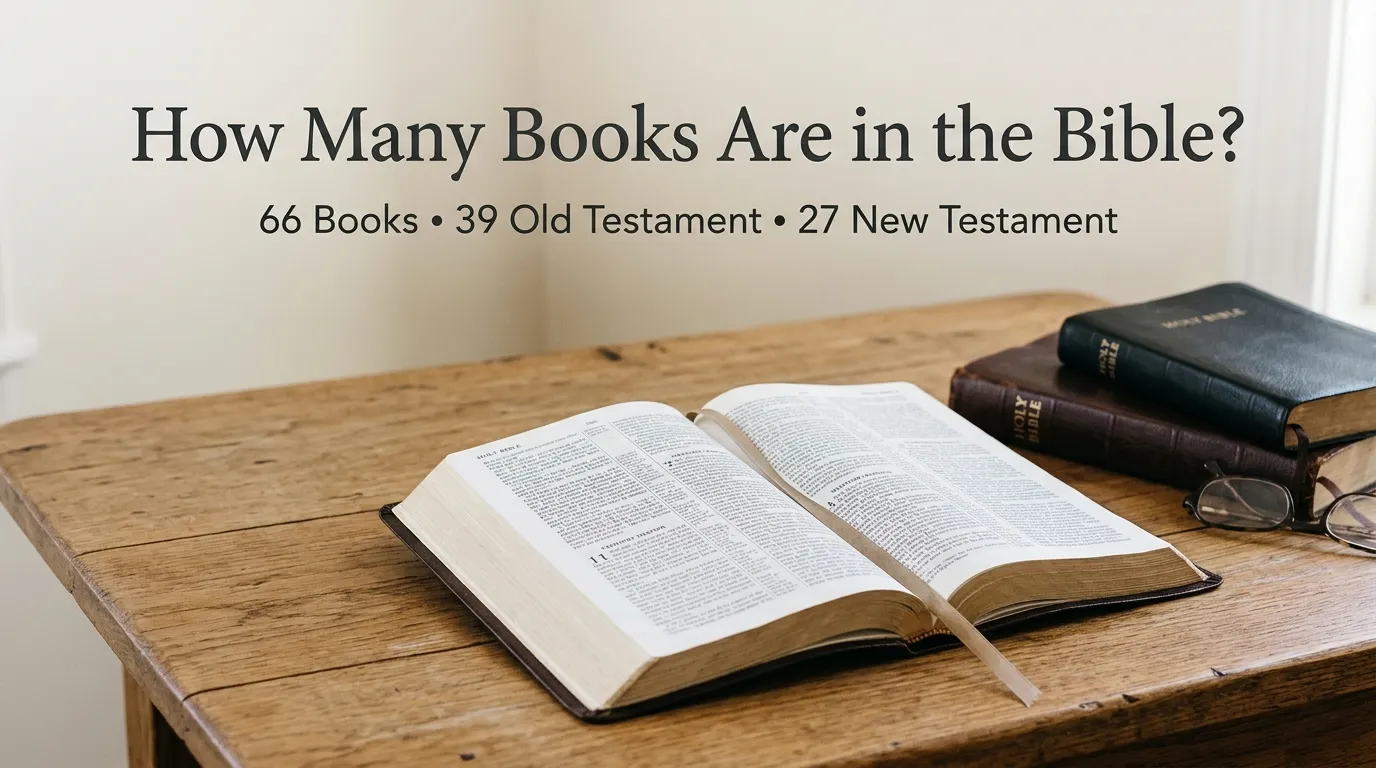
The answer depends on which Bible you are holding. A Protestant Bible has 66 books. A Catholic Bible has 73 books. An Eastern Orthodox Bible often has 76 to 81 books, and the Ethiopian Orthodox Bible is usually counted as 81 books.
The New Testament is the same in all of these Bibles. It has 27 books. The difference is in the Old Testament. That is the simple answer, and the rest of this guide explains why the numbers are different, what the extra books are, and how you can check your own Bible with confidence.
If you only need one number for school, church, or a quick search, use 66 for a Protestant Bible, because that is the most common Bible in English speaking churches. If your Bible is Catholic, use 73. If you are not sure, look at the table of contents. Count the books before Matthew. That count will tell you which tradition your Bible follows.
Why Different Bibles Have Different Numbers
The Bible is not one single book written at one time. It is a library of books written over many centuries by many writers. Early Jewish and Christian communities read, copied, and used these books in worship. Over time, each community made a list of the books it accepted as Scripture. That list is called a canon. The word canon means a measuring rod or a standard. It is the list that a church uses to say, these books carry full authority for faith and life.
Different communities did not all make the same list at the same time. Some followed the Hebrew tradition closely. Some followed the Greek translation of the Hebrew Scriptures, which is called the Septuagint. The Septuagint included extra books that were not in the later Hebrew list. Churches that used the Septuagint in worship kept those books. Churches that returned to the Hebrew list in the Reformation left them out of the Old Testament, or placed them in a separate section.
This is why the counts differ. It is not because one church secretly added new books last week. It is because old communities made different choices about ancient books, and those choices stayed in place for centuries.
The Main Counts in One Table
| Bible tradition | Old Testament books | New Testament books | Total books |
| Protestant | 39 | 27 | 66 |
| Catholic | 46 | 27 | 73 |
| Eastern Orthodox, common count | 49 to 54 | 27 | 76 to 81 |
| Ethiopian Orthodox, common count | 54 | 27 | 81 |
| Hebrew Bible, Jewish counting | 24, counted in a different way | Not included | 24 |
The Hebrew Bible row needs a clear note. Jewish tradition counts the same Old Testament material as 24 books, not 39. The material is the same in most cases. The counting is different. For example, the twelve Minor Prophets are counted as one book in Jewish tradition, but as twelve books in Christian Bibles. Samuel, Kings, and Chronicles are also grouped in a different way. So a smaller number does not mean less material. It means a different way of grouping.
The 66 Books in a Protestant Bible
The Protestant Old Testament has 39 books. They fall into five groups. The Law has five books: Genesis, Exodus, Leviticus, Numbers, and Deuteronomy. The History books have twelve books: Joshua, Judges, Ruth, 1 Samuel, 2 Samuel, 1 Kings, 2 Kings, 1 Chronicles, 2 Chronicles, Ezra, Nehemiah, and Esther. The Wisdom and Poetry books have five books: Job, Psalms, Proverbs, Ecclesiastes, and Song of Solomon. The Major Prophets have five books: Isaiah, Jeremiah, Lamentations, Ezekiel, and Daniel. The Minor Prophets have twelve books: Hosea, Joel, Amos, Obadiah, Jonah, Micah, Nahum, Habakkuk, Zephaniah, Haggai, Zechariah, and Malachi.
The New Testament has 27 books. The Gospels have four books: Matthew, Mark, Luke, and John. Acts is the history book of the early church. The letters of Paul have thirteen books: Romans, 1 Corinthians, 2 Corinthians, Galatians, Ephesians, Philippians, Colossians, 1 Thessalonians, 2 Thessalonians, 1 Timothy, 2 Timothy, Titus, and Philemon. The general letters have eight books: Hebrews, James, 1 Peter, 2 Peter, 1 John, 2 John, 3 John, and Jude. Revelation is the final book of prophecy and hope.
When you add 39 and 27, you get 66. That is the full Protestant Bible, from Genesis to Revelation. Many readers find it helpful to learn the groups first, and then learn the books inside each group. That makes the whole Bible feel less like a long list and more like a library with clear shelves.
What Are the Extra Books in Catholic and Orthodox Bibles
Catholic Bibles add seven full books to the Old Testament, plus extra parts inside Esther and Daniel. The seven books are Tobit, Judith, Wisdom, Sirach, Baruch, 1 Maccabees, and 2 Maccabees. Catholics call these books deuterocanonical. That word means second canon. It means these books were accepted a little later in the history of the list, but they are still accepted as Scripture in Catholic teaching.
Protestants often call the same books Apocrypha. In older use, that word simply meant hidden or unclear books. In modern Protestant use, it often means books that are useful for history and reading, but not given the same authority as the 66 books. Some Protestant Bibles print these books in a separate section between the Old and New Testaments. That way readers can read them without mixing them into the main Old Testament list.
Orthodox Bibles keep even more material. They often include Psalm 151, the Prayer of Manasseh, 3 Maccabees, and other writings from the Greek tradition. The exact list can change a little from one Orthodox church to another. Greek, Russian, and other Orthodox churches do not all print the exact same table of contents. That is why you will see a range, such as 76 to 81, rather than one fixed number for all Orthodox Bibles.
The Ethiopian Orthodox Bible keeps the widest list. It includes books such as 1 Enoch and Jubilees, which no other major church counts as Scripture. That is a separate topic, and it is covered in full in the Ethiopian Bible guide in this batch. For this article, the key point is simple. Ethiopia kept a very old and very wide collection, and that is why its count is high.
Why the New Testament Is Always 27
This is a point that many top articles mention only in passing, and it deserves a clear answer. All major Christian traditions agree on the 27 books of the New Testament. There is no Catholic New Testament with extra books, and no Orthodox New Testament with a different gospel list. The four Gospels, Acts, the letters, and Revelation are the same in every tradition.
The reason is history. By the fourth century, churches across the Roman world had already reached broad agreement on these 27 books. A letter from Athanasius in the year 367 listed the same 27 books that are in Bibles today. Later councils in Hippo in 393 and Carthage in 397 confirmed the same list. The books were chosen because they were linked to the apostles, they were widely used in churches, and they agreed with the teaching that Christians had received about Jesus.
That agreement matters for readers today. Even when churches disagree about some Old Testament books, they share the same New Testament witness to Jesus. The story of his life, death, and resurrection, and the teaching of the apostles, is common ground.
How the Canon Was Formed, Step by Step
The canon was not formed in one meeting on one day. It grew in stages. First, books were written and shared. Then, churches read them in worship and copied them by hand. Then, leaders and councils tested them against clear questions. Was the book linked to a prophet or an apostle. Was it old and widely known. Did it agree with the core teaching of the faith. Was it used by many churches, not just one small group.
The Old Testament list was already largely settled by the time of Jesus. In Luke 24:44, Jesus speaks of the Law, the Prophets, and the Psalms. That three part shape matches the Jewish way of grouping the Scriptures. The New Testament list took longer, because the books were still being written in the first century, and churches needed time to share and test them.
The Reformation in the sixteenth century reopened the Old Testament question. Reformers such as Martin Luther argued that the Old Testament should follow the Hebrew list. The Catholic Council of Trent in 1546 confirmed the Catholic list, including the deuterocanonical books. That is why the difference became fixed in printed Bibles after that time. Before printing, handwritten Bibles could vary a little from place to place. After printing, each tradition printed its own fixed list.
How to Check Which Bible You Have
You do not need to guess. Open the table of contents and count. If you see 39 books before Matthew, you have a Protestant Old Testament. If you see Tobit, Judith, Wisdom, Sirach, Baruch, 1 Maccabees, and 2 Maccabees in the Old Testament, you have a Catholic Bible. If you see Psalm 151 or 3 Maccabees, you likely have an Orthodox Bible. If you see 1 Enoch or Jubilees, you likely have an Ethiopian Bible or a special edition that includes those books.
Also check the title page. Many Bibles print the tradition on the cover or in the front pages. Words such as Catholic Edition, Orthodox Study Bible, or Apocrypha give you a clear clue. If your Bible has a separate section called Apocrypha between the Testaments, that section holds the extra books, and the main Old Testament still has 39 books.
This check is useful when you buy a Bible, when you join a Bible study, or when you compare notes with a friend from another church. You are not reading a different faith. You are reading a different table of contents, shaped by a different history.
A Simple Reading Plan for All 66 Books
Many readers feel stuck after learning the count. They ask, where do I start. Here is a simple plan that works for beginners and for returning readers. Start with one Gospel. John is a good first choice because it is clear about who Jesus is. Then read Genesis, to see the start of the story. Then read Psalms for prayer, and Proverbs for daily wisdom. Then read Acts, to see the early church. Then read Romans, to see the core teaching about faith and grace.
After that, mix short and long books. Read a short book such as Ruth, Jonah, or Philippians when you have little time. Read a longer book such as Isaiah or Matthew when you have more time. Do not feel that you must read from Genesis to Revelation in order on your first journey. Many readers finish more when they move between the Old and New Testaments, and when they finish short books early and gain confidence.
A one year plan breaks the Bible into daily parts. A slower plan reads one chapter a day. Both plans work. The best plan is the one you will actually keep. Read a little each day, pray before you read, and ask one simple question after each part. What does this show me about God, and what does it ask me to do today.
Common Mistakes About the Number of Books
One common mistake is to say that Catholics added books to the Bible. A fairer way to say it is that Catholics kept books that were already in the Greek Old Testament, while Protestants later set those books apart. Another common mistake is to say that Protestants removed books from the Bible in secret. A fairer way to say it is that Reformers chose the Hebrew list as their standard, and printed the other books separately.
Another mistake is to think that more books always means a better Bible. The number alone does not tell you about translation quality, study notes, or readability. A good Bible is one you can read, understand, and trust. Check the translation, the notes, and the church tradition behind the edition, and choose the one that helps you read with care.
A final mistake is to mix up chapters, verses, and books. A book is a whole work, such as Genesis or Romans. A chapter is a large section inside a book. A verse is a small sentence or part inside a chapter. The Bible has 66 books, 1,189 chapters in a Protestant Bible, and more than 31,000 verses. Those three numbers answer three different questions, so do not use them as if they were the same.
FAQs
Bible verse for me today
“I am the Alpha and the Omega,” says the Lord God, “who is, and who was, and who is to come, the Almighty.” (Revelation 1:8)
This verse reminds you that God holds all of time and your day securely in His hands.
Bible verse for today morning
This is the day that the Lord has made; let us rejoice and be glad in it. (Psalm 118:24)
Start your morning with gratitude, knowing every new day is a gift from God.
Bible verse of the day about strength
But they who wait for the Lord shall renew their strength; they shall mount up with wings like eagles; they shall run and not be weary; they shall walk and not faint. (Isaiah 40:31)
When you feel weak, trusting in God brings fresh strength and endurance.
Inspirational verse of the day
I can do all things through him who strengthens me. (Philippians 4:13)
This powerful reminder encourages you that Christ’s power enables you to face any challenge.
Short Bible Verse for today
The Lord is my strength and my shield. (Psalm 28:7a)
A simple yet profound truth: God protects and empowers you every moment.
Bible Verse for today with reflection
Fear not, for I am with you; be not dismayed, for I am your God; I will strengthen you, I will help you, I will uphold you with my righteous right hand. (Isaiah 41:10)
Reflect on how God promises His personal presence and support—no matter what you face today, you are not alone.
Bible Verse for tonight
In peace I will both lie down and sleep; for you alone, O Lord, make me dwell in safety. (Psalm 4:8)
As the day ends, rest in the assurance that God watches over you through the night.
Random Bible chapter generator
Try reading Psalm 23 today—a short, comforting chapter about the Lord as your shepherd.
It speaks of guidance, provision, and peace even in difficult valleys.
Final Takeaway
The number of books in the Bible tells a story about history, language, and church life. Protestant Bibles have 66 books. Catholic Bibles have 73 books. Orthodox Bibles have a wider list, often 76 to 81 books. Ethiopian Bibles are usually counted as 81 books. The New Testament is 27 books in every case.
Do not let the different numbers confuse you or divide you from other Christians. The core story is shared. God created the world, God called a people, God sent Jesus, and God is making all things new. That story runs from Genesis to Revelation in every Bible, no matter how the table of contents is counted. Open your Bible, learn its shape, and read it day by day with prayer and trust. The best Bible for you is the one you open, read, and live by.
Discover More Post
- Adversity Meaning in the Bible: A Biblical Guide
- Caleb Meaning in the Bible: Symbolism, Faith & Lessons
- Passover Meaning in the Bible: God’s Powerful Message

Hi, I’m James Patterson, a storyteller who loves creating thrilling mysteries, unforgettable characters, and page-turning adventures. Through TheBiblimeaning, I share insights about authors, books, literary meanings, biographies, and the stories behind famous writers. My goal is to help readers discover the deeper world of literature while enjoying engaging and informative content.