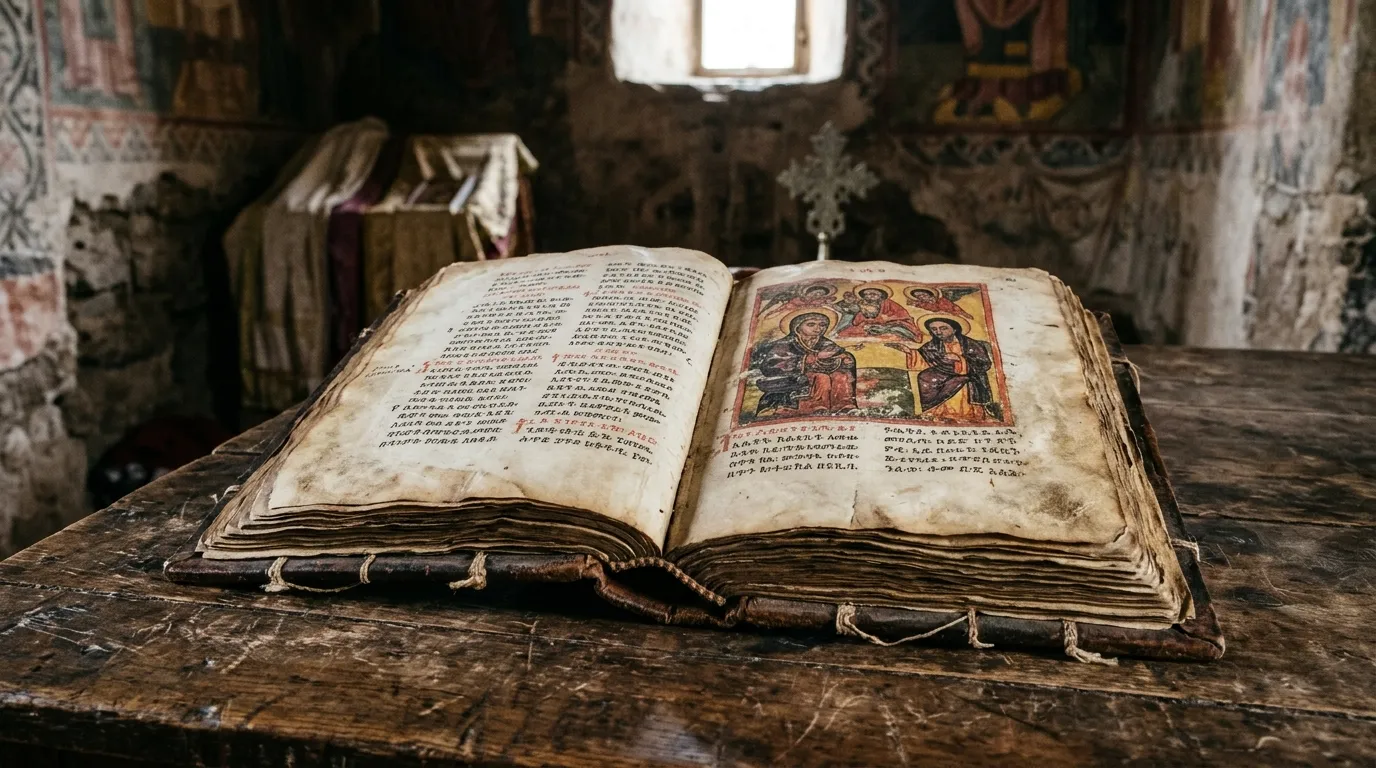
The Ethiopian Bible is the Bible of the Ethiopian Orthodox Tewahedo Church, one of the oldest Christian churches in the world.
It is written and chanted in Ge’ez, an ancient language of Ethiopia that is still used in church worship today. It is the largest Bible canon in Christianity.
It is usually counted as 81 books, and when every separate work inside combined books is counted on its own, the total reaches 88 books.
It includes all the books in a Protestant Bible, plus books that no other major church counts as Scripture, such as 1 Enoch, Jubilees, and the three books of Meqabyan.
What the Ethiopian Bible Is
The Ethiopian Orthodox Tewahedo Church has tens of millions of members, mainly in Ethiopia and Eritrea. The word Tewahedo means made one or united. It points to the church teaching about the united nature of Christ. The church traces its faith to very early times. Ethiopian tradition links its Christian story to the Ethiopian official in Acts 8:26-39, who heard the good news about Jesus from Philip and was baptised on the road. History also records that Christianity became the faith of the Aksumite kingdom in the fourth century, under King Ezana. From that time, Ethiopia kept its own church life, its own language for worship, and its own wide collection of Scriptures.
The Ethiopian Bible is not a new translation made for the internet age. It is a living canon. Monks and scribes copied it by hand on parchment for more than a thousand years. Churches still chant from it in Ge’ez. Families still hear it in worship even when they speak Amharic or another modern language at home. That mix of old language and living worship is part of what makes it special.
Why 81 Books and 88 Books Are Both Used
This is the most confusing point for new readers, and it has a clear answer. Both numbers are correct. They answer slightly different counting questions.
The traditional church number is 81. That number is fixed in church teaching. But Ethiopia never held one council that printed a single itemised list for all time, so the way the 81 are grouped can change. In the narrower counting, the Old Testament has 54 books and the New Testament has the familiar 27 books. That adds up to 81.
In the broader counting, the Old Testament has 46 books and the New Testament has 35 books. That also adds up to 81. The broader New Testament adds early church order books, such as the Sinodos, the Book of the Covenant, Ethiopic Clement, and the Ethiopic Didascalia. These are books about church order, teaching, and worship from the early church. In the narrower counting, some of these works are grouped inside other books or counted in a different way.
When every work inside a combined book is counted separately, the total rises to 88. For example, the Sinodos has four parts. If you count it as one book, the total stays lower. If you count each part on its own, the total rises. The same happens with books that were once bound together, such as Samuel or Ezra and Nehemiah in other traditions. Modern collected editions often use the title 88 books because that is the fullest way to print the canon, with nothing folded inside another book.
So when you see 81, think of the traditional church total. When you see 88, think of the full separate count. Neither number means that a new book was invented. It means that old books were grouped or split in a different way.
Comparison Table
| Bible tradition | Old Testament | New Testament | Total |
| Protestant | 39 | 27 | 66 |
| Catholic | 46 | 27 | 73 |
| Eastern Orthodox, common | 49 to 54 | 27 | 76 to 81 |
| Ethiopian Orthodox, narrower count | 54 | 27 | 81 |
| Ethiopian Orthodox, broader count | 46 | 35 | 81 |
| Ethiopian Orthodox, full separate count | Not fixed in one table | Not fixed in one table | 88 |
The table shows the key point at a glance. Every tradition shares the same core. Ethiopia keeps that core and then keeps more. The New Testament is the same 27 books in the narrower Ethiopian count. Only the broader count adds church order books to the New Testament list.
Books Found Only in the Ethiopian Bible
The most famous unique books are 1 Enoch, Jubilees, and 1 to 3 Meqabyan. Each one deserves a plain explanation.
1 Enoch is linked to Enoch, the man in Genesis 5:24 who walked with God. The book tells of angels called Watchers, of giants, of journeys through the heavens, and of judgement and hope. It is quoted in the New Testament letter of Jude, in Jude 1:14-15. The full text survives only in Ge’ez. That is why Ethiopia matters so much for this book. Without Ethiopian scribes, the full book would have been lost to the wider church.
Jubilees retells Genesis and the start of Exodus. It organises history into periods of 49 years, called jubilees. It is often called Little Genesis. Parts of it were found among the Dead Sea Scrolls in Hebrew, but the full text survives only in Ge’ez. Jubilees helps readers see how early Jewish communities read Genesis, how they thought about the calendar, and how they kept the law.
The three books of Meqabyan are often confused with Maccabees, but they are different books. Catholic Bibles include 1 and 2 Maccabees. Those books tell the story of Judas Maccabeus and the Jewish revolt against Antiochus. The Ethiopian Meqabyan have different kings, different martyrs, and different stories. They were written on their own, with long teaching about faith under pressure and about resurrection. They were not translated into English until the twenty first century. That makes them among the least read canonical books in the world today.
Other unique or broader books include 4 Baruch, also called the Rest of the Words of Baruch, and Ezra Sutuel, also known as the apocalypse of Ezra or 2 Esdras. Ezra Sutuel wrestles with suffering after exile, with justice, and with hope for the age to come. It asks many of the same hard questions as Job and Revelation, but in its own voice.
The Ethiopian Old Testament also includes the books that Catholics call deuterocanonical, such as Tobit, Judith, Wisdom, Sirach, and Baruch. Protestants often place those books in a separate Apocrypha section. In Ethiopia, they sit inside the main canon.
The Language Ge’ez and the Garima Gospels
Ge’ez is an ancient Semitic language, related to Hebrew and Arabic. It is no longer spoken as a daily street language, but it remains the liturgical language of the Ethiopian Orthodox Church, much as Latin remains important in the Catholic Church. Priests chant in Ge’ez. Scribes copied the whole Bible in Ge’ez. That long copying tradition is why the canon survived.
The Garima Gospels are two illuminated Gospel books kept at Abba Garima Monastery near Adwa in northern Ethiopia. They have been dated by radiocarbon testing to roughly AD 390 to 660. That makes them among the earliest complete illuminated Christian manuscripts in the world. They are older than the famous Book of Kells. They show that Ethiopian scribes were making beautiful, complete Gospel books while much of Europe was still learning to read and copy on a large scale.
Ethiopian manuscripts are also famous for their art. Bright colours, clear faces, large eyes, and patterned borders fill the pages. The art is not decoration alone. It teaches the story to people who may not read Ge’ez with ease. It also shows how deeply the Bible lived in Ethiopian culture, in church, in home, and in art.
A Short History: Aksum, Frumentius, and the Nine Saints
The history begins with a shipwreck story that Ethiopian tradition loves to tell. In the early fourth century, a young Christian from Tyre named Frumentius was captured on the Red Sea coast and taken to the Aksumite court. He rose to become a royal tutor. Around the 330s, King Ezana embraced Christianity. Aksumite coins soon carried the cross, among the first coins in the world to do so. Frumentius travelled to Alexandria, where Athanasius made him the first bishop of Aksum. Ethiopians remember him as Abba Salama, the Father of Peace, and as Kesate Birhan, the Revealer of Light.
Over the next two centuries, monastic missionaries planted monasteries across the highlands. Tradition remembers them as the Nine Saints. They carried forward the translation of the Scriptures into Ge’ez. The collection they translated was broad. It reflected the wide Greek libraries of the early Christian world, and it included Enoch and Jubilees.
Meanwhile, churches in the Mediterranean were making narrower lists. The Council of Laodicea around AD 363 limited public reading in church to canonical books, and lists from that time left Enoch out. Athanasius wrote a festal letter in 367 that defined a tighter canon for Egypt. These were decisions made by particular communities for worship and teaching. Their practical effect was that Greek and Latin scribes gradually stopped copying the excluded books, and copies stopped existing in those regions.
Ethiopia lay outside those decisions. It kept its wider inheritance. After the rise of Islam in the seventh century, Ethiopia was largely cut off from Mediterranean Christianity. The highlands became a kind of time capsule. Monasteries kept copying the same broad canon, century after century, on parchment made from local goatskin. When the Scottish traveller James Bruce carried Ge’ez manuscripts of Enoch back to Europe in 1773, Western scholars were amazed. When the Dead Sea Scrolls were found in the twentieth century, with Aramaic Enoch and Hebrew Jubilees among them, the verdict was clear. The books Ethiopia had preserved were genuinely ancient, and Ethiopian scribes had preserved them well.
Is the Ethiopian Bible the Oldest Bible
Many book covers and websites say that the Ethiopian Bible is the oldest and most complete Bible on earth, and nearly 800 years older than the King James Version. That claim needs care. It is true that Ethiopian manuscripts are very old, and that the canon is the most complete in terms of book count. It is not true in a simple sense that there was one first complete Bible, and that Ethiopia alone kept it while all others cut it down.
The Bible was never one master book that was later trimmed. It was a library that grew over centuries. Different communities made different lists. No single original Bible existed for Ethiopia to preserve in full. What is true, and remarkable enough without exaggeration, is that the Ethiopian canon is one of the oldest continuously used canons in Christianity, and the one that best preserves the breadth of what many early Jewish and Christian communities actually read.
Also, the King James Version was first published in 1611. Saying that a manuscript is 800 years older than that version is not the same as saying that the Ethiopian canon is 800 years older than the Bible itself. The Garima Gospels are very old manuscripts, but they are Gospel books, not a complete 81 book Bible in one volume from that early date. A fair summary is this. Ethiopia kept the widest canon, it kept it without a break, and its manuscripts are among the oldest Christian books that survive.
Readers should be careful with sales claims. A book that promises the oldest and most complete Bible may be a modern collected edition, not an ancient manuscript. That does not make it useless. It may be a helpful English collection. It does mean that you should check who translated it, which books are included, and whether the translation is scholarly or popular.
How the Ethiopian Bible Differs in Theology and Worship
The canon difference is not only about book count. It also reflects a different way of holding Scripture and tradition together. Protestant teaching often stresses Scripture alone as the final authority. The Ethiopian Orthodox Church holds Scripture together with the living tradition of the church, including liturgy, fasting, feasts, and the teaching of the fathers. That does not mean that tradition replaces Scripture. It means that Scripture is read inside worship, inside community life, and inside a long chain of practice.
Fasting is a clear example. Ethiopian Orthodox Christians fast for many days in the year, including Wednesdays, Fridays, and the long fasts before Easter and other feasts. The Bible is read and chanted during those seasons. The Ark of the Covenant is also central in Ethiopian church life. Every church has a replica of the Ark, called a tabot, kept in the sanctuary. Ethiopian tradition says that the original Ark was brought to Ethiopia in ancient times, linked to the story of Solomon and the Queen of Sheba in 1 Kings 10. That story is told in the Kebra Nagast, the Glory of Kings, a national and religious book that is deeply loved in Ethiopia, even though it is not counted as a Bible book in the same way as Genesis or Matthew.
For readers from other traditions, the respectful approach is to learn first and judge later. You can read Enoch or Jubilees for history and context without changing your own canon. Reading a book is not the same as canonising it. Many scholars read these books every day for background to the New Testament, because Jude quotes Enoch, and because the world of Jesus was shaped by the same Jewish writings.
Where to Read the Ethiopian Bible in English
There is no single official English translation of the complete Ethiopian canon issued by the Ethiopian Orthodox Church. Ge’ez remains the scriptural language, and Amharic translations serve the church’s own faithful in Ethiopia. English readers have had to build the canon piece by piece from scholarly editions.
The trail is long. Richard Laurence published the first English 1 Enoch in 1821. R. H. Charles produced standard scholarly translations of Jubilees in 1902 and Enoch in 1917. The books of Meqabyan waited until the twenty first century for English translation. The Sinodos and Didascalia still live mostly in academic editions for specialists.
Modern collected editions now try to close that gap. They print all 88 books in order, in modern English. When you choose one, check three things. First, who translated each book, and is the translator named. Second, does the edition explain the 81 and 88 counting, or does it hide it. Third, does it give notes about where the text comes from, or does it present every book as if it had the same history. A good edition will be honest about gaps, about translation choices, and about books that survive only in Ge’ez.
A sensible reading order for beginners is to start with the familiar books, then move to the unique books one at a time. Read 1 Enoch after Genesis and Jude, so you can see the link. Read Jubilees after Genesis, so you can see the retelling. Read Meqabyan after 1 and 2 Maccabees, so you can see how different they are, despite the similar name. Read Ezra Sutuel after Job, so you can hear its questions about suffering in context.
FAQs
Ethiopian Bible 88 books in English
The Ethiopian Orthodox Tewahedo Church officially recognizes an 81-book canon; the “88 books” figure arises when multi-part texts such as the Sinodos are counted separately.
Several modern English editions claiming the full 88-book collection (including Enoch, Jubilees, and the three Meqabyan) are sold commercially, though no single official Church-authorized English translation of the complete canon currently exists.
The Ethiopian Bible PDF
Complete English PDFs of the full Ethiopian canon are not officially published by the Church; most available files are either partial scholarly translations or commercial compilations.
Scans of Amharic or Ge’ez versions, along with selected extra books, can be found on Internet Archive, while English readers typically rely on paid modern editions.
Ethiopian Bible 88 books pdf
PDFs marketed as the “88-book Ethiopian Bible” are usually commercial English compilations that combine the Protestant 66 books with Enoch, Jubilees, Meqabyan, and other texts.
Free versions circulating online vary widely in completeness and accuracy; reliable full-text English editions are generally paid downloads or print books.
Ethiopian Bible PDF download
Free PDF downloads of the complete English Ethiopian Bible are limited; Internet Archive hosts some Amharic/Ge’ez scans and partial English collections of the extra books.
For a modern English version covering the broader canon, most readers purchase commercial e-books or printed volumes rather than free downloads.
The Ethiopian Bible in English free
No complete, Church-authorized free English translation of the full 81- or 88-book canon is available.
Individual books such as 1 Enoch and Jubilees can be read free online through public-domain scholarly editions, while full compiled volumes are typically sold.
Ethiopian Bible free online
Partial free online access exists for the distinctive books (Enoch, Jubilees, Meqabyan) via academic and public-domain sites.
Apps and websites offer the standard 66-book text plus some deuterocanonical material at no cost, but the complete Ethiopian canon in English remains largely behind paid editions.
Ethiopian Bible app
Free mobile apps such as “Ethiopian Bible” by GeezApps provide the full 81-book Amharic text, English (KJV) for the 66 shared books, and selected extra Ethiopian texts.
These apps support offline reading, parallel languages (Amharic/English/Tigrinya), and Ethiopian calendar features on both Android and iOS.
Ethiopian Bible Amazon
Amazon offers multiple English print and Kindle editions marketed as the complete Ethiopian Bible (often labeled 81 or 88 books), including volumes that contain Enoch, Jubilees, and the Meqabyan.
Prices and quality vary; readers are advised to check reviews and table-of-contents details, as not every listing contains the full traditional Ethiopian canon.
Final Takeaway
The Ethiopian Bible is a gift to the whole church, even for readers who will never adopt its canon. It shows that Christianity did not begin in Europe alone. It began in many places at once, and it lived in Africa from very early times, with its own language, its own art, and its own wide library of Scriptures.
Discover More Post
- Adversity Meaning in the Bible: A Biblical Guide
- Caleb Meaning in the Bible: Symbolism, Faith & Lessons
- Passover Meaning in the Bible: God’s Powerful Message

I’m Nicholas Sparks, and storytelling has always been my passion. Through TheBiblimeaning, I share insights about my books, unforgettable characters, romance, emotions, and the deeper meanings behind my stories. This platform brings readers closer to my writing journey, latest releases, and the inspiration that shapes every novel I create.