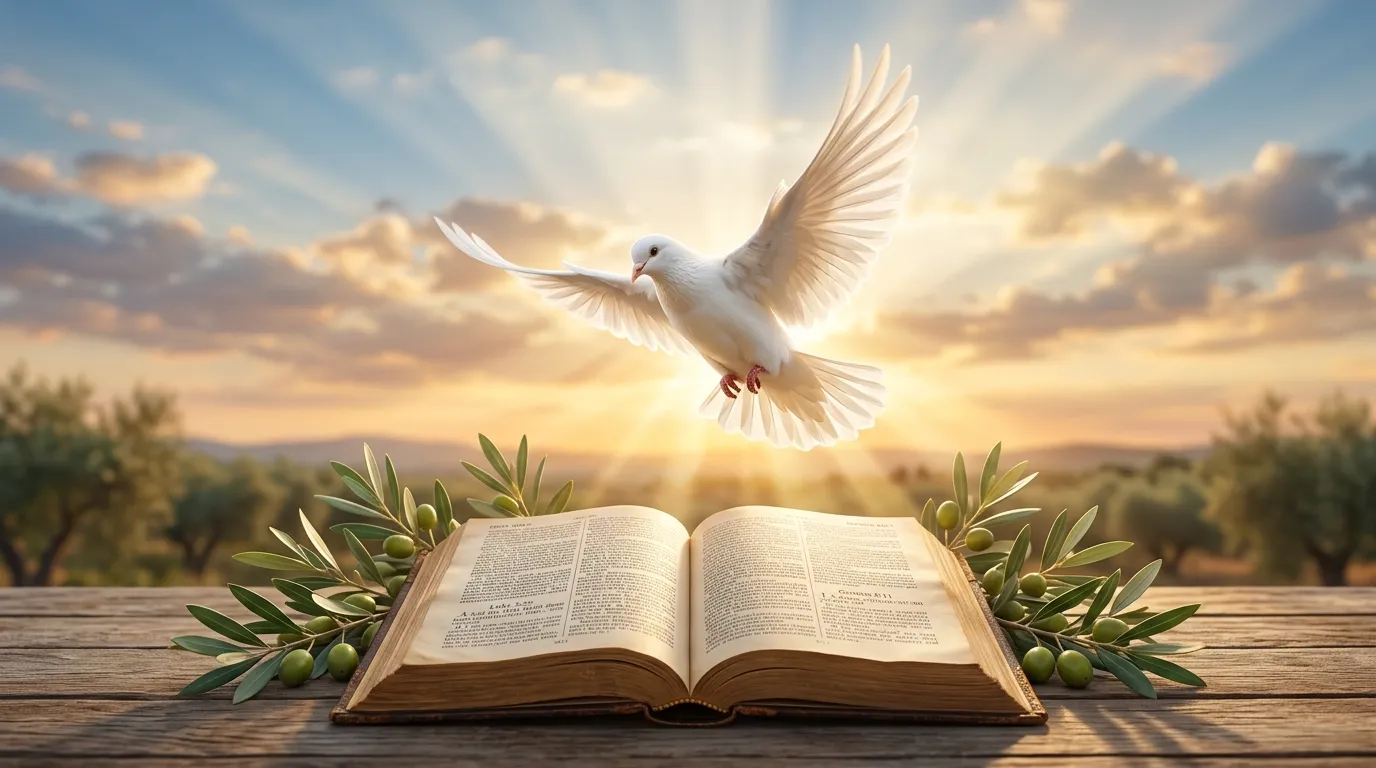
The dove meaning in the Bible centers on peace, purity, new beginnings, and the gentle presence of the Holy Spirit.
When you see a dove in Scripture, it often points to God’s mercy, restoration, and the quiet power of His Spirit at work.
In this article, you will discover the rich biblical symbolism of the dove, key stories where it appears, what the original Hebrew and Greek words reveal, and how this symbol speaks to your life today.
You are a new believer seeking hope or a mature Christian longing for deeper intimacy with the Holy Spirit.
Quick Reference Table
| Reference | Key Event/Symbol | Main Meaning |
| Genesis 8 | Noah sends dove after the flood | Peace, end of judgment, new life |
| Matthew 3:16; Mark 1:10; Luke 3:22; John 1:32 | Holy Spirit at Jesus’ baptism | Holy Spirit’s gentle descent |
| Leviticus 1:14; 5:7 | people with low-income | Accessibility of atonement |
| Matthew 10:16 | Jesus’ instruction to disciples | Innocence and purity |
| Song of Solomon | Poetic imagery | Love, beauty, faithfulness |
Biblical Meaning
The dove consistently represents gentleness, innocence, and divine peace throughout Scripture. It is not a random symbol but one woven into God’s story of redemption from the aftermath of judgment to the arrival of the Savior.
3 Doves Biblical Meaning
Although the Bible does not specifically mention the symbolic meaning of three doves together, the number three often represents completeness, divine perfection, and God’s presence. Doves, on the other hand, symbolize peace, purity, hope, and the Holy Spirit. When these biblical themes are combined, three doves can remind believers of God’s perfect peace and faithful guidance. This interpretation is symbolic rather than a direct biblical teaching, so it should not be presented as an established doctrine.
Meaning of Dove Spiritual
Spiritually, a dove represents peace, purity, love, hope, and God’s gentle presence. Throughout Scripture, the dove is associated with reconciliation, new beginnings, and the work of the Holy Spirit. It encourages believers to trust God’s guidance with humble and faithful hearts. While different cultures may attach additional meanings to doves, the Bible consistently points to them as symbols of innocence, faithfulness, and the comforting presence of God in the lives of His people.
Meaning of White Dove in the Bible
A white dove is widely recognized as a symbol of peace, purity, and the Holy Spirit. Although the Bible does not specifically describe the dove at Jesus’ baptism as white, Christian tradition often portrays it that way because white represents holiness and righteousness. The image of a white dove reminds believers of God’s peace, forgiveness, and the transforming work of the Holy Spirit. Its symbolism reflects biblical themes rather than a direct statement found in Scripture.
Holy Spirit as a Dove Bible Verse
One of the clearest Bible verses about the Holy Spirit appearing as a dove is found during Jesus’ baptism. Matthew 3:16 explains that the Spirit of God descended like a dove and rested on Jesus. Similar accounts also appear in Mark 1:10, Luke 3:22, and John 1:32. The dove highlights the Holy Spirit’s gentle, peaceful, and divine presence, confirming Jesus as God’s beloved Son and the promised Messiah.
Dove Symbolism Death
The Bible does not teach that seeing a dove is a sign of death. Instead, doves are commonly associated with peace, hope, purity, and God’s presence. Some cultural traditions connect doves with departed souls or death, but these beliefs do not come from Scripture. In the Bible, the dove is a positive symbol that points toward renewal, comfort, and God’s faithfulness. Christians should rely on biblical truth rather than superstition when interpreting spiritual symbols.
How Many Times Is Dove Mentioned in the Bible
The word “dove” appears dozens of times throughout the Bible, though the exact count may vary slightly depending on the translation. Doves are mentioned in stories such as Noah’s flood, the sacrificial laws of the Old Testament, the poetic language of the Song of Solomon, and the baptism of Jesus. These references consistently emphasize themes of peace, innocence, devotion, sacrifice, and the presence of God’s Spirit.
2 Doves in the Bible
Two doves appear in several important biblical contexts, especially in the Old Testament sacrificial system. They were often offered by people who could not afford larger animals, showing that God’s grace was available to everyone regardless of wealth. Mary and Joseph also presented two birds after Jesus’ birth according to the Law of Moses. These offerings symbolize humility, obedience, worship, and God’s acceptance of sincere faith from every believer.
Characteristics of a Dove in the Bible
The Bible presents doves as gentle, innocent, peaceful, faithful, and pure creatures. Their calm nature makes them powerful symbols of humility and trust in God. Jesus encouraged His followers to be “innocent as doves” while remaining wise in a challenging world. Doves also demonstrate loyalty and devotion, reinforcing biblical lessons about living with integrity, compassion, and a heart that reflects God’s character in everyday life.
Hebrew/Greek Meaning
In the Old Testament, the Hebrew word is yonah (יוֹנָה), which simply means dove. It carries connotations of mourning or cooing in some contexts, but primarily evokes gentleness and a messenger of good news. The prophet Jonah shares this name, linking him thematically to themes of reluctant obedience and God’s mercy.
In the New Testament, the Greek word peristera (περιστερά) refers to a dove or pigeon. It highlights the bird’s common use in sacrifices and its reputation for purity and harmlessness.
Biblical Context
Doves appear in several key moments that mark transitions from chaos to order, judgment to mercy, and anticipation to fulfillment.
In Genesis, after the flood, Noah releases a dove three times. The first two returns show the earth is not yet ready; the second brings back an olive leaf, signaling life and peace restored. The third does not return, confirming dry ground. This act echoes ancient practices of using birds to find land but carries deeper theological weight as God’s sign of reconciliation.
Doves were also practical in Israelite worship. They served as affordable sacrifices for those who could not afford larger animals (Leviticus 1:14, 5:7), showing God’s care for the people with low-income and the accessibility of forgiveness.
In the New Testament, the most profound appearance occurs at Jesus’ baptism. The Holy Spirit descends like a dove and remains on Him, accompanied by the Father’s voice of approval. This moment publicly affirms Jesus’ identity and launches His ministry in the power of the Spirit.
Bible Verses with Explanations
- Genesis 8:11 (ESV): And the dove came back to him in the evening, and behold, in her mouth was a freshly plucked olive leaf. So Noah knew that the waters had subsided from the earth.” Context: After months in the ark, this leaf brought tangible hope. Meaning: God’s judgment gives way to mercy. Relevance: The dove announces that a new chapter has begun.
- Matthew 3:16 (ESV): And when Jesus was baptized, immediately he went up from the water, and behold, the heavens were opened to him, and he saw the Spirit of God descending like a dove and coming to rest on him.” Context: Jesus’ public identification with sinners in baptism. Meaning: The Spirit’s gentle, abiding presence. Relevance: It reveals the Trinity and models the Spirit-empowered life believers are invited into.
- Matthew 10:16 (ESV): Behold, I am sending you out as sheep in the midst of wolves, so be wise as serpents and innocent as doves.” Context: Jesus prepares disciples for persecution. Meaning: Purity without naivety. Relevance: Christians are called to navigate a hostile world with Christlike gentleness.
Spiritual Meaning
The dove points to the Holy Spirit’s character: gentle yet powerful, pure, and life-giving. It reminds us that God’s presence often comes not in dramatic force but in quiet assurance, much like the Spirit hovering over the waters at creation (Genesis 1:2) or descending at baptism.
Symbolism
- Peace: The olive branch remains a universal emblem of reconciliation.
- Purity and Innocence: Doves were clean birds suitable for sacrifice.
- New Beginnings: From flood to dry land; from Jesus’ baptism to the start of the gospel.
- Love and Faithfulness: Used poetically in Song of Solomon.
- The Holy Spirit: The primary New Testament association.
Practical Application
For new believers, the dove offers comfort: just as it signaled the end of the flood, the Holy Spirit assures you that your past sins do not define your future. For mature Christians and pastors, it calls you to embody dove-like innocence while exercising serpent-like wisdom in ministry and relationships. Women, youth, and students can draw strength from the Spirit’s gentle guidance in daily decisions.
Ask yourself: Where do I need the Holy Spirit’s peace today? How can I live with greater purity and gentleness toward others?
Common Misunderstandings
Some assume the Holy Spirit literally looked like a physical dove; Scripture says like a dove, indicating manner of descent, gentle and peaceful rather than exact appearance. Others over-spiritualize every dove sighting as a direct sign, but the Bible ties the symbol primarily to specific redemptive moments. Dreams of doves may encourage hope but should be tested against Scripture rather than treated as infallible messages.
Dream Meaning
The Bible does not provide a specific dream dictionary, but doves in dreams often echo biblical themes of peace, the Spirit’s comfort, or new seasons. If you dream of a dove, prayerfully consider areas of your life needing reconciliation or fresh anointing by the Holy Spirit. Always ground interpretation in the written Word.
More Searched Questions About Doves in the Bible
What do the Hebrew and Greek words for dove mean, word by word?
Dove in the Old Testament is yonah (H3123), and the word simply means dove: a bird, not an idea. The prophet Jonah bears the same Hebrew word as his name, listed separately as H3124 for the person, which is why the body’s own Hebrew section rightly links the prophet to the bird’s name. That link is a name fact, never a claim that Jonah’s story is about doves: Jonah’s book is about a prophet, a storm, a fish, and a city, and no dove appears in it. In the New Testament the word is peristera (G4058), also simply dove, the bird of the baptism accounts and of the sacrifices. The body’s own Hebrew section gives the short forms without numbers; the Strong’s numbers and the Jonah name fact are what this answer adds.
A word written in another script is the same Hebrew or Greek word spelled in another alphabet, and its meaning stays where the root puts it. There is no separate meaning in another language to give, and the searches that ask for one are answered by that single fact. The dove’s meaning in the Bible does not come from its name, which only names the bird; it comes from what doves do in the stories, which the next questions take up one by one. And no single settled count of “dove” in the King James Bible is printed here, because the count depends on whether “dove”, “doves”, “turtledove” and “turtledoves” are counted together, which the ninth question explains.
What happened with Noah’s dove, sending by sending?
Noah sent the dove three times, and each sending is told at its verse. First: “Also he sent forth a dove from him, to see if the waters were abated from off the face of the ground; But the dove found no rest for the sole of her foot, and she returned unto him into the ark, for the waters were on the face of the whole earth” (Genesis 8:8-9, in part). The dove returned because there was nowhere to rest. Second, after seven more days: “And the dove came in to him in the evening; and, lo, in her mouth was an olive leaf pluckt off: so Noah knew that the waters were abated from off the earth” (Genesis 8:11). The leaf showed life returning, but the dove still came back. Third, after seven more days: “And he stayed yet other seven days; and sent forth the dove; which returned not again unto him any more” (Genesis 8:12). The dove that did not return was the sign the ground was dry.
One honest note belongs here, because the searches often say the dove symbolized peace at that moment. The text never says so. Genesis 8 tells what the dove did, returned, returned with a leaf, did not return, and it never names peace as the dove’s meaning there. The dove as a peace symbol is later tradition, built on this story and on the olive leaf, and it is stated here as tradition, not as text. The body’s own table calls the flood entry “Peace, end of judgment, new life”, which is the traditional reading in short form; the text itself gives the sign, dry ground, and the tradition gives the emblem, and the two are kept apart here.
What happened at Jesus’ baptism, and is the dove the Holy Spirit?
All four Gospels tell it, and the wording is a comparison in every one. Matthew: “And Jesus, when he was baptized, went up straightway out of the water: and, lo, the heavens were opened unto him, and he saw the Spirit of God descending like a dove, and lighting upon him” (Matthew 3:16). Mark: “And straightway coming up out of the water, he saw the heavens opened, and the Spirit like a dove descending upon him” (Mark 1:10). John: “And John bare record, saying, I saw the Spirit descending from heaven like a dove, and it abode upon him” (John 1:32). In each case the Spirit descended “like a dove”: the dove describes the manner of the descent, gentle, visible, coming to rest, not the identity of the Spirit. The Spirit is not a dove, and no Gospel says He is.
Luke’s wording is kept in its own place, never blended into the other three: “And the Holy Ghost descended in a bodily shape like a dove upon him, and a voice came from heaven, which said, Thou art my beloved Son; in thee I am well pleased” (Luke 3:22). Luke adds “in a bodily shape”, which is why the searches that ask whether the dove was physical belong here: Luke says the descent had a bodily shape like a dove, while Matthew, Mark and John say only “like a dove”. The body’s own misunderstandings section already keeps this balance, that Scripture indicates manner of descent rather than exact appearance, and this answer keeps it there: a visible descent compared to a dove, not a bird identified as the Spirit.
Why were doves offered as sacrifices, and who offered them?
Doves were the offering of the poor, and the law says so by its own provision. For a burnt offering of birds: “And if the burnt sacrifice for his offering to the LORD be of fowls, then he shall bring his offering of turtledoves, or of young pigeons” (Leviticus 1:14). For a trespass offering, when the offerer could not afford a lamb: “And if he be not able to bring a lamb, then he shall bring for his trespass, which he hath committed, two turtledoves, or two young pigeons, unto the LORD” (Leviticus 5:7, in part). For purification after childbirth, the same provision: “And if she be not able to bring a lamb, then she shall bring two turtles, or two young pigeons” (Leviticus 12:8, in part). The pattern is the same in every case: a lamb if able, birds if not, so that no one was shut out of worship by poverty.
The best known pair of birds stands at Jesus’ own presentation: “And to offer a sacrifice according to that which is said in the law of the Lord, A pair of turtledoves, or two young pigeons” (Luke 2:24). Mary and Joseph brought the poor person’s offering, which is why the body’s own table rightly calls the Leviticus provision “Accessibility of atonement”. The body’s own two-doves section already says the same, that the offerings show God’s grace available regardless of wealth, and this answer keeps it there: two birds, not because birds were preferred, but because the law made room for those who could not afford more, and the holy family stood in that room.
What does a white dove mean, and was the baptism dove white?
The Bible never says the baptism dove was white. Matthew, Mark, Luke and John all say “like a dove” and none of them names a colour, which is why the searches that ask for a white dove at the baptism have no verse to point to. The white dove of Christian art is tradition: white reads as purity and holiness, so artists painted the Spirit’s dove white, and the image stuck. The body’s own white-dove section already says this honestly, that the Bible does not specifically describe the dove at Jesus’ baptism as white and that Christian tradition often portrays it that way because white represents holiness and righteousness. The tradition is kept as tradition here, never upgraded into text.
The death searches belong in the same answer, because the body already fences them. The Bible does not teach that seeing a dove is a sign of death; doves are associated with peace, hope, purity, and God’s presence, and the body’s own death section says the cultural link between doves and departed souls does not come from Scripture. A white dove at a funeral or a memorial is therefore a cultural emblem of peace and of the departed, not a Bible sign, and no verse promises that a white dove sighting means anything about death or about the dead. The white dove means what the tradition means by it, peace, purity, the Spirit, and the body’s own fence stands: Scripture, not custom, decides.
What is a turtledove, and is it the same as a dove?
No, and keeping them apart matters, because the searches mix them. A turtledove is tor (H8449), a different Hebrew word from yonah, naming a different bird: the turtledove, a small migratory dove known for its soft cooing. It stands in the covenant scene with Abram: “And he said unto him, Take me an heifer of three years old, and a she goat of three years old, and a ram of three years old, and a turtledove, and a young pigeon” (Genesis 15:9). It stands in the Song’s spring passage: “The flowers appear on the earth; the time of the singing of birds is come, and the voice of the turtle is heard in our land” (Song of Solomon 2:12). In both places the King James wording calls it “turtle” or “turtledove”, never simply “dove”, and the two birds are never blended in the text.
The practical difference is in the sacrifices, where the turtledove is the bird most often named. Leviticus 1:14, 5:7 and 12:8 all name turtledoves or young pigeons, and Luke 2:24 names the pair at Jesus’ presentation as turtledoves or young pigeons. So when the searches ask about a turtledove’s meaning, the answer is the sacrifice answer: love, faithfulness, innocence, humility, and acceptable sacrifice, in the body’s own FAQ words, because the turtledove is the bird of the altar, offered by the poor and by the holy family alike. The dove of Noah and of baptism is yonah and peristera; the turtledove of the altar is tor. Two birds, two words, two roles, never one.
Why is the dove a symbol of peace, and does the Bible say so?
The Bible gives the dove’s peace associations in pictures, not in a definition. The psalmist wishes for the dove’s escape: “And I said, Oh that I had wings like a dove! for then would I fly away, and be at rest” (Psalm 55:6). The Song uses the dove for beauty and love, eyes like doves, a voice like the turtle’s, a love that is gentle and faithful. Noah’s dove, returning with an olive leaf and then not returning, gave later readers the picture of peace after judgment, storm passed, ground dry, life beginning again. The body’s own symbolism section already traces this line, that the olive branch remains a universal emblem of reconciliation, and the peace reading grows out of these pictures together.
But no verse calls the dove the universal symbol of peace, and that sentence is stated plainly, because the searches often assume it. The Bible never says “the dove is the symbol of peace”; it shows doves in peaceful roles, and later culture, from the olive branch to the peace movement to the white dove of art, made the emblem universal. The emblem is therefore culture built on Scripture, not Scripture itself, and the two are kept apart here. The dove means peace in the way the pictures mean it: rest after flight, leaf after flood, gentle descent after baptism, and the reader who wants a verse that names the dove as peace’s symbol will not find one, because none exists.
What about a mourning dove, a black dove, or a glowing dove?
Each of these has the same honest answer: it is not a Bible term, and the searches that ask for it deserve the negative plainly. No mourning dove stands in the King James Bible. The mourning dove is a modern North American bird name, and its associations with peace, comfort, hope, and gentle care, in the body’s own FAQ words, are culture, not text: the bird’s soft cooing sounds mournful to modern ears, and modern readers attached comfort to it. The body’s own FAQ is right in short form that the mourning dove is not specifically mentioned in the Bible, and this answer keeps it there: no verse, no story, no symbol, only a modern name laid over an ancient bird family.
The same holds for the other two. No black dove stands in the Bible; the black bird of the flood story is the raven, kept strictly apart: “And he sent forth a raven, which went forth to and fro, until the waters were dried up from off the earth” (Genesis 8:7). The raven went first, before any dove, and the two birds are never confused in the text, so a “black dove” search has no Bible bird to point to. No red dove and no glowing dove stand in the Bible either; both are modern art, decoration, or digital imagery, not Scripture. The searches that ask for them are answered by that single fact: the Bible’s doves are yonah, peristera, and tor, and no other colour or glow is added by any verse.
How many times is a dove mentioned in the Bible?
There is no single settled number, and the searches that ask for one deserve the reason, not a guess. The count depends on the counting rule, and three rules change the total. First, which English forms count: “dove” alone, or “dove”, “doves”, “turtledove” and “turtledoves” together. Second, which language counts: the English word in the King James Bible, or the Hebrew and Greek words behind it, yonah, tor, and peristera, which do not map one to one onto the English word, since “turtle” in Song of Solomon 2:12 is tor, not yonah. Third, which text counts: the King James Bible, or a modern version that renders the same Hebrew and Greek words differently, sometimes as “pigeon” rather than “dove”. Any total printed without its rule hides those choices, so no total is printed here.
What can be said plainly is where doves stand. They stand across both Testaments, from Noah’s ark to the sacrifices of Leviticus to the Song’s poetry to the baptism of Jesus, and they stand most thickly where God’s people meet mercy: after judgment, at the altar, and at the start of the gospel. The body’s own count lines are hedged, “dozens of times” in the body and “around 50 times” in the FAQ, both with “depending on the translation”, and this answer does not replace them with a competing total. The searches that ask “how many times is dove mentioned in the bible” are therefore answered the same way as every count question in this series: name the rule, and the number follows the rule, so a number without a rule tells the reader nothing.
What spiritual meaning can believers take from the dove today?
This answer is application, and it is labelled as application, because the Bible assigns the dove no fixed spiritual meaning list and no present-day programme. What believers can take from the passages is gentleness with wisdom, in Jesus’ own pairing: “Behold, I send you forth as sheep in the midst of wolves: be ye therefore wise as serpents, and harmless as doves” (Matthew 10:16). Harmless as doves does not mean helpless: it means pure, without guile, refusing to strike back, paired with serpent wisdom, so that gentleness is never naivety. The second application is new beginnings: from flood to dry land, from baptism to ministry, the dove marks the turn from judgment to mercy and from old life to new, and the body’s own practical section already points this way, that past sins do not define the future.
The third application is the Spirit’s quiet presence, and it is labelled as application too. The Spirit descended like a dove, gently, visibly, coming to rest, and the body’s own spiritual section already says God’s presence often comes not in dramatic force but in quiet assurance. No verse promises that seeing a dove carries a fixed meaning, and no sign-reading rule is invented here: a dove sighting is not a message with a decoder, and the body’s own dream line already says dreams of doves should be tested against Scripture rather than treated as infallible messages. The dove’s spiritual meaning, honestly stated, is the pattern of the passages themselves: gentle, pure, faithful, present, and pointing always to the God who sends it, never to the bird itself.
FAQs
What does a dove mean in the Bible?
In the Bible, a dove symbolizes peace, purity, hope, the Holy Spirit, and God’s faithfulness.
What does a turtle dove mean in the Bible?
In the Bible, a turtle dove represents love, faithfulness, innocence, humility, and acceptable sacrifice before God.
What does a mourning dove mean in the Bible?
Although the mourning dove is not specifically mentioned in the Bible, it is often associated with peace, comfort, hope, and God’s gentle care.
Does a dove symbolize death in the Bible?
No, the Bible mainly associates doves with peace, hope, purity, and the Holy Spirit rather than death.
How many times is a dove mentioned in the Bible?
The dove is mentioned around 50 times in the Bible, depending on the translation.
What are the characteristics of a dove in the Bible?
The Bible portrays doves as gentle, innocent, peaceful, faithful, and pure.
What do 2 doves symbolize in the Bible?
Two doves often represent purification, sacrifice, and humble worship in biblical teachings.
Conclusion
The dove’s message throughout Scripture is one of hope: God brings peace after storm, purity after sin, and His abiding Spirit to empower His people.
As you walk with Christ, may the same gentle Spirit that descended on Jesus rest upon you, leading you into new beginnings and faithful obedience.
And the peace of God, which surpasses all understanding, will guard your hearts and your minds in Christ Jesus (Philippians 4:7). Let the dove remind you daily of God’s faithful presence and invite you to live as His gentle, pure representative in the world.
Discover More Post
- Hope Meaning in the Bible Explained Clearly
- Hope Meaning in the Bible Explained Clearly
- Understanding the Meaning of Proverbs in the Bible
- Lust Meaning in Bible: A Christian Guide