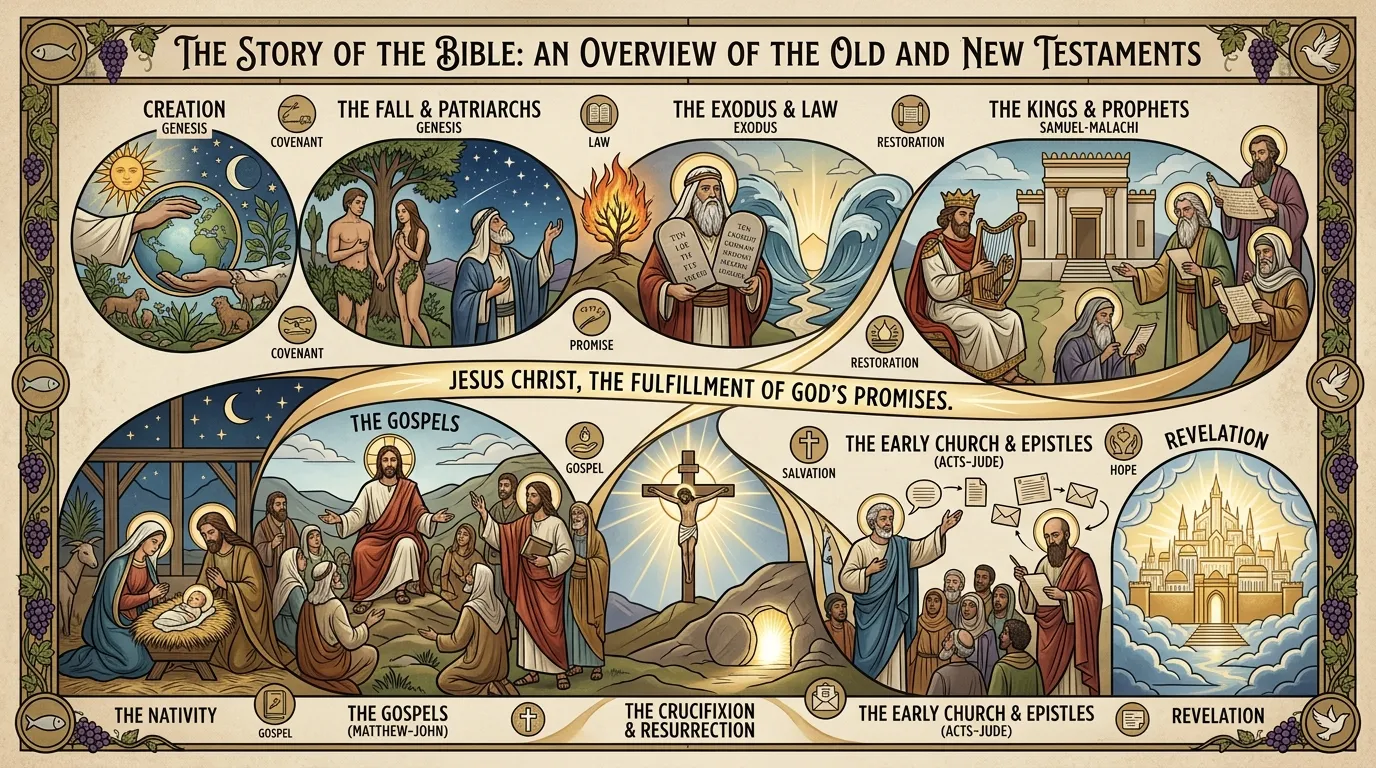
Have you ever wondered, “What does the Bible say about my situation?”
Whether you’re seeking guidance, comfort, wisdom, or answers to life’s biggest questions, the Bible offers timeless truths that speak to every generation.
As God’s inspired Word, Scripture provides direction for daily living, encouragement during difficult times, and hope for the future.
From faith and love to forgiveness, salvation, and purpose, the Bible addresses the topics that matter most.
Understanding what the Bible says can strengthen your relationship with God and help you navigate life with confidence.
In this guide, we’ll explore key biblical teachings and uncover the powerful messages God has for those who seek Him with an open heart.
A Quiet Moment That Changed Everything
Imagine you are standing outside on a quiet morning. The world feels heavy. Maybe you just went through a hard season a loss, a broken relationship, a long period of doubt. And then, out of nowhere, a dove lands nearby. It does not fly away. It simply stays.
You notice it. And something inside you shifts.
Many people who see a dove in this way say they feel it deep in their chest a warmth, a stillness, a sense that something beyond this world is reaching toward them. Others have dreamed of a dove glowing with soft white light, carrying peace into places in their heart where peace had not been for a long time.
If you have had this kind of moment, you are not alone. And you are not imagining things.
The Bible is rich with the image of the dove. From the earliest pages of Genesis to the waters of the Jordan River where Jesus was baptized, the dove carries one of the most powerful spiritual messages in all of Scripture. It is not just a bird. In the language of the Bible, the dove is a messenger from God a sign of peace, renewal, hope, and the living presence of the Holy Spirit.
So what does it mean when you see one? What is God trying to say?
Let us walk through this together, slowly and with open hearts.
Biblical Meaning of Seeing a Dove
To understand what the Bible says about the dove, we have to go back to the very beginning to a world covered in water and a man named Noah.
Genesis 8:10–12 tells us that after the great flood, Noah sent a dove out of the ark to see if the waters had gone down. The first time, the dove came back with nothing. But the second time, it returned carrying an olive branch in its beak. That single moment changed everything. It was the sign that God’s judgment had passed. Dry land was coming. New life was possible.
For thousands of years, that image has carried a message for every believer: when the storm is over, God sends a sign of peace.
The dove did not arrive in the middle of the storm. It came after. And that is often how God works. He does not always take away the flood right away. But He sends a sign sometimes a bird, sometimes a feeling, sometimes a Scripture that rises in your heart at exactly the right moment to remind you that dry ground is coming.
The second great Biblical appearance of the dove comes in the New Testament. When Jesus was baptized in the Jordan River, Matthew 3:16 tells us that as He came up out of the water, the heavens opened and the Spirit of God descended like a dove and landed on Him. At the same moment, the voice of God spoke from Heaven saying, This is my beloved Son, in whom I am well pleased.
This is one of the most powerful moments in all of the Bible. The dove was not just present it was the visible form of the Holy Spirit Himself.
This tells us something deep about what the dove means. When you see a dove in real life, in a dream, in a vision it can be a gentle reminder that the Holy Spirit is near. God is not far away, watching from a distance. He is here. Hovering. Present. Just as His Spirit hovered over the waters in Genesis 1:2 before creation began, He hovers over the moments of your life, ready to bring something new into being.
The dove also appears in the Song of Solomon, where it is used as a term of endearment My dove, my perfect one (Song of Solomon 6:9). This tells us that God sees us not as problems to be fixed, but as beloved. He calls us His dove. Gentle. Treasured. Known.
In Psalm 55:6, David in a moment of deep pain cried out, Oh, that I had the wings of a dove! I would fly away and be at rest. Even here, the dove is tied to a longing for peace and refuge, a desire to rest in God when the world feels too loud.
And in Hosea 11:11, God promises His people, They will come trembling like doves from Egypt. Even after wandering, after failure, after a long journey away from home the dove still finds its way back. And so can we.
Warning Meanings to Consider
Not every appearance of the dove carries only comfort. Sometimes God sends a dove as a gentle warning a call to slow down, to pay attention, to return to Him. In Isaiah 38:14, Hezekiah compared his distress to the mourning of a dove. If you are seeing doves in a time of deep unrest or grief, it may be God saying: I see you. I hear you. Come to me before you go any further.
The dove is, above all, a bird of peace and peace is only possible when we stop running and return to God.
Spiritual Significance and Symbolism of the Dove
Beyond specific Bible verses, the dove carries a rich language of symbolism that has spoken to the hearts of Christians for centuries.
Purity and Innocence
In the Old Testament, doves were one of the offerings acceptable for sacrifice. A family that could not afford a lamb could bring two doves. This was the offering Mary and Joseph brought when they dedicated the baby Jesus at the temple (Luke 2:24). The dove, then, is connected to purity not perfection, but a heart that comes before God as it is, with nothing to hide.
If you feel like you have wandered too far, or sinned too deeply, the dove reminds you that God still accepts your offering. He still welcomes you. You do not need to be cleaned up first.
Gentleness and Simplicity
In Matthew 10:16, Jesus said, Be as shrewd as serpents and as innocent as doves. Here, the dove represents gentleness of spirit a way of moving through the world with grace rather than force. When you see a dove, it may be an invitation to soften something in yourself. To approach a hard situation with peace instead of aggression. To trust rather than to strive.
Divine Presence and Nearness
Perhaps the most powerful spiritual meaning of the dove is simply this: God is near. When the Holy Spirit descended like a dove at Jesus’s baptism, it was not hidden or mysterious. It was visible. It was clear. God wanted people to see it.
When a dove appears at just the right moment after a prayer, in the middle of grief, on the morning of a hard decision many Christians believe this is God’s way of saying: I am here. I have not left you. Walk forward.
Hope and New Beginnings
The olive branch carried by Noah’s dove remains one of the most recognizable symbols in the world. When you are in the middle of a flood emotional, relational, financial, spiritual and a dove appears, the Biblical message is clear: something new is about to begin. The old season is ending. A fresh chapter is coming.
Biblical Interpretations in Dreams or Real Life
Many Christians report seeing doves at turning points in their lives after a funeral, on the day of a difficult decision, while praying about something that has weighed on them for years. Others dream of doves. Both can carry deep spiritual meaning.
In Real Life
A dove that lands near you and does not fly away is often seen as a visitation a moment when the spiritual world is touching the physical one.
In Dreams
Dreaming of a white dove in peaceful flight often signals peace coming to a troubled situation. A dove carrying something in its beak may represent answered prayer or a message being delivered. A dove that appears to be lost or hurt may signal a need to pray for peace for yourself, your family, or a situation that needs healing.
A stormy or dark dream with a dove still present carries a message of endurance: even in the storm, the Spirit is with you. The dove does not leave when the rain comes.
Whatever the form, always bring what you see back to prayer and Scripture. Ask God directly: What are you showing me? What do you want me to hear?
Practical Lessons & Faith Insights
Seeing a dove whether in waking life or in a dream is an invitation to pause, pray, and listen.
Here is what you can take with you:
Be still. The dove is a quiet bird. When it appears, match its energy. Slow down. Breathe. Give God room to speak.
Pray with expectation. The dove at Jesus’s baptism came right after an act of obedience. When you step into what God is calling you to do, watch for signs of His presence following close behind.
Trust the process. Noah sent the dove twice before it returned with good news. Sometimes the answer does not come the first time. Keep seeking. Keep praying. The olive branch is coming.
Open your heart to healing. If the dove appears in a season of pain, it is not mocking you. It is promising you. Comfort is on its way. You are not forgotten.
Walk gently. Let the dove remind you to move through your relationships, your work, and your faith with the gentleness Jesus described innocent as a dove.
Frequently Asked Questions
What does a dove symbolize in the Bible?
In the Bible, a dove symbolizes the Holy Spirit, peace, purity, and new beginnings. It is most famously seen at the baptism of Jesus in Matthew 3:16, where the Spirit descended like a dove.
Is seeing a dove a sign from God?
Many Christians believe that seeing a dove especially at meaningful or spiritually significant moments can be a gentle sign of God’s presence and reassurance. It is always wise to bring such experiences before God in prayer and test them against Scripture.
What does it mean to dream about a white dove?
Dreaming of a white dove typically carries a message of peace, hope, and spiritual comfort. It may indicate that God is bringing calm to a turbulent season or that prayer is being answered.
What does a dove carrying an olive branch mean in the Bible?
This image comes from Genesis 8, when Noah’s dove returned with an olive branch after the flood. It represents the end of God’s judgment and the beginning of restoration a promise that the storm is over and new life is coming.
Why did the Holy Spirit appear as a dove?
The dove is associated with gentleness, purity, and peace all characteristics of the Holy Spirit. By descending in the form of a dove, God made His presence visible and tender, not terrifying. It was a sign of love, not power.
More Searched Questions About What the Bible Says
How can I find all the Bible verses about one topic?
Jesus gave His hearers a command that is also the method: “Search the scriptures; for in them ye think ye have eternal life: and they are they which testify of me” (John 5:39). Searching begins with words. An exhaustive concordance lists every place where a word occurs in a given translation, so a reader who looks up forgive can follow the whole family: forgave, forgiven, forgiving, forgiveness. The best known of these, Strong’s concordance, also ties every English word to the Hebrew or Greek word behind it, so a subject is not missed just because different translators printed it with different English words. The cross references printed in the margins of many Bibles do the same joining work from the other side, leading from one verse to the other verses that use its key words, and topical Bibles and topical indexes gather the verses under headings, such as prayer, money or anger, ready made.
Two honest cautions belong with the tool. First, search under several words, not one: the Bible often speaks about a subject without using our word for it, so the reader who only searches for the modern term will miss most of what is there. Second, a pile of keyword results is a beginning, not an answer. An app can collect every verse containing a word in seconds, but a verse found is not yet a verse understood. The answers below take up what to do with the pile once it is gathered: read the verses whole, read them together, and notice what kind of passage each one is.
What is a topical Bible study?
A topical Bible study gathers everything Scripture says on one subject, from Genesis to Revelation, instead of working straight through one book of the Bible in its own order. The subject might be prayer, money, anger, marriage, or any question a reader brings to the text. Paul describes the careful handling such gathering requires: “Study to shew thyself approved unto God, a workman that needeth not to be ashamed, rightly dividing the word of truth” (2 Timothy 2:15). A workman measures twice and cuts once; a topical study does its measuring by collecting the whole of what is written before it dares to sum any of it up.
Its working shape is simple to state. The topic is chosen; the passages are gathered by the searching described above; each passage is then read where it stands, in its own chapter and its own setting; and only then is the Bible’s teaching on the subject summarized, keeping commands, promises, warnings and examples in their own places, as the answers that follow explain. Its strength is that a subject is seen whole, as no single book presents it. Its weakness is the mirror image: a study built from lifted verses can quietly lose the setting of every verse it lifts. How to work through one single verse step by step is a different skill again, and it is treated on its own page of this site; the topical method here is about gathering the whole Bible’s witness on one theme.
Why is one verse by itself not enough to say what the Bible teaches?
Because a single verse, lifted out of its passage, can be made to carry a meaning the passage itself refuses. Quoting one verse as though it were the whole answer even has a name: proof texting. The Bible contains a sobering scene of it. In the wilderness, the devil quoted Scripture at Jesus Himself, arguing from a real psalm: “for it is written, He shall give his angels charge concerning thee: and in their hands they shall bear thee up, lest at any time thou dash thy foot against a stone” (Matthew 4:6). The quotation was accurate. Its use was a lie, because the psalm was being aimed against the God who gave it.
Jesus answered with the rule that governs every topic search: “It is written again, Thou shalt not tempt the Lord thy God” (Matthew 4:7). It is written again. Scripture is answered with Scripture, passage is set beside passage, and a subject is settled by everything the Bible says on it together, with the clear passages framing the harder ones. That is why the topical gathering described on this page matters: it is the practical guard against proof texting. A verse nobody can check against the rest of the Bible’s teaching is a verse being asked to work alone, and the devil’s example shows where that road can lead.
Does the Bible approve of everything it records?
No, and confusing the Bible’s record with the Bible’s approval is one of the commonest mistakes in reading it. The Bible truthfully records the serpent’s lies in Eden, the sins of God’s own people, murders, betrayals and foolish speeches, none of which it commends. David’s adultery is recorded in the same book that records God’s judgment on it. The patriarchs’ polygamy is recorded as a fact of their households; no command anywhere tells God’s people to practise it, and the histories themselves show the strife it brought into those homes. A passage can be in the Bible because it truly happened, because it warns, or because it shows what needed redeeming, without God’s approval resting on it for a moment.
Why, then, record such things at all? Paul answers directly: “For whatsoever things were written aforetime were written for our learning, that we through patience and comfort of the scriptures might have hope” (Romans 15:4). And of Israel’s failures in the wilderness he says: “Now all these things happened unto them for ensamples: and they are written for our admonition, upon whom the ends of the world are come” (1 Corinthians 10:11). The record teaches even where it never approves. God’s approval is known from His commands, from the judgments and commendations the passage itself states, and from the teaching of Christ. The reader’s task is to keep recording and approving apart, and let each passage say which of the two it is doing.
What is the difference between descriptive and prescriptive passages?
A descriptive passage describes what happened. A prescriptive passage prescribes what God’s people are to do. Much confusion in topic searching comes from reading one kind as the other. Luke’s picture of the first church in Jerusalem is descriptive: “And all that believed were together, and had all things common; And sold their possessions and goods, and parted them to all men, as every man had need” (Acts 2:44-45). It describes an outburst of generosity in one young church. No verse commands every believer in every age to sell all property, and the later letters show Christians still owning the houses they met in. The example teaches glad generosity; it is not a property law.
Some passages sit near the border, and honesty admits it rather than forcing them. Foot washing is the classic case: “If I then, your Lord and Master, have washed your feet; ye also ought to wash one another’s feet. For I have given you an example, that ye should do as I have done to you” (John 13:14-15). Some churches practise literal foot washing as a church ordinance, taking the words at their plainest. Most read the “example” Jesus names as a pattern of humble service, to be done to one another in whatever form the need takes. Both readings honour the same verses; what neither may do is pretend the question is not there. The reader’s working question for any passage found in a topic search is therefore double: what is this passage doing, describing or prescribing, and to whom was it first spoken?
What if the Bible never mentions my topic directly?
Then honesty has to say so. The Bible never mentions cars, the internet, smartphones or modern surgery by name, and some of the searches behind this article ask whether the Bible talks about everything. It does not address every modern subject directly, and it damages the Bible’s credibility when a verse is claimed to “say” something it never mentions. What Scripture claims for itself is not an index of topics but an equipment for life: “All scripture is given by inspiration of God, and is profitable for doctrine, for reproof, for correction, for instruction in righteousness: That the man of God may be perfect, throughly furnished unto all good works” (2 Timothy 3:16-17). Furnished for all good works is a larger claim than a dictionary of subjects, and it is reached through principles, not name tags.
The careful way with an unmentioned topic runs like this. Gather what the Bible says on the ground nearest to it: for questions about new technology, its teaching on speech, honesty, purity, time, money and love of neighbour. Let its plain commands bind where they reach, and let its principles guide where they apply. Then say plainly which of the two you are holding, a command or a principle drawn to a conclusion, because a conclusion honestly labelled is worth more than a verse pretended. And where Scripture leaves a matter to the conscience of the believer, no reader should bind another’s conscience more tightly than the text itself does. A topic the Bible answers by principle is not a topic the Bible failed to answer; it is a topic it answered at the depth where its answer cannot date.
What is the difference between topical preaching and expository preaching?
Topical preaching takes one subject and gathers the Bible’s teaching on it from across the whole book, exactly as the topical study above does. Expository preaching works through a passage, or a whole book, in its own order, explaining and applying what that text says in its own setting. Both stand under the same charge Paul gave Timothy: “Preach the word; be instant in season, out of season; reprove, rebuke, exhort with all longsuffering and doctrine” (2 Timothy 4:2). Neither method is named in that verse; what is named is the word, preached whole, with patience.
Each has its strength and its characteristic danger, and fairness names both. Topical preaching serves people carrying one pressing question today, and it can show them the whole Bible’s answer in one hearing; its danger is the preacher’s outline choosing the verses, which, if the gathering is partial, becomes proof texting from a pulpit. Expository preaching keeps the passage itself in charge, and it carries a congregation through ground no preacher would have chosen on his own, including the hard parts; its danger is distance, if it expounds texts week by week and never lands on the questions the hearers actually brought through the door. Most healthy pulpits have known both kinds. The test of either sermon is the same test this whole page applies: were the texts allowed to say everything they say, in their settings, together?
Which “what does the Bible say about” topics do people search for most?
The real searches cluster where life presses hardest. There are the questions of the home and the heart: what does the Bible say about love, about marriage, about divorce, about finding a husband or a wife, about forgiveness. There are the conscience questions: about tattoos and piercings, about gambling, about cremation. There are the debated questions of church life, such as women pastors and abortion. And there are the heaviest ones: about heaven, about death, about life’s problems, and about suicidal thoughts. People are not idly curious when they type these searches. They are usually standing in the middle of the thing they are asking about, which is why this site gives several of them whole articles of their own: marriage, forgiveness, death and what follows it, cremation, and depression, among others.
One honest observation finishes the list, because the Bible does not treat these topics in one uniform way, and a good answer has to notice which way it is using. Forgiveness carries direct commands from the mouth of Jesus. Tattoos rest on essentially one Old Testament verse: “Ye shall not make any cuttings in your flesh for the dead, nor print any marks upon you: I am the LORD” (Leviticus 19:28), a verse sitting inside a passage about mourning customs for the dead, which Christian readers have read in more than one way since. Gambling is never named in Scripture at all, and is answered from what the Bible says about money, contentment, honest work and the love of gain. So the search is the beginning of the work, not the end of it: the verses a topic search gathers still have to be read whole, read together, and read for what they actually are, commands, records, examples or principles, before anyone can fairly say what the Bible says.
Conclusion
The dove is not just a bird. In the language of Scripture, it is a living symbol of God’s presence, peace, and faithfulness. From the floodwaters of Genesis to the banks of the Jordan River, the dove has carried a message of hope through every generation of believers.
If you have seen a dove recently in your yard, on a walk, in the quiet corner of a dream do not dismiss it. Let it lead you back to the One who sent it. He has something to say to you. And what He speaks, He speaks in peace.
Seek Him. Trust Him. And let His Spirit lead you like a dove toward still waters.

Hi, I’m James Patterson, a storyteller who loves creating thrilling mysteries, unforgettable characters, and page-turning adventures. Through TheBiblimeaning, I share insights about authors, books, literary meanings, biographies, and the stories behind famous writers. My goal is to help readers discover the deeper world of literature while enjoying engaging and informative content.










