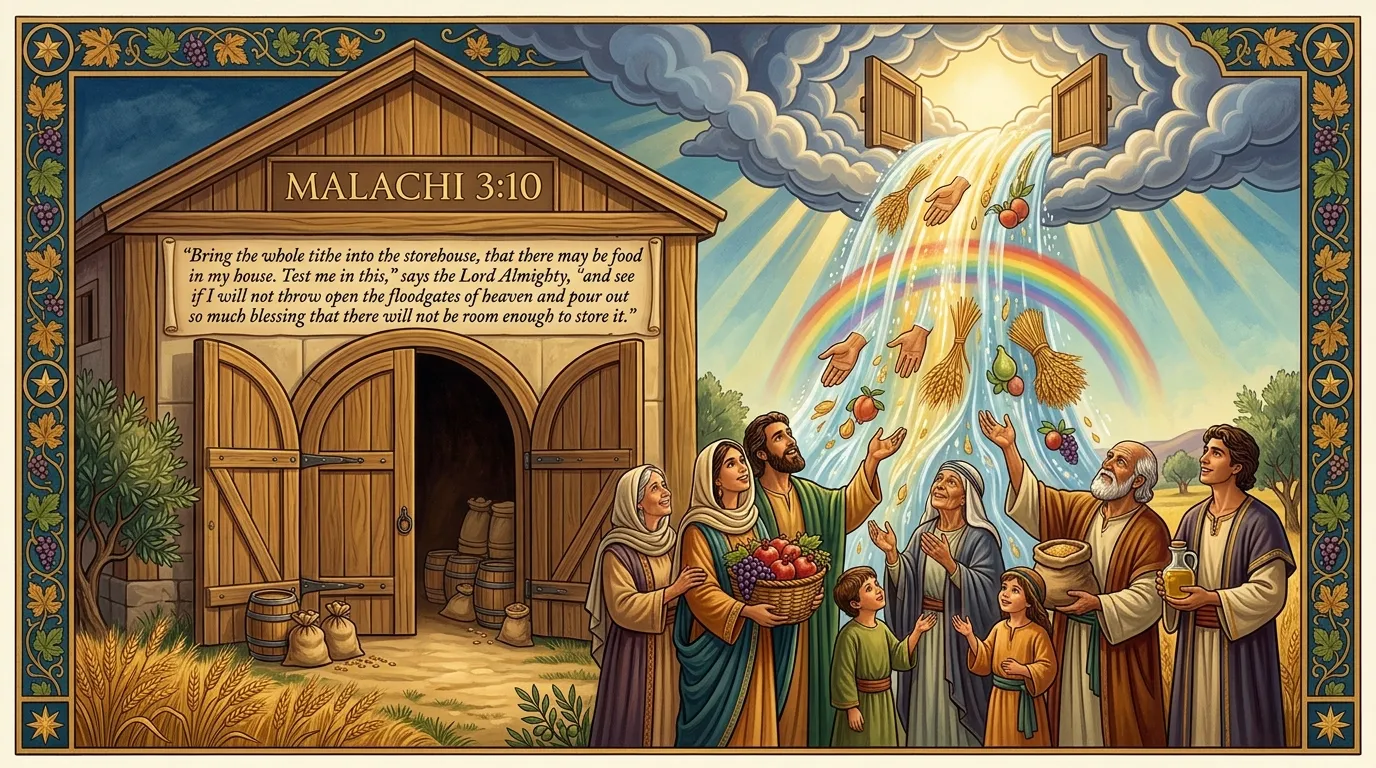
Picture an old stone barn, doors thrown wide open, sunlight pouring across the wooden floor. The harvest has come in, and there’s barely room for it all.
This image isn’t just about grain or money. It’s about trust. It’s about a heart that gives first and believes God second.
If you’ve come across Malachi 3:10 and felt something stir inside you, you’re not alone. This verse has comforted and challenged believers for generations.
It speaks about tithing, but it speaks about something deeper too. It speaks about faith.
The verse reads, Bring the whole tithe into the storehouse, that there may be food in my house.
Test me in this, says the Lord Almighty, and see if I will not throw open the floodgates of heaven and pour out so much blessing that there will not be room enough to store it.
That’s bold language. God rarely invites us to test Him. Yet here, He does exactly that.
So what does this verse really mean for your life today? What is God asking of His people, and what is He promising in return? Let’s walk through the Biblical meaning together, with open hearts and quiet trust.
Malachi 3:10 Meaning
Malachi 3:10 teaches that God called Israel to bring their full tithes into the storehouse so His temple ministry could continue. The verse highlights God’s faithfulness and invites His people to trust Him rather than depend only on their own resources. While spoken to ancient Israel, it also reminds Christians that giving should flow from a willing and grateful heart. The main message is about faithful obedience, trust in God’s provision, and honoring Him with what He has provided.
Malachi 3:10 Meaning Explanation
A clear explanation of Malachi 3:10 begins with its original audience. God addressed the Israelites because many had neglected their tithes, affecting the support of the temple and the priests. Through the prophet Malachi, God challenged them to return to faithful worship and promised to bless their obedience. The verse is not a guarantee of instant wealth but a powerful reminder that God rewards sincere faithfulness, generosity, and wholehearted trust in Him.
Malachi 3:10 Meaning Tagalog
Sa Tagalog, ang kahulugan ng Malakias 3:10 ay ang paanyaya ng Diyos na magtiwala sa Kanya sa pamamagitan ng tapat na pagbibigay. Hindi lamang ito tungkol sa ikapu kundi tungkol sa puso ng tao na handang sumunod at magpasalamat sa Diyos. Ipinapakita ng talata na ang Diyos ay tapat sa Kanyang mga pangako at kayang tugunan ang pangangailangan ng Kanyang bayan habang sila ay namumuhay nang may pananampalataya at katapatan.
Malachi 3:10 Meaning in Tagalog
Ang Malakias 3:10 sa Tagalog ay nagpapakita na nais ng Diyos ang tapat na pagsunod at bukas-palad na pagbibigay mula sa Kanyang mga anak. Ang talata ay unang ibinigay sa Israel, ngunit ang aral nito ay nananatiling mahalaga ngayon. Hinihikayat nito ang mga mananampalataya na magtiwala sa Diyos higit kaysa sa kanilang sariling kakayahan. Ang tunay na pagpapala ay hindi lamang materyal kundi pati espirituwal na kapayapaan, paglago, at mas malalim na relasyon sa Diyos.
Malachi 3:10 Meaning and Context
The context of Malachi 3:10 is essential for understanding its meaning. God spoke through the prophet Malachi to rebuke Israel for neglecting their covenant responsibilities, including withholding tithes that supported temple worship. His invitation to “test” Him was unique and demonstrated His willingness to prove His faithfulness to a disobedient nation. Read in context, the verse emphasizes covenant restoration, sincere repentance, faithful stewardship, and confidence in God’s unfailing provision rather than promising automatic financial prosperity.
Biblical Meaning of Malachi 3:10
Malachi was the last prophet before centuries of Biblical silence. His words came at a low point. The people of Israel had grown cold. They were holding back from God, offering Him their leftovers instead of their best. They had forgotten what it meant to honor Him first.
In this setting, God speaks through Malachi with both correction and hope. He calls His people back to faithful giving, not because He needs their money, but because their hearts needed to be realigned with Him.
The storehouse mentioned in this verse was the temple treasury. Tithes brought food and resources for the priests and for the needs of the community. By withholding their tithes, the people were starving God’s house and weakening their own spiritual community.
But this verse isn’t only a rebuke. It’s also a promise. God says clearly that if His people give faithfully, He will respond. He will throw open the floodgates of heaven. This phrase echoes the story of Noah, when heaven’s floodgates opened to flood the earth. Here, the image is reversed. Instead of judgment, it’s divine blessing, poured out without measure.
This connects to other scriptures about giving and trust. In 2 Corinthians 9:6-7, Paul writes that whoever sows generously will also reap generously, and God loves a cheerful giver. In Proverbs 3:9-10, we’re told to honor the Lord with our wealth, and our barns will be filled with plenty.
There’s also a warning woven into Malachi 3:10. The verses just before it call withholding tithes a form of robbing God (Malachi 3:8). That’s strong language, but it points to something simple. When we hold back from God out of fear or selfishness, we miss out on the very blessing He longs to give us.
The heart of this verse isn’t about money alone. It’s about faith in action. It’s a call to trust God enough to give first, before we see the outcome. It’s a call to believe that His provision is real, even when our hands feel empty.
Spiritual Significance and Symbolism
Malachi 3:10 carries a quiet, powerful lesson about transformation. Giving isn’t just an act. It’s a posture of the heart. When we give freely, we declare that God is our true provider, not our paycheck, not our savings, not our own effort.
This verse invites a shift from fear to faith. Many of us hold tightly to what we have because we’re afraid there won’t be enough. But God asks us to loosen our grip and trust His hands instead.
Think of a small seed buried in dark soil. It looks like loss. It looks like nothing is happening. But underground, roots are forming. Life is stirring. That’s what faithful giving looks like in our spiritual journey. It feels like letting go, but it’s actually planting something new.
In daily life, this might look like giving generously even when your budget feels tight. It might mean trusting God with your time, your gifts, or your finances when logic says to hold back. Each small act of obedience becomes an act of worship, a quiet prayer that says, God, I trust You more than I trust myself.
Biblical Interpretations in Dreams or Real Life
Sometimes the message of Malachi 3:10 shows up unexpectedly, in a dream, a sermon, or a quiet thought during prayer. If this verse keeps coming to mind, it may be God’s gentle nudge toward generosity or trust in an area you’ve been holding back.
In dreams, images of overflowing barns, open doors, or pouring rain often symbolize blessing and divine provision. A peaceful version of this dream may point to coming abundance or answered prayer. A stressful or fearful version might reflect anxiety about finances or trust issues that need to be surrendered to God.
Whatever the setting, the message stays the same. God is inviting deeper trust. He’s reminding you that His presence and provision are not far away.
Practical Lessons & Faith Insights
Let this verse soften your heart toward generosity. Give what you can, even if it feels small. Trust God’s timing, not your own timeline. Let go of fear and lean into faith. Bring your worries to Him in prayer, and watch how He provides in ways you never expected.
FAQs
Malachi 3:10 sermon
A sermon on Malachi 3:10 highlights faithful giving, trusting God, and His promise to bless those who honor Him with sincere hearts.
Malachi 3:10 Message
The message of Malachi 3:10 is that God calls His people to faithful obedience and invites them to trust His faithful provision.
Malachi 3:10 meaning tagalog
Malachi 3:10 in Tagalog refers to God’s call for faithful giving and His promise to bless those who obey Him wholeheartedly.
Malachi 3:10-12 meaning
Malachi 3:10–12 teaches that God blesses faithful obedience and uses His provision to demonstrate His covenant faithfulness.
Malachi 3:10 sermon outlines
Malachi 3:10 sermon outlines often focus on faithful stewardship, trusting God’s promises, and experiencing His abundant blessings.
Malachi 3:10 verse
Malachi 3:10 is a Bible verse that encourages faithful giving and confidence in God’s ability to provide for His people.
Malachi 3:9-10 meaning
Malachi 3:9–10 explains that Israel’s unfaithfulness affected their relationship with God, who called them to return through obedience.
What is the storehouse in Malachi 3:10
The storehouse in Malachi 3:10 was the temple storage where tithes were kept to support the priests and God’s work.
More Searched Questions About Malachi 3:10
What does Malachi 3:10 say in the King James Version, word for word?
The article above quotes this verse in a modern translation, the one that reads “throw open the floodgates of heaven” and “says the Lord Almighty”, without naming which translation it is. Many readers search for the King James wording itself, so here it is, word for word: “Bring ye all the tithes into the storehouse, that there may be meat in mine house, and prove me now herewith, saith the LORD of hosts, if I will not open you the windows of heaven, and pour you out a blessing, that there shall not be room enough to receive it” (Malachi 3:10). Two of its older words need a plain note. “Meat” in the English of 1611 means food of any kind, not only flesh. And “the LORD of hosts” is the same Hebrew title that modern versions print as “the LORD Almighty”: the LORD of the armies of heaven.
Verse 10 is one speech with the verses around it, and they are quoted here in full so the whole thing can be read together. Before it: “Will a man rob God? Yet ye have robbed me. But ye say, Wherein have we robbed thee? In tithes and offerings. Ye are cursed with a curse: for ye have robbed me, even this whole nation” (Malachi 3:8-9). After it: “And I will rebuke the devourer for your sakes, and he shall not destroy the fruits of your ground; neither shall your vine cast her fruit before the time in the field, saith the LORD of hosts. And all nations shall call you blessed: for ye shall be a delightsome land, saith the LORD of hosts” (Malachi 3:11-12). Read as one speech, the passage has an accusation, a command, a challenge, and a promise, and the answers below take those pieces one at a time, in that order.
What does it mean that Israel was robbing God?
God puts the charge as a question and answer, in a pattern that runs through the whole book of Malachi: He speaks, the people dispute His words, and He answers the dispute. “Will a man rob God? Yet ye have robbed me. But ye say, Wherein have we robbed thee? In tithes and offerings” (Malachi 3:8). Robbery here does not mean taking something out of God’s hand. It means keeping back what the covenant had already assigned to Him and to His house: the tithes that were to feed the Levites and keep the temple service going, and the offerings that belonged on His altar. What Israel treated as its own surplus, God counted as His portion withheld. That is why the strong word “rob” is used, and it is aimed at the nation as a whole, priests and people together, in a time when the temple service itself was being neglected.
The sentence that follows is the covenant’s own language: “Ye are cursed with a curse: for ye have robbed me, even this whole nation” (Malachi 3:9). Under the covenant given through Moses, Israel’s life in the land carried stated blessings for obedience and stated curses for breaking faith, and Malachi speaks from inside that arrangement. The speech is also framed, a few lines earlier, as an invitation rather than a final sentence: “Return unto me, and I will return unto you, saith the LORD of hosts” (Malachi 3:7). Teachers differ over how this curse sentence carries over to Christians, and this article does not settle that here. What Christian readers do hold in the same hand is Paul’s word about the curse of the law itself: “Christ hath redeemed us from the curse of the law, being made a curse for us: for it is written, Cursed is every one that hangeth on a tree” (Galatians 3:13). Malachi 3:9 was never written to be aimed at one struggling giver; in its own setting it is God’s charge against a whole nation that had let His house go empty, joined to His call for that nation to return.
What was the storehouse, and what was actually brought into it?
The storehouse was a set of storage chambers in the temple in Jerusalem, the rooms where the food tithe was kept. Nehemiah, governing Jerusalem in the same period Malachi addresses, describes the system working: the Levites collected the tithes in the towns, “and the Levites shall bring up the tithe of the tithes unto the house of our God, to the chambers, into the treasure house” (Nehemiah 10:38), from which the priests received their share. And when the people responded to the call, the record names what actually arrived: “Then brought all Judah the tithe of the corn and the new wine and the oil unto the treasuries” (Nehemiah 13:12). Corn means grain. So the storehouse held food: grain, wine, oil, and the produce of field and tree. That is why Malachi 3:10 says “that there may be meat in mine house”: in the King James wording, meat is food, and God’s house needed food in it because people lived from it.
The people who lived from it were the Levites, the tribe set apart for the service of God’s house. They had received no farmland of their own among the tribes, and the tithe was put in place of land: “And, behold, I have given the children of Levi all the tenth in Israel for an inheritance, for their service which they serve, even the service of the tabernacle of the congregation” (Numbers 18:21). Nehemiah shows what happened when the food stopped coming: “And I perceived that the portions of the Levites had not been given them: for the Levites and the singers, that did the work, were fled every one to his field” (Nehemiah 13:10). The singers and temple workers had to abandon the service and farm for their own survival. So the storehouse was not a vault for treasure and not a picture or a symbol. It was the pantry of God’s house, stocked with food so that the households who served there, and in turn the priests, could eat and the worship of God could go on.
What exactly was the tithe under the Law, and was it only ten percent?
The word tithe simply means a tenth part. The Law measured that tenth on what the land produced, not on wages: “And all the tithe of the land, whether of the seed of the land, or of the fruit of the tree, is the LORD’S: it is holy unto the LORD” (Leviticus 27:30), and again, “Thou shalt truly tithe all the increase of thy seed, that the field bringeth forth year by year” (Deuteronomy 14:22). Grain, fruit, oil, wine, and the increase of herds and flocks: this is the tithe Malachi’s hearers knew, and the main tithe of it went to the Levites for their service, as the answer above shows. There was no salary and no pay packet in this system at all.
The Law also names more than one tenth. Deuteronomy describes a tithe the Israelite household itself ate at the yearly feasts in God’s chosen place: “And thou shalt eat before the LORD thy God, in the place which he shall choose to place his name there, the tithe of thy corn, of thy wine, and of thine oil, and the firstlings of thy herds and of thy flocks; that thou mayest learn to fear the LORD thy God always” (Deuteronomy 14:23). And every third year a tithe stayed in the towns for the vulnerable: “At the end of three years thou shalt bring forth all the tithe of thine increase the same year, and shalt lay it up within thy gates: And the Levite, (because he hath no part nor inheritance with thee,) and the stranger, and the fatherless, and the widow, which are within thy gates, shall come, and shall eat and be satisfied; that the LORD thy God may bless thee in all the work of thine hand which thou doest” (Deuteronomy 14:28-29). Teachers who add these tithes together reach totals well above ten percent of produce across the years, but that arithmetic is teachers’ counting from the texts: the Bible itself never prints one total percentage, and part of the festival tithe was eaten by the giver’s own household. One more fact belongs here, because searches ask about it: tithing is older than Moses. Abraham gave a tenth of the spoils of a single battle to Melchizedek, “And he gave him tithes of all” (Genesis 14:20), and Jacob vowed, “of all that thou shalt give me I will surely give the tenth unto thee” (Genesis 28:22). Those are events and a vow, not a standing yearly law, and both sides of the New Testament discussion below make use of them.
Does God really invite people to test Him in Malachi 3:10?
He does, and the King James wording is “prove me now herewith, saith the LORD of hosts” (Malachi 3:10). To prove in this older English means to test, to put something to the proof. The invitation sounds surprising because the Law itself forbids testing God: “Ye shall not tempt the LORD your God, as ye tempted him in Massah” (Deuteronomy 6:16). At Massah, Israel had tested God in unbelief, demanding that He prove Himself on their terms before they would trust Him. In Malachi the direction is reversed. God Himself issues the invitation, and the thing to be proved is specific: His faithfulness to His own covenant promise, measured in the chapter’s own terms, heaven opened over the fields and the devourer rebuked from the crops. It is not an invitation to experiment on God about anything at all, and the test hangs on obedience already done: bring the tithes, then see.
The invitation also stands inside a call to return, which is the sentence just before the robbing charge: “Return unto me, and I will return unto you, saith the LORD of hosts” (Malachi 3:7). The promise was spoken to one nation, under one covenant, whose harvests rose and fell with rain they could not control, and it concerned that nation’s restoration to the covenant it had let slip. Teachers differ on how directly a Christian today should claim this exact invitation for himself, and this article leaves that question where the texts leave it, with the readings in the New Testament answer below. What the verse itself will not support is a detachable formula, as though the words “prove me” turned giving into a machine for outcomes. The God of Malachi 3 invites His returning people to find out whether He keeps His word. He does not put Himself at the disposal of a technique.
What are the windows of heaven, and what blessing does the verse actually promise?
“Windows of heaven” is a Hebrew picture of openings in the sky through which rain comes down. Scripture uses the phrase in only a few places, and they agree with each other. At the flood: “the same day were all the fountains of the great deep broken up, and the windows of heaven were opened” (Genesis 7:11), and rain fell. In judgment on the earth, Isaiah says “the windows from on high are open” (Isaiah 24:18). And in Samaria, starving under siege, a royal officer scoffed at the promise of food by the next day: “Behold, if the LORD would make windows in heaven, might this thing be?” (2 Kings 7:2). Even the scoffer knew what the words meant: windows in heaven meant rain, and rain meant crops, and crops meant bread. So when Malachi 3:10 promises that God will open the windows of heaven, its first hearers heard a promise of rain sent on a dry land in its season, not a shower of banknotes.
The rest of the promise is spelled out in the next two verses, quoted in full in the first answer on this page, and every part of it belongs to that same farming world. “I will rebuke the devourer for your sakes” (Malachi 3:11): the devourer is whatever devours the crop before it can be gathered, which teachers generally read as the locust and the pests of the field, and the verse gives its own evidence, “he shall not destroy the fruits of your ground; neither shall your vine cast her fruit before the time in the field”. Then the result among the nations: “And all nations shall call you blessed: for ye shall be a delightsome land, saith the LORD of hosts” (Malachi 3:12). An honest boundary belongs here, and the article above already states it in its own words: this is not a guarantee of instant wealth. Nothing in these verses promises an individual giver a salary increase, a thriving business, or riches. The promise is a covenant blessing on a nation’s land and harvests, inside its own setting. How far its picture reaches into Christian giving today is a real question, and it is the one the next answer treats with the teachers’ readings labelled.
Do Christians have to tithe today? What does the New Testament actually say?
Start with the facts that every reading has to work with. No verse in the New Testament commands church members to give ten percent of their income. The only direct mention of tithing in the teaching of Jesus is this one: “Woe unto you, scribes and Pharisees, hypocrites! for ye pay tithe of mint and anise and cummin, and have omitted the weightier matters of the law, judgment, mercy, and faith: these ought ye to have done, and not to leave the other undone” (Matthew 23:23). Its setting matters: Jesus is speaking to leaders still living under the Mosaic covenant, before the cross, and even there He places judgment, mercy, and faith above the careful tithing of garden herbs. The New Testament’s own instructions for the collection use different measures altogether. Paul writes: “Upon the first day of the week let every one of you lay by him in store, as God hath prospered him, that there be no gatherings when I come” (1 Corinthians 16:2), and, for a relief collection, “Every man according as he purposeth in his heart, so let him give; not grudgingly, or of necessity: for God loveth a cheerful giver” (2 Corinthians 9:7). About that same collection Paul says plainly, “I speak not by commandment” (2 Corinthians 8:8).
Teachers read these same texts in more than one settled way, and the main readings are set out here without this article declaring one of them the winner. Many churches teach the tithe as the continuing biblical standard and the starting point of a believer’s giving, pointing to Abraham and Jacob giving a tenth before the Law existed (Genesis 14:20 and Genesis 28:22, answered above) and to the fact that Jesus corrected the Pharisees’ priorities in Matthew 23:23 without cancelling the tithe itself. Many other teachers answer that the tithe belonged to Israel’s covenant system, where it worked as the provision for a priestly tribe, a temple, and the poor of the land, and that the new covenant measure is not a percentage but giving that is generous, regular, sacrificial, and cheerful, sized by how God has prospered each giver. A middle reading keeps the tenth as a wise pattern and a floor for many believers while denying that it stands as a law carrying Malachi’s curse behind it. What no reading of these texts does is turn Malachi 3:10 into a threat or a bargain: in every camp, the New Testament’s own tone for giving is worship and gladness, not fear.
Should giving be figured on gross income or net income?
Honestly stated: the Bible never answers this question in these terms, because it never defines the tithe on a wage in the first place. Gross and net are payroll words, and there are no payrolls in Malachi. The measures the texts do give are harvest measures: “all the increase of thy seed” (Deuteronomy 14:22), “all the tithe of the land” (Leviticus 27:30). The closest principle to the gross side of the modern argument is the principle of firstfruits: “Honour the LORD with thy substance, and with the firstfruits of all thine increase” (Proverbs 3:9). Firstfruits is the language of order and priority: God receives from the top of the increase, before the rest is consumed. It is because of that principle that many people who tithe today calculate on their gross pay, giving before tax and deductions take their share, as the nearest modern equivalent of first.
Others answer that taxes and deductions are realities the ancient texts never picture, and they give a first and cheerful portion of what actually reaches their hands; pastors and teachers land in both places, and no verse settles payroll arithmetic either way. The same honest limit covers the related questions people search with this one: giving while in debt, giving from a pension or benefits, and giving on money received as a gift. For all of them Scripture supplies principles rather than rules: giving that is first, that is proportioned to how God has prospered the giver, and that is cheerful rather than squeezed out by pressure (2 Corinthians 9:7). Anyone who claims to find an exact dollar formula for these situations inside Malachi 3:10 is claiming more than the verse contains, whichever side of the gross and net question he is arguing from.
Are firstfruits and the tithe the same thing?
They are related, and searches often run them together, but in the Bible’s own system they are not the same thing. Firstfruits are the first portion of a harvest, brought first, before the rest is used: “The first of the firstfruits of thy land thou shalt bring into the house of the LORD thy God” (Exodus 23:19). Deuteronomy pictures the bringing of them, a basket of the first produce carried to God’s chosen place with a spoken confession of how God had delivered His people: “That thou shalt take of the first of all the fruit of the earth, which thou shalt bring of thy land that the LORD thy God giveth thee, and shalt put it in a basket, and shalt go unto the place which the LORD thy God shall choose to place his name there” (Deuteronomy 26:2). The firstfruits said, in acted form, that the whole harvest was God’s gift and that He came first in it.
The tithe is a different thing: a measured tenth of the whole increase (Leviticus 27:30, answered above), brought year by year, and largely eaten or distributed among the Levites, the poor, and the giver’s own household at the feasts, rather than presented as a first portion at the altar. Both practices put God first from what the land gives, which is why they stand side by side in the Law’s system and why Proverbs can call the honouring of God a matter of “the firstfruits of all thine increase” (Proverbs 3:9). But they are two parts of that system, not two names for one payment. One modern use deserves a plain note: many teachers and churches today use the word firstfruits loosely, for a first salary, a first profit, or a special gift at the start of a year. That is a borrowed use of the word, a practice of teachers rather than the thing Exodus and Deuteronomy describe, and in Malachi the word under discussion is neither of them: it is the tithe, the tenth, brought into the storehouse of God’s house.
Conclusion
Malachi 3:10 reminds us that God is faithful, even when our faith feels small. He invites us to trust Him, to give freely, and to watch Him pour out blessings beyond what we can imagine. Hold onto hope. God’s hands are always open toward you.
Discover More Post
- Adrian Name Meaning in Bible: Is This Name in the Bible?
- Jacob Name Meaning in Bible: Biblical Meaning & Lessons
- Sanctify Meaning in the Bible: God’s True Purpose

Hi, I’m James Patterson, a storyteller who loves creating thrilling mysteries, unforgettable characters, and page-turning adventures. Through TheBiblimeaning, I share insights about authors, books, literary meanings, biographies, and the stories behind famous writers. My goal is to help readers discover the deeper world of literature while enjoying engaging and informative content.