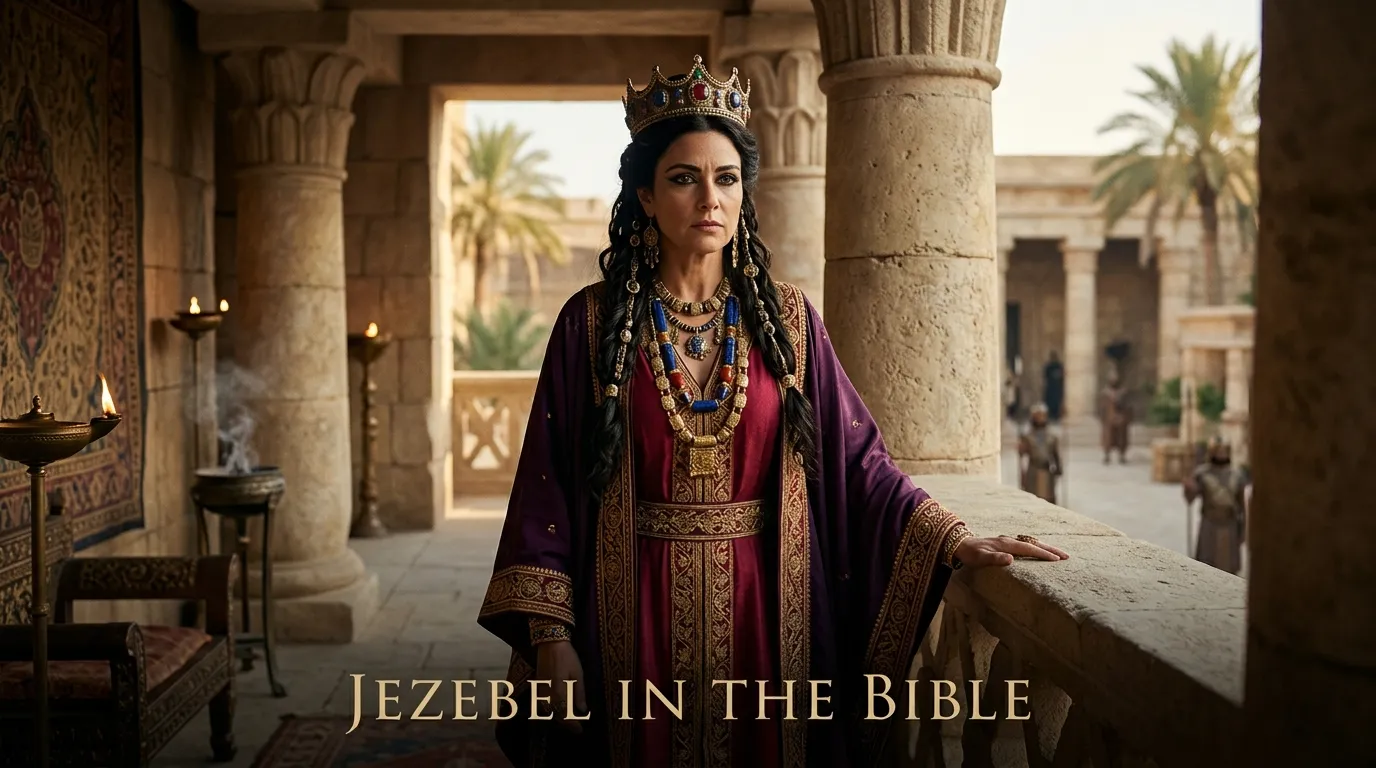
Jezebel in Scripture is the Princess from Tyre who married King Ahab of Israel.
She backed the praise of Baal and Asherah, attacked the prophets of the Lord, set up Naboth’s death to seize his vines, and threatened the prophet Elijah.
She died a harsh, foretold death at Jezreel by King Jehu.
Her story, told mainly in 1 and 2 Kings, is a warning about idol rites, misuse of might, and leading others from God.
Who Was Jezebel
Jezebel was the daughter of Ethbaal, king of the Sidonians, a ruler from Tyre. Her marriage to Ahab was a state alliance, the kind of royal marriage that tied nations as one through family bonds. He was king of the northern kingdom of Israel. In Israel, though, that alliance brought religious consequences.
The queen brought Baal rites with her. She backed hundreds of prophets of Baal and Asherah. She used royal might to make those rites central in Samaria. Scripture presents Ahab as a king who did evil, and Jezebel as a strong pull who encouraged and allowed that evil.
The text says there was no one like Ahab who sold himself to do evil, as his wife the queen stirred him up. That does not remove Ahab’s responsibility. It shows how a marriage, a court, and a nation’s worship can shape one another. The queen was not a passive queen consort.
She acted, wrote notes in the king’s name, used the royal seal, told elders, and shaped plans. Scholars have debated her name. Some link it to a phrase meaning where is the prince, tied to Baal as a god. Older books list a sense tied to chaste.
Scripture does not explain her name as a riddle. It shows her heart through deeds. Those deeds are love for Baal, hate for the Lord’s prophets, sly tricks of law for personal gain, and refusing to repent when met by Elijah. Ask whether your pull leads others to God or from him now.
Jezebel, Elijah, and the Contest on Mount Carmel
The best known clash between Jezebel and a prophet of God comes through Elijah. By the time of 1 Kings 18, Israel is in drought, Baal prophets are backed by the court, and the Lord’s prophets have been killed or hid. The prophet sets a test on Mount Carmel. Two altars and two gifts will show which god answers by fire, and that god is the true God.
The Baal prophets call, cut themselves, and shout from morning to noon without answer. The prophet repairs the Lord’s altar, soaks the gift with water, prays briefly, and fire falls, burning the gift, wood, stones, and water. The men and women fall down and say that the Lord is God, and the Baal prophets are killed. That win does not end her power.
When Ahab tells Jezebel what Elijah has done, she sends a man with a death threat. By tomorrow, the prophet’s life will be like the life of one of the Baal prophets. The prophet flees in fear to Beersheba and then into the desert, asking God to take his life. He had just stood firm on Carmel.
That turn startles many readers, and it teaches a key lesson: true men and women can feel fear and fatigue after a great win, and God meets them not with blame alone, but with food, rest, and a soft word at Horeb. Her threat also shows her way. She does not debate faith in public. She uses royal might and direct threats to silence foes.
She had by now backed the killing of the Lord’s prophets. Obadiah had hid 100 prophets in caves to save them. Her court was not a place of free talk. It was a place where love for Baal was praised and love for the Lord was deadly.
What did Jezebel do in the Bible
Jezebel was a queen of Israel who led many people away from worshiping God. She was the wife of King Ahab and supported the worship of Baal. She also tried to kill God’s prophets and used her power to harm innocent people. One well-known story tells how she arranged the death of Naboth to take his vineyard. Her actions brought great trouble to Israel. Her story warns readers about the dangers of pride, false worship, and the abuse of power.
Jezebel in the Bible KJV
In the King James Version (KJV), Jezebel appears as a powerful queen who opposed God’s prophets. First Kings 16:31 describes her marriage to King Ahab and her support for Baal worship. In First Kings 18, she tries to destroy the Lord’s prophets. First Kings 21 tells how she plans Naboth’s death. The KJV gives readers a clear account of her choices and their results. These passages show why Jezebel became a lasting symbol of evil influence in the Bible.
What happened to Jezebel in the Bible
Jezebel faced a tragic end after years of opposing God’s word. Jehu came to Jezreel to take control of the kingdom. When Jezebel saw him, she looked out of an upper window. At Jehu’s command, her servants threw her down, and she died. Later, Jehu ordered her burial, but most of her body had been eaten by dogs. This fulfilled the judgment spoken by the prophet Elijah. Her story is recorded in Second Kings 9:30–37.
Jezebel in the Bible husband
Jezebel’s husband was King Ahab, who ruled the northern kingdom of Israel. Their marriage joined the royal families of Israel and Sidon. Jezebel was the daughter of Ethbaal, king of the Sidonians. She strongly influenced Ahab and encouraged him to worship Baal. Together, their rule became known for serious wrongdoing in the sight of God. Ahab also allowed Jezebel to use royal power against innocent people. Their story appears mainly in First Kings, chapters 16–21.
Jezebel in the Bible chapter
The main story of Jezebel appears in several chapters of First and Second Kings. First Kings 16 introduces her marriage to Ahab and her influence on Israel’s worship. First Kings 18 describes her attack on God’s prophets. First Kings 21 tells the story of Naboth’s vineyard and her cruel plan. Second Kings 9:30–37 records her final moments and death. Reading these passages in order helps readers understand her actions, her influence, and the judgment that followed.
Jezebel in the Bible death
Jezebel died in Jezreel during Jehu’s rise to power. When Jehu arrived, she looked through an upper window and spoke to him. He called for help from anyone inside, and two or three servants pushed her out of the window. She fell to the ground and died. When Jehu later ordered her burial, only parts of her body remained. This terrible end fulfilled Elijah’s prophecy in First Kings 21:23, as recorded in Second Kings 9:30–37.
Jezebel in the Bible Revelation
Revelation 2:20 mentions a woman called Jezebel who taught and misled people in the church at Thyatira. She encouraged believers to take part in sexual sin and food offered to idols. The name may point to the Old Testament queen because both stories involve false worship and harmful influence. The passage warns the church not to accept teachings that lead people away from God. It also shows the need to stay faithful to biblical truth, even when wrong ideas seem attractive.
Jezebel spirit
The phrase “Jezebel spirit” is used in some Christian communities to describe harmful behavior linked to manipulation, control, false worship, and opposition to God’s truth. However, the Bible does not use this exact phrase as the name of a spirit. It comes from the way some readers connect Queen Jezebel’s actions with the warning in Revelation 2:20. It is important to use this term with care and avoid labeling people unfairly. The biblical stories focus on actions, choices, and spiritual faithfulness.
Naboth’s Vineyard: Power Used to Steal
The story of Naboth’s vines in 1 Kings 21 is the clearest picture of her misuse of might. Naboth owned a vines in Jezreel, next to Ahab’s house. Ahab wanted it for a garden. Ahab offered to buy it or swap it for a better vines.
She wrote notes in Ahab’s name, sealed with his seal, to the elders and chiefs of Naboth’s city. She told them to call a fast and seat Naboth in a high place. Then they were to bring two worthless men to charge him falsely of cursing God and the king. The elders obeyed, Naboth was stoned to death, and the queen told Ahab to take hold of the vines.
The Naboth story is not just about a vines. It is about greed, false words, death, and theft. All break God’s law, all enabled by royal might used without right. It warns readers that might with no answer breaks law itself, turning a fast, a court, and a city’s elders into tools for theft.
Jezebel’s Death at Jezreel
Her death is told in 2 Kings 9, years after Naboth’s death. Jehu is anointed king to execute judgment on the house of Ahab. Jehu rides to Jezreel, where King Joram, Ahab’s son, is recovering from wounds. Jezebel hears Jehu is coming, paints her eyes, sets her hair, and looks out of a window.
Dogs have devoured the rest, fulfilling Elijah’s word to the letter. In the plot at Jezreel, dogs will devour the flesh of the queen. Her body will be like trash on the field, so no one will be able to say, this is the queen.
The horror of that end is meant in the story. It marks the end of Baal’s rule at court. It marks the fall of a house that led Israel into idol rites, and the truth of God’s prophet word.
It raises hard questions for modern readers about violence in the Old Testament. The story does not invite readers to celebrate cruelty. It presents divine judgment on a long way of idol rites, attack, and murder, carried out through political change in a harsh age. Readers should sit with that strain honestly, rather than easing the story or using it to defend harm now.
1 Kings 21:23 – And concerning Jezebel, the Lord also spoke, saying, The dogs will devour Jezebel by the wall of Jezreel.
Jezebel in Revelation and Later Use of Her Name
Jezebel appears again, as a sign, in the last book, 2:20. The risen Christ, speaking to the church in Thyatira, says the church bears with a woman called Jezebel, who calls herself a prophet. She teaches and leads servants astray to do sexual sin and eat food given to gods. This is not a claim that the old queen lived again in Thyatira.
Her name is used as a sign for a false teacher who leads those who trust God into idol rites and compromise. That teacher is like the old queen who led Israel into Baal rites. That use explains why Jezebel became a name in late church speech for a wicked, sly, or tempting woman. Readers should use that language with care.
Lessons From Jezebel’s Story Today
First, pull matters. Jezebel did not act alone, but her pull shaped a king, a court, and a land. Parents, guides, chiefs, and friends all shape others by what they praise, reward, and bear. A small compromise at court became national idol rites.
A small compromise at home or at work can also grow, if it is said again and praised. Second, law and might must serve right, not selfish desire. Jezebel used notes, seals, fasts, and courts, all good tools in themselves, to commit murder and theft. When courts are used to protect the strong and punish the innocent, they lose their moral weight.
| Event in Jezebel’s story | Bible passage | What it shows |
| Marriage to Ahab and Baal rites | 1 Kings 16:31-33 | Political alliance brings Baal and Asherah worship into Israel |
| Persecution of the Lord’s prophets | 1 Kings 18:4, 13 | Court power used to kill or hide faithful prophets |
| Contest on Mount Carmel | 1 Kings 18:16-40 | The Lord answers by fire; Baal prophets are killed |
| Threat to Elijah | 1 Kings 19:1-3 | Royal fear drives a bold prophet to flee |
| Naboth’s vines and murder | 1 Kings 21:1-16 | False charges and stoning used to steal ancestral land |
| Elijah’s judgment word | 1 Kings 21:17-24 | Dogs will devour Jezebel by the wall of Jezreel |
| Death by Jehu | 2 Kings 9:30-37 | Prophecy fulfilled at Jezreel; only skull, feet, and hands remain |
| Symbolic Jezebel in Thyatira | Revelation 2:20 | Name used for lies that leads believers into idolatry |
| Person in the story | Role | Lesson for readers |
| Jezebel | Queen who promotes Baal and misuses power | Influence without right breaks a land |
| Ahab | King who allows and benefits from her actions | Passive consent makes a leader guilty too |
| Elijah | Prophet who confronts idolatry and flees in fear | Bold faith and human fear can exist in the same person |
| Naboth | Landowner who refuses to sell his land | Firm refusal can cost dearly, yet keeps God’s law |
| Jehu | King anointed to judge Ahab’s house | God’s judgment can come through political change, not just through miracles |
| Obadiah | Court man who hides 100 prophets | Quiet faith can save lives in a hard court |
FAQ
Who was Jezebel in the Bible
Jezebel was a Princess from Tyre, daughter of Ethbaal, king of the Sidonians. She married King Ahab of Israel. She backed Baal and Asherah worship, attacked the Lord’s prophets, set up Naboth’s death, and threatened Elijah. She died at Jezreel by Jehu, as the prophet had foretold.
What did Jezebel do that was so bad
She used royal might to replace praise of the Lord with Baal rites. She backed Baal prophets and sought to kill the Lord’s prophets. She orchestrated a false trial that led to Naboth being stoned so Ahab could take his vines. Her story combines idol rites, hate, sly tricks of law, death, and theft.
How did Jezebel die
At Jezreel, Jehu ordered her eunuchs to throw her from a window. She was crushed by horses. Dogs devoured her body, leaving just her skull, feet, and hands. That fulfilled Elijah’s word in 1 Kings 21:23 that dogs would devour Jezebel by the wall of Jezreel.
What does Jezebel mean in Revelation
In the last book 2:20, Jezebel is used as a sign for a woman in Thyatira. She calls herself a prophet. She leads those who trust God into idol rites and sexual sin. It is not the old queen alive again, but a name for the same way of lies and leading God’s people astray.
Why is Jezebel’s name used as an insult today
Because her story from Scripture became a sign for wickedness, sly tricks, and revolt against God, her name entered speech as a name. It stands for a wicked or tempting woman. Readers should use it with care, focusing on the way from God’s Word of idol rites and lies, not as a common tag for strong women. Let the word shape how you use might and pull now.
Did Jezebel repent before she died
Scripture records no turning back by Jezebel. Ahab humbled himself after Elijah’s judgment and the ruin on his house was delayed, but the queen faced Jehu in royal dress and defiance. Her story contrasts with Ahab’s brief low heart. It warns against a hardened refusal to turn from wrong.
What can Christians learn from Jezebel today
Christians can learn that pull shapes others and that might must serve right. They can learn that God’s word stands when prophets flee or the innocent suffer, and that turning back and lowly heart are possible till ways harden. The story warns guides and chiefs not to lead others into idol rites or compromise, whatever form those gods take now. Stay humble early, till a way hardens into a way of life.
Conclusion
Jezebel’s story in 1 Kings and 2 Kings is a grim account. It shows what happens when might is used to protect idol rites and hide truth. She backed Baal rites and attacked the prophets of the Lord. She set up the death of Naboth to take his vines, and threatened Elijah after the test on Mount Carmel.
Discover More Post
- Firmament in the Bible: What Does It Mean and Why Is It Important?
- How to Read the Bible: A Simple Guide for Everyone
- What Is the Difference Between Catholic and Christian
- Seek First the Kingdom of God: Meaning, Context, and Daily Life

Hi, I’m James Patterson, a storyteller who loves creating thrilling mysteries, unforgettable characters, and page-turning adventures. Through TheBiblimeaning, I share insights about authors, books, literary meanings, biographies, and the stories behind famous writers. My goal is to help readers discover the deeper world of literature while enjoying engaging and informative content.