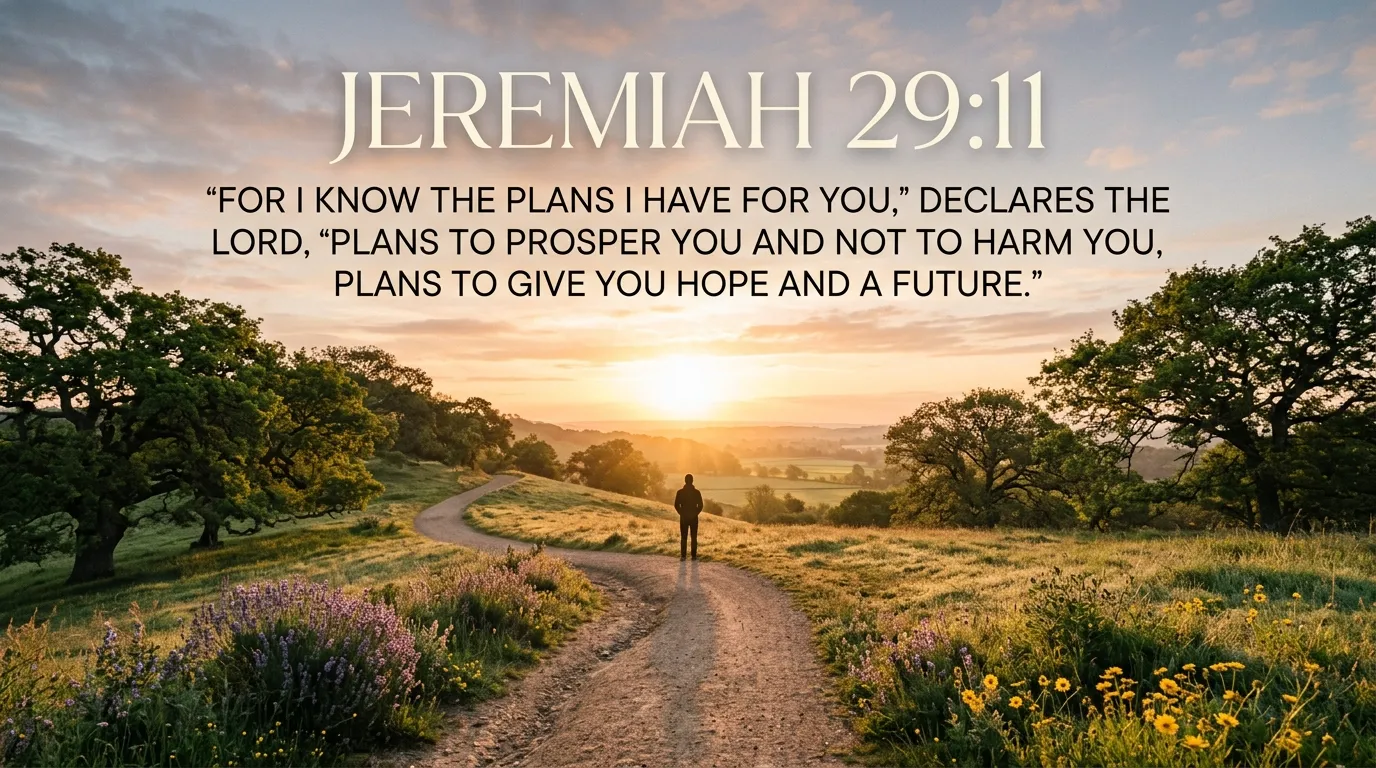
Have you ever faced a season when nothing seemed clear? Maybe doors closed, plans failed, or your future felt uncertain.
In moments like these, many Christians turn to one of the most loved Bible verses ever written Jeremiah 29:11.
This verse has brought comfort to millions of believers around the world. It reminds us that even when life feels confusing, God is still working behind the scenes.
His plans are greater than our fears, and His timing is always perfect.
The words of Jeremiah 29:11 speak directly to people who need hope. They assure us that God sees the whole picture when we can only see a small part.
When challenges come, this verse offers peace and confidence that our lives are not left to chance.
But what is the true Jeremiah 29:11 meaning? Was it only for the people of Israel, or does it still carry a spiritual message for Christians today?
Let’s explore the biblical meaning, spiritual symbolism, and life-changing lessons hidden within this powerful verse.
Biblical Meaning of Jeremiah 29:11
Jeremiah 29:11 says:
“For I know the plans I have for you,” declares the Lord, “plans to prosper you and not to harm you, plans to give you hope and a future.”
These words were spoken by God through the prophet Jeremiah to the people of Israel. At the time, they were living in exile in Babylon. They had lost their homes, their freedom, and much of their hope.
Many of them expected God to rescue them quickly. Instead, God told them that they would remain in exile for many years. Yet in the middle of that difficult message, He gave them a promise: He had not forgotten them.
The true Jeremiah 29:11 meaning begins with understanding God’s faithfulness. Even when His people were far from home, God still had a purpose for their lives.
This verse teaches several important truths:
God has a plan. Life is not random. God works through every season, even painful ones.
God’s plans are good. His purpose is not to destroy us but to lead us toward hope and spiritual growth.
God sees the future. While we worry about tomorrow, God already knows what lies ahead.
God remains present during hardship. The Israelites were still in exile, but God was with them there.
For Christians today, this verse does not mean life will always be easy. It does not promise wealth, comfort, or instant success. Instead, it promises that God is guiding His children according to His loving purpose.
Other Bible verses support this message:
- Romans 8:28 teaches that God works all things together for good for those who love Him.
- Proverbs 3:5-6 encourages believers to trust the Lord rather than their own understanding.
- Psalm 33:11 says that God’s plans stand forever.
There is also a gentle warning within the verse. Sometimes people want God’s blessings without trusting His process. The Israelites had to wait patiently before seeing God’s promise fulfilled.
The biblical symbolism found in Jeremiah 29:11 is one of hope, trust, divine guidance, and faithful endurance. It reminds believers that difficult seasons are often part of God’s greater story.
Spiritual Significance and Symbolism
The spiritual symbolism of Jeremiah 29:11 reaches far beyond its original audience.
At its heart, the verse represents hope during uncertainty. Many people experience moments when they feel lost or discouraged. This scripture reminds them that God still has a direction for their lives.
Another important symbol is divine guidance. Just as a shepherd leads sheep through unknown paths, God guides His people through life’s twists and turns.
The verse also points to spiritual growth. Often, God uses waiting seasons to strengthen faith. What feels like a delay may actually be preparation.
Imagine a seed planted in the ground. For a time, nothing seems to happen. Yet beneath the soil, roots are growing. In the same way, God may be working in unseen ways within our lives.
For many Christians, Jeremiah 29:11 becomes a source of comfort during prayer. It reminds them that God is still writing their story, even when they cannot see the next chapter.
The spiritual message is clear: trust God even when you do not understand the journey.
Biblical Interpretations in Dreams or Real Life
Sometimes people encounter Jeremiah 29:11 in unexpected ways. They may see the verse repeatedly, hear it during worship, dream about it, or feel drawn to it during a difficult season.
In dreams, this verse often symbolizes encouragement, reassurance, and hope. It may remind believers that God is guiding them through a period of uncertainty.
If the dream feels peaceful, it can point to God’s presence and care. It may be a reminder to trust His timing and remain faithful.
If the dream occurs during a stressful situation, it may serve as a gentle invitation to release fear and place the future in God’s hands.
In real life, many people connect with Jeremiah 29:11 when facing major decisions, career changes, family struggles, or spiritual questions. The verse encourages prayer rather than panic.
Rather than treating it as a prediction, Christians should view it as a reminder of God’s character. He is loving, faithful, and committed to His people.
Through both dreams and daily life experiences, the Christian meaning of Jeremiah 29:11 remains the same: God’s plans are guided by wisdom, love, and eternal purpose.
Practical Lessons and Faith Insights
Jeremiah 29:11 offers simple but powerful lessons:
- Trust God’s timing even when answers seem delayed.
- Pray with faith during uncertain seasons.
- Remember that God sees the future clearly.
- Stay hopeful when circumstances look difficult.
- Believe that God can bring good from challenges.
Every season has a purpose when it is placed in God’s hands.
FAQs
What is the true meaning of Jeremiah 29:11?
The verse teaches that God has good plans for His people. It emphasizes hope, guidance, and trust in God’s purpose, even during difficult times.
Does Jeremiah 29:11 promise success and wealth?
Not necessarily. The verse focuses on God’s good intentions and spiritual purpose rather than guaranteeing material prosperity.
Who was Jeremiah 29:11 originally written to?
It was written to the Israelites living in exile in Babylon. God used the message to encourage them during a challenging period.
How can Christians apply Jeremiah 29:11 today?
Christians can apply it by trusting God’s guidance, remaining faithful during hardships, and believing that He is working for their good.
What does Jeremiah 29:11 mean in dreams?
In dreams, it often symbolizes hope, reassurance, divine guidance, and encouragement to trust God’s plan for the future.
More Searched Questions About Jeremiah 29:11
What do the Hebrew words “thoughts” and “peace” mean in Jeremiah 29:11?
Here is the verse in full, in the King James wording: “For I know the thoughts that I think toward you, saith the LORD, thoughts of peace, and not of evil, to give you an expected end” (Jeremiah 29:11). Two of its words carry the whole weight. The word behind “thoughts” is machashavot, from a Hebrew verb that means to think, to plan and to devise; it is used in the Old Testament both for a craftsman’s designs and for purposes people form in their hearts. The King James Version keeps “thoughts”, the NIV says “plans”, and both are renderings of this one word. These are not passing moods. They are the settled intentions of a King about a people He has carried into exile and not forgotten.
The second word is “peace”, and in Hebrew it is one word: shalom. Shalom means far more than the absence of trouble. It is wholeness, welfare, health, safety and enough: a whole community at peace, provided for and set right. The NIV turns this one word into “plans to prosper you”, and that translation choice needs an honest note. To a modern ear, “prosper” sounds like money, promotion and success. Shalom is larger than that and far less private: it is the well being of a whole people in the place where God has put them. Set against it is the opposite word, “evil”, in Hebrew ra’ah, which here means calamity and harm rather than wickedness: God’s thoughts toward His people are not thoughts of ruin. Read the verse with its own words in place and it says: I know the plans I am planning for you, plans for your wholeness and welfare, and not for your destruction.
What is the “expected end” in Jeremiah 29:11?
The King James phrase “an expected end” holds two Hebrew words side by side. The first is acharith, the latter end of a thing, the outcome waiting at the far side of a long story; the NIV renders it “future”. The second is tiqvah, hope; the NIV puts the two in the other order, “hope and a future”. The promise is not mainly that the exiles would feel hopeful. It is that a real end existed, fixed by God on the far side of Babylon, and that a hope was tied to it like something held in the hand.
Tiqvah has a second life in the Old Testament that most readers never hear about. In many places it means hope, but at its root it is a cord, a rope. When the spies left Jericho, they told Rahab: “thou shalt bind this line of scarlet thread in the window which thou didst let us down by” (Joshua 2:18), and the word the King James Version calls a “line” is tiqvah: Rahab bound a scarlet cord in her window and waited behind it for the city to fall (Joshua 2:21). Zechariah later calls God’s exiled people “prisoners of hope”, using the same word (Zechariah 9:12). So the hope of Jeremiah 29:11 is not a wish. It is pictured in Scripture as a cord let down and held on to, handed by God to people who had to wait a long time inside a place they did not choose.
Who carried Jeremiah’s letter to Babylon, and what else does the letter say?
Jeremiah 29 is not a sermon or a saying. It is a letter, and the chapter names the men who carried it: Jeremiah sent it “by the hand of Elasah the son of Shaphan, and Gemariah the son of Hilkiah”, two officials whom King Zedekiah was sending to Nebuchadnezzar in Babylon (Jeremiah 29:3). The letter travelled with a royal embassy, addressed “unto the residue of the elders which were carried away captives, and to the priests, and to the prophets, and to all the people whom Nebuchadnezzar had carried away captive from Jerusalem to Babylon” (Jeremiah 29:1): the community taken in the deportation of 597 BC, when King Jeconiah was carried off.
Verse 11 sits in the middle of much more than itself. The letter opens with orders to settle: “Build ye houses, and dwell in them; and plant gardens, and eat the fruit of them” (Jeremiah 29:5), marry, raise families, “that ye may be increased there, and not diminished” (Jeremiah 29:6). It tells them to seek the city’s peace (Jeremiah 29:7), and it warns them against the prophets and dreamers living among them: “they prophesy falsely unto you in my name: I have not sent them, saith the LORD” (Jeremiah 29:9). Two of those false prophets are then named for judgment, Ahab the son of Kolaiah and Zedekiah the son of Maaseiah (Jeremiah 29:21). And the correspondence ran in both directions. Shemaiah the Nehelamite wrote back from Babylon to Jerusalem demanding that Jeremiah be punished for writing such a letter, and God’s answer came through Jeremiah: Shemaiah “shall not have a man to dwell among this people; neither shall he behold the good that I will do for my people, saith the LORD” (Jeremiah 29:32). Verse 11 was written into a live argument about how long the exile would last and who was telling the truth about it. It was never a loose promise floating free of that fight.
Who was Hananiah, and what was his two year promise?
Chapter 28 introduces the rival voice. In the temple at Jerusalem, in front of the priests and all the people, a prophet named Hananiah announced the exact opposite of Jeremiah’s timeline: “Within two full years will I bring again into this place all the vessels of the LORD’s house, that Nebuchadnezzar king of Babylon took away from this place” (Jeremiah 28:3), and Jeconiah and all the captives would come home with them, “for I will break the yoke of the king of Babylon” (Jeremiah 28:4). Two years, everything restored, the very people Jeremiah’s letter was written to back in their own houses. It was the message everyone wanted to hear.
Jeremiah’s first answer was “Amen”: he wished with all his heart that it were true, and then he set the only honest test, that a prophet who prophesies peace will be known as truly sent when his word comes to pass. Hananiah answered by breaking the wooden yoke bars Jeremiah was wearing, and God replaced them with bars of iron and sent Jeremiah back with a word for Hananiah himself: “this year thou shalt die, because thou hast taught rebellion against the LORD” (Jeremiah 28:16). “So Hananiah the prophet died the same year in the seventh month” (Jeremiah 28:17). Read chapter 29 after chapter 28 and the letter’s meaning sharpens. God’s people had been offered two futures by two prophets: two years of easy hope, or seventy years of honest hope ending in a real return. The prophet of the two years was in his grave before the year had turned. Jeremiah 29:11 is not cheerful optimism. It is the comfort God gives His people after the false comfort has been refused.
What are the seventy years, and what did Daniel do with this promise?
The number stands twice in Jeremiah. The prophecy itself says: “these nations shall serve the king of Babylon seventy years” (Jeremiah 25:11), and the letter repeats it as the promise’s foundation: “For thus saith the LORD, That after seventy years be accomplished at Babylon I will visit you, and perform my good word toward you, in causing you to return to this place” (Jeremiah 29:10). Seventy years is a full lifetime. The grown men and women who heard the letter would not live to walk home; their children and grandchildren would, which is exactly why the letter tells them to marry and multiply in Babylon (Jeremiah 29:6). The span can be traced from the first deportations to the return under Cyrus, and honest readers have fixed its exact starting and ending points in more than one way. Its force in the letter does not depend on that arithmetic: the wait would be long, it was set by God and not by their feelings, and it would end.
The clearest proof that this promise worked the way it was meant to is Daniel, himself one of the exiles carried to Babylon as a young man. Near the end of the seventy years he wrote: “I Daniel understood by books the number of the years, whereof the word of the LORD came to Jeremiah the prophet, that he would accomplish seventy years in the desolations of Jerusalem” (Daniel 9:2). Notice what Daniel did when he saw the time was nearly up. He did not sit back and wait for the promise to perform itself. He prayed, confessed his people’s sins at length and begged God to turn back His anger, doing in person exactly what the letter had described: calling upon God and searching for Him with all his heart (Jeremiah 29:12-13). And the book of Ezra opens by naming the result: Cyrus’s decree of release went out “that the word of the LORD by the mouth of Jeremiah might be fulfilled” (Ezra 1:1). The promise of Jeremiah 29:11 was read, prayed and kept, in that order.
What does “seek the peace of the city” mean in Jeremiah 29:7?
The verse stands near the head of the letter: “And seek the peace of the city whither I have caused you to be carried away captives, and pray unto the LORD for it: for in the peace thereof shall ye have peace” (Jeremiah 29:7). In Hebrew the one word shalom sounds three times in this single sentence: seek the shalom of the city, pray for it, for in its shalom you will have shalom. The city is Babylon: the capital of the empire that had burned the temple, smashed Jerusalem’s walls and marched these very readers away in chains. God does not tell them to curse it, to plot against it or to keep themselves pure of it in sulky isolation. He ties their welfare inside its welfare and orders them to pray for the place that hurt them.
This is also where verse 11 begins, because the “thoughts of peace” of verse 11 are thoughts of this same shalom. Before the promise of peace reaches the exiles, the duty of peace is handed to them: God plans shalom for a people He is simultaneously teaching to seek shalom for their enemies’ city. Their future did not run around Babylon. It ran through its streets, its gardens, its marriages and its markets, and the road home began with praying for the place they most wanted to escape.
What do verses 12 to 14 add to Jeremiah 29:11?
The promise does not end at verse 11, and it does not begin to work until its “then”. After the seventy years of verse 10 comes this: “Then shall ye call upon me, and ye shall go and pray unto me, and I will hearken unto you. And ye shall seek me, and find me, when ye shall search for me with all your heart” (Jeremiah 29:12-13). The finding is real, and it carries a condition: with all your heart. Nor was the condition new. Moses had promised a future scattered Israel the very same thing centuries earlier: “if from thence thou shalt seek the LORD thy God, thou shalt find him, if thou seek him with all thy heart and with all thy soul” (Deuteronomy 4:29). Jeremiah was holding God’s people to their oldest promise, not inventing a new technique for getting prayers answered.
Verse 14 then widens the frame beyond anything the first readers could see: “And I will be found of you, saith the LORD: and I will turn away your captivity, and I will gather you from all the nations, and from all the places whither I have driven you” (Jeremiah 29:14). The letter’s readers had been driven to one place, Babylon. The promise already speaks of all nations and all places, as though the return from Babylon would be the first instalment of a larger homecoming. The expected end is bigger than survival: a God who is found, a captivity that is turned, and a people gathered from everywhere they were scattered.
How does Jeremiah 29:11 lead into the new covenant?
Jeremiah’s book does not stop at chapter 29. The chapters that follow it, chapters 30 to 33, gather the promises of restoration for the same exiled people, and at their centre stands the promise of a new covenant: “I will put my law in their inward parts, and write it in their hearts; and will be their God, and they shall be my people” (Jeremiah 31:33), sealed with the words “for I will forgive their iniquity, and I will remember their sin no more” (Jeremiah 31:34). The connection should be stated exactly as it is. Chapter 29 itself never uses the phrase “new covenant”; the link is inside one prophet’s book, where the exiles who are promised an expected end in chapter 29 are promised a forgiven and rewritten heart in chapter 31.
That link keeps Jeremiah 29:11 in its true proportion. The future God was planning for His people was never only about surviving Babylon and making one journey home. Its deepest content was pardon: a people whose sins would be remembered no more, carrying God’s law inside them rather than only on stone. Readers who stop at verse 11 are standing in the doorway of the book’s hope. Chapters 30 to 33 are the house it opens into.
Is Jeremiah 29:11 a promise for me today?
This question is searched in several honest forms: “is jeremiah 29 11 a promise for everyone”, “jeremiah 29 11 is not about you”, and “can i apply jeremiah 29 11 to my life”. The verse deserves the careful answer, not the quick one. It was spoken to a named community, the exiles in Babylon, and every “you” in it is plural: God addresses the whole congregation at once, the way a letter does, not any single reader alone. It carries a date, “after seventy years be accomplished at Babylon” (Jeremiah 29:10), a place, and a sequel, the seeking of verses 12 and 13. It is not God’s guarantee to an individual today of prosperity, success, health or a quick change of circumstances, and the people who first owned the promise mostly died in the foreign land it told them to settle in and pray for. Taken as a personal promise slip with your own name written in, the verse will quietly disappoint you, because it was never written on those terms.
What does reach today’s reader is the God the verse describes, and He does not change. His settled thoughts toward His people are thoughts of shalom and not of ruin. He keeps timed promises across spans longer than a lifetime, as Daniel lived to read in Jeremiah’s own scroll. And the invitation attached to this future is repeated all through Scripture: “ye shall seek me, and find me, when ye shall search for me with all your heart” (Jeremiah 29:13), the same pattern Moses promised in Deuteronomy 4:29 and the same pattern Jesus teaches when He says that those who seek will find (Matthew 7:7). The honest way to receive Jeremiah 29:11 is in that order: first as Israel’s promise, spoken in exile and kept to the letter; then as a window into the character of the God who made it, who is to be trusted for the future He has actually promised His people in Christ, and who is still found by everyone who searches for Him with all their heart.
Conclusion
The deeper Jeremiah 29:11 meaning is a reminder that God never abandons His people. Even during seasons of waiting, uncertainty, or hardship, His plans remain filled with hope and purpose.
This beloved verse encourages believers to trust God’s wisdom, seek Him in prayer, and walk forward in faith. No matter what lies ahead, God’s loving guidance can lead you toward a future shaped by His grace and perfect plan.