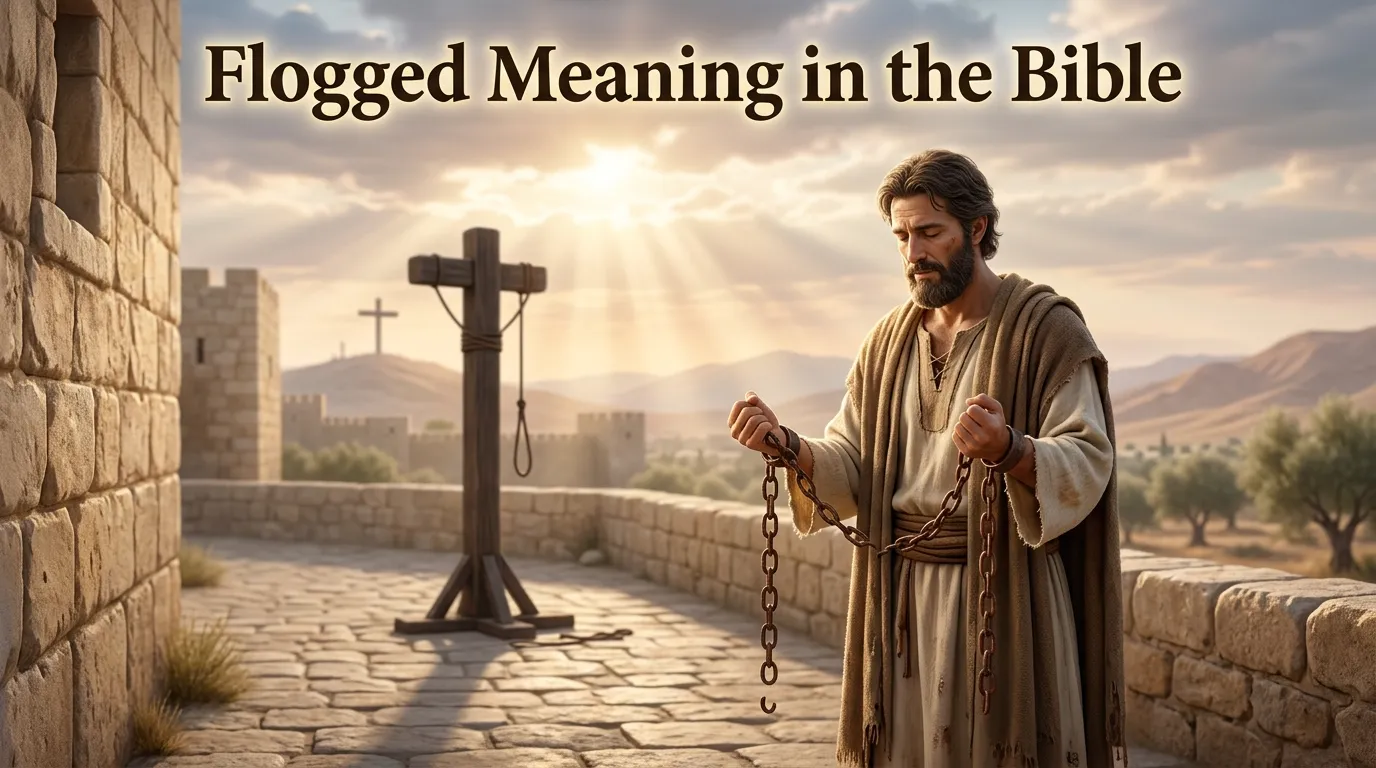
Have you ever read about Jesus being flogged and wondered what that word truly means? The Bible uses this word to describe real suffering, real pain, and real love.
Understanding the flogged meaning in the bible helps us see how much Jesus gave for us. This word appears in powerful moments of Scripture, especially during the trial and suffering of Christ.
Many readers search for the biblical meaning of flogged because they want to understand prophecy, sacrifice, and grace more deeply.
This word connects to justice, punishment, and also to healing through Christ’s wounds.
When we understand flogged in scripture, our faith grows stronger and our gratitude deepens.
This article will walk you through the full meaning, history, and spiritual lessons behind this word.
We will look at real Bible verses, Greek word origins, and how this applies to your daily walk with God.
Let’s explore what the Bible says about flogged meaning in the bible.
Biblical Meaning of Flogged
The word flogged means to be whipped or beaten severely, often as a legal punishment. In Bible times, flogging was a common Roman and Jewish practice used to punish criminals. The biblical meaning of flogged points to intense physical suffering, humiliation, and injustice.
In the New Testament, the Greek word often translated as flogged is phragelloo (φραγελλόω), meaning to scourge or whip. Roman sources describe a whip with leather straps, sometimes weighted with bone or metal. It was designed to cause deep pain and lasting damage to the body.
The first major appearance of this word in the context of Jesus is found in Matthew 27:26. Pilate had Jesus flogged before sending Him to be crucified. This act fulfilled ancient prophecy and revealed the depth of Christ’s sacrifice for humanity’s sin.
Understanding flogged in scripture also means understanding suffering with purpose. Jesus was flogged, not because He was guilty, but because of our sin. This truth turns painful history into a message of grace, hope, and salvation.
Quick Reference Table
| Aspect | Meaning |
| Focus Word | Flogged |
| Hebrew words | nakah (to strike), makkah (a blow or stripe), shot (a whip or scourge) |
| Greek Root | Phragelloo (φραγελλόω) |
| First Appearance | Matthew 27:26 |
| Core Meaning | To whip, scourge, or beat severely |
| Positive Meaning | Christ’s suffering brings healing and salvation |
| Warning Meaning | Consequence of sin, injustice, and rebellion |
| Key Figures | Jesus Christ, Paul, Roman soldiers |
| Symbolism | Suffering, sacrifice, redemption |
Key Bible Verses

The Bible gives us clear pictures of flogging through several key verses. These verses help us understand both the physical and spiritual weight of this word.
Matthew 27:26 (ESV)
Then he released for them Barabbas, and having scourged Jesus, delivered him to be crucified.
John 19:1 (NIV)
Then Pilate took Jesus and had him flogged.
Isaiah 53:5 (ESV)
But he was pierced for our transgressions; he was crushed for our iniquities; upon him was the chastisement that brought us peace, and with his wounds we are healed.
These verses show that being flogged was not random suffering. It was part of God’s plan to bring healing to broken people. Every stripe Jesus took had eternal meaning.
Biblical Context

To understand the biblical meaning of flogged, we must look at the culture of that time. Roman flogging was extremely brutal and often happened before crucifixion. Soldiers used whips designed to tear skin and muscle, causing severe blood loss.
Jewish law also allowed flogging as punishment, but it had limits. Deuteronomy 25:3 says punishment should not exceed forty lashes, to avoid degrading a person completely. This shows that even ancient law had boundaries, unlike the Roman practice used on Jesus.
When Jesus was flogged, He experienced the harshest form of this punishment. Historical accounts, along with Isaiah 53, show that His body was severely wounded before He even reached the cross. This context helps us understand why His sacrifice carries such deep emotional and spiritual weight.
The Apostle Paul also experienced flogging during his ministry. In 2 Corinthians 11:24, Paul says he received forty lashes minus one five different times. This shows that being flogged was a real danger faced by early Christian believers who spread the gospel.
Spiritual Meaning

The spiritual significance of flogged goes far beyond physical pain. It represents the price of sin and the depth of God’s love. When Jesus was flogged, He took on suffering that we deserved because of our sins.
1 Peter 2:24 (ESV) says, He himself bore our sins in his body on the tree, that we might die to sin and live to righteousness. By his wounds you have been healed. This verse connects flogging directly to healing and salvation.
The spiritual significance of flogged teaches us about grace. Jesus did not deserve punishment, yet He accepted it willingly out of love. This reminds believers that true grace often comes through sacrifice.
This word also teaches us about transformation. Just as Jesus turned suffering into salvation, God can turn our pain into purpose. The Holy Spirit uses even difficult seasons to shape our faith and character.
Biblical Symbolism
Flogging symbolizes more than punishment; it represents substitution and redemption. Jesus took the stripes so that we could be spiritually whole. This symbol connects deeply to themes of mercy and justice working together.
In Scripture, wounds and stripes often symbolize both judgment and healing. Isaiah 53:5 clearly links wounds with being healed. This paradox is central to Christian faith: pain leading to peace.
The color red, associated with blood from flogging, symbolizes atonement throughout the Bible. From the Passover lamb’s blood to Christ’s wounds, blood consistently represents covering for sin. This makes the symbolism of flogged connect directly to the larger story of salvation.
Common Misunderstandings
Many people confuse flogging with simple punishment or discipline. In truth, biblical flogging was often extreme, sometimes life-threatening. It was far more severe than modern ideas of punishment or correction.
Some believe flogging in the Bible was only physical, missing its deeper spiritual meaning. However, Scripture ties this suffering directly to grace and redemption. Ignoring this connection misses the heart of the gospel message.
Others mistakenly think flogging only applied to criminals or sinners. Yet Jesus, who was sinless, was flogged unjustly. This shows that suffering in the Bible is not always a punishment for personal wrongdoing: it can also be sacrificial and redemptive.
Daily Christian Application
Understanding flogged in the Bible should shape how we live daily. When we remember Christ’s suffering, we should feel motivated to live with gratitude and humility. His pain was not wasted; it brought healing to the world.
This truth also teaches us to trust God during our own suffering. Just as Jesus turned suffering into salvation, God can use our struggles for growth. Romans 8:28 reminds us that God works all things together for good for those who love Him.
We are also called to show compassion to those who suffer unjustly today. Understanding flogging’s brutality should increase our empathy toward victims of injustice worldwide. Christians are called to defend the weak, just as Christ identified with suffering.
Finally, this word calls us to deeper prayer and reflection. Spend time thanking Jesus for His sacrifice each day. Let His wounds remind you of the price paid for your freedom.
Faith Takeaways
- Pray, Thank Jesus for the suffering He endured for your salvation.
- Trust, Believe that God can bring healing even through painful seasons.
- Reflect, Consider the depth of love shown through Christ’s flogging and death.
- Seek, Seek a deeper relationship with God through gratitude and worship.
- Remember, Remember that by His wounds, we are truly healed.
FAQs
1. What is the flogged meaning in the bible?
The flogged meaning in the bible refers to being whipped or beaten severely as punishment. Jesus was flogged before His crucifixion, fulfilling prophecy and showing His sacrificial love for humanity.
2. Why was Jesus flogged before crucifixion?
Roman custom often included flogging before execution to weaken the prisoner. Jesus was flogged unjustly, though innocent, fulfilling Isaiah 53’s prophecy about suffering for others’ sins.
3. What does flogged mean in Greek?
The Greek word is phragelloo, meaning to whip or scourge severely. This word emphasizes the intense physical suffering Jesus experienced during His trial.
4. Is flogged the same as scourging in the Bible?
Yes, in most Bible translations, flogged and scourged refer to the same brutal whipping punishment. Both describe the suffering Jesus faced before His crucifixion.
5. What is the spiritual significance of flogged in scripture?
The spiritual significance of flogged points to healing through Christ’s suffering. 1 Peter 2:24 shows His wounds bring spiritual restoration and freedom from sin.
6. Did Paul get flogged in the Bible?
Yes, Paul mentions being flogged multiple times in 2 Corinthians 11:24. He suffered greatly for spreading the gospel message across many regions.
7. What can Christians learn from Jesus being flogged?
Christians learn about sacrifice, grace, and God’s deep love through Christ’s flogging. It teaches believers to trust God through suffering and find purpose in pain.
More Searched Questions About Flogged in the Bible
What is the difference between flogged and scourged in the Bible?
They are two English words for the same act, and which one a reader meets depends on the translation in front of him. The King James Bible never uses the word flogged at all. Its word is scourged. Where this article’s quoted versions say”having scourged Jesus” (Matthew 27:26, ESV) and “had him flogged” (John 19:1, NIV), the King James reads: “and when he had scourged Jesus, he delivered him to be crucified” (Matthew 27:26), and “Then Pilate therefore took Jesus, and scourged him” (John 19:1). Flogged is simply the newer English dress of the same punishment, and no difference of act, instrument or severity should be built on which word a translation happens to carry.
Behind the King James word stand two different Greek verbs, and telling them apart is worth more than telling the English words apart. The first is mastigoo (Strong’s G3146), to flog with a mastix, a whip. It is John’s verb for what Pilate did, and it is the verb Jesus himself uses for what awaited him and his followers: “And shall deliver him to the Gentiles to mock, and to scourge, and to crucify him” (Matthew 20:19), and to the disciples, “they will scourge you in their synagogues” (Matthew 10:17). The second is phragelloo (Strong’s G5417), a verb Greek borrowed from Rome’s own word for its whip, the Latin flagellum, and it stands only twice in the New Testament, at Matthew 27:26 and Mark 15:15: “and delivered Jesus, when he had scourged him, to be crucified”. The searches also ask for flagellation: that is the Latin-derived English name of the same Roman punishment, not a separate Bible word or a separate event.
What was Jesus scourged with?
The honest answer is that no Gospel says. Matthew and Mark give one verb, phragelloo, a word borrowed from the Latin flagellum, which tells us the instrument was the Roman whip used in public punishment. John gives a different verb, mastigoo, to flog with a whip. Between them the evangelists name the act and its agent, Pilate, and nothing else: no Gospel describes the whip, counts its thongs, or lists anything fixed into it. The detailed pictures found in books and sermons, of straps weighted with pieces of bone or metal, come from descriptions of the Roman flagellum outside the Gospels. Readers will meet them as historical background, and they may be accurate background, but they are not statements of the Bible, and this article does not print them as facts of the text.
What Scripture gives instead of the instrument is the frame around the act, and it gives it beforehand. The servant of Isaiah speaks in the first person: “I gave my back to the smiters, and my cheeks to them that plucked off the hair: I hid not my face from shame and spitting” (Isaiah 50:6). The smiters there are the participle of nakah, the ordinary Hebrew verb for striking, the same verb that does the beating in the law of Deuteronomy 25 below. And Jesus places the scourging inside his own foretelling, in one line with the mocking and the cross (Matthew 20:19, quoted in the answer above). Luke’s account even shows the scourging exceeding what Pilate had proposed: “I will therefore chastise him, and release him” (Luke 23:16). The Bible’s emphasis is never on the whip’s construction. It is on who was scourged, though innocent, and on the stripes the next answers open.
What does the word whip mean in the Bible?
The Old Testament’s whip word is shot (Strong’s H7752), a lash, rendered “whip” and “scourge” in the King James. As a literal instrument it stands in the mouth of a king: Rehoboam boasts to the people, “my father hath chastised you with whips, but I will chastise you with scorpions” (1 Kings 12:11), where the whip is the measure of his father’s rule and the scorpions of his promised worse. Proverbs sets the same everyday tool in its row of corrections: a whip for the horse, a bridle for the ass, and a rod for the fool’s back (Proverbs 26:3). In such places the whip is simply the common instrument for driving and for discipline in that world, named without ceremony.
The searches ask what the whip symbolizes, and the texts answer: most of shot’s work in the Old Testament is picture work, not punishment work. Job speaks of “the scourge of the tongue” (Job 5:21), words that lash like a whip. Isaiah’s Jerusalem leaders feel safe from “the overflowing scourge” (Isaiah 28:15, 18), a flood of judgment pictured as a lash sweeping through the land, and the same prophet hears God promise to stir up a scourge against Assyria herself (Isaiah 10:26). Nahum hears an invading army arrive with “the noise of a whip” (Nahum 3:2). So in the Old Testament the whip mostly pictures calamity, judgment and driving power, while the actual whipping of a man in a court is told with other words: the verb nakah, to strike, and its noun makkah, a blow or stripe, which the next answers open at Deuteronomy 25.
What does beaten with rods mean in the Bible?
It is a different punishment from the whip, and it has its own Greek verb: rhabdizo (Strong’s G4463), to beat with rods, from rhabdos, a rod. The verb stands only twice in the New Testament. At Philippi, “the magistrates rent off their clothes, and commanded to beat them” (Acts 16:22), and of Paul and Silas the record adds, “And when they had laid many stripes upon them, they cast them into prison” (Acts 16:23): many stripes, laid on with rods by the city’s officers, with no trial held and no count given. Paul files the same kind of beating in his own list as a separate item from his synagogue floggings: “Thrice was I beaten with rods” (2 Corinthians 11:25). Rods were the Roman officers’ instrument, and a rod beating was a summary street punishment, not a court sentence counted under a law.
The returned searches also ask the plainer form, what beaten means, and Acts holds a beating with no instrument named at all. When the council at Jerusalem had heard Gamaliel’s counsel, “when they had called the apostles, and beaten them, they commanded that they should not speak in the name of Jesus, and let them go” (Acts 5:40). Beaten is all the text says, and no instrument should be supplied for it. One more rod standing belongs to God himself, and it is picture language for his covenant discipline, not a human court: “Then will I visit their transgression with the rod, and their iniquity with stripes” (Psalm 89:32), spoken of David’s line. Kept in their places, the three are distinct: rods for the Roman officers’ beating, the whip for the scourging, and beaten where Scripture itself names nothing in the hand.
What was the flogging law of Deuteronomy 25, and why was forty the limit?
This is the Old Testament’s one flogging law, and it is a court sentence, not a household or religious practice. Its setting is a lawsuit: “If there be a controversy between men, and they come unto judgment, that the judges may judge them; then they shall justify the righteous, and condemn the wicked” (Deuteronomy 25:1). The sentence follows: “And it shall be, if the wicked man be worthy to be beaten, that the judge shall cause him to lie down, and to be beaten before his face, according to his fault, by a certain number. Forty stripes he may give him, and not exceed: lest, if he should exceed, and beat him above these with many stripes, then thy brother should seem vile unto thee” (Deuteronomy 25:2-3). The verb is nakah (Strong’s H5221), to strike or beat, which the lexicons list in this very passage in the sense of beating by authority. The counted blows are makkot, the plural of makkah (Strong’s H4347), a blow or stripe, the word that stands in verse 3’s “many stripes”.
Every part of the law is measured: a judge present, the man beaten before his face, the number fitted to the fault, and a hard ceiling of forty. The reason for the ceiling is stated in the law itself, and it is about the man’s standing, not the court’s convenience: beyond the number, “thy brother should seem vile unto thee”. Even a condemned man remains a brother, and the punishment must not be allowed to degrade him into a thing. This is Israel’s civil law for its courts, given to judges for cases between two men, and it should be read as exactly that. No New Testament text reapplies its sentence as a discipline for the church today. What the New Testament takes from it is its measure, which appears in Paul’s own list in the next answer.
Why did Paul receive forty stripes save one, five times?
The words are Paul’s own, in the catalogue of what his ministry had cost him, and the list repays being read whole: “Of the Jews five times received I forty stripes save one. Thrice was I beaten with rods, once was I stoned, thrice I suffered shipwreck, a night and a day I have been in the deep” (2 Corinthians 11:24-25). Two different beatings stand side by side and must not be merged. The rod beatings, three of them, were Roman, the punishment of the answer above. The five floggings were Jewish sentences, received from the Jews, and they were counted by Deuteronomy’s measure: forty stripes, save one. Save one is the verse’s own arithmetic: one short of the forty, which is thirty nine. Jesus had named the very setting Paul would meet: “they will scourge you in their synagogues” (Matthew 10:17), and “some of them shall ye scourge in your synagogues” (Matthew 23:34).
Why stop one short of the law’s own limit? The law said forty and not exceed (Deuteronomy 25:3). The later Jewish practice, and it is stated here as practice and tradition rather than as a verse, was to give one fewer than the maximum, so that if the count were mistaken by one stroke, the law would still not have been broken. Paul’s phrase takes that careful count for granted; his readers knew the custom. Set beside it, the scourging of Jesus belonged to a different legal world altogether. Rome’s scourging before a cross carried no forty ceiling and no save one, and no Gospel gives it any number at all. The popular claim that Jesus received thirty nine lashes borrows Paul’s Jewish count and lays it on Jesus’ Roman scourging, and the texts, read at their own places, do not allow the move.
What does “by his stripes we are healed” mean?
A stripe, in the King James wording, is the wound mark a blow leaves on the body: the bruise or weal itself. Isaiah’s word is chabburah (Strong’s H2250), a stripe or bruise, the same word the law uses when it measures an injury “stripe for stripe” (Exodus 21:25). The verse stands inside the servant song: “But he was wounded for our transgressions, he was bruised for our iniquities: the chastisement of our peace was upon him; and with his stripes we are healed” (Isaiah 53:5). The stripes are Christ’s, the healing is ours, and the joining word is with, or by: the healing comes by means of the wounds. Peter takes the very word up in Greek, molops (Strong’s G3468), a bruise or blow mark, the Greek Old Testament’s rendering of Isaiah’s chabburah, standing once in the New Testament in his quotation of this verse: “Who his own self bare our sins in his own body on the tree, that we, being dead to sins, should live unto righteousness: by whose stripes ye were healed” (1 Peter 2:24).
What healing, then? Peter defines it inside his own sentence, and his definition governs the phrase. The healed are people dead to sins and living to righteousness, and his next verse names the cure as a homecoming: “For ye were as sheep going astray; but are now returned unto the Shepherd and Bishop of your souls” (1 Peter 2:25). The healing of Isaiah 53:5, as the apostle himself applies it, is the cure of sin and of straying. One verse earlier in Isaiah’s chapter stands a different word, and it should not be merged into this one: “Surely he hath borne our griefs, and carried our sorrows” (Isaiah 53:4), and it is that verse, the bearing of griefs and sorrows, that Matthew quotes over Jesus’ healing of the sick: “Himself took our infirmities, and bare our sicknesses” (Matthew 8:17). The two verses stand side by side in the chapter, and the New Testament quotes each at its own place. A claim of guaranteed present healing built on verse 5 alone goes past Peter’s own application; a reading that denies the chapter speaks of sickness at all goes past Matthew’s.
What happened when the apostles were beaten, and when Paul was about to be scourged?
The apostles met the beating Jesus had foretold, and early. The Jerusalem council, having heard Gamaliel urge caution, called the apostles in and beat them, and let them go with a command of silence (Acts 5:40, quoted in the rods answer above); the record adds that they left the council rejoicing that they were counted worthy to suffer shame for his name. The hall of faith keeps the same register. Inside its roll of those who endured, Hebrews lists “cruel mockings and scourgings” among the trials of God’s people: “And others had trial of cruel mockings and scourgings, yea, moreover of bonds and imprisonment” (Hebrews 11:36). The word there is the plural of mastix (Strong’s G3148), the whip itself, the noun behind the verb mastigoo: scourgings stand in that chapter not as a mark of God’s absence but in the honour list of faith.
The sharpest scene is a scourging that never happened. At Jerusalem the chief captain ordered Paul brought into the castle “and bade that he should be examined by scourging; that he might know wherefore they cried so against him” (Acts 22:24): the scourging was to be an interrogation, the whip used to draw out a charge. “And as they bound him with thongs, Paul said unto the centurion that stood by, Is it lawful for you to scourge a man that is a Roman, and uncondemned?” (Acts 22:25). The question stopped the proceeding at once: a Roman citizen, untried, stood under a protection the law would not let them cross, and Paul, who had already taken the counted synagogue stripes five times and the rods three times without that shield being raised, raised it here and was untied. The contrast stands in the record without decoration. The citizenship that saved Paul from one scourging with a single sentence was never claimed by Jesus, who was scourged, and then crucified, under the same empire’s law.
How many times was Jesus flogged?
Once, as the Gospels record it. Matthew 27:26, Mark 15:15 and John 19:1 each describe the same event: Pilate had Jesus scourged during the trial, before the crucifixion. Luke does not narrate the scourging itself; he records Pilate twice offering to chastise Jesus and release him (Luke 23:16, Luke 23:22). John places the scourging before the final sentence and Matthew and Mark place it after the sentence, which has led some readers to count two scourgings, but the event, the agent (Pilate) and the place (the Praetorium) are the same, so the plain reading is one scourging told in different order. No Gospel gives a number of lashes for Jesus. The popular figure of 39 lashes borrows Paul’s Jewish count (2 Corinthians 11:24) and lays it on Jesus’ Roman scourging, and the texts do not allow that move.
Who flogged Jesus?
Roman soldiers, acting on Pilate’s order. Matthew 27:26 says Pilate had Jesus flogged and delivered him to be crucified, and Mark 15:15 says the same, adding that Pilate acted to satisfy the crowd. John 19:1 says Pilate took Jesus and had him flogged. After the order, the governor’s soldiers took Jesus into the Praetorium and gathered the whole cohort around him (Matthew 27:27, Mark 15:16), and it was those soldiers who mocked him, put the crown of thorns on him and led him out to the cross. It was not the Jewish authorities who flogged Jesus. His flogging was Roman, which is why it had no forty lash limit and no count. Paul’s five floggings were different: they were Jewish synagogue sentences (2 Corinthians 11:24). The contrast matters: Jesus was scourged by the empire’s soldiers, though he had been declared innocent.
Why did Pilate have Jesus flogged if he found no fault in him?
Because Pilate was trying to satisfy the crowd without passing a death sentence. Three times he declared Jesus innocent: “I find no fault in this man” (Luke 23:4), “I find in him no fault at all” (John 18:38), and again, “I find no fault in him” (John 19:4, John 19:6). Luke records his plan plainly: “I will therefore chastise him, and release him” (Luke 23:16, repeated in Luke 23:22). The word chastise is paideuo, to discipline or correct. The scourging was meant as a compromise, a punishment harsh enough to satisfy the accusers while letting Pilate release the prisoner. It did not work: the crowd kept demanding the cross, and Pilate gave the sentence. The flogging was therefore not a punishment for a proven crime. It was a political concession by a governor who knew the prisoner was innocent, and it fulfilled Isaiah’s picture of the servant wounded for others (Isaiah 53:5).
What happened after Jesus was flogged?
The soldiers mocked him as a king, then led him out to the cross. Matthew 27:27-31 says the governor’s soldiers took Jesus into the common hall, stripped him, put a scarlet robe on him, twisted a crown of thorns onto his head, put a reed in his right hand, knelt before him and said, “Hail, King of the Jews!”, spat on him and struck him on the head with the reed. Mark 15:16-20 and John 19:2-3 tell the same scene with a purple robe. Then they took the robe off, put his own clothes on him and led him away to crucify him. On the way out they found Simon of Cyrene and compelled him to carry the cross (Matthew 27:32, Mark 15:21, Luke 23:26), which is commonly read as a sign of how weakened Jesus was by the scourging, though the text itself gives no reason for it.
How was a Roman flogging carried out?
The Gospels do not describe the procedure, so the steps below come from Roman sources and historians, not from the Bible text. The victim was stripped of his clothing and his hands were tied to an upright post. The instrument was the flagrum, also called the flagellum, a short whip with several leather thongs in which small iron balls or sharp pieces of sheep bone were tied at intervals, as described by Edwards and others in the Journal of the American Medical Association, 1986. Two soldiers, called lictors, flogged the back, buttocks and legs, or one soldier alternated positions. The severity depended on the lictors, and the beating was meant to weaken the victim to a state just short of collapse or death. Roman practice knew no count limit. After the scourging, the soldiers often taunted the victim.
How severe was the flogging Jesus endured?
The Gospels give no medical description and no number of lashes, so the honest answer is that its severity is shown by what followed, not by a count. The scourging was meant to weaken a man to just short of collapse, and Jesus came out of it so weakened that Simon of Cyrene had to carry his cross (Mark 15:21). Isaiah’s servant song gives the prophetic picture in advance: “his visage was so marred more than any man, and his form more than the sons of men” (Isaiah 52:14). Roman writers describe the flagrum tearing skin and muscle and causing severe blood loss, which is why the punishment could kill. The article’s own caution stands: the Gospels name the act and the agent, Pilate, and nothing else about the whip. What Scripture stresses is not the number of wounds but who bore them, innocent, and for whom.
Where does the Bible talk about flogging?
In the Old Testament: the law of stripes (Deuteronomy 25:2-3), the whip (1 Kings 12:11, Proverbs 26:3), the servant’s back (Isaiah 50:6), the stripes that heal (Isaiah 53:5), the plowers on the back (Psalm 129:3), and the rod and stripes of discipline (Psalm 89:32). In the New Testament: Jesus’ predictions (Matthew 20:19, Mark 10:34, Luke 18:33), the scourging itself (Matthew 27:26, Mark 15:15, John 19:1), Pilate’s offer to chastise (Luke 23:16, Luke 23:22), the apostles beaten (Acts 5:40), Paul and Silas beaten with rods at Philippi (Acts 16:22-23), Paul’s own list (2 Corinthians 11:24-25), Paul nearly scourged for interrogation (Acts 22:24-25), Paul’s mention of beating believers in synagogues (Acts 22:19), and the scourgings of the faithful (Hebrews 11:36). First Peter 2:24 applies Isaiah 53:5 to the cross.
What is the difference between flogging and crucifixion?
They are two different punishments, and Jesus endured both. Flogging, or scourging, is whipping: a beating with a whip that tears the skin and weakens the body but is not itself a method of execution. Crucifixion is execution: the victim is nailed to a cross and left to die. Flogging often came first, as a preliminary punishment before crucifixion, to weaken the prisoner, and that is the order in the Gospels (Matthew 27:26, Mark 15:15). But the two were not always paired: flogging was also a standalone sentence, as in the Jewish synagogue floggings Paul received (2 Corinthians 11:24), and crucifixion did not always follow a scourging. The cross killed Jesus; the scourging prepared the way. Confusing the two understates what he endured, because he suffered both in the same day.
Does any psalm describe the scourging?
Psalm 129:3 gives the picture in one line: “The plowers plowed upon my back: they made long their furrows.” The psalm is Israel’s song about affliction from its youth, not a direct prophecy naming the cross, so it should not be quoted as a prediction of the scourging. But the image is the scourging in picture form: a back cut into long furrows like a plowed field, and older commentators, Adam Clarke among them, read it as a picture of cruel scourging. The verse that follows answers the picture with deliverance: “The LORD is righteous: he hath cut asunder the cords of the wicked” (Psalm 129:4). Read with Isaiah 52:14, which says the servant’s appearance was marred beyond human likeness, the psalm gives the Old Testament’s most graphic image of a back torn by lashes, and the same psalm insists the suffering does not win.
Did Jesus forgive the soldiers who flogged him?
From the cross he prayed for those who put him there: “Father, forgive them; for they know not what they do” (Luke 23:34). The soldiers who flogged him are inside that prayer, since they were the same men who mocked him, crowned him with thorns and nailed him to the cross (Matthew 27:27-31). The prayer does not name the flogging separately, and it does not excuse what they did: “they know not what they do” is the reason given, ignorance, not innocence. The forgiveness is offered from the victim himself, while the wounds are still fresh. That is the point the article’s application section makes in practice: the man who was flogged answered with intercession, not revenge, and believers are called to the same posture toward those who wrong them.
What does flogged mean in the bible?
It means to be whipped or beaten severely, often as a legal punishment, pointing to intense physical suffering, humiliation, and injustice.
Flogged meaning in the bible?
To whip, scourge, or beat severely. I2 the New Testament, the Greek word often translated as flogged is phragelloo, meaning to scourge or whip.
What is flogged in the bible?
In the Bible, flogging is a severe whipping punishment. The clearest example is Matthew 27:26, where Pilate had Jesus flogged before sending Him to be crucified.
Define flogged in the bible?
Flogged means whipped or scourged severely as punishment. Spiritually, the article links it to substitution and redemption, with Isaiah 53:5 connecting His wounds to healing.
Conclusion
The flogged meaning in the bible reveals a powerful story of suffering, love, and redemption. Jesus endured painful flogging so that we could experience healing and grace. This truth should deepen our faith and gratitude every single day.
As you reflect on this word, remember that God can turn pain into purpose. Just as Christ’s wounds brought healing, your struggles can lead to spiritual growth. Let this truth strengthen your walk with God today.
Discover More Articles
- What Is the Holy Meaning in the Bible? Full Guide
- Revelation Meaning in Bible: A Complete Bible Guide
- What Is the Joy Meaning in the Bible? Complete Guide