Have you ever opened your Bible and wondered, What does this actually mean for my life right now? You are not alone.
Millions of people pick up the Bible every day feeling that same mix of curiosity, hope, and maybe a little confusion. The Bible is the most read book in human history and yet its depths still surprise even lifelong believers.
Bible meaning explained is more than a search term. It is the honest question every heart asks when it first encounters Scripture.
Whether you found a verse on a coffee mug or heard one read at a funeral, something in you leaned in. That pull is real. And it is worth following.
The word Bible comes from the Greek biblia, meaning the books. But the Bible is not just a collection of ancient writings.
Believers across centuries have understood it as the living Word of God breathed out by the Holy Spirit, written through human hands, and meant to speak directly to your soul.
Understanding Bible meaning helps you move beyond surface reading into something that can genuinely change the way you see yourself and the world around you.
Scripture is not a rulebook. It is an invitation to know God, receive grace, and walk in faith day by day.
Let’s explore what the Bible says about Bible meaning.
Biblical Meaning of Bible Meaning Explained
The Root and Origin
The biblical meaning of Scripture begins with two key ancient words. In Hebrew, the word dabar (דָּבָר) means word, matter, or thing. It carries the idea that God’s words are not just sounds they are events. When God speaks, something happens. In the New Testament Greek, the word logos (λόγος) takes this further. It means word, reason, and divine communication. John opens his Gospel using this exact word to describe Jesus Himself.
The Bible meaning explained through these roots tells us something powerful: God’s words are not passive. They are active, purposeful, and alive.
First Appearance in the Bible
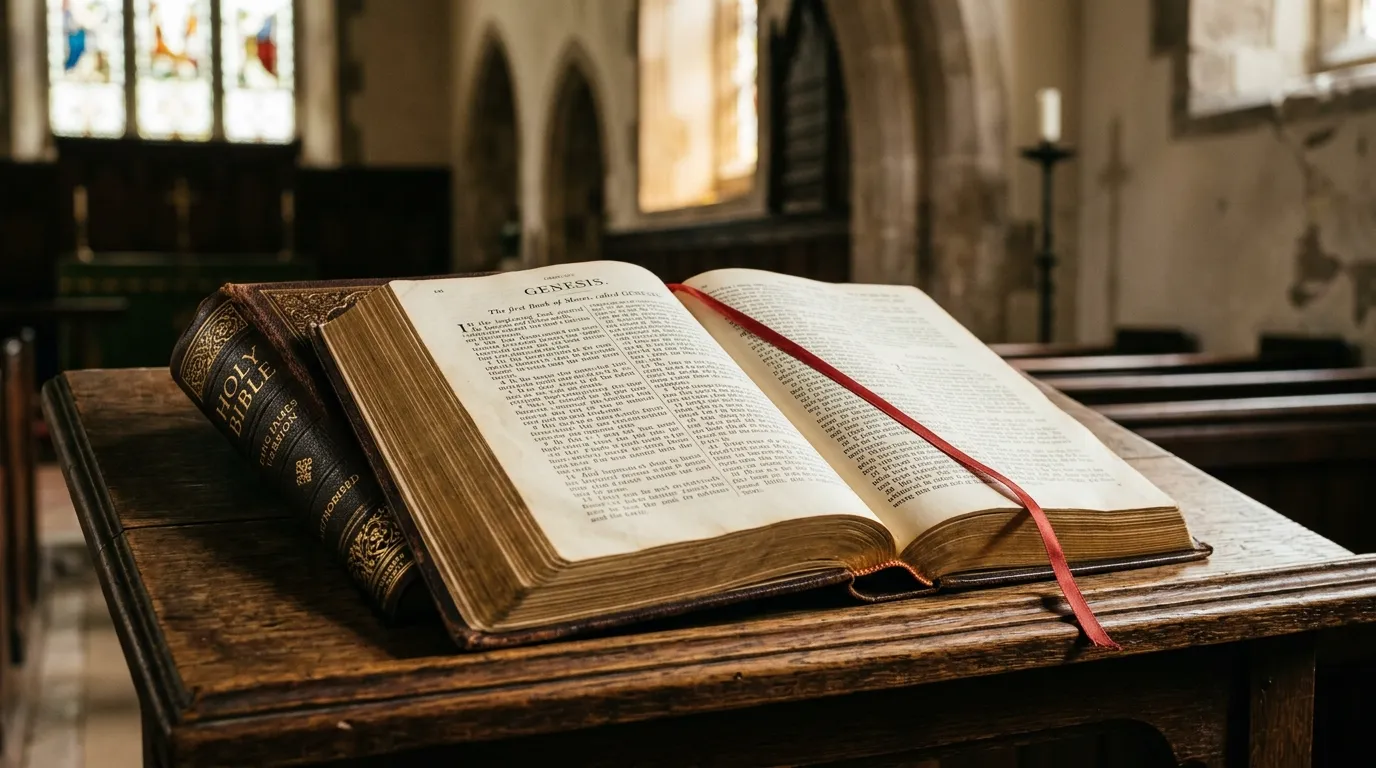
The first time God speaks in Scripture appears in Genesis 1:3 And God said, ‘Let there be light,’ and there was light. (ESV) This is the Bible’s opening act of meaning-making. God’s Word created reality itself. That is the foundation of every other verse in Scripture.
From that first moment, the pattern is clear: what God says matters. His words carry weight, purpose, and divine message for all who hear them.
Key Bible Verses
Here are three foundational passages that explain what the Bible itself is and does:
All Scripture is breathed out by God and profitable for teaching, for reproof, for correction, and for training in righteousness. 2 Timothy 3:16 (ESV)
For the word of God is living and active, sharper than any two-edged sword, piercing to the division of soul and of spirit, of joints and of marrow, and discerning the thoughts and intentions of the heart. Hebrews 4:12 (ESV)
Your word is a lamp to my feet and a light to my path. Psalm 119:105 (ESV)
These three verses each reveal a different layer of Bible meaning explained. First, Scripture comes from God. Second, it is alive and cuts through spiritual noise. Third, it guides real, daily decisions.
Positive Meaning and Deeper Warning
The positive meaning of the Bible is transformation. It builds faith, restores broken people, and gives wisdom where confusion once lived. But there is also a deeper warning woven through Scripture: the Word must be received with humility, not pride. James 1:22 warns, Be doers of the word, and not hearers only, deceiving yourselves. Knowing the Bible without living it leads to spiritual dullness.
Connected to a Biblical Figure
King David is one of the clearest examples of someone who clung to Bible meaning in scripture. He called God’s Word sweeter than honey (Psalm 19:10). Even when he sinned deeply, he returned to God through Scripture through prayer, confession, and praise. His life shows that the Bible is not just for perfect people. It is for broken ones seeking grace.
Quick Reference Table
| Aspect | Details |
| Hebrew/Greek Root | Hebrew: dabar (word/matter); Greek: logos (word/divine reason) |
| First Biblical Appearance | Genesis 1:3 And God said, ‘Let there be light’ |
| Core Biblical Meaning | God’s living, active communication to humanity for guidance, correction, and transformation |
| Key Bible Verses | 2 Timothy 3:16; Hebrews 4:12; Psalm 119:105 |
| Connected Biblical Figures | King David (Psalm 19, 119); Timothy (2 Timothy 3); the Apostle John (John 1:1) |
| Spiritual Symbolism | A lamp, a sword, seed planted in the heart, bread for the soul |
| Dream/Vision Meaning | Encountering Scripture in dreams often signals a call to seek God more closely through prayer |
| Faith Lesson | The Bible is not just to be read it is to be trusted, obeyed, and allowed to reshape your life |
Spiritual Significance
The spiritual significance of Bible meaning goes far beyond information. The Bible is the primary way the Holy Spirit speaks to ordinary people in ordinary moments. You might be reading a passage you have read a hundred times when, suddenly, one phrase lights up with new meaning. That is not coincidence. That is the Spirit making Scripture personal.
The Bible operates on multiple levels at once. On the surface, it tells stories. Beneath that, it reveals patterns. Beneath that, it points to Jesus His life, death, and resurrection as the center of all human history. Every book, every poem, every prophecy in Scripture finds its meaning in Him.
Transformation is the goal. The Bible is not meant to make you smarter. It is meant to make you more like Christ. Reading it without that aim is like eating food only to spit it out you miss the nourishment.
The spiritual significance of the Bible also includes its role in community. For centuries, people have gathered to read Scripture together. That shared practice builds something no podcast or self-help book can: a community rooted in a truth bigger than any one person.
C.S. Lewis once wrote: It is in the process of being worshipped that God communicates His presence to men. Scripture is a central part of that worship. When you open the Bible, you step into a space where God has already been speaking and still is.
Personal reflection question: When was the last time a Bible verse surprised you and what did you do with that surprise?
Related Biblical Concepts Table
| Concept | Meaning | Key Verse | Lesson |
| Bible Meaning Explained | God’s Word is living, active, and personally meaningful | Hebrews 4:12 | Read to be changed, not just informed |
| Grace | God’s unearned favor freely given | Ephesians 2:8 | You cannot earn what is already given |
| Faith | Trusting God even when you cannot see | Hebrews 11:1 | Faith is not feeling it is a choice |
| Holy Spirit | God’s presence within believers, guiding truth | John 16:13 | The Spirit opens Scripture’s meaning to your heart |
| Prayer | Direct, honest conversation with God | Philippians 4:6 | Prayer and Scripture work together one speaks, one listens |
Dream and Real Life Meaning
People sometimes encounter Bible meaning explained through unexpected channels including dreams. Throughout Scripture, God used dreams to deliver divine messages to people like Joseph, Daniel, and Solomon. This means that if you sense God speaking to you in a dream involving Scripture or a specific verse, it is worth taking seriously.
In peaceful dreams, a Bible verse might arrive as comfort a reminder that God sees your situation and is already working. In more urgent dreams, Scripture might appear as a warning or call to action. Both experiences have precedent in the Bible.
How do you know if an experience is from God? Three tests help. First, does it align with what the Bible already teaches? God will never contradict Himself. Second, does it point you toward love, humility, and service not pride or fear? Third, does your Christian community confirm what you sense?
Prayer and journaling are powerful companions here. When you write down what a passage means to you and bring it to God in honest conversation, clarity tends to come. You do not need a theology degree. You need a willing heart and a quiet few minutes to listen.
Faith Takeaways
- Pray before you read the Bible. Ask the Holy Spirit to open your eyes to what God wants you to see today not just what you already know.
- Trust that the Bible is enough. You do not need every question answered to take the next step. Scripture gives you enough light for the path directly ahead.
- Reflect on one verse each day rather than rushing through chapters. Let the meaning settle in your heart before moving on.
- Seek community with others who take the Bible seriously. Bible meaning deepens in conversation questions asked together often land on answers no one finds alone.
- Remember that transformation is slow and real. The Bible is not a quick fix. It is a lifelong companion that keeps revealing new layers as you grow.
FAQs
1. What does Bible meaning explained actually refer to? The phrase Bible meaning explained refers to the process of understanding what Scripture says, what it meant in its original context, and how it applies to life today. It covers word origins, historical background, and personal application. Good Bible study always asks three questions: What did it say? What did it mean then? What does it mean for me now?
2. How do I find the biblical meaning of a specific word or verse? Start with a good Bible dictionary or concordance. Tools like Strong’s Concordance let you look up the original Hebrew or Greek word behind any English translation. Many free online resources walk through Bible meaning in scripture passage by passage. But the most important habit is reading slowly, praying for understanding, and letting the text speak before consulting commentaries.
3. Is the Bible’s meaning the same for everyone? The core meaning of any passage rooted in its original language, context, and purpose stays consistent. But how Scripture applies personally can vary based on your circumstances, season of life, and what the Holy Spirit highlights for you. This is not relativism. God can speak the same truth to different people in uniquely personal ways without the truth itself changing.
4. What is the spiritual significance of Bible meaning for daily life? The spiritual significance of Bible meaning shows up most in daily decisions. When you know what Scripture says about worry, relationships, money, and identity, you have a compass for real life. Faith is not separate from daily living it is woven through it. The Bible gives language, wisdom, and grace for every ordinary moment.
5. Why do different Bible translations say things differently? Translation is an art as much as a science. Languages do not map perfectly onto each other. A word like the Greek charis (grace) carries layers of meaning that no single English word fully captures. Different translations ESV, NIV, NLT, KJV make different choices about whether to be word-for-word literal or thought-for-thought readable. Reading two or three versions side by side can unlock deeper Bible meaning explained for any given passage.
6. Can the Bible meaning explained apply to someone who is not religious? Absolutely. The Bible contains profound wisdom about human nature, justice, love, grief, and community that connects with anyone, regardless of belief background. Many people who do not consider themselves Christians find Bible meaning in scripture genuinely meaningful. The words themselves are an invitation not a requirement to believe before you read.
7. How do I avoid misunderstanding the Bible’s meaning? The most common mistake is reading a verse in isolation. Context is everything. Always read the verses before and after, the chapter it sits in, and the book it belongs to. Ask who wrote it, to whom, and why. Prayer helps too approaching Scripture with humility rather than a predetermined conclusion opens you to what the text actually says instead of what you want it to say.
More Searched Questions About Bible Verse Meaning and Explanation
How can I explain a Bible verse step by step?
Explaining a verse is a craft with an order to it, and the order matters because each step protects the next one. Here are the steps in the order honest teachers use them. One: read the verse slowly and notice its actual words, not the words you expected to find. Two: read the verses before and after it, the whole paragraph at least, because most verses are one link in an argument or a story. Three: ask who is speaking, who is being spoken to, and when, since a promise to Israel, a word of Jesus to His disciples and a proverb for everyone are handled differently. Four: ask what kind of writing this is: history, poetry, a letter, a prophecy, a parable, a law. Five: compare two or three translations side by side, and wherever they differ, slow down, because a difference in wording often marks the exact place that needs care. Six: look up one or two key words in the language the verse was written in, using a concordance or a free interlinear tool, and note the range of ways that word is used elsewhere.
Seven: follow the cross references printed in many Bibles, the verses that use the same words or treat the same subject, and let Scripture comment on Scripture. Eight: ask what the verse does not say, because many famous misunderstandings come from adding a promise, a condition or a threat that is simply not on the page. Nine: state the meaning in one plain sentence of your own words; if you cannot do that, you have not finished the earlier steps. Ten, and only now: ask what this meaning asks of you, since application built on a meaning you have not checked is a house on sand. The whole work can be framed by the psalmist’s prayer: “Open thou mine eyes, that I may behold wondrous things out of thy law” (Psalm 119:18). One honest warning belongs with the method itself: these steps will settle a great deal, but they do not end every disagreement, because honest, careful readers still differ over some verses. The steps give you better questions and firmer ground. They do not make any reader, including you, the final judge of the text.
Can you walk through one verse with those steps, so I can see how it works?
Take a famous verse that is often lifted off its page: “I can do all things through Christ which strengtheneth me” (Philippians 4:13). Step two changes everything here, because the verses before it say what “all things” means. Paul writes: “Not that I speak in respect of want: for I have learned, in whatsoever state I am, therewith to be content” (Philippians 4:11), and “I know both how to be abased, and I know how to abound: every where and in all things I am instructed both to be full and to be hungry, both to abound and to suffer need” (Philippians 4:12). Step three fills in the scene: the speaker is Paul, an apostle writing from imprisonment to the church at Philippi, in a letter that is largely a thank you note for their gift and an encouragement to stand firm. Step four notes the kind of writing: this is a personal letter, not a proverb collection and not a prophecy, so its words carry the warmth and the limits of one man’s real situation.
The later steps finish the work. Step five notices that some translations print “through him who strengthens me” where the King James prints “through Christ which strengtheneth me”; the paragraph itself names Christ as the strengthener, so the difference is wording, not sense. Step eight, what the verse does not say, may be the most useful step of all for this verse: Paul does not claim he could achieve any goal he set his mind to, pass any test or win any contest. The “all things” he lists are being content with much and with little, full and hungry. Step nine can now be said in one sentence: in Christ, Paul had learned to endure every circumstance, plenty or poverty, without being ruled by either. Step ten, application, then follows honestly: the verse steadies a believer in hardship and in success; it is not a guarantee of success itself. This site carries a full article on Philippians 4:13; the walk through here is kept short on purpose, as a picture of the method rather than the full treatment.
How do I find the meaning of a specific verse I have come across?
Begin with the verse itself, where it stands. First confirm the reference is right, since references are often copied wrongly from one website to the next. Then open a complete Bible, in print or in a trustworthy app, and read the verse inside its paragraph, then its chapter. Before any tool is opened, the verse’s own book is its first and best commentary: the chapters around it tell you the speaker, the occasion and the argument the verse belongs to. Write down, in your own words, what the passage seems to say, and write down your exact question too, because “what does this verse mean” usually hides a sharper question, such as what one word means, or how the verse fits the verse before it, or whether it is a promise you may claim.
Only then turn to the helps, in this order. Read the verse in a second translation, and note any difference in wording. Follow the cross references. Then open a commentary, which is a book of notes by a teacher who has worked through the passage, and see how your reading compares. Notice that this search is different from finding verses on a topic, which is a separate task treated on its own page of this site: there, you start with a subject and gather texts; here, you start with one text and dig where you stand. If the verse is still unclear after honest work, that is a normal result and not a failure. Note what is clear, mark what is not, and ask a pastor, a teacher or a mature believer to look at it with you. The meaning of a verse is found the way the verse was given: patiently, in its place, in company.
What does it mean, in practice, to read a verse in context?
In practice it means reading in widening circles instead of reading a numbered line alone. The first circle is the sentence. Many single verses are only half of a sentence, and the punctuation in your Bible was added by translators, so a verse that looks like a complete promise may be the second half of a thought that began two verses earlier. The second circle is the paragraph, the unit the writer was actually building. The third circle is the whole book, its purpose and its first readers. The fourth circle is the whole Bible, where clearer passages steady the reading of harder ones. Jeremiah 29:11 shows why the circles matter. On its own it is quoted as a personal promise of success: “For I know the thoughts that I think toward you, saith the LORD, thoughts of peace, and not of evil, to give you an expected end” (Jeremiah 29:11). Read one verse earlier and the ground shifts: “For thus saith the LORD, That after seventy years be accomplished at Babylon I will visit you, and perform my good word toward you, in causing you to return to this place” (Jeremiah 29:10). The verse stands inside a letter, sent to a whole community of exiles in Babylon, and the “you” throughout is plural. The promise is real, and greater in its place than on a poster, but its first address and its timing belong to that letter.
Three habits make context a practice rather than a slogan. Never quote a verse you have not read together with its paragraph. Always identify who the “you” is before applying a verse to yourself. And always check whether the words are God’s promise, a human being’s words that Scripture records, a proverb describing how life generally goes, or a picture in poetry, because each kind is handled in its own way. It should also be said plainly that context is not a magic key that settles everything. It closes the door on many popular misuses, and it must be done before any other step, but some passages remain hard even in their full setting, and the honest reader admits that rather than forcing the passage to say more than it does.
Does a verse mean what it meant to its first hearers, or what it means to me today?
Teachers of Bible study make a standard distinction here, and it protects both the text and the reader. It is a teachers’ distinction rather than a phrase from Scripture itself, and it runs like this. The meaning of a verse is what its writer, speaking for God, said to the people who first heard it. That meaning does not change with the centuries, because the words and their occasion do not change. The application of a verse is how that fixed meaning bears on a reader in a different place and time, and application does change, because readers and circumstances differ. Isaiah 41:10 is a fair example: “Fear thou not; for I am with thee: be not dismayed; for I am thy God: I will strengthen thee; yea, I will help thee; yea, I will uphold thee with the right hand of my righteousness” (Isaiah 41:10). Those words were spoken first to Israel, a small and frightened people facing exile and empire, and their first hearers heard them inside God’s promises to that nation.
Honest application then works in two directions. Some of what a verse carries belongs to its first hearers in a way it cannot simply be reissued: the specific promises of return from Babylon, of land and of national deliverance were addressed to that people in that moment. But the God who is revealed in the verse does not change: His nearness to His people, His strength given to the weak and His right hand upholding them are true of Him in every age, so a believer today receives the verse as real comfort and as a true picture of God’s character, without printing his own name into every “thee” and “thou”. Where exactly the line falls with individual promises is a place where churches and teachers differ, and those differences should be named rather than hidden. What no honest reading may do is make the verse mean something new that its first hearers could not have found in it. New circumstances, yes. New meaning, no.
How do I use a commentary and a concordance honestly?
The Bible itself gives the picture of asking for a guide. Philip meets a man reading Isaiah in his chariot: “And Philip ran thither to him, and heard him read the prophet Esaias, and said, Understandest thou what thou readest? And he said, How can I, except some man should guide me? And he desired Philip that he would come up and sit with him” (Acts 8:30-31). A commentary is that guide in book form: the notes of a teacher who has read the passage closely. Use it honestly by doing your own work first, so that you come with a reading of your own to test rather than a blank page to be filled. Then read more than one commentary where you can, because commentators disagree, and the places where good teachers disagree are exactly the places to hold your conclusions gently. A commentary is a man’s words about God’s words. It can be wise, learned and wrong, sometimes all three in one paragraph, and it is never to be quoted the way Scripture is quoted.
A concordance does a different job. It lists every place a given word appears, so you can see how the Bible itself uses that word across its pages. Tools built on Strong’s numbering connect an English word to the Hebrew or Greek word behind it and show that word’s range of uses, and free websites and apps now put an interlinear text, the original and the English side by side, in any reader’s hands. The honesty rule for these tools is simple: the list gives a range, and the sentence chooses. A Greek or Hebrew word may carry several shades of meaning across the Bible, but in one verse it carries the shade its own sentence gives it. Never pick the rarest meaning in the list because it sounds deeper, never build a teaching on one word against the plain sense of its paragraph, and never trust a definition you have not checked against the word’s other appearances. Used this way, the tools serve the text. Used the other way, the text ends up serving the tool.
Why do two translations word the same verse differently?
One reason is the nature of language itself. Take a verse this post has already quoted: “All scripture is given by inspiration of God, and is profitable for doctrine, for reproof, for correction, for instruction in righteousness” (2 Timothy 3:16). Behind “given by inspiration of God” stands one Greek word, theopneustos, built from the words for God and for breathing, which is why many newer translations print “breathed out by God” instead. Neither printing is a different Bible; they are two honest English attempts at one Greek word that no single English phrase covers exactly. Translations also differ by approach. Some aim to follow the wording of the original as closely as English allows, even when the result sounds stiff. Others aim to carry the meaning in natural modern English, even when the sentence has to be rebuilt. Both approaches have strengths and costs, and neither is automatically the faithful one in every verse, which is why comparing translations is itself one of the steps in the method above.
The second reason is the copies the translators worked from. The Bible was copied by hand for centuries, and the surviving copies differ from one another in a small number of places, mostly in tiny details. Occasionally the difference is visible in English. The King James text of the Lord’s Prayer ends with the words, “For thine is the kingdom, and the power, and the glory, for ever. Amen” (Matthew 6:13). That closing line is not found in the earliest copies of Matthew that survive, so many modern translations leave it out of the main text or print it in a note. Readers sometimes ask whether all translations can then be accurate. The honest answer is that the well known translations agree with one another on the overwhelming majority of the text, that most differences are differences of wording rather than of substance, and that the small number of copy differences are openly marked in study editions. This article does not declare any one translation the only right one. It recommends the opposite habit: read in more than one, and let their agreement carry the weight.
How do I explain a verse to a child, or to someone completely new to the Bible?
One rule governs the whole task: the same meaning, in smaller words. Simplifying is changing the clothing of a meaning, never changing the meaning itself. Take a verse children are often given: “The LORD is my shepherd; I shall not want” (Psalm 23:1). Explain it with the picture the verse itself uses, because the picture is the teaching. A shepherd feeds his sheep, leads them to water, counts them and goes after the one that strays. So the verse says God does that for His people, and “I shall not want” in a child’s words means: I will not be left without what I need, because my Shepherd is looking after me. Notice the honesty line that must not be crossed even for a child: the verse does not mean “I get everything I want”, and softening it into that promise teaches a small reader a meaning the psalm never carried, which will break later when life does not match it.
For the rest, work from the verse outward. Read the verse aloud together, more than once. Answer the question the child or the new believer actually asks, which is often simpler and better than the question you prepared for. Let them say the meaning back in their own words, and correct gently only where the sense has changed, not where the wording is clumsy. With new believers, add the paragraph around the verse as soon as they can carry it, since the steps of the method belong to them too. And hold this test over everything you say to a beginner: never give a meaning you would not defend in front of a scholar. Children and new believers deserve simpler words. They never deserve a different Bible.
What should I do when two verses seem to contradict each other?
Face the pair honestly, with both verses in full. Paul writes: “Therefore we conclude that a man is justified by faith without the deeds of the law” (Romans 3:28). James writes: “Ye see then how that by works a man is justified, and not by faith only” (James 2:24). The first step is the method’s own: read both passages whole, Romans 3 and 4 and James 2, and notice each writer’s opponent. Paul is answering people who hoped to be accepted by God through law keeping. James is answering people whose claimed faith produced no action at all, a profession he calls dead. The second step is to ask whether the same word is doing the same work in both places, since “justify” can carry the sense of being declared righteous and the sense of being shown to be righteous.
The main readings teachers give of this pair should be set out and labelled, not quietly settled. One reading holds that Paul speaks of how a sinner is accepted by God, by faith, while James speaks of how a living faith is shown before people, by works, so the two answer different questions. Another reading holds that both describe one gospel from two sides, since the faith Paul praises is never alone for long, and James attacks only the empty claim to have it. Other traditions read the two together as one account in which faith is formed and completed by love expressed in works. This article does not settle between those readings, and it warns against two equal and opposite mistakes: forcing a harmony in one sitting, and announcing a contradiction in one sitting. Scripture itself concedes that some passages are, in Peter’s words, “some things hard to be understood” (2 Peter 3:16). Honest readers still differ over some pairs of verses. Reading both in place, knowing each writer’s aim, and admitting where your understanding stops is not a defeat. It is the method working as it should.
How can I check a verse I saw quoted on a poster, a mug or online?
Start with the most famous misquote in circulation. Posters, mugs and speeches regularly print: money is the root of all evil. The verse actually reads: “For the love of money is the root of all evil: which while some coveted after, they have erred from the faith, and pierced themselves through with many sorrows” (1 Timothy 6:10). Dropping three small words changed the target completely: the Bible does not call money itself the root of evil; it names the love of money. So the first check is a word check. Find the reference, open the verse in a complete Bible, and compare the quoted words with the printed words, watching for dropped words, added words and softened words. The second check is a sentence check: read the whole verse, not the fragment on the poster, since many quotations end mid sentence exactly where the meaning would have been qualified.
Three more faults cover most of what circulates. The reference may be wrong or may not exist at all, attached to a saying the Bible never made. The words may be a paraphrase, one person’s summary printed inside quotation marks as though it were the text. Or the wording may be spliced, half from one translation and half from another, forming a sentence no Bible prints. Comparing two translations, the same habit recommended elsewhere in this section, catches most of these cases in about two minutes. If a wording cannot be found in any translation, treat it as someone’s summary and judge it as a summary: it may be fair or it may not, but it is not a quotation. This small check is not pedantry. It is simply step one of the whole method, starting from the words actually on the page, applied to the verses other people hand you.
What do the chapter and verse numbers mean, and who put them there?
The numbers are an address system, nothing more and nothing less: they tell a reader where a passage stands so that two people, or two thousand, can open to the same words at the same moment. The Bible’s writers wrote continuous text without them. The prophets, the evangelists and the apostles wrote sentences and paragraphs; the small numbers printed in modern Bibles were added many centuries later, by scholars serving readers, and they are a tool for finding the text rather than part of the text itself. That is why every reader has met the odd result of the system: a verse division that cuts a sentence in two, so that a verse quoted alone begins in the middle of a thought. The numbers are signposts. The sentences are the road.
The history, in brief, is this. The chapter divisions used in nearly every Bible today are credited to Stephen Langton, Archbishop of Canterbury, who worked them out around the year 1205. Verse numbers for the New Testament were first printed by Robert Estienne, also known as Stephanus, a French printer and scholar, in 1551. The Geneva Bible of 1560 then carried chapters and verses through the whole Bible in English, and the system has been standard ever since. Receive the numbers as the genuine gift they are: without them, the steps in this section, the cross references, the concordance work and the quick checking of a quoted verse would all be painfully slow. Just remember their rank. They were made to help you find the words. They were never made to cut the words apart, and the habit of reading whole paragraphs is how a reader honours both the gift and the text.
Conclusion
Bible meaning explained comes down to two great truths. First, the Bible is the living, breathing Word of a God who wants to be known. It is not a dead document it is a living letter addressed to every generation, including yours. Second, the Bible’s meaning is not just for the mind. It is for the whole person to heal, guide, correct, and restore.
The grass withers, the flower fades, but the word of our God will stand forever. Isaiah 40:8 (ESV)
That promise has outlasted every empire that tried to silence it. And it is still standing today waiting for you to open the page, ask your honest questions, and let the words do what they have always done.
You are not too late, too broken, or too far gone to find meaning here. The Book is open. Come as you are.

Hi, I’m James Patterson, a storyteller who loves creating thrilling mysteries, unforgettable characters, and page-turning adventures. Through TheBiblimeaning, I share insights about authors, books, literary meanings, biographies, and the stories behind famous writers. My goal is to help readers discover the deeper world of literature while enjoying engaging and informative content.