Have you ever read the word raiment in the Bible and wondered what it truly means? This old English word shows up again and again in Scripture.
It is not just about clothes. It carries a deep spiritual message about identity, covering, and grace.
Many readers skip over this word because it feels old-fashioned. But the biblical meaning of raiment touches some of the most powerful stories in the Bible.
From Adam and Eve’s first covering to Jesus’ shining garments on the mountain, raiment tells a story of God’s care for His people.
This article will walk you through the full meaning of raiment in Scripture. We will look at its Hebrew and Greek roots, its first appearance in the Bible, and what it teaches us today.
Let’s explore what the Bible says about raiment meaning in the bible.
Biblical Meaning of Raiment
The word raiment simply means clothing or garments. It is an old English term used often in the King James Version of the Bible. But in Scripture, raiment usually means much more than fabric on a body.
In Hebrew, the word often translated as raiment is beged (בֶּגֶד), which means covering or garment. In Greek, the New Testament uses himation (ἱμάτιον), meaning outer garment or cloak. Both words point to something worn on the outside that shows a person’s condition, status, or heart.
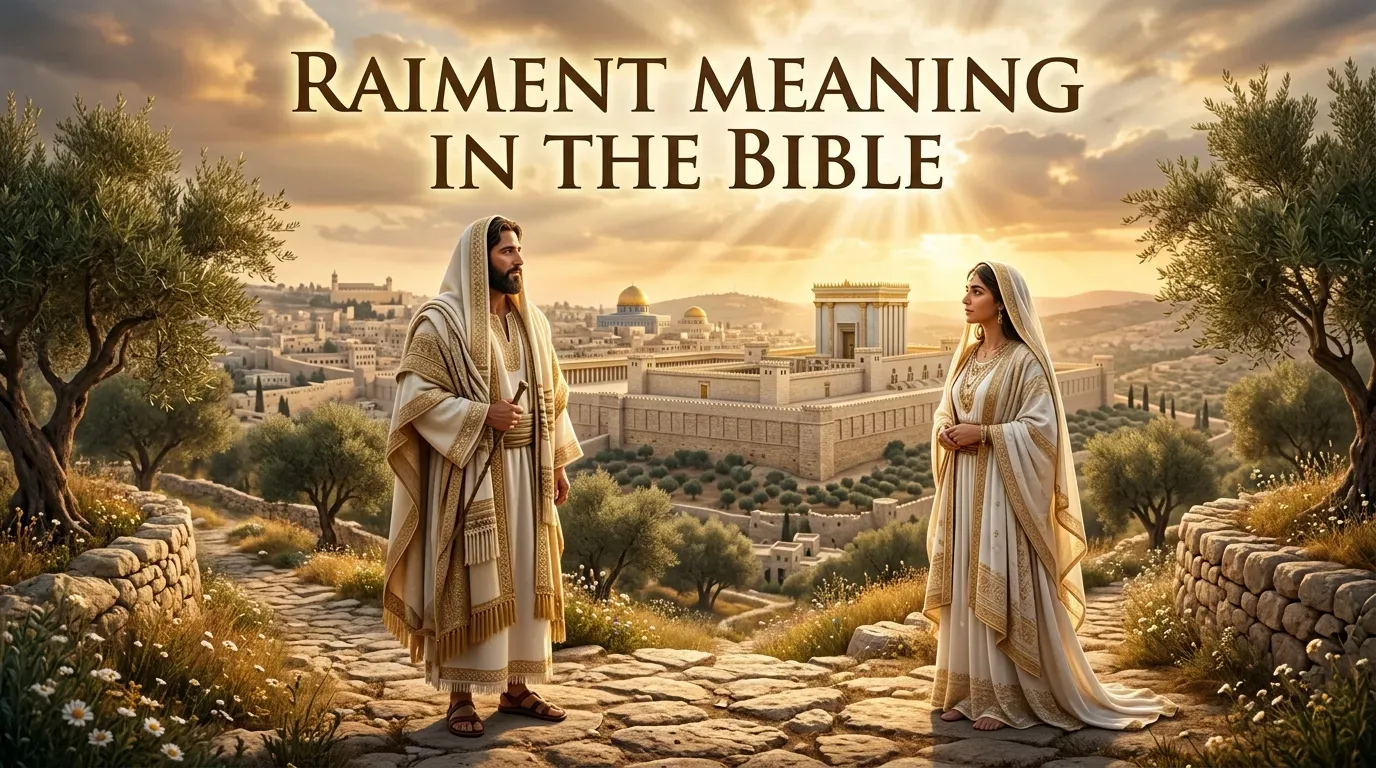
The biblical meaning of raiment is tied closely to identity. What a person wore in Bible times often showed their role, their grief, their joy, or their standing before God. Kings wore royal raiment. Mourners wore torn or rough raiment. Priests wore holy raiment set apart for worship.
Raiment in scripture is never just about style. It is about covering, dignity, and divine provision. God cares about how His people are clothed, both physically and spiritually.
Featured Snippet Answer: Raiment in the Bible means clothing or garments, often symbolizing a person’s spiritual condition, status, or identity. It comes from the Hebrew word beged and the Greek word himation, both meaning covering or outer garment. Raiment often points to God’s provision, protection, and the believer’s spiritual transformation.
Quick Reference Table
| Aspect | Meaning |
| Focus Word | Raiment |
| Hebrew Root | Beged (בֶּגֶד) – covering, garment |
| Greek Root | Himation (ἱμάτιον) – outer garment, cloak |
| First Appearance | Genesis 24:53 |
| Simple Meaning | Clothing, garments, covering |
| Spiritual Meaning | Identity, righteousness, transformation |
| Positive Symbol | God’s provision, righteousness, glory |
| Warning Symbol | Pride, vanity, false covering |
| Related Figures | Adam, Eve, Joseph, Jesus, the Prodigal Son |
| Key Books | Genesis, Matthew, Luke, Revelation |
Key Bible Verses
The Bible mentions raiment in many places. Here are a few verses that show its meaning clearly.
Genesis 27:15 (ESV): Then Rebekah took the best garments of Esau her older son, which were with her in the house, and put them on Jacob her younger son.
Matthew 6:28 (NIV): And why do you worry about clothes? See how the flowers of the field grow. They do not labor or spin.
Matthew 17:2 (ESV): And he was transfigured before them, and his face shone like the sun, and his clothes became white as light.
These verses show raiment used for family blessing, God’s daily care, and divine glory shown through Jesus.
Biblical Context
To understand raiment in scripture, we need to look at how ancient people used clothing. In Bible times, garments were often handmade and costly. What a person wore told others their family, their wealth, and even their sadness or joy.
The first appearance of raiment-related covering is found early in Genesis. After Adam and Eve sinned, the Lord God made for Adam and for his wife garments of skins and clothed them (Genesis 3:21, ESV). This is the first time God Himself provides covering for His people.
Later in Genesis 24:53, raiment is given as a wedding gift to Rebekah. This shows raiment used as a sign of honor and blessing. Joseph’s coat of many colors in Genesis 37:3 is another famous raiment story, showing favor from his father Jacob.
In the New Testament, raiment appears in the story of the Prodigal Son. The father calls for the best robe to be put on his returning son (Luke 15:22). This robe was raiment of restoration, not punishment.
Raiment also plays a role in the story of John the Baptist, who wore clothing of camel’s hair (Matthew 3:4, ESV). His rough raiment matched his simple, humble message of repentance. This shows how raiment often reflected a person’s calling and lifestyle.
At the crucifixion, soldiers divided his garments among them, casting lots (John 19:23-24). Even Jesus’ raiment carried prophetic weight, fulfilling Psalm 22:18 written centuries earlier. This small detail shows how closely Scripture ties raiment to God’s greater plan.
Spiritual Meaning
The spiritual significance of raiment goes far beyond cloth. In the Bible, garments often represent a person’s spiritual state before God. Sin is sometimes described as filthy garments, while righteousness is shown as clean, white raiment.
Isaiah 61:10 speaks of being clothed with the garments of salvation and covered with the robe of righteousness. This shows raiment as a picture of grace given by God, not earned by human effort.
In Zechariah 3:3-4, the high priest Joshua stands before the angel, clothed with filthy garments. God commands, Remove the filthy garments from him… I will clothe you with pure vestments. This is a beautiful image of forgiveness and transformation.
The New Testament continues this idea. Paul writes in Galatians 3:27, For as many of you as were baptized into Christ have put on Christ. Raiment becomes a symbol of new life through faith and the Holy Spirit.
This spiritual meaning is not a small side lesson. It runs through the whole story of the Bible, from the garden of Eden to the final pages of Revelation. Revelation 19:8 describes the bride of Christ clothed with fine linen, bright and pure, and explains that the fine linen is the righteous deeds of the saints. This shows raiment tied directly to a life of faithful obedience.
Even Job, in his suffering, spoke of raiment. He said, I have laid my splendor in the dust (Job 19:9, NIV), showing how loss of raiment pictured loss of honor. Scripture uses raiment consistently to show what is happening on the inside of a person’s heart, not just what covers their body.
Biblical Symbolism
Raiment carries strong symbolism throughout Scripture. It can represent both blessing and warning, depending on the context.
Positive symbolism includes:
- Royal raiment showing honor and authority
- White raiment showing purity and holiness
- New raiment showing restoration and grace
- Wedding raiment showing joy and covenant
Warning symbolism includes:
- Torn raiment showing grief or mourning
- Filthy raiment showing sin or shame
- Borrowed raiment showing deception, as with Jacob and Esau
- Missing wedding garment in Matthew 22:11-13, showing unpreparedness for God’s kingdom
This balance teaches us that raiment is never neutral in Scripture. It always points to something deeper happening in the heart.
Consider Joseph, whose coat of many colors became a symbol of favor, but later a source of jealousy and betrayal from his brothers (Genesis 37:23). His raiment was stripped from him, yet God still worked through his story for good. This shows that even when raiment is taken away, God’s purpose can still stand firm.
The high priest’s garments in Exodus 28 are another rich example. Every stone, color, and thread carried meaning, pointing to holiness, order, and the seriousness of approaching God. These details remind us that raiment in worship settings was never random; it always carried divine instruction and purpose.
Common Misunderstandings
Many people think raiment only means fancy or formal clothing. This is not accurate. Raiment simply means any garment, whether rich or poor, plain or royal.
Another misunderstanding is thinking raiment verses are only about outward appearance. In truth, most raiment passages point to inner spiritual condition. God looks past the fabric to the heart of the wearer.
Some also assume raiment always means something positive. But Scripture shows raiment used in warnings too, like torn garments showing distress or false coverings showing deceit. Understanding the biblical meaning of raiment means reading each verse in its full context.
A final misunderstanding is thinking raiment is an outdated word with no modern value. While the term itself is old English, the truths behind it are timeless. God’s care for our covering, our identity, and our transformation is just as real today as it was in Bible times.
Daily Christian Application
Understanding raiment can shape how we live today. When we read about God clothing Adam and Eve, we remember that God provides for our needs, even after failure.
When we see Jesus’ raiment turn radiant white on the mountain, we are reminded that our lives can shine with His glory through transformation. We do not have to stay in our old ways.
We can also apply the lesson from the Prodigal Son. No matter how far we have wandered, God is ready to clothe us with new raiment through grace and welcome us home. This is a daily reminder to walk in humility and thankfulness.
Practically, this can shape simple daily habits. Before starting your day, you might pray and ask God to clothe your heart with patience, kindness, and truth, much like Colossians 3:12 encourages believers to put on compassion and humility. This turns an old biblical word into a living, breathing part of your walk with God.
Parents can also teach children about raiment using these stories. Explaining how God clothed Adam and Eve, or how the father welcomed home his lost son with a robe, gives young hearts a picture of grace they can understand and remember for life.
Faith Takeaways
- Pray that God would clothe your heart with His righteousness each day.
- Trust that God provides covering and care, just as He did for Adam and Eve.
- Reflect on what your spiritual raiment looks like before the Lord.
- Seek transformation through Christ, not just outward change.
- Remember that true raiment comes from grace, not human effort.
FAQs
What does raiment mean in the Bible? Raiment means clothing or garments. It often carries a deeper meaning, showing a person’s spiritual condition, status, or relationship with God throughout Scripture.
What is the biblical meaning of raiment in Genesis? In Genesis, raiment first appears when God clothes Adam and Eve with garments of skin. This shows God’s mercy and provision after sin entered the world.
Is raiment mentioned in the New Testament? Yes, raiment appears often in the New Testament. It is seen in Jesus’ transfiguration, the Prodigal Son’s robe, and Paul’s teaching about putting on Christ.
What is the spiritual significance of raiment? The spiritual significance of raiment is tied to identity and transformation. Clean raiment often represents righteousness, while torn or filthy raiment shows sin or grief.
Does raiment in scripture always mean literal clothing? Not always. While raiment often refers to literal garments, it is frequently used as a symbol for a person’s spiritual state before God.
What does white raiment symbolize in the Bible? White raiment symbolizes purity, holiness, and victory. It is seen in Jesus’ transfiguration and in Revelation, describing believers who overcome through faith.
Why does raiment matter for Christians today? Raiment matters because it reminds Christians that God cares for both physical needs and spiritual condition. It points us toward grace, renewal, and life in Christ.
Conclusion
The biblical meaning of raiment is far richer than simple clothing. It touches themes of covering, identity, grief, honor, and grace throughout Scripture. From Adam and Eve’s first garments to the shining raiment of Christ, this word carries deep spiritual weight.
As you reflect on raiment in scripture, consider your own spiritual covering today. Are you clothed in your own effort, or are you resting in the righteousness God freely gives? May this study of raiment draw you closer to the heart of God and His endless grace.
Discover More Articles
- What Is the Holy Meaning in the Bible? Full Guide
- Revelation Meaning in Bible: A Complete Bible Guide
- What Is the Joy Meaning in the Bible? Complete Guide

I’m Nicholas Sparks, and storytelling has always been my passion. Through TheBiblimeaning, I share insights about my books, unforgettable characters, romance, emotions, and the deeper meanings behind my stories. This platform brings readers closer to my writing journey, latest releases, and the inspiration that shapes every novel I create.