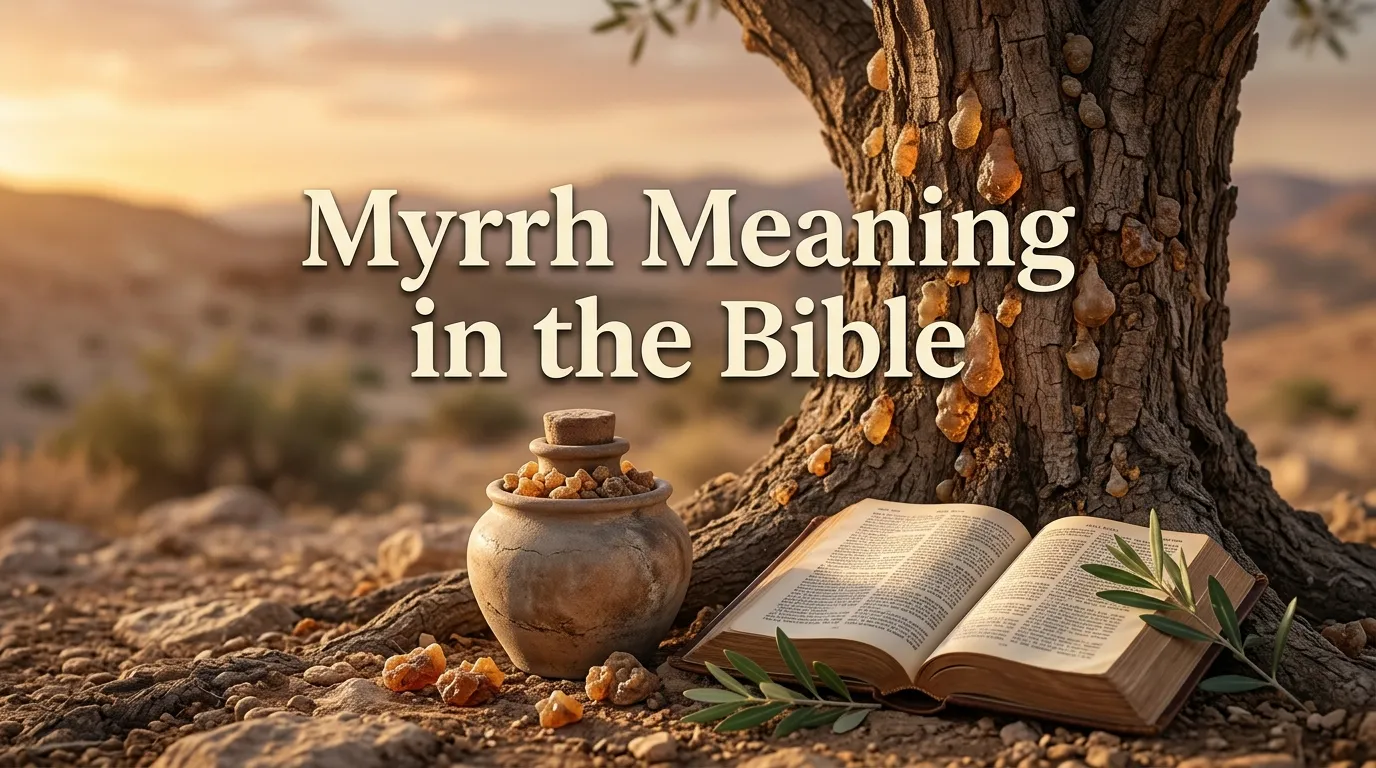
Myrrh shows up at two of the most important moments in the Bible: the birth of Jesus and His death. That is not a coincidence.
The myrrh meaning in the Bible points to suffering, sacrifice, and costly love. It was a fragrant resin used for worship, healing, burial, and beauty. But its deepest meaning is spiritual.
Myrrh quietly tells the story of Jesus from the manger to the cross.
In this article, you will learn what myrrh is, what its name means in Hebrew and Greek, every major Bible passage that mentions it, and what it symbolizes spiritually.
By the end, you will understand why the wise men brought it to a newborn king and why that gift was not as strange as it first sounds.
Quick Reference Table
| Question | Answer |
| What is myrrh? | A fragrant resin from the Commiphora tree, native to Arabia and East Africa |
| Hebrew word | mor (מור) |
| Greek word | smyrna (σμύρνα) |
| First biblical mention | Genesis 37:25 (traders carrying myrrh) |
| Most famous mention | Matthew 2:11 (gift of the Magi) |
| Main biblical uses | Anointing oil, perfume, burial spice, wine additive, bridal fragrance |
| Core symbolism | Suffering, death, sacrifice, and costly devotion |
| Connected to Jesus | Given at His birth (Matthew 2:11) and offered at His death (Mark 15:23; John 19:39) |
Biblical Meaning of Myrrh
Myrrh appears throughout Scripture as a symbol of something precious that comes through pain. The tree itself has to be wounded before it releases its resin. That detail matters. In the Bible, myrrh is almost never just a pleasant scent. It is tied to sacrifice, mourning, and worship that costs something.
This is why myrrh appears at Jesus’ birth and at His death. Both moments point to the same truth: salvation would come through suffering.
Hebrew and Greek Meaning
The Hebrew word for myrrh is mor (מור), which comes from a root meaning bitter. This is a literal description. Myrrh has a bitter taste, even though its smell is warm and sweet.
The Greek word is smyrna (σμύρνα), used in the New Testament. Interestingly, the ancient city of Smyrna (mentioned in Revelation 2:8–11) shared this name, likely because myrrh was traded there. Revelation 2:10 tells the church in Smyrna to be faithful unto death a striking echo of what myrrh itself represents.
So both languages agree: myrrh means something valuable that carries a bitter edge.
Biblical Context: What Was Myrrh Used For?
Myrrh came from the sap of the Commiphora tree, found in modern-day Yemen, Somalia, and Ethiopia. When the bark was cut, the tree bled a resin that hardened into fragrant drops. Traders carried it along caravan routes through the Middle East, which is why Ishmaelite merchants were transporting it in Genesis 37:25.
In the ancient world, myrrh had several uses:
- Sacred anointing oil God commanded Moses to include myrrh in the oil used to consecrate the tabernacle and priests (Exodus 30:23–25).
- Perfume and cosmetics Myrrh was mixed into oils to scent skin and clothing (Psalm 45:8; Esther 2:12).
- Burial spice Because it slowed decay and masked odor, myrrh was used to prepare bodies for burial (John 19:39–40).
- A numbing agent in wine Myrrh was sometimes added to wine to dull pain (Mark 15:23).
- A symbol of romantic love In Song of Solomon, myrrh describes the beauty and desirability of a bridegroom or bride.
Because it had to be imported from distant lands, myrrh was expensive. Giving myrrh was never a small gesture. It was a costly offering.
Bible Verses About Myrrh (With Explanation)
Genesis 37:25 Myrrh and Joseph’s Betrayal
Then they sat down to eat a meal. And as they raised their eyes and looked, behold, a caravan of Ishmaelites was coming from Gilead, with their camels bearing aromatic gum and balm and myrrh, on their way to bring them down to Egypt.
Exodus 30:23–25 Myrrh in the Holy Anointing Oil
Take also for yourself the finest of spices: of flowing myrrh five hundred shekels… You shall make of these a holy anointing oil.
God specifically commanded myrrh as the first ingredient in the oil used to set apart the priests, the tabernacle, and its furnishings.
Psalm 45:8 Myrrh and the Anointed King
All Your garments are fragrant with myrrh and aloes and cassia…
This psalm celebrates a royal wedding, but many Bible scholars see it as also pointing forward to the Messiah, the ultimate anointed King. Myrrh again connects to anointing a sign of honor and divine appointment.
Song of Solomon 1:13, 3:6, 5:1 Myrrh and Love
My beloved is to me a pouch of myrrh that lies all night between my breasts. (Song of Solomon 1:13)
In this poetic book, myrrh describes deep affection and desire between such as spouses,. This reminds readers that biblical symbols often carry more than one layer of meaning.
Esther 2:12 Myrrh and Purification
…the regulation for the women, twelve months… six months with oil of myrrh and six months with spices and cosmetics for women…
Before Esther could go before the king, she underwent a lengthy beautification process that included myrrh oil.
Matthew 2:11 Myrrh Given to the Christ Child
After coming into the house they saw the Child with Mary His mother; and they fell to the ground and worshiped Him. Then, opening their treasures, they presented to Him gifts of gold, frankincense, and myrrh.
Mark 15:23 Myrrh Offered on the Cross
They tried to give Him wine mixed with myrrh; but He did not take it.
As Jesus hung on the cross, soldiers offered Him wine mixed with myrrh, likely meant to dull the pain. Jesus refused it.
Symbolism of Myrrh in the Bible
Putting these passages together, myrrh carries a few consistent meanings throughout Scripture:
- Suffering and death used in burial, offered (and refused) at the crucifixion.
- Sacrifice and cost always expensive, always given at great personal cost.
- Holiness and consecration a core ingredient in the oil that set apart priests and sacred objects.
- Love and devotion used in Song of Solomon to express deep affection.
- Honor toward royalty brought to a king (Psalm 45) and to the King of Kings (Matthew 2).
Myrrh’s dual nature bitter to the taste, sweet to the smell mirrors the gospel itself. The cross was bitter suffering, yet it produced the sweetest outcome: salvation.
Spiritual Meaning of Myrrh Today
For believers today, myrrh is a picture of worship that costs something. The Magi did not bring Jesus something convenient. They brought something rare and expensive, and myrrh, in particular, pointed straight to the purpose of His coming to suffer and die for sin.
Myrrh also reminds us that Jesus entered fully into human suffering.
For anyone walking through a hard season, myrrh’s story offers quiet comfort: Jesus knows suffering intimately. He did not avoid it. He walked through it, on purpose, out of love.
Common Misunderstandings About Myrrh
Myrrh was not primarily medicine in the biblical accounts. While myrrh had medicinal and antiseptic properties in the ancient world, Scripture emphasizes its use in worship, burial, and fragrance rather than healing.
The wise men’s gift was not just a nice-smelling perfume. Many nativity retellings gloss over myrrh, focusing on gold and frankincense. But myrrh’s link to burial makes it the most prophetically loaded gift of the three a hint of the cross given at the manger.
Myrrh is not a magical or mystical substance. Some outside traditions attach superstitious meanings to myrrh. The Bible presents it plainly, as a real, valuable spice with symbolic significance tied to worship and sacrifice, not as an object with spiritual power in itself.
FAQs
What does myrrh symbolize in the Bible?
Myrrh symbolizes suffering, sacrifice, and costly devotion. It appears at both the birth and death of Jesus, connecting His entire life to the purpose of the cross.
Why did the wise men give Jesus myrrh?
Myrrh was a burial spice. Giving it to the infant Jesus foreshadowed His death for the sins of the world, even as He was celebrated as a newborn King.
What is the difference between frankincense and myrrh?
Frankincense was burned as incense in worship, symbolizing prayer and Jesus’ divinity as God. Myrrh was used for burial and healing, symbolizing His humanity and coming death.
Is myrrh mentioned at Jesus’ death as well as His birth?
Yes. Myrrh was offered to Jesus mixed with wine on the cross (Mark 15:23), and Nicodemus used a large quantity of myrrh to prepare His body for burial (John 19:39–40).
What does myrrh mean in Hebrew?
The Hebrew word mor means bitter, describing the resin’s sharp taste even though its fragrance is sweet.
Conclusion
Myrrh is a small detail with a big message. From a Persian palace to a Bethlehem stable to a Roman cross, this fragrant, bitter resin quietly traces the story of Jesus a King who came not to avoid suffering, but to walk through it for us.
The next time you read about myrrh in Scripture, remember what it points to: a love willing to pay the highest cost. That is the heart of the gospel, wrapped in a single, ancient spice.
Discover More Post
- Eliana Name Meaning in the Bible: Faith, Origin & Bible Meaning
- Defiled Meaning in the Bible: A Complete Biblical Guide
- Meaning of Stronghold in the Bible: A Complete Biblical Guide
- Meaning of Love in the Bible: A Complete Biblical Guide

I’m Nicholas Sparks, and storytelling has always been my passion. Through TheBiblimeaning, I share insights about my books, unforgettable characters, romance, emotions, and the deeper meanings behind my stories. This platform brings readers closer to my writing journey, latest releases, and the inspiration that shapes every novel I create.