Have you ever met someone whose name just seemed to carry weight? Like the name itself meant something bigger than one person could hold?
That’s how it feels with the name Micah. Parents today choose it because it sounds strong and gentle at the same time.
But long before it became popular on baby name lists, Micah was woven into the fabric of Scripture a name that carried a bold declaration right inside its letters.
The Micah meaning in Bible is far richer than most people realize. It’s not just a name. It’s a question.
The Hebrew form of Micah Mikayahu literally means “Who is like God?” or “Who is like Yahweh?” That’s a rhetorical question, of course. The answer the Bible gives is clear: no one. Not a single created thing compares to the living God.
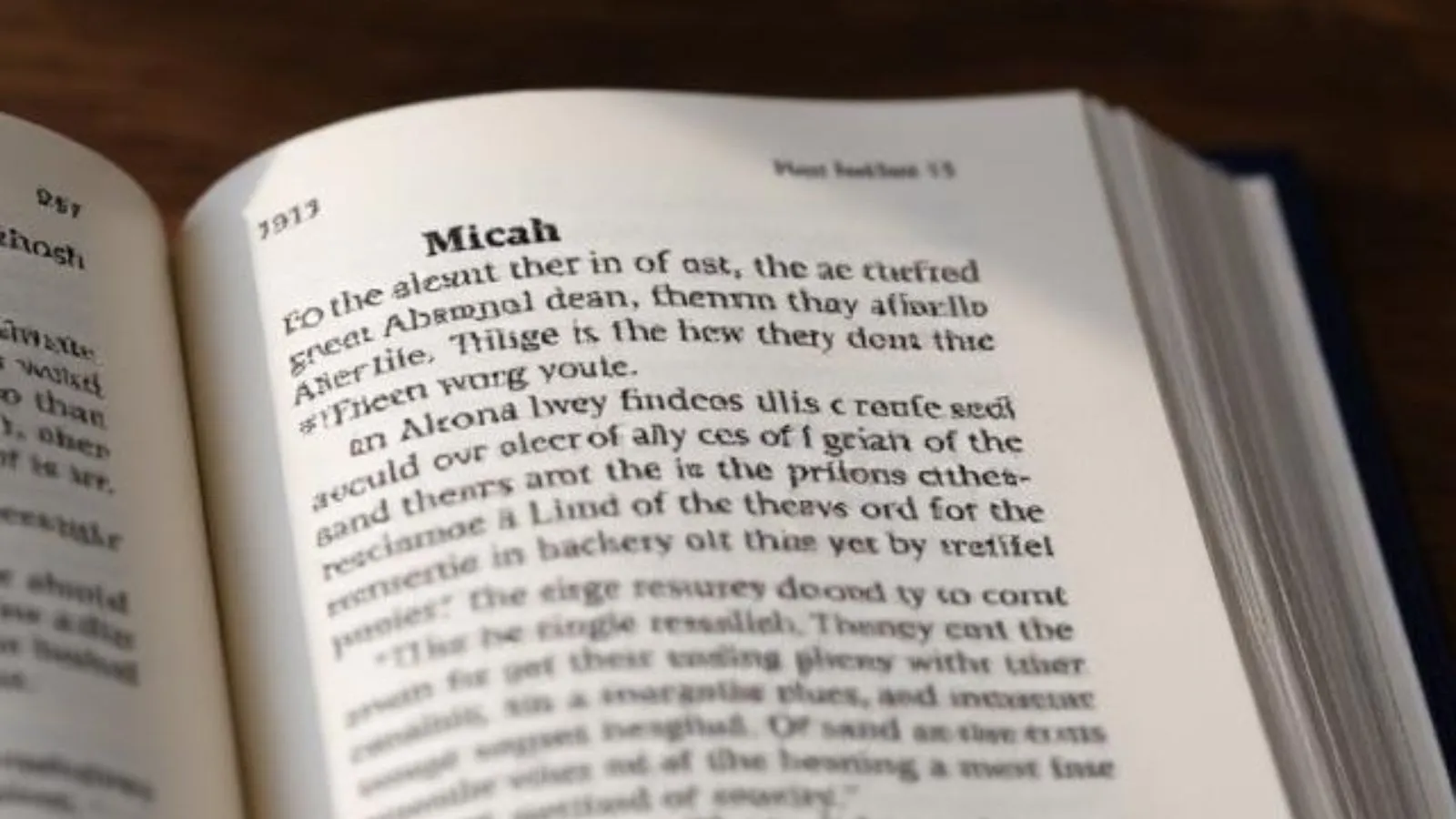
Micah shows up first as a personal name and then as the title of an entire prophetic book. The man behind the book, the Prophet Micah, lived during one of Israel’s most turbulent centuries. He watched kings rise and fall.
He saw injustice pile up like rubble on a crumbling city wall. And through it all, he spoke. He called people back to God with words that still echo through history.
Biblical Meaning of Micah in Bible
The name Micah comes from the Hebrew root מִיכָה (Mikah) or its fuller form מִיכָיָהוּ (Mikayahu). Both forms share the same core: the word mi (מִי), meaning “who,” combined with Yah or Yahweh, the sacred name of God. So every time someone in ancient Israel said the name Micah, they were really asking Who is like God? It was almost a prayer built into a name.
This is significant. Names in the ancient Hebrew world weren’t just labels. They were identity statements. They told you something true about a person or, in this case, about the God that person belonged to. The name Micah quietly proclaimed divine supremacy just by being spoken aloud.
The first appearance of the name in Scripture comes in Judges 17:1 “There was a man of the hill country of Ephraim whose name was Micah.” This is actually a cautionary story. This Micah set up his own shrine and made his own idols, which the narrative treats as a sad departure from true faith. It’s a reminder that even a beautiful name doesn’t guarantee a faithful life. Still, the name’s meaning stands apart from the man’s choices.
The most celebrated biblical figure to carry this name is undoubtedly the Prophet Micah, whose words fill the book bearing his name. He prophesied alongside Isaiah, during the reigns of Jotham, Ahaz, and Hezekiah in Judah. His ministry likely spanned from around 735 to 700 BC. He came from Moresheth, a small rural town not the center of religious power. And yet God chose him to deliver some of the most piercing words in all of prophetic Scripture.
Consider Micah 6:8 (NIV): “He has shown you, O mortal, what is good. And what does the Lord require of you? To act justly and to love mercy and to walk humbly with your God.” These three phrases justice, mercy, humility are the heartbeat of the book. They feel simple. They are not easy.
Micah also carried a message of hope. Micah 5:2 (ESV) reads: “But you, O Bethlehem Ephrathah, who are too little to be among the clans of Judah, from you shall come forth for me one who is to be ruler in Israel, whose coming forth is from of old, from ancient days.” This is a direct Messianic prophecy pointing to Jesus spoken 700 years before Bethlehem saw a stable light up under a star.
And Micah 7:18 (NIV) closes the book beautifully: “Who is a God like you, who pardons sin and forgives the transgression of the remnant of his inheritance?” Notice the echo. The prophet’s very name Who is like God? becomes the final question of the book. The answer is written in grace. No one is like God. And that is the best news possible.
Quick Reference Table
| Aspect | Details |
| Hebrew/Greek Root | מִיכָה (Mikah) / מִיכָיָהוּ (Mikayahu) “Who is like God?” or “Who is like Yahweh?” |
| First Biblical Appearance | Judges 17:1 a man of Ephraim named Micah |
| Core Biblical Meaning | Divine incomparability; a proclamation that no one equals God |
| Key Bible Verses | Micah 6:8; Micah 5:2; Micah 7:18 |
| Connected Biblical Figures | Prophet Micah of Moresheth; the Ephraimite Micah in Judges; Isaiah (contemporary prophet) |
| Spiritual Symbolism | Humility before God, divine justice, prophetic courage, Messianic hope |
| Dream/Vision Meaning | May signal a call to humble surrender, justice-seeking, or renewed devotion to God |
| Faith Lesson | True faith asks “Who is like God?” and finds rest in the answer: no one |
Spiritual Significance
The spiritual significance of Micah goes deeper than a name or even a prophet. It’s about the posture of the human heart before an incomparable God. When you say “Who is like God?”, you’re not searching for an answer. You already know it. You’re declaring your smallness and you’re doing it on purpose.
In the Christian life, this kind of humility isn’t weakness. It’s actually the beginning of real faith. The moment you stop comparing God to earthly power, earthly wisdom, or earthly love and recognize that He exceeds all of them something shifts in you. That’s what the name Micah keeps nudging you toward.
The prophet himself modeled this. He didn’t come from Jerusalem. He had no royal connections. But he carried God’s word without apology. That’s the Holy Spirit doing what only the Holy Spirit can do filling ordinary people with extraordinary purpose.
There’s also the thread of transformation woven through the book. Micah doesn’t only scold. He restores. Chapter 4 opens with a vision of nations streaming to God’s mountain, turning their swords into plowshares. That’s not defeat that’s the most radical kind of grace.
C.S. Lewis once wrote: “A proud man is always looking down on things and people; and, of course, as long as you are looking down, you cannot see something that is above you.” The name Micah is an invitation to look up. To ask the question. To receive the answer. God is above all and that reality doesn’t diminish us. It frees us.
Here’s something to sit with: Where in your life have you been comparing God to something smaller a human leader, a financial plan, your own strength? What would it look like to ask, honestly, “Who is like God?” and let that question reorder your day?
Related Biblical Concepts Table
| Concept | Meaning | Key Verse | Lesson |
| Micah meaning in Bible | “Who is like God?” divine incomparability | Micah 7:18 | God’s nature invites awe and humility |
| Justice | God’s call to fairness and righteousness in all relationships | Micah 6:8 | Faith without justice is incomplete |
| Mercy | Steadfast love and compassionate action toward others | Lamentations 3:22–23 | God’s mercy is the model for ours |
| Humility | Walking with God from a posture of smallness and trust | Proverbs 22:4 | Humility opens the door to divine guidance |
| Prophetic Courage | Speaking God’s truth even in uncomfortable settings | Jeremiah 1:7–8 | God equips those He calls, regardless of background |
Dream and Real Life Meaning
People sometimes encounter the name Micah in a dream or feel strongly drawn to it during a season of prayer. What might that mean? Dreams in Scripture were often channels of divine message think of Joseph, Daniel, even the wise men who were warned in a dream not to return to Herod. So it’s worth paying attention.
If the name Micah appears in a peaceful dream, it may be an invitation to rest in God’s incomparability. Life is overwhelming you right now. The name might be whispering: Stop striving. Who is like God? Let Him be enough. That’s a word of comfort, not crisis.
If the encounter feels urgent, or if the name surfaces during a difficult decision, it could be a prompt toward prophetic courage. Maybe there’s a truth you’ve been hesitant to speak. Maybe there’s an injustice you’ve been watching silently. The spirit of Micah ordinary background, extraordinary obedience might be the pattern God is pointing you toward.
How do you test it? The Bible offers a standard in 1 John 4:1 test everything against Scripture and the character of God. A genuine divine message will never contradict God’s Word. It will draw you toward faith, love, and humility never fear or pride.
Pray about it. Write it down. Share it with a trusted spiritual friend or mentor. Journaling what you felt and what Scripture you sense connected to it is a healthy, grounded practice. God is not in the business of confusion. He’s in the business of clarity and peace.
Faith Takeaways
- Pray with the question “Who is like God?” on your lips let it reshape your worship and reset your priorities each morning.
- Trust that God’s incomparability is not a distant fact but a personal promise: the God who is above all things is also close to you.
- Reflect on where injustice, lack of mercy, or pride may have crept into your everyday life and invite the Holy Spirit to convict and restore.
- Seek the courage of Micah when God calls you to speak truth He doesn’t require a powerful platform, only a willing heart.
- Remember that the Micah meaning in Bible always ends in hope: the final note of the prophet’s book is forgiveness, and God’s delight in showing it.
FAQs
1. What is the Micah meaning in Bible, exactly? The Micah meaning in Bible comes from the Hebrew name Mikayahu, which translates as “Who is like God?” or “Who is like Yahweh?” It’s a rhetorical question that declares the uniqueness and supremacy of God. No created being, no human power, no false god compares to Him. The name was both a personal identity and a theological statement in ancient Israel.
2. Who was the Prophet Micah in the Old Testament? Micah was a prophet from Moresheth, a small town in Judah’s hill country. He ministered around 735–700 BC, contemporarily with the prophet Isaiah..
3. What does Micah 6:8 mean spiritually? Micah 6:8 says: “He has shown you, O mortal, what is good. And what does the Lord require of you? To act justly and to love mercy and to walk humbly with your God.
4. Is Micah a good name to give a child, Biblically speaking? Absolutely. The biblical meaning of Micah is one of the most theologically rich names a parent could choose. Every time that name is spoken, it quietly asks the greatest question: Who is like God? Naming a child Micah is, in a sense, a declaration of faith built right into their identity.
5. What is Micah in scripture prophesied about Jesus? Micah 5:2 is one of the clearest Messianic prophecies in the Old Testament. It names Bethlehem specifically as the birthplace of the coming ruler of Israel. Matthew 2:6 directly quotes this verse when the Magi ask about where the Messiah would be born.
6. What is the spiritual significance of Micah for Christians today? The spiritual significance of Micah for Christians is layered. First, the name itself invites constant acknowledgment of God’s supremacy. Second, the prophet’s life demonstrates that God uses people who aren’t famous or powerful He uses willing ones.
Conclusion
The Micah meaning in Bible leaves us with two unforgettable truths. First, God is incomparable no person, power, or plan can rival Him, and resting in that reality is the foundation of real peace. Second, God uses ordinary people. Micah wasn’t from Jerusalem. He had no title. But God filled his voice with words that changed history and still do.
Micah 7:18 says it best: “Who is a God like you, who pardons sin and forgives the transgression of the remnant of his inheritance? You do not stay angry forever but delight to show mercy.” God doesn’t just tolerate us. He delights to show us mercy. That is the God whose name is woven into Micah’s.
May that name remind you today and every day that the God who is beyond all comparison is also tenderly, personally, and joyfully for you.