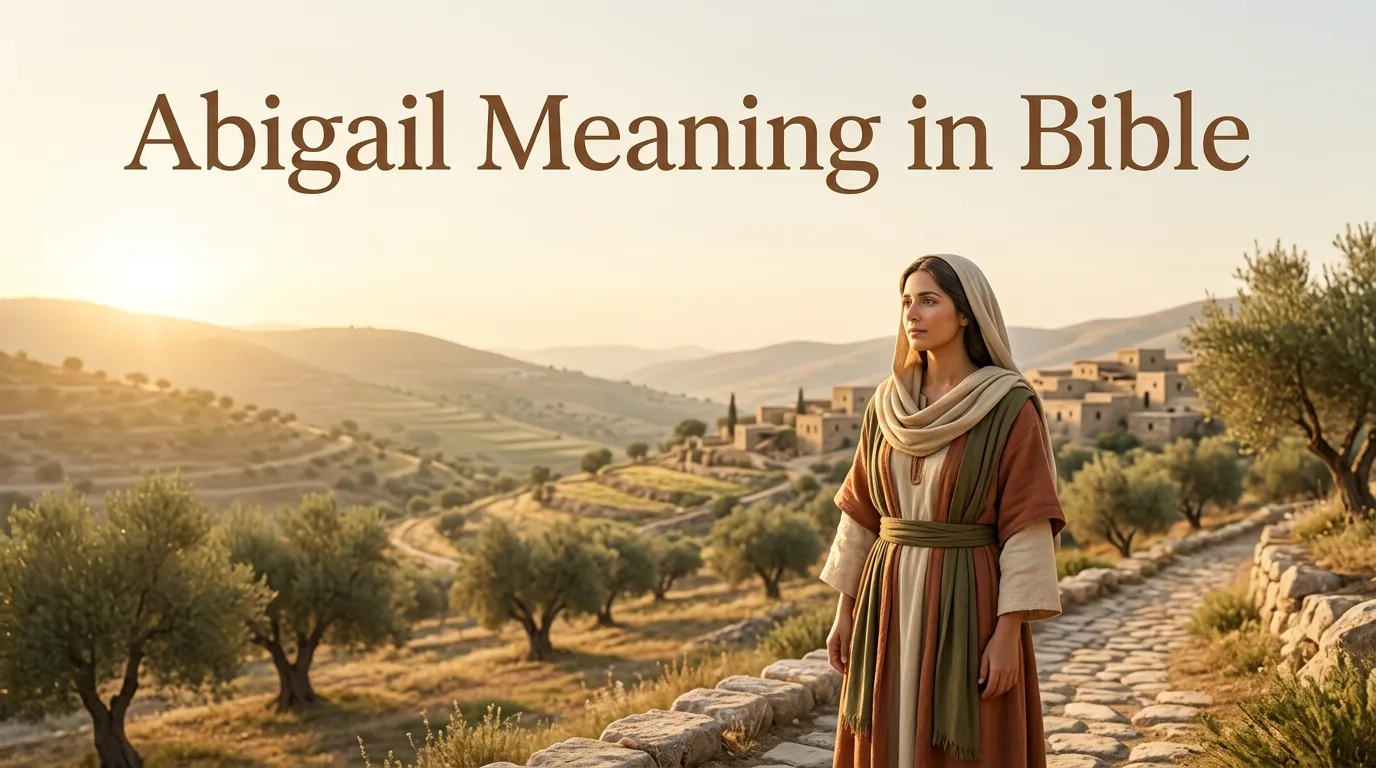
The name Abigail carries a beautiful message of joy rooted in the father.
In the Bible, Abigail meaning in Bible points to a woman of intelligence, courage, and discernment who stepped into a tense moment and changed the course of events.
Readers looking for the meaning of Abigail will discover both the Hebrew roots of her name and the powerful story of the woman who became one of King David’s wives.
This article explores her name, her actions in Scripture, the lessons she offers, and practical ways Bible study writers and ministry leaders can apply her example.
Quick Reference Table
| Aspect | Details |
| Hebrew Name | אֲבִיגַיִל (ʾĂḇîḡayil or Aviḡayil) |
| Primary Meaning | My father is joy / Father of joy |
| Key Scripture | 1 Samuel 25 |
| Main Role | Wife of Nabal, later wife of David |
| Character Traits | Wise, beautiful, decisive, peacemaking |
| Son | Chileab (also called Daniel) |
| Secondary Figure | Sister of David (1 Chronicles 2:16) |
Biblical Meaning of Abigail
Abigail appears primarily as the wise and beautiful wife of a wealthy but foolish man named Nabal. After Nabal’s death she becomes one of David’s wives. Scripture presents her as a woman of good understanding who recognized danger, acted quickly, and spoke words that restrained a future king from bloodshed. Her story shows that God often works through people who combine practical wisdom with humility and faith in His purposes.
A second Abigail appears as a sister of David and mother of Amasa (1 Chronicles 2:16–17; 2 Samuel 17:25). The focus of most Bible study and teaching rests on the first Abigail because of the detailed narrative in 1 Samuel 25.
Hebrew Meaning of the Name Abigail
The name Abigail comes from two Hebrew elements. The first is אָב (ʾāv or ʾab), meaning “father.” The second is גִּיל (gîl or gil), related to rejoicing, joy, or exultation. Together the name is commonly rendered “my father is joy,” “the father is joyful,” or “father of joy.” Scholars note slight variations in spelling across the biblical text, yet the core sense of paternal joy remains consistent.
This meaning is not abstract. In the culture of ancient Israel a name often expressed hope, thanksgiving, or a parent’s experience of God’s goodness. Calling a daughter Abigail declared that her presence brought joy connected to the father’s household and, by extension, to the God who gives life and gladness.
Biblical Context and Story of Abigail
The main account unfolds in 1 Samuel 25. David and his men were living as fugitives while Saul pursued them. During the sheep-shearing season in the wilderness of Paran, David’s men had protected Nabal’s flocks. When David sent young men to request provisions as a reasonable return for that protection, Nabal answered with insult and refusal.
David, angered by the response, prepared four hundred men to destroy every male in Nabal’s household. A servant warned Abigail of the danger. Scripture describes her as “a woman of good understanding and beautiful appearance” while noting that Nabal was “harsh and evil in his doings” (1 Samuel 25:3).
Abigail acted at once. She prepared a generous gifttwo hundred loaves of bread, two skins of wine, five prepared sheep, grain, raisins, and fig cakesand loaded them on donkeys. Without telling her husband, she rode out to meet David. When she saw him she dismounted, fell on her face, and took responsibility for the offense. She appealed to David not to avenge himself by his own hand, reminded him that the Lord would establish his house, and asked him to remember her when the Lord dealt well with him.
David received her words as from the Lord. He blessed her for restraining him from bloodguilt and accepted the gift. Abigail returned home, waited until Nabal was sober the next morning, and told him what had happened. His heart failed him, and about ten days later the Lord struck Nabal and he died. When David heard the news he praised God for dealing with Nabal and then sent messengers to take Abigail as his wife. She accepted and became David’s wife, later bearing him a son named Chileab (also called Daniel).
The narrative sits between accounts of David’s restraint toward Saul, highlighting a different kind of testhow David would handle personal insult and the temptation to take justice into his own hands.
Key Bible Verses with Full Explanation
1 Samuel 25:3
“The name of the man was Nabal, and the name of his wife Abigail. And she was a woman of good understanding and beautiful appearance; but the man was harsh and evil in his doings. He was of the house of Caleb.”
This verse sets the contrast that drives the story. Abigail’s wisdom and beauty stand opposite Nabal’s harshness. The detail that he belonged to the house of Caleb roots the family in Judah’s inheritance, making Nabal’s failure to honor David’s protection all the more striking.
1 Samuel 25:23–31
Abigail’s speech is the heart of the chapter. She bows, accepts blame, names her husband’s folly, and then turns David’s attention to the Lord’s future for him. She declares that the Lord has restrained David from bloodshed and that when the Lord has appointed him ruler over Israel he will have no cause for grief or a troubled conscience. Her words blend humility, theological insight, and practical peacemaking. David himself recognizes that God sent her (1 Samuel 25:32–34).
1 Samuel 25:39
“So when David heard that Nabal was dead, he said, ‘Blessed be the Lord, who has pleaded the cause of my reproach from the hand of Nabal, and has kept His servant from evil! For the Lord has returned the wickedness of Nabal on his own head.’”
David attributes both the protection and the judgment to the Lord. The verse underscores that vengeance belongs to God and that Abigail’s intervention preserved David’s integrity.
These passages together show a woman who understood the moment, spoke truth with grace, and trusted God with the outcome.
Spiritual Meaning and Application
Abigail’s name and story together point to joy that flows from the Father and wisdom that protects life. She models the peacemaker who steps between conflict and potential disaster. Her quick action, generous provision, and humble speech prevented unnecessary bloodshed and kept David from a stain that could have marked the beginning of his reign.
Believers today can see in her an example of discernment under pressure. She did not wait for perfect conditions or public recognition. She assessed the danger, used the resources she had, and spoke words that honored both God and the future king. Her life also reminds us that God can bring lasting joy and new purpose out of difficult marriages and sudden loss.
For those who carry the name or study the account, Abigail points beyond herself to the God who is the true source of joy and the One who establishes the house of His anointed.
Practical Application for Bible Book Creators and Authors
Bible study writers, devotional authors, and ministry leaders can draw rich material from Abigail’s story. Consider these approaches:
- Structure a short study around the contrast between wisdom and folly, using Nabal and Abigail as living illustrations of Proverbs themes.
- Highlight her speech as a model of persuasive, God-centered communication. Readers who lead small groups or write teaching materials can learn how to combine humility, truth, and hope.
- Explore themes of divine restraint and timing. David was kept from sin; Nabal’s judgment came in God’s way and time. This offers pastoral encouragement for those waiting on the Lord.
- Address the reality of difficult marriages and unexpected change with honesty and hope, always pointing to God’s sovereignty rather than offering simplistic formulas.
- When writing for women, present Abigail as a woman of agency and faith without turning her into a modern activist figure. Keep the focus on her trust in the Lord’s purposes for David and for herself.
- Include the secondary Abigail briefly to show that Scripture sometimes uses the same name for different people, teaching careful reading of context.
These angles serve American Christian readers who want both accurate biblical content and practical application for life and ministry.
Common Misunderstandings
Some readers assume Abigail was primarily motivated by self-preservation or romantic interest in David. The text emphasizes her concern for her household and for David’s future reputation before the Lord. Others overlook the second Abigail and conflate the two women. Careful study of the genealogies keeps the accounts distinct. Finally, the name’s meaning is sometimes reduced to a generic “joyful” without the specific “father” element. Retaining the full Hebrew sense preserves the richness of the biblical picture.
FAQs
Q: What is the spiritual meaning of the name Abigail?
A: Spiritually, Abigail represents wisdom, peace, humility, and faithfulness to God in difficult situations.
Q: What is the lesson of Abigail in the Bible?
A: Abigail teaches the importance of wisdom, humility, peacemaking, and trusting God during conflict.
Q: What are the characteristics of Abigail in the Bible?
A: Abigail is known for her wisdom, courage, humility, discernment, kindness, and wise leadership.
Q: What does Abigail mean in the Quran?
A: Abigail is not mentioned in the Quran, but her name is well known from the Bible.
Q: What is the connection between Abigail and Jesus in the Bible?
A: Abigail foreshadows Christ-like qualities by acting as a humble peacemaker who helps bring reconciliation.
Q: What does Abigail mean in Greek?
A: In Greek, Abigail is written as Abigaia and retains the Hebrew meaning, “my father’s joy.”
Q: How many Abigails are in the Bible?
A: The Bible mentions several women named Abigail, with David’s wife being the most well-known.
Q: Who is the father of Abigail in the Bible?
A: Abigail, David’s wife, is identified as the widow of Nabal, while another Abigail was the daughter of Jesse according to some biblical references.
Conclusion
The Abigail meaning in Bible is more than a pleasant definition. It is a reminder that the Father is the source of true joy and that He often works through discerning, courageous people to protect His purposes.
Abigail’s story encourages every reader whether writing the next Bible study, leading a small group, or simply walking through ordinary days to seek wisdom, speak with grace, and trust the Lord with the results. As David himself recognized, the Lord sent her at the right moment. May the same Lord grant His people today the understanding and joy that marked her life, so that His name is honored and His people are kept from unnecessary harm.
Discover More Post
- Christ Meaning in Bible: Origin, Purpose & Truth
- Anoint Meaning in Bible: Symbolism, Purpose & Meaning
- Consecration Meaning in the Bible: A Complete Biblical Guide
- Gentiles Meaning in Bible: What Does It Really Mean?

I’m Nicholas Sparks, and storytelling has always been my passion. Through TheBiblimeaning, I share insights about my books, unforgettable characters, romance, emotions, and the deeper meanings behind my stories. This platform brings readers closer to my writing journey, latest releases, and the inspiration that shapes every novel I create.